
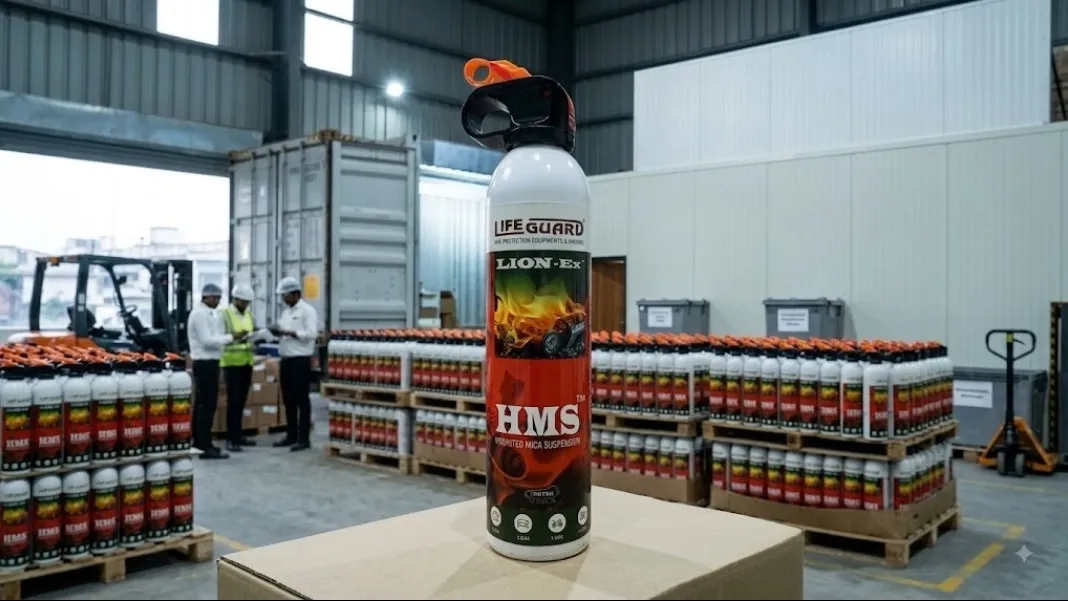
EV Battery Fire Safety OEM Manufacturer Germany – LIFEGUARD®
The rapid development of electric mobility is transforming the automotive, public transportation, logistics, industrial, and battery technology sectors. As electric vehicles increasingly depend on high-capacity lithium-ion battery systems, manufacturers are placing greater emphasis on EV battery fire safety, early detection, thermal runaway management, automatic suppression, and vehicle-level system integration.
Lithium-ion batteries provide excellent energy density and performance, but abnormal electrical, mechanical, or thermal conditions can create serious fire risks. Internal short circuits, overcharging, mechanical damage, excessive temperatures, cooling-system failures, and battery defects can potentially initiate thermal runaway.
LIFEGUARD® – United Fire Equipments Pvt. Ltd. provides engineered fire protection and suppression solutions for electric vehicle and lithium-ion battery applications.
As an EV Battery Fire Safety OEM Manufacturer Germany, LIFEGUARD® focuses on developing customized OEM-oriented solutions combining:
Early Detection + Alarm + Automatic Suppression + Battery Cooling + Thermal Runaway Risk Management + OEM Integration
Our solutions can be developed for EV manufacturers, electric bus OEMs, electric truck manufacturers, battery pack manufacturers, system integrators, industrial vehicle manufacturers, fleet operators, charging infrastructure projects, and battery testing applications.
EV Battery Fire Safety OEM Manufacturer in Germany
Electric vehicle battery packs consist of multiple lithium-ion cells arranged into modules and complete battery assemblies.
Although sophisticated battery management and thermal-management systems are used to maintain normal operation, battery cells can still experience abnormal conditions caused by internal or external events.
Potential causes of battery fire incidents may include:
- Internal electrical short circuits
- External short circuits
- Battery overcharging
- Cell manufacturing defects
- Mechanical impact
- Vehicle collision
- Battery penetration or crushing
- Excessive operating temperature
- Cooling-system malfunction
- Charger faults
- Electrical connection failure
- Battery ageing
- External fire exposure
- Improper servicing or installation
An OEM battery fire safety system should therefore be developed around the specific battery chemistry, pack geometry, vehicle architecture, operating conditions, and intended protection objective.
Understanding EV Battery Thermal Runaway
Thermal runaway is one of the most important hazards associated with lithium-ion battery systems.
It can occur when heat generation inside a battery cell becomes greater than the amount of heat that the cell can dissipate.
A developing battery event may progress through stages such as:
Battery Fault → Temperature Rise → Internal Reaction → Gas Generation → Venting → Thermal Runaway → Fire → Cell-to-Cell Propagation
When heat from one affected cell reaches neighbouring cells, the incident may propagate through the battery module or pack.
For this reason, EV battery fire safety should address more than visible flame suppression.
An engineered protection strategy may include:
- Early detection of abnormal heat
- Fire and fault monitoring
- Alarm generation
- Automatic system activation
- Battery isolation
- Vehicle shutdown signals
- Localized suppression
- Battery cooling
- Heat absorption
- Thermal propagation control
- Emergency response integration
LIFEGUARD® OEM EV Battery Fire Safety System
LIFEGUARD® develops application-specific EV battery fire safety concepts that can combine detection, control, alarm, and suppression components.
Depending on the vehicle and project requirements, a system may include:
- Linear heat detection cable
- Temperature sensors
- Smoke detectors
- Gas detection
- Flame detection
- Multi-criteria detection
- Fire alarm and releasing controller
- Automatic actuation mechanism
- Suppression agent cylinder
- Distribution tubing
- Fire suppression piping
- Specialized discharge nozzles
- Manual activation device
- Audible warning
- Visual alarm
- Battery isolation interface
- Vehicle shutdown interface
- Charging shutdown interface
- Remote monitoring signals
The final system configuration should be selected after reviewing the actual battery and vehicle arrangement.
OEM Fire Safety Engineering for Electric Vehicles
OEM applications require more than selecting individual fire suppression components.
The fire protection system must be suitable for integration into the original vehicle architecture.
LIFEGUARD® can develop OEM fire safety concepts considering:
- Vehicle type
- Battery chemistry
- Battery energy capacity
- Number of battery packs
- Number of battery modules
- Battery pack dimensions
- Enclosure construction
- Installation position
- Vehicle mounting points
- Available installation space
- Detection locations
- Suppression cylinder location
- Nozzle positioning
- Pipe and tube routing
- Vehicle vibration
- Temperature variation
- Dust and moisture exposure
- Electrical interfaces
- Control logic
- Maintenance accessibility
This approach helps make the fire safety system an integrated part of the vehicle rather than an externally added component.
Early Detection for EV Battery Fire Safety
Early detection can provide additional time to initiate protective actions before a battery incident develops further.
A battery fault may produce warning conditions such as:
- Abnormal temperature rise
- Smoke
- Gas generation
- Open flame
- Electrical fault indications
Depending on the application, LIFEGUARD® can develop detection strategies using several technologies.
Linear Heat Detection
Linear heat detection can provide continuous temperature-sensitive monitoring around battery compartments and battery packs.
It can be particularly useful for:
- Roof-mounted battery systems
- Under-floor battery packs
- Distributed battery compartments
- Long battery enclosures
- Restricted installation spaces
Temperature Detection
Temperature sensors can monitor selected high-risk locations for abnormal thermal conditions.
Gas Detection
Certain lithium-ion battery fault conditions can generate gases before or during thermal runaway. Suitable gas monitoring may therefore be incorporated where appropriate.
Smoke Detection
Smoke detection can be considered for enclosed battery areas or related applications where environmental conditions support reliable detection.
Flame Detection
Flame detectors may be used where rapid recognition of an exposed flame is required.
Multi-Criteria Detection
Combining multiple detection technologies can provide a more comprehensive monitoring approach for complex battery hazards.
Automatic EV Battery Fire Suppression System
Automatic fire suppression can provide a rapid response when predetermined detection conditions are satisfied.
A typical automatic protection sequence may follow:
Detection → Alarm → Confirmation Logic → Safety Signal → Suppression Activation
Depending on system architecture, the controller may also provide signals for:
- Vehicle shutdown
- Battery isolation
- Charger shutdown
- Ventilation control
- Audible warning
- Visual warning
- Remote alarm indication
Automatic operation can reduce dependence on immediate manual intervention.
Battery Cooling and Thermal Propagation Management
One of the major challenges of lithium-ion battery incidents is continuing internal heat generation.
Even after visible flames are reduced or extinguished, an affected battery cell may remain at a high temperature.
This means that an EV battery fire safety strategy may need to focus on cooling and reduction of thermal propagation.
An engineered cooling approach may assist in:
- Reducing battery temperature
- Absorbing heat
- Limiting heat transfer
- Protecting adjacent battery cells
- Reducing cell-to-cell propagation
- Limiting secondary ignition
- Supporting safer emergency response
The suppression and cooling method should be selected based on battery chemistry, pack configuration, enclosure construction, and available application data.
EV Bus Battery Fire Safety OEM Manufacturer Germany
Electric buses are an important application for automatic battery fire protection because they can contain several high-capacity battery packs and transport multiple passengers.
Battery packs may be installed:
- On the vehicle roof
- Under the floor
- At the rear
- Along vehicle sides
- Inside dedicated battery compartments
- At multiple distributed locations
LIFEGUARD® can develop OEM-oriented EV bus protection concepts incorporating:
- Linear heat detection
- Automatic temperature monitoring
- Battery compartment fire detection
- Suppression cylinders
- Distribution tubing
- Multiple discharge nozzles
- Automatic activation
- Manual activation
- Audible and visual alarm
- Battery isolation signals
- Vehicle shutdown interfaces
System engineering should account for the specific bus architecture, battery layout, environmental conditions, and maintenance requirements.
EV Truck Battery Fire Safety OEM Solutions
Electric trucks and heavy commercial vehicles often use high-capacity battery systems and operate under demanding conditions.
The fire safety system may need to withstand:
- Continuous vibration
- Road shocks
- Mechanical movement
- Dust
- Moisture
- Temperature fluctuations
- Extended operating hours
- High charging loads
- Harsh outdoor environments
LIFEGUARD® can develop customized battery fire protection solutions for electric trucks and commercial EV platforms.
Electric Car Battery Fire Safety
Passenger electric vehicles often integrate their battery systems underneath the vehicle floor or within compact structural areas.
OEM fire safety engineering may consider:
- Battery pack dimensions
- Battery enclosure configuration
- Vehicle floor structure
- Weight limitations
- Available mounting locations
- Detection positions
- Nozzle positions
- Suppression access
- Electrical interface
- Service accessibility
Compact system design and proper component integration are especially important for passenger EV applications.
Electric Commercial Vehicle Fire Safety
Fire protection solutions can also be developed for:
- Electric vans
- Electric delivery vehicles
- Electric minibuses
- Municipal electric vehicles
- Utility EVs
- Fleet vehicles
- Special-purpose electric vehicles
For high-utilization commercial fleets, early detection and automatic protection can provide an additional layer of fire-risk management.
Industrial EV Battery Fire Safety
Battery-powered industrial vehicles are increasingly used in manufacturing, logistics, warehousing, airports, ports, and material-handling operations.
Potential applications include:
- Electric forklifts
- Automated guided vehicles
- Autonomous mobile robots
- Electric warehouse trucks
- Mining EVs
- Battery-powered construction equipment
- Airport ground-support vehicles
- Industrial transport equipment
An automatic battery fire safety system can help protect personnel, machinery, inventory, production facilities, and other nearby assets.
EV Charging Infrastructure Fire Safety
EV battery fire safety also extends to charging and battery-handling infrastructure.
Applications may include:
- Public EV charging stations
- Electric bus depots
- Electric truck charging hubs
- Fleet charging areas
- Commercial charging locations
- Workplace charging
- Battery charging rooms
- Battery swapping facilities
A suitable fire safety strategy may incorporate:
- Heat detection
- Smoke detection
- Fire alarm systems
- Emergency electrical isolation
- Charging shutdown
- Automatic suppression
- Suitable portable firefighting equipment
- Emergency access
- Emergency procedures
Battery Testing Laboratory Fire Protection
Lithium-ion battery testing laboratories can present specialized fire risks because cells and complete battery packs may intentionally be exposed to demanding or abnormal conditions.
Possible applications include:
- Battery cell testing
- Module testing
- Full battery pack testing
- Charging and discharging tests
- Thermal testing
- Prototype testing
- Mechanical testing
- Battery abuse testing
- Research and development laboratories
Fire safety concepts may include rapid detection, automatic suppression, thermal monitoring, localized discharge, and emergency shutdown interfaces.
Lithium-Ion Battery Manufacturing Facility Fire Safety
Battery manufacturing plants can contain substantial quantities of battery cells, modules, and completed packs.
Areas requiring fire-risk assessment may include:
- Cell manufacturing
- Battery module assembly
- Battery pack assembly
- Charging areas
- Testing laboratories
- Prototype development
- Finished battery storage
- Damaged battery quarantine areas
- Quality-control facilities
The fire protection approach should be based on battery chemistry, quantity, state of charge, facility layout, and operating processes.
OEM Integration for German EV Manufacturers
For vehicle manufacturers, an EV battery fire safety system should be designed for repeatable integration into the production process.
OEM-oriented system development can consider:
- Compact component dimensions
- Low installation footprint
- Component weight
- Battery geometry
- Standardized cylinder mounting
- Standardized nozzle positions
- Repeatable tubing routes
- Electrical connectors
- Control-system interfaces
- Vehicle safety signals
- Service access
- Production-line assembly
- Component replacement procedures
This can support consistent installation across multiple vehicles of the same model or platform.
EV Battery Fire Safety OEM Development Process
A structured OEM development approach may include:
Battery Data Review → Hazard Identification → Vehicle Study → Fire Protection Concept → Detection Selection → Suppression Selection → Component Engineering → Nozzle Layout → Control Logic → Prototype Integration → Testing → Documentation
This approach allows the system to be developed according to actual vehicle architecture and risk.
Customized EV Battery Fire Safety Engineering
No single fire protection configuration is suitable for every electric vehicle.
Important design parameters may include:
- Battery chemistry
- Cell type
- Battery capacity
- Battery pack dimensions
- Number of battery modules
- Enclosure configuration
- Battery location
- Operating temperature
- Ventilation
- Charging conditions
- Detection requirements
- Fire suppression objective
- Cooling requirement
- Agent quantity
- Number of nozzles
- Nozzle orientation
- Distribution network
- Cylinder position
- Electrical integration
- Vehicle-control interface
- Environmental exposure
- Service and maintenance requirements
LIFEGUARD® develops project-specific solutions based on these technical inputs.
Key Components of an OEM EV Battery Fire Safety System
Fire Detection Equipment
Detection equipment monitors battery areas for defined fire-related conditions.
Control and Releasing Unit
The controller receives signals from detection equipment and can initiate predetermined actions such as:
- Alarm activation
- Suppression release
- Vehicle shutdown signal
- Battery isolation
- Charger shutdown
- Remote alarm transmission
Suppression Agent Cylinder
A suitable suppression or cooling medium is stored in a cylinder or container selected according to the application.
Distribution Network
Pipes or tubing transport the suppression medium toward the selected battery protection zones.
Mobile applications require consideration of vibration, routing restrictions, mechanical movement, and environmental exposure.
Discharge Nozzles
Nozzles distribute the suppression medium toward identified high-risk locations.
The number, position, orientation, and discharge arrangement should be determined through application-specific engineering.
Manual Activation
Where required, a manual release arrangement can provide an additional method of initiating the system.
Benefits of OEM EV Battery Fire Safety Integration
OEM integration can provide several practical advantages, including:
- Earlier consideration of fire safety during vehicle development
- Better use of available installation space
- Standardized component mounting
- Repeatable installation
- Consistent nozzle placement
- Improved system integration
- Simplified service access
- Easier component replacement
- Better production documentation
- Model-specific system engineering
- Improved integration with vehicle controls
Applications of LIFEGUARD® EV Battery Fire Safety Systems
LIFEGUARD® solutions can be developed for:
- Electric passenger vehicles
- Electric buses
- Electric coaches
- Electric trucks
- Electric vans
- Commercial EVs
- Industrial electric vehicles
- Electric forklifts
- Automated guided vehicles
- Autonomous vehicles
- Battery-powered machinery
- Battery packs
- Battery cabinets
- Battery enclosures
- Charging facilities
- Fleet charging depots
- Battery testing laboratories
- Battery manufacturing plants
- Battery storage applications
Why Choose LIFEGUARD® as an EV Battery Fire Safety OEM Manufacturer Germany?
OEM-Focused Engineering
LIFEGUARD® can develop system concepts around original vehicle and battery designs.
Application-Specific Solutions
Each vehicle platform is evaluated according to its battery configuration and operating conditions.
Early Detection Strategy
Different detection technologies can be integrated to provide appropriate battery monitoring.
Automatic Suppression
Automatic activation can provide rapid intervention after defined detection conditions are reached.
Battery Cooling Focus
Fire protection strategies can incorporate cooling and heat-management considerations where appropriate.
Thermal Runaway Risk Management
The protection concept can focus on reducing heat transfer and limiting propagation to neighbouring battery modules.
Customized Nozzle Arrangement
Nozzle quantity and positioning can be engineered around battery pack geometry and identified fire-risk areas.
System Integration Support
Fire protection can be developed for interaction with alarms, battery isolation, charger shutdown, or vehicle safety functions as required by the project architecture.
Technical Project Support
Depending on the project scope, support can include:
- Application assessment
- System concept development
- Detection selection
- Suppression selection
- Component selection
- Layout development
- Nozzle arrangement
- Installation guidance
- Technical documentation
- Testing support
Industries We Support
LIFEGUARD® EV battery fire safety solutions can be relevant to:
- Automotive OEMs
- EV manufacturers
- Electric bus manufacturers
- Electric truck manufacturers
- Battery cell manufacturers
- Battery pack manufacturers
- Battery system integrators
- Fleet operators
- Public transportation companies
- Logistics companies
- Industrial vehicle manufacturers
- Charging infrastructure providers
- Battery testing laboratories
- Engineering consultants
- EPC organizations
- Research and development facilities
EV Battery Fire Safety Solutions Across Germany
LIFEGUARD® can support project enquiries associated with automotive, industrial, battery, logistics, and electric mobility applications throughout Germany, including:
Berlin, Munich, Stuttgart, Hamburg, Frankfurt, Cologne, Düsseldorf, Wolfsburg, Hanover, Leipzig, Dresden, Bremen, Nuremberg and other regions across Germany.
Every project should be evaluated according to the intended application, battery architecture, and applicable technical and regulatory requirements.
Frequently Asked Questions
What is an EV battery fire safety system?
An EV battery fire safety system is an engineered arrangement combining suitable detection, alarm, control, suppression, and potentially cooling technologies to respond to abnormal lithium-ion battery heat or fire conditions.
Why do EV batteries require specialized fire protection?
Lithium-ion batteries can experience thermal runaway, generate internal heat, release gases, and potentially transfer heat to neighbouring battery cells.
What does OEM mean in EV battery fire protection?
OEM integration means developing the fire protection system so that it can be incorporated into the original vehicle or battery equipment design rather than added only after manufacturing.
Can an EV battery fire safety system activate automatically?
Yes. Depending on the system configuration, fire or heat detection can initiate alarm functions, vehicle safety signals, and automatic suppression.
Can LIFEGUARD® develop an OEM solution for electric buses?
Yes. Application-specific concepts can be developed according to battery locations, compartment dimensions, vehicle architecture, detection requirements, and available installation space.
Can the system be customized for electric trucks?
Yes. Electric truck systems can be engineered considering large battery packs, vibration, environmental exposure, operating cycles, and installation restrictions.
Is cooling important for EV battery fire safety?
Cooling may be important because an affected lithium-ion cell can continue generating heat even after visible flames have been controlled.
Can one EV battery fire safety design be used for every vehicle?
No. Battery chemistry, capacity, pack geometry, vehicle platform, operating environment, and protection requirements vary significantly.
Can the system interface with the vehicle's safety controls?
Depending on the project architecture, suitable control signals can be incorporated for alarms, battery isolation, charging shutdown, vehicle shutdown, or other emergency functions.
LIFEGUARD® – EV Battery Fire Safety OEM Manufacturer Germany
As electric mobility continues to develop, vehicle and battery manufacturers require fire safety solutions that can be engineered around the specific behaviour of lithium-ion batteries and integrated into modern vehicle architectures.
LIFEGUARD® – United Fire Equipments Pvt. Ltd. develops customized EV battery fire safety concepts combining:
Early Detection + Automatic Alarm + Fire Suppression + Battery Cooling + Thermal Runaway Risk Management + OEM Integration
Whether the requirement is for an electric bus, electric truck, passenger EV, industrial vehicle, lithium-ion battery pack, battery testing laboratory, charging installation, or battery manufacturing facility, LIFEGUARD® can support application-specific fire protection engineering.
Contact LIFEGUARD®
United Fire Equipments Pvt. Ltd.
Manufacturer of ISI Certified Fire Safety Equipment
📞 8048034226
📧 ufe126@gmail.com | info@lifeguardindia.in
SEO Meta Title
EV Battery Fire Safety OEM Manufacturer Germany | LIFEGUARD®
SEO Meta Description
Looking for an EV Battery Fire Safety OEM Manufacturer Germany? LIFEGUARD® provides customized lithium-ion battery fire detection, suppression, cooling and thermal runaway protection solutions for electric buses, trucks, EVs and battery applications.
Primary SEO Keyword
EV Battery Fire Safety OEM Manufacturer Germany
Secondary SEO Keywords
EV battery fire safety manufacturer Germany, EV battery fire safety OEM Germany, EV battery fire protection OEM manufacturer Germany, lithium-ion battery fire safety manufacturer Germany, EV battery fire suppression manufacturer Germany, electric bus battery fire protection Germany, EV truck fire safety Germany, EV battery thermal runaway protection Germany, electric vehicle fire suppression OEM Germany, lithium battery fire safety Germany, EV battery cooling system manufacturer Germany, automatic EV fire suppression Germany, battery thermal runaway suppression Germany, EV OEM fire protection system Germany, electric vehicle battery fire protection manufacturer Germany.
Suggested URL Slug
/ev-battery-fire-safety-oem-manufacturer-germany/
Suggested H1
EV Battery Fire Safety OEM Manufacturer Germany
Suggested SEO Image Alt Text
EV Battery Fire Safety OEM Manufacturer Germany – LIFEGUARD® Lithium-Ion Battery Fire Protection and Thermal Runaway Solution
Keywords






