
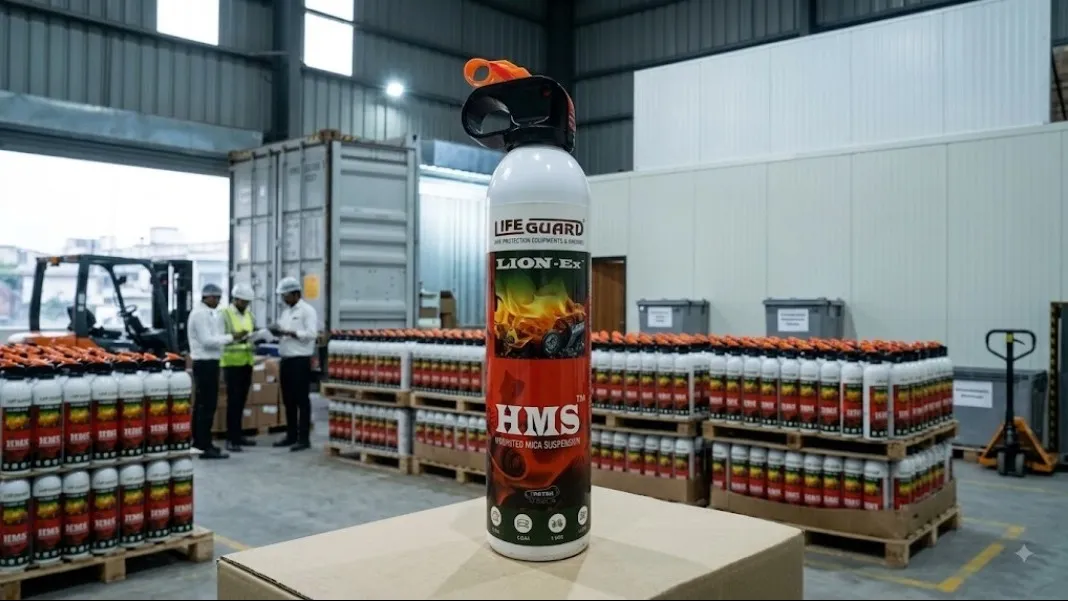
EV Battery Fire Safety Solutions Germany
Advanced Lithium-Ion Battery Fire Protection Solutions by LIFEGUARD®
Germany’s growing electric vehicle ecosystem, battery manufacturing sector, EV charging infrastructure, renewable energy projects, and Battery Energy Storage Systems are creating a strong requirement for specialized EV battery fire safety solutions.
Lithium-ion battery fires require a different approach from many conventional fire hazards. Battery failure can involve thermal runaway, rapid temperature rise, combustible gas release, smoke generation, cell-to-cell propagation, intense heat, and possible re-ignition.
LIFEGUARD®, a brand of United Fire Equipments Pvt. Ltd., provides engineered EV battery fire safety solutions for Germany for electric vehicles, battery packs, electric buses, electric trucks, EV charging stations, battery manufacturing plants, testing laboratories, battery warehouses, fleet depots, and Battery Energy Storage Systems.
Our approach focuses on combining:
Early Detection → Alarm → Automatic Suppression → Cooling → Propagation Control → Emergency Shutdown → Continuous Monitoring
Why EV Battery Fire Safety Is Important
Electric vehicle batteries consist of multiple lithium-ion cells and modules storing significant amounts of electrical energy within compact enclosures.
Battery cells may become unstable due to:
- Internal short circuits
- Overcharging
- Electrical faults
- Excessive temperature
- Mechanical damage
- Vehicle collision
- Manufacturing defects
- Cell degradation
- Charging-system malfunction
- External heat exposure
- Improper handling
- Physical damage to battery modules
When a battery cell enters thermal runaway, uncontrolled internal reactions may generate rapidly increasing heat.
This heat can potentially affect neighboring cells and modules, creating a cascading event.
An effective battery fire safety solution should therefore address not only visible flames but also:
- Heat generation
- Battery gases
- Fire propagation
- Cooling requirements
- Electrical isolation
- Emergency shutdown
- Continued monitoring
- Re-ignition risk
LIFEGUARD® EV Battery Fire Safety Solutions Germany
LIFEGUARD® develops customized fire safety solutions according to the specific battery application and project requirements.
A complete solution may incorporate:
- Linear Heat Sensing Cable
- Heat detection
- Smoke detection
- Aspirating smoke detection
- Gas detection
- Temperature monitoring
- Automatic fire suppression
- Local application suppression
- Battery cooling arrangements
- Fire suppression cylinders
- Distribution piping
- Strategically positioned nozzles
- Fire suppression control panels
- Manual release stations
- Abort switches
- Audible alarms
- Visual alarms
- Emergency shutdown interfaces
- Fire alarm integration
- Battery Management System integration
- Remote monitoring
The final configuration should be selected according to battery chemistry, stored energy, enclosure dimensions, ventilation, operating environment, and fire-risk assessment.
EV Battery Thermal Runaway Safety Solutions
What Is Thermal Runaway?
Thermal runaway is an uncontrolled self-heating process that can occur within a lithium-ion battery cell.
The event may involve:
- Rapid temperature increase
- Cell venting
- Smoke
- Flammable gas release
- Fire
- Heat transfer
- Cell-to-cell propagation
- Module-to-module propagation
- Secondary fires
- Re-ignition
Because of these characteristics, an EV battery fire safety solution should consider the complete battery incident lifecycle.
Early Thermal Runaway Detection
Early identification of abnormal battery conditions can provide valuable time for initiating alarms and protective actions.
Detection technologies may include:
- Linear heat sensing
- Point heat detection
- Smoke detection
- Aspirating smoke detection
- Gas detection
- Temperature monitoring
- Multi-criteria detection
Automatic Fire Suppression
Automatic suppression can reduce the delay between confirmed fire detection and protective action.
Depending on the application, suppression may be directed toward:
- Individual battery compartments
- Battery modules
- Battery racks
- Vehicle battery enclosures
- Charging equipment
- BESS cabinets
- Testing chambers
Battery Cooling
Cooling can be an important part of lithium-ion battery fire safety because internal battery heat may remain after visible flames have been controlled.
The cooling strategy should be selected based on the actual battery hazard and project design.
Thermal Propagation Control
An important objective is to reduce the possibility of an incident involving one battery cell or module spreading to surrounding batteries.
A properly engineered fire safety concept can combine detection, suppression, cooling, separation, and emergency response measures.
Early Detection Solutions for EV Batteries
Linear Heat Sensing Cable
Linear Heat Sensing Cable provides continuous temperature-based detection along a defined path.
It can be suitable for:
- EV battery compartments
- Electric bus battery packs
- Electric truck battery systems
- Battery racks
- BESS installations
- Battery cabinets
- Battery storage facilities
- Charging areas
Linear detection can be particularly useful where battery hazards extend across long or irregularly shaped areas.
Heat Detection
Heat detectors monitor abnormal temperature conditions and can initiate alarm or suppression-control signals.
Smoke Detection
Smoke detection can provide early warning where the environmental conditions allow reliable detection.
Aspirating Smoke Detection
Aspirating smoke detection can provide very early warning in sensitive environments such as:
- Battery rooms
- BESS facilities
- Battery manufacturing plants
- Testing laboratories
- Storage rooms
- Control rooms
- Electrical rooms
Gas Detection
Lithium-ion batteries can release gases during certain stages of failure.
Gas detection may therefore be incorporated as an additional layer of battery condition monitoring where appropriate.
Automatic EV Battery Fire Suppression Solutions Germany
Automatic suppression systems can be designed around predefined detection and release logic.
A typical operating sequence may be:
Battery Abnormality → Detection → Alarm → Verification → Suppression Release → Fire Control → Cooling → Emergency Shutdown → Monitoring
Depending on the project, the control system may interface with:
- Battery Management System
- Fire Alarm System
- Building Management System
- Vehicle control system
- Charging shutdown
- Emergency electrical isolation
- Ventilation controls
- Remote monitoring systems
The final cause-and-effect logic should be developed according to the approved project requirements.
EV Battery Pack Fire Safety Solutions
Modern EV battery packs vary significantly in construction and capacity.
Important design parameters can include:
- Battery chemistry
- Cell format
- Number of cells
- Number of modules
- Total stored energy
- Pack geometry
- Enclosure construction
- Battery cooling system
- Ventilation
- Detection locations
- Nozzle locations
- Available installation space
- Service accessibility
LIFEGUARD® can develop customized battery pack fire safety solutions based on these parameters.
Electric Car Battery Fire Safety Germany
Electric passenger vehicles require fire safety solutions that can be engineered around compact and complex battery configurations.
Protection strategies may involve:
- Battery temperature monitoring
- Early heat detection
- Localized suppression
- Electrical isolation
- Alarm generation
- Battery cooling
- System monitoring
LIFEGUARD® can support EV manufacturers, battery pack developers, vehicle integrators, and testing facilities with application-specific fire safety concepts.
Electric Bus Battery Fire Safety Solutions Germany
Electric buses often contain large-capacity lithium-ion battery packs located on the roof, underfloor, at the rear, or within dedicated compartments.
Fire safety systems may incorporate:
- Linear Heat Sensing Cable
- Heat detectors
- Automatic fire suppression
- Local application discharge
- Audible and visual alarm
- Emergency shutdown
- Battery Management System interface
- Continuous monitoring
Solutions can be developed for:
- City electric buses
- Intercity electric buses
- Public transport fleets
- Electric school buses
- Bus charging depots
- Maintenance workshops
Electric Truck Battery Fire Safety Solutions Germany
Heavy-duty electric trucks can contain substantial battery capacities and operate under demanding transportation and charging cycles.
Fire safety solutions may be developed for:
- Electric trucks
- Commercial electric vehicles
- Logistics fleets
- Battery compartments
- Charging depots
- Fleet parking areas
- Maintenance facilities
- Industrial electric vehicles
EV Charging Station Fire Safety Solutions Germany
EV charging infrastructure combines high-power electrical equipment with vehicles containing high-energy lithium-ion batteries.
Fire safety engineering can be considered for:
- Public charging stations
- DC fast charging facilities
- Commercial charging hubs
- Fleet charging depots
- Electric bus depots
- Electric truck charging stations
- Shopping centres
- Office parking areas
- Underground parking
- Residential charging facilities
- Industrial charging sites
A comprehensive charging-station safety concept may include:
- Heat detection
- Smoke detection
- Fire alarm
- Automatic suppression
- Emergency power isolation
- Charging shutdown
- Ventilation control
- Emergency response provisions
Battery Energy Storage System Fire Safety Solutions Germany
Battery Energy Storage Systems can contain large numbers of lithium-ion cells and modules installed within racks, cabinets, containers, or dedicated rooms.
BESS fire safety can require a multi-layered approach.
Potential systems may include:
- Aspirating smoke detection
- Linear heat sensing
- Gas detection
- Battery rack monitoring
- Automatic fire suppression
- Cooling arrangements
- Fire alarm and control panels
- Emergency shutdown
- Ventilation interfaces
- BMS integration
- Remote monitoring
LIFEGUARD® can develop project-specific BESS fire safety solutions based on battery chemistry, system layout, stored energy, enclosure arrangement, and fire-risk assessment.
Battery Manufacturing Fire Safety Solutions Germany
Battery manufacturing facilities can involve cells at several stages of production, charging, assembly, testing, and storage.
Fire safety may be required for:
- Cell manufacturing areas
- Module assembly lines
- Battery pack assembly
- Formation areas
- Ageing rooms
- Charging areas
- Testing laboratories
- Battery storage rooms
- Finished product warehouses
- Research and development facilities
Customized detection and suppression systems can be engineered according to the particular manufacturing process.
Battery Testing Laboratory Fire Safety Solutions
Battery testing environments can intentionally expose cells or battery packs to demanding operating conditions.
Testing activities may involve:
- Thermal stress
- Overcharge testing
- Short-circuit testing
- Electrical abuse
- Mechanical impact
- Vibration
- Charging cycles
- Discharging cycles
These environments can benefit from rapid detection, automatic alarm, engineered suppression, and emergency isolation.
Lithium-Ion Battery Warehouse Fire Safety Germany
Battery warehouses may contain significant quantities of lithium-ion cells, modules, battery packs, and associated packaging.
A fire safety strategy may consider:
- Early warning smoke detection
- Heat detection
- Gas monitoring
- Fire alarm
- Automatic suppression
- Cooling arrangements
- Compartmentation
- Battery separation
- Emergency access
- Emergency response planning
The correct protection strategy depends on factors including battery type, quantity, state of charge, packaging, and storage configuration.
Customized EV Battery Fire Safety Engineering
There is no universal fire protection system suitable for every lithium-ion battery installation.
LIFEGUARD® follows an application-specific engineering approach.
Step 1 – Requirement Analysis
Project information and battery system details are reviewed.
Step 2 – Hazard Assessment
Potential battery fire and thermal runaway risks are evaluated.
Step 3 – Detection Selection
Suitable heat, smoke, gas, or aspirating detection technologies are considered.
Step 4 – Suppression Strategy
The appropriate suppression and cooling concept is developed according to the hazard.
Step 5 – System Engineering
Nozzle positions, piping arrangement, controls, alarms, and interfaces are developed.
Step 6 – Equipment Selection
Components are selected according to the approved technical design.
Step 7 – Supply & Installation Support
Equipment supply can be supported with installation drawings and technical guidance.
Step 8 – Testing & Commissioning
System functionality, detection logic, alarms, control interfaces, and suppression operation can be verified as required by the project.
Key Components of EV Battery Fire Safety Systems
Depending on the approved solution, equipment may include:
- Fire suppression cylinder
- Cylinder valve
- Pressure monitoring arrangement
- Flexible discharge hose
- Distribution piping
- Stainless steel tubing
- Fire suppression nozzles
- Linear Heat Sensing Cable
- Heat detectors
- Smoke detectors
- Aspirating smoke detection
- Gas detectors
- Fire suppression control panel
- Manual release switch
- Abort switch
- Solenoid actuator
- Pressure switch
- Hooter
- Visual alarm
- Emergency shutdown interface
- BMS interface
- Fire alarm interface
- Remote monitoring equipment
The final component configuration should be determined according to the approved system design.
Benefits of LIFEGUARD® EV Battery Fire Safety Solutions
Early Warning
Detection technologies can help identify abnormal heat, smoke, or gas conditions at an early stage.
Automatic Response
Automatic suppression can provide rapid intervention when predefined activation conditions are satisfied.
Localized Protection
Suppression systems can be engineered for defined battery packs, compartments, cabinets, racks, or other high-risk zones.
Battery Cooling
Appropriate cooling strategies can help reduce heat exposure to surrounding battery cells and equipment.
Thermal Runaway Risk Management
The fire safety strategy can consider the possibility of cell-to-cell and module-to-module propagation.
Customized Engineering
Each system can be developed according to the specific battery, vehicle, enclosure, or facility.
System Integration
Where technically compatible, fire safety systems may integrate with:
- Battery Management Systems
- Fire Alarm Systems
- Building Management Systems
- Vehicle control systems
- Emergency shutdown
- Charging shutdown
- Ventilation
- Remote monitoring
EV Battery Fire Safety Solutions for German Industries
LIFEGUARD® can support fire safety requirements associated with:
- Automotive OEMs
- Electric vehicle manufacturers
- Battery manufacturers
- Battery pack manufacturers
- Electric bus manufacturers
- Electric truck manufacturers
- EV component manufacturers
- Charging infrastructure companies
- Fleet operators
- Battery testing laboratories
- Research facilities
- Renewable energy projects
- Battery Energy Storage Systems
- Data centres
- Battery warehouses
- Logistics facilities
- Industrial manufacturing plants
EV Battery Fire Safety Solutions for Major German Locations
LIFEGUARD® can evaluate project requirements associated with locations across Germany, including:
- Berlin
- Munich
- Stuttgart
- Frankfurt
- Hamburg
- Cologne
- Düsseldorf
- Wolfsburg
- Leipzig
- Dresden
- Hanover
- Bremen
- Dortmund
- Essen
- Nuremberg
Technical proposals can be developed according to project specifications, battery application, required quantity, system configuration, and scope of supply.
Why Choose LIFEGUARD® for EV Battery Fire Safety Solutions Germany?
Organizations searching for reliable EV battery fire safety solutions in Germany can approach LIFEGUARD® for customized and engineering-oriented solutions.
Our capabilities include:
- EV battery fire safety systems
- EV battery fire protection
- Lithium-ion battery fire suppression
- Thermal runaway protection concepts
- Battery cooling solutions
- Linear Heat Sensing Cable systems
- Early warning smoke detection
- Gas detection
- Automatic fire suppression
- Local application suppression
- EV battery compartment protection
- Electric bus fire safety
- Electric truck fire safety
- EV charging station protection
- BESS fire safety
- Battery warehouse protection
- OEM fire protection solutions
- Technical drawings
- Technical data sheets
- Bill of quantities
- Installation guidance
- Testing and commissioning support
Integrated EV Battery Fire Safety Strategy
An effective lithium-ion battery fire safety solution should consider several complementary layers of protection rather than relying on one individual component.
A typical approach may be:
Battery Monitoring → Early Detection → Alarm → Automatic Suppression → Cooling → Propagation Control → Electrical Isolation → Emergency Response → Continued Monitoring
This integrated approach can help address the complex hazards associated with modern lithium-ion battery systems.
Frequently Asked Questions
What are EV battery fire safety solutions?
EV battery fire safety solutions are engineered combinations of detection, alarm, suppression, cooling, control, isolation, and monitoring technologies designed for electric vehicle battery hazards.
Why are lithium-ion battery fires different?
Lithium-ion battery incidents can involve thermal runaway, rapid heat release, gases, propagation between cells, and possible re-ignition, requiring application-specific fire safety planning.
Can an EV battery fire safety system detect thermal runaway?
Heat, smoke, gas, temperature, and other detection technologies may help identify conditions associated with developing battery failure. The exact solution depends on the battery application.
Can EV battery fire suppression work automatically?
Yes. Automatic suppression can be configured to operate when predefined detection and release conditions are satisfied.
Can fire safety systems be customized for EV battery packs?
Yes. Detection routing, suppression equipment, piping, nozzles, control logic, and interfaces can be developed according to the battery pack configuration.
Can LIFEGUARD® provide electric bus battery fire safety solutions?
Yes. Application-specific solutions can be developed for battery compartments and other identified fire hazards in electric buses.
Does LIFEGUARD® provide BESS fire safety solutions?
Yes. LIFEGUARD® can develop fire detection and suppression concepts for lithium-ion Battery Energy Storage System installations.
Can EV battery fire safety systems integrate with a BMS?
Where compatible interfaces are available, alarm, fire, fault, and shutdown signals can be integrated with a Battery Management System and other control systems.
Can LIFEGUARD® support projects in Germany?
Yes. LIFEGUARD® can evaluate project requirements for Germany based on battery application, technical specifications, required quantities, system integration requirements, and scope of supply.
LIFEGUARD® – EV Battery Fire Safety Solutions Partner for Germany
For automotive manufacturers, EV OEMs, battery manufacturers, system integrators, charging infrastructure providers, fleet operators, BESS developers, renewable energy companies, laboratories, logistics facilities, and industrial organizations looking for EV battery fire safety solutions in Germany, LIFEGUARD® provides customized fire safety engineering and equipment solutions.
Our approach focuses on:
Early Detection + Automatic Suppression + Battery Cooling + Thermal Runaway Risk Management + System Integration + Continued Monitoring
From initial battery hazard evaluation and system concept through technical engineering, equipment selection, supply, documentation, installation guidance, testing, and commissioning support, LIFEGUARD® can assist with modern EV and lithium-ion battery fire safety requirements.
Contact LIFEGUARD®
United Fire Equipments Pvt. Ltd.
Manufacturer of ISI Certified Fire Safety Equipment
📞 8048034226
📧 ufe126@gmail.com | info@lifeguardindia.in
Suggested SEO Meta Title
EV Battery Fire Safety Solutions Germany | LIFEGUARD®
Suggested SEO Meta Description
LIFEGUARD® provides EV battery fire safety solutions for Germany, including lithium-ion battery fire suppression, thermal runaway protection, early detection, EV charging fire safety and BESS protection solutions.
Primary SEO Keywords
EV battery fire safety solutions Germany, EV battery fire protection solutions Germany, EV battery fire suppression solutions Germany, lithium-ion battery fire safety Germany, EV battery thermal runaway solutions Germany, electric vehicle battery fire protection Germany, lithium battery fire safety solutions Germany, EV fire suppression solutions Germany, EV battery safety system Germany, battery fire protection solutions Germany.
Supporting SEO Keywords
EV battery fire suppression Germany, lithium battery thermal runaway protection Germany, EV battery fire detection Germany, electric vehicle fire safety Germany, battery cooling system Germany, lithium-ion battery safety solutions Germany, automatic EV fire suppression Germany, EV battery protection system Germany.
Long-Tail SEO Keywords
EV battery thermal runaway fire safety solutions Germany, lithium-ion battery fire suppression solutions Germany, EV battery pack fire protection Germany, electric bus battery fire safety Germany, electric truck battery fire protection Germany, EV charging station fire safety Germany, BESS fire safety solutions Germany, battery energy storage fire suppression Germany, lithium battery warehouse fire safety Germany, customized EV battery fire safety system Germany.
Keywords






