
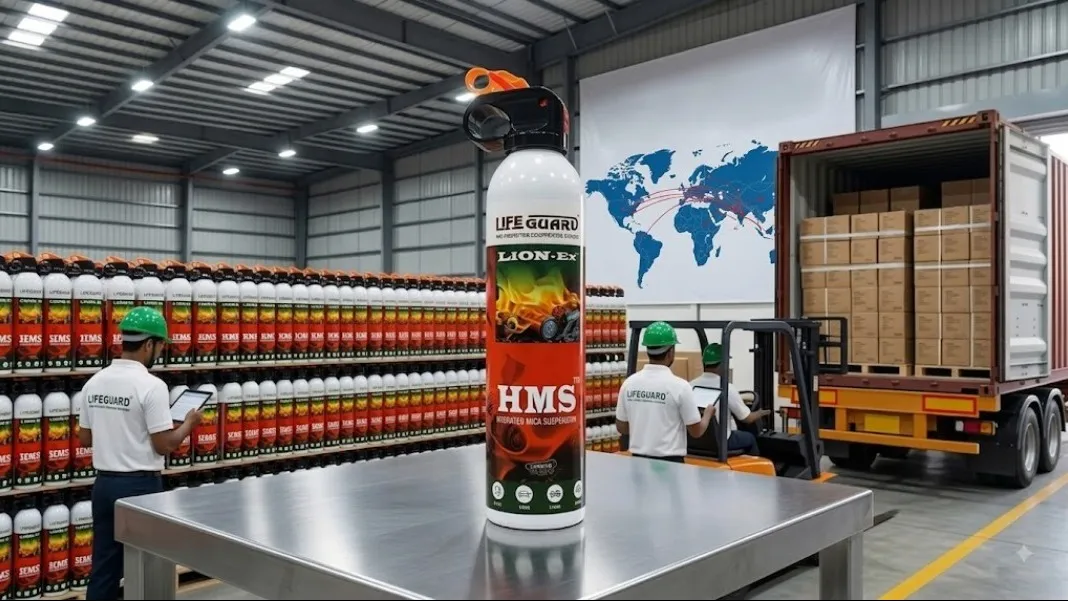
EV Battery Fire Suppression System Exporter India – LIFEGUARD®
The rapid expansion of electric mobility is creating a growing demand for advanced fire protection technologies capable of addressing the unique hazards associated with lithium-ion batteries. Electric cars, electric buses, commercial EV fleets, battery swapping stations, charging infrastructure and battery manufacturing facilities all require specialized protection against thermal runaway, rapid heat generation, cell-to-cell propagation and re-ignition.
LIFEGUARD® – United Fire Equipments Pvt. Ltd. provides engineered fire safety solutions for lithium-ion battery applications. As an EV battery fire suppression system exporter in India, LIFEGUARD® offers customized solutions for electric vehicles, EV battery packs, charging stations, battery manufacturing facilities, electric buses, commercial vehicles and other high-risk lithium battery applications.
Our focus is on developing application-specific solutions combining early detection, automatic activation, localized suppression, thermal management and system integration.
EV Battery Fire Suppression System Exporter from India
Customers searching for a reliable EV battery fire suppression system exporter India require more than a conventional fire extinguisher supplier.
Lithium-ion battery incidents involve complex thermal and chemical processes. Effective protection therefore requires an engineered approach based on battery type, pack construction, energy capacity, installation arrangement and expected fire scenario.
LIFEGUARD® provides solutions for requirements such as:
- EV battery fire suppression systems
- Lithium battery thermal runaway protection
- Automatic EV battery fire suppression
- Electric bus battery fire suppression
- Electric truck battery protection
- EV charging station fire protection
- Battery pack fire suppression
- Battery cabinet protection
- Lithium battery storage fire protection
- Battery manufacturing facility protection
Our systems can be configured according to individual project requirements for domestic and international applications.
Understanding EV Lithium-Ion Battery Fire Risks
An electric vehicle battery normally consists of multiple lithium-ion cells arranged into modules, which are then assembled into a complete battery pack.
If a cell becomes damaged, overheated or electrically unstable, it can enter thermal runaway.
Potential causes include:
- Internal short circuits
- Overcharging
- Electrical malfunction
- Excessive temperature
- Mechanical damage
- Vehicle collision
- Manufacturing defects
- Cell penetration
- Cooling system failure
- Damaged battery modules
- Abnormal operating conditions
During thermal runaway, heat generated inside the cell can accelerate additional chemical reactions.
A typical progression may involve:
Abnormal Heating → Gas Generation → Cell Venting → Thermal Runaway → Fire → Heat Transfer → Cell-to-Cell Propagation
This chain reaction is one of the primary reasons specialized EV battery fire suppression is required.
Why Conventional Fire Suppression May Not Be Enough
Traditional fire extinguishing methods are primarily intended to control combustion.
An EV battery fire presents additional challenges because the battery may continue generating heat internally even after external flames have been reduced.
Major concerns include:
- Continued internal heat generation
- Re-ignition
- Difficult access to battery cells
- High-voltage electrical components
- Cell-to-cell thermal propagation
- Flammable vapour generation
- Toxic smoke
- Jet flames
- Rapid temperature escalation
Therefore, an effective EV fire protection strategy should consider both fire suppression and thermal control.
LIFEGUARD® EV Battery Fire Suppression Solutions
LIFEGUARD® designs specialized fire suppression concepts according to the protected hazard.
The final solution depends on factors including:
- Battery chemistry
- Battery pack capacity
- Battery enclosure design
- Number of modules
- Cell arrangement
- Vehicle configuration
- Installation location
- Accessibility
- Ventilation
- Expected operating temperatures
- Fire risk assessment
There is no single system configuration suitable for every electric vehicle battery.
Automatic EV Battery Fire Suppression System
Automatic suppression can provide an important safety advantage by reducing dependence on manual response.
An engineered system may include:
- Suppression agent cylinder
- Cylinder valve
- Pressure gauge
- Automatic detection
- Linear heat sensing
- Temperature monitoring
- Distribution manifold
- Stainless steel tubing
- Flexible discharge connections
- Discharge nozzles
- Manual activation
- Alarm indication
- Pressure monitoring
- Electrical shutdown interface
When abnormal temperature or fire conditions are detected, the system can initiate an alarm and activate the suppression sequence according to the designed control philosophy.
EV Battery Pack Fire Suppression System
Battery packs are often installed beneath the vehicle floor, within the chassis, at the rear of the vehicle or on the roof of larger commercial electric vehicles.
Such installations can make manual firefighting access difficult.
An automatic battery pack suppression system can position detection and discharge components close to the protected battery area.
A typical arrangement can be:
EV Battery Pack → Detection → Control/Activation → Suppression Cylinder → Distribution Tube → Nozzles → Battery Hazard
This localized arrangement can reduce response time and direct the suppression medium toward critical battery areas.
Local Application EV Battery Fire Suppression
Local application systems are designed to protect specific battery zones rather than an entire large enclosure.
Applications may include:
- Traction battery packs
- Individual battery compartments
- Battery modules
- Battery cabinets
- High-voltage electrical compartments
- Charging equipment
- Battery testing equipment
- Battery storage enclosures
Strategically positioned nozzles can discharge the suppression medium directly into the protected hazard area.
Hydrated Mica Suspension-Based EV Battery Protection
For specialized lithium-ion battery hazards, LIFEGUARD® can provide engineered Hydrated Mica Suspension (HMS)-based systems as part of a thermal management and fire protection concept.
An HMS fire suppression arrangement may include:
- Agent storage cylinder
- Automatic discharge valve
- Pressure monitoring
- Heat sensing arrangement
- Stainless steel distribution tubing
- Flexible hoses
- Distribution manifolds
- Discharge nozzles
- Automatic activation
- Manual activation provisions
The configuration is selected according to the battery pack, enclosure and protected area.
Importance of Thermal Management
Suppressing visible flames is only one part of lithium-ion battery fire management.
Reducing heat transfer to neighbouring battery cells can be important in controlling propagation.
The overall EV battery fire protection concept should therefore focus on:
Detection + Suppression + Cooling + Propagation Control + Monitoring
Early Detection for EV Battery Fire Suppression
The earlier an abnormal battery condition is identified, the greater the opportunity for appropriate protective action.
Depending on the application, EV fire suppression systems can incorporate different detection technologies.
Linear Heat Detection
Linear Heat Detection or Linear Heat Sensing can be installed close to battery packs, modules or electrical equipment.
It can provide localized temperature-based detection along the protected area.
Temperature Detection
Temperature sensors can continuously monitor high-risk battery zones and initiate warnings when abnormal temperatures occur.
Smoke Detection
Smoke detection can provide warning during the developing stages of a battery incident.
Aspirating Smoke Detection
For EV battery rooms, warehouses and charging facilities, aspirating smoke detection can provide very early warning by continuously sampling air from the protected space.
Gas Detection
Battery cells may release gases during abnormal conditions before or during thermal runaway.
Where appropriate, suitable gas sensing can form another layer of early warning.
Flame Detection
For locations where open flames may develop rapidly, UV, IR or multi-spectrum flame detection may be considered according to the project requirements.
Electric Bus Battery Fire Suppression Systems
Electric buses commonly use large-capacity traction battery packs. Battery packs may be installed on the roof, beneath the floor or in dedicated compartments.
LIFEGUARD® can develop battery fire suppression concepts for electric buses covering:
- Traction batteries
- Battery modules
- Battery compartments
- Power electronics
- Electrical cabinets
- Motor compartments
- Charging interfaces
- Auxiliary electrical systems
A multi-zone configuration may be developed when several battery compartments require protection.
Automatic Electric Bus Fire Suppression
A typical electric bus system can combine:
Heat Detection → Alarm → Automatic Suppression → Electrical Isolation → Emergency Warning
The exact sequence should be determined according to the vehicle manufacturer, project specification and system engineering requirements.
Electric Truck Battery Fire Protection
Electric trucks and commercial EVs can contain high-capacity battery packs and operate continuously in logistics, industrial and municipal applications.
LIFEGUARD® can provide customized fire suppression solutions for:
- Electric delivery trucks
- Electric logistics vehicles
- Electric utility vehicles
- Electric municipal vehicles
- Commercial electric fleets
- Battery-powered industrial vehicles
Protection can be designed around the actual location and configuration of the vehicle's battery system.
EV Charging Station Fire Suppression
The rapid development of charging infrastructure is creating additional fire protection requirements.
EV charging stations may involve hazards associated with both the charging equipment and the connected vehicle.
Potential hazards include:
- Battery overheating
- Thermal runaway during charging
- Charger electrical faults
- Connector damage
- Cable overheating
- Short circuits
- Power electronics failure
- Vehicle collision
A comprehensive charging station fire protection strategy may include:
- Suitable fire extinguishers
- Smoke detection
- Heat detection
- Flame detection where required
- Electrical cabinet suppression
- Automatic shutdown
- Emergency power isolation
- Audible and visual alarms
- Fire alarm integration
Fast Charging Station Protection
High-power DC charging installations may contain substantial power electronics and electrical equipment.
Dedicated suppression systems can be designed for:
- Charger cabinets
- Electrical panels
- Power conversion equipment
- Distribution cabinets
- Control panels
- Associated equipment enclosures
EV Battery Manufacturing Facility Fire Protection
Lithium battery manufacturing and EV assembly facilities can contain large numbers of cells, modules and battery packs.
Fire protection requirements may exist across several process areas:
Cell Storage → Module Assembly → Battery Pack Assembly → Testing → Charging → Vehicle Integration → Finished Battery Storage
Each stage presents a different hazard profile.
LIFEGUARD® can develop solutions for:
- Cell storage areas
- Battery module assembly
- Battery pack assembly
- Formation and charging areas
- Battery test laboratories
- Finished battery warehouses
- Electrical rooms
- Production machinery
Battery Testing Laboratory Fire Suppression
Battery testing may intentionally expose cells or battery packs to abnormal operating conditions.
Test procedures can involve:
- Overcharging
- Thermal exposure
- Electrical stress
- Short circuit conditions
- Mechanical damage
- Abnormal discharge
- Environmental testing
For this reason, battery test chambers may require dedicated detection and localized suppression arrangements.
Lithium Battery Storage and Warehouse Protection
Warehouses storing EV batteries can contain significant concentrations of stored energy.
The overall fire protection strategy should consider:
- Battery chemistry
- Battery quantity
- State of charge
- Rack configuration
- Storage height
- Separation distances
- Ventilation
- Fire compartmentation
- Detection
- Suppression
- Emergency response
Solutions can be developed for:
- EV battery warehouses
- Spare battery storage
- Automotive component warehouses
- Battery distribution centres
- Battery recycling facilities
- Battery quarantine areas
Integrated EV Battery Fire Safety System
The strongest EV battery protection strategy uses multiple layers of safety.
A typical integrated approach may include:
Battery Monitoring → Early Detection → Alarm → Vehicle/Equipment Shutdown → Fire Suppression → Thermal Control → Emergency Response
Depending on the application, the fire suppression system may interface with:
- Battery Management System
- Vehicle Control Unit
- Charging system
- Fire alarm system
- Building Management System
- HVAC controls
- Emergency shutdown system
- Remote monitoring platform
Applications of EV Battery Fire Suppression Systems
LIFEGUARD® solutions can be developed for:
- Electric passenger vehicles
- Electric buses
- Electric trucks
- Electric taxis
- Electric delivery vehicles
- Commercial EV fleets
- EV charging stations
- Fast charging stations
- Electric bus charging depots
- EV workshops
- Automotive manufacturing plants
- Lithium battery factories
- Battery testing laboratories
- Battery warehouses
- Battery recycling facilities
- Battery swapping stations
- Battery-powered industrial equipment
Export-Oriented EV Battery Fire Suppression Solutions from India
As an EV battery fire suppression system exporter from India, LIFEGUARD® can support project-specific requirements for international customers, distributors, system integrators, contractors and engineering organizations.
Our approach can include:
- Technical requirement evaluation
- Application-specific design
- Product selection
- System configuration
- Detection and suppression integration
- Nozzle arrangement
- Distribution system design
- Technical data sheets
- Drawings
- Installation guidance
- Testing and commissioning support
- Export documentation support
Customized Systems for International Projects
Export projects often differ in battery configuration, environmental conditions, installation practices and local technical requirements.
Accordingly, LIFEGUARD® systems can be engineered based on project-specific inputs rather than offering one generic package.
Important design inputs can include:
- Battery chemistry
- Total energy capacity
- Battery dimensions
- Number of modules
- Protected compartment size
- Vehicle type
- Ambient conditions
- Required detection philosophy
- Automatic or manual activation
- Electrical interface requirements
Why Choose LIFEGUARD® as an EV Battery Fire Suppression System Exporter?
Specialized Battery Fire Protection
Our approach focuses on lithium-ion battery hazards including thermal runaway, propagation and re-ignition.
Customized Engineering
The system can be designed specifically around the EV platform or protected battery installation.
Early Warning Detection
Multiple detection technologies can be incorporated to improve response time.
Automatic Suppression
Automatic activation can provide rapid suppression close to the battery hazard.
Localized Protection
Nozzles and sensing elements can be positioned around high-risk areas for focused protection.
Integrated Safety Controls
Fire detection can be coordinated with alarms, power isolation, charger shutdown and other emergency systems.
OEM Fire Safety Experience
LIFEGUARD® provides engineered fire protection equipment and solutions for specialized industrial and commercial applications.
Technical Support
Our team can assist with engineering, drawings, technical documentation and project-specific system development.
Our EV Battery Fire Suppression Design Process
Step 1 – Battery Risk Assessment
We evaluate the battery chemistry, capacity, configuration and operating environment.
Step 2 – Hazard Mapping
Potential thermal runaway initiation zones and propagation paths are identified.
Step 3 – Detection Design
Appropriate heat, temperature, smoke, gas or flame detection is selected according to the application.
Step 4 – Suppression System Selection
A suitable suppression and thermal management concept is developed.
Step 5 – Cylinder and Distribution Design
The required storage cylinder, tubing, manifolds and discharge arrangement are engineered.
Step 6 – Nozzle Placement
Discharge nozzles are positioned according to the protected battery geometry.
Step 7 – System Integration
Detection and suppression signals can be coordinated with:
- Alarm system
- Charger shutdown
- Battery isolation
- Vehicle control system
- HVAC shutdown
- Emergency control system
Step 8 – Testing and Commissioning
The final system can be functionally tested to verify detection, alarm and suppression operation.
Frequently Asked Questions
What is an EV battery fire suppression system?
An EV battery fire suppression system is an engineered arrangement designed to detect abnormal heat or fire conditions around electric vehicle batteries and initiate an appropriate suppression response.
Why do lithium-ion batteries require specialized fire protection?
Lithium-ion cells can enter thermal runaway and continue producing heat internally. This heat may spread to neighbouring cells and result in propagation or re-ignition.
Can an EV fire suppression system activate automatically?
Yes. Depending on the system design, heat or other detection technologies can initiate automatic suppression.
Can EV battery packs have dedicated suppression nozzles?
Where the battery and vehicle design permits, localized discharge nozzles can be positioned to protect specific battery compartments or battery pack areas.
Can the system be integrated with the BMS?
Where compatible interfaces are available, suppression and alarm systems can be integrated with the Battery Management System or other vehicle and facility controls.
Do you provide fire suppression for electric buses?
Yes. Application-specific suppression solutions can be developed for electric bus battery compartments and associated electrical hazards.
Do you provide fire suppression systems for EV charging stations?
Yes. Fire protection solutions can be developed for charging equipment, electrical cabinets and associated EV charging infrastructure.
Do you export EV battery fire suppression systems from India?
LIFEGUARD® can support international project requirements for engineered EV and lithium-ion battery fire suppression systems, including technical documentation and project-specific system configuration.
LIFEGUARD® – EV Battery Fire Suppression System Exporter India
The transition from conventional vehicles to electric mobility is creating a need for a new generation of fire protection technology.
EV battery safety requires a system capable of responding to the unique characteristics of lithium-ion batteries.
LIFEGUARD® provides engineered solutions based on the principle of:
Early Detection → Rapid Alarm → Automatic Activation → Fire Suppression → Thermal Management → Propagation Control
Whether the requirement is for an electric car, electric bus, electric truck, EV charging station, battery manufacturing plant, battery warehouse or lithium-ion battery testing facility, our team can develop a project-specific fire protection concept.
Contact LIFEGUARD®
United Fire Equipments Pvt. Ltd.
LIFEGUARD® – Manufacturer of ISI Certified Fire Safety Equipment
For enquiries regarding EV battery fire suppression systems, lithium-ion battery thermal runaway protection and export requirements from India, contact:
Phone: 8048034226
Email: ufe126@gmail.com | info@lifeguardindia.in
Suggested SEO Meta Title
EV Battery Fire Suppression System Exporter India | LIFEGUARD®
Suggested Meta Description
Looking for an EV battery fire suppression system exporter in India? LIFEGUARD® provides engineered lithium-ion battery thermal runaway protection, automatic EV battery suppression, electric bus fire protection and EV charging station fire safety solutions.
Primary SEO Keywords
EV battery fire suppression system exporter India, EV fire suppression system exporter India, lithium battery fire suppression exporter India, electric vehicle battery fire suppression India, EV thermal runaway suppression system India, EV battery fire protection exporter India, electric bus battery fire suppression India, lithium ion battery suppression system exporter, EV charging station fire suppression India, automatic EV battery fire suppression system.
Long-Tail SEO Keywords
- Best EV battery fire suppression system exporter India
- EV lithium battery fire suppression manufacturer exporter India
- Automatic EV battery fire suppression system India
- Lithium-ion battery thermal runaway suppression exporter India
- Electric bus battery fire suppression system exporter India
- Electric truck battery fire protection system India
- EV charging station fire suppression system exporter India
- Battery pack fire suppression manufacturer India
- EV battery thermal runaway protection system India
- Lithium battery automatic fire suppression exporter India
Suggested URL Slug
/ev-battery-fire-suppression-system-exporter-india/
Keywords






