
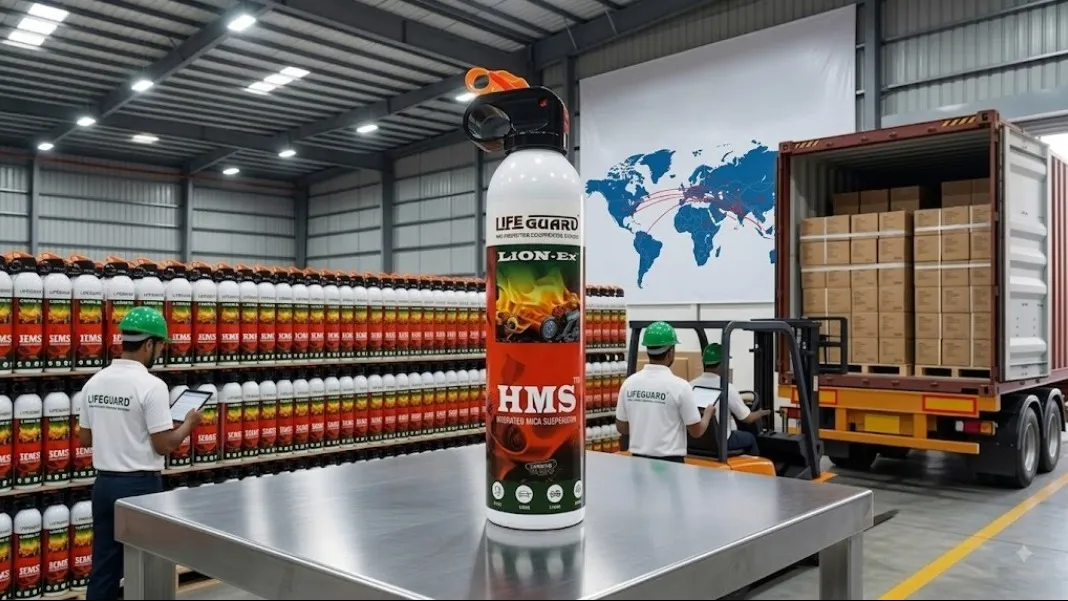
EV Battery Fire Suppression System OEM Manufacturer in India
The rapid growth of electric vehicles, lithium-ion battery manufacturing, battery swapping stations, EV charging infrastructure, electric buses, electric trucks and energy storage applications is creating a strong need for specialized fire protection systems capable of managing the unique hazards associated with lithium-ion batteries.
LIFEGUARD® – United Fire Equipments Pvt. Ltd. offers engineered fire protection solutions for organizations searching for a reliable EV battery fire suppression system OEM manufacturer in India. Our solutions are developed for electric vehicles, EV battery packs, battery compartments, charging stations, battery manufacturing facilities, workshops, warehouses and other lithium-ion battery applications where early detection, suppression, cooling and thermal runaway control are important.
Unlike conventional fires, lithium-ion battery incidents can involve thermal runaway, extremely rapid temperature rise, flammable gas release, propagation from one cell to another and possible re-ignition. For this reason, an EV battery fire protection system should be engineered according to the actual battery chemistry, capacity, installation configuration and project risk.
LIFEGUARD® – EV Battery Fire Suppression System OEM Manufacturer in India
As an Indian fire protection equipment manufacturer, LIFEGUARD® focuses on application-specific fire detection and suppression solutions for modern electric mobility and battery installations.
Our EV battery fire suppression solutions can be considered for:
- Electric cars
- Electric buses
- Electric trucks
- Electric commercial vehicles
- Battery swapping stations
- EV charging stations
- Battery manufacturing plants
- Battery testing laboratories
- EV service centres
- Lithium battery warehouses
- Battery storage facilities
- Vehicle assembly plants
- Battery pack enclosures
- Electrical and control compartments
The objective is to provide an integrated solution that helps detect abnormal conditions, initiate timely response and reduce the possibility of fire propagation.
Understanding EV Battery Fire Risk
Most modern electric vehicles use lithium-ion battery technology because of its high energy density, performance and charging efficiency.
However, batteries may become unstable due to conditions such as:
- Internal short circuit
- Overcharging
- Mechanical damage
- Collision impact
- External heat exposure
- Manufacturing defects
- Battery cell failure
- Electrical faults
- Improper battery handling
- Excessive operating temperature
- Battery management system malfunction
If a battery cell reaches a critical temperature, it may enter thermal runaway.
The event may progress as:
Cell abnormality → Heat generation → Gas release → Thermal runaway → Fire → Cell-to-cell propagation → Possible re-ignition
This makes lithium-ion battery fire protection fundamentally different from many conventional fire hazards.
What Is an EV Battery Fire Suppression System?
An EV battery fire suppression system is a specialized fire protection arrangement designed to detect and respond to hazardous conditions involving lithium-ion battery packs or battery-related installations.
Depending on the application, a system may combine:
- Heat detection
- Linear heat sensing
- Smoke detection
- Gas detection
- Flame detection
- Automatic suppression
- Cooling arrangements
- Alarm generation
- Electrical shutdown
- Vehicle or equipment isolation
- Remote monitoring
The most suitable configuration depends on the size and type of battery, vehicle design, operating environment and required level of protection.
EV Battery Fire Suppression System for Electric Vehicles
For vehicle applications, suppression systems may be designed for critical areas such as:
- Battery pack compartments
- Electrical panels
- Power distribution areas
- Charging electronics
- Motor control compartments
- Auxiliary battery areas
Automatic systems can help initiate an early response without depending entirely on manual firefighting intervention.
For OEM and vehicle manufacturers, the fire protection arrangement can be customized according to:
- Vehicle model
- Battery configuration
- Battery compartment dimensions
- Available mounting space
- Detection strategy
- Suppression agent requirement
- Piping or tubing route
- Nozzle location
- Control panel integration
- Vehicle electrical interface
EV Battery Fire Suppression for Electric Buses
Electric buses generally use larger battery systems than passenger vehicles and may have multiple battery packs mounted at different locations.
LIFEGUARD® can support engineered fire protection concepts for:
- Electric city buses
- School buses
- Electric coaches
- Airport buses
- Industrial transport buses
- Public transportation fleets
A system may include strategic detector and nozzle positioning around high-risk battery and electrical areas.
Electric Bus Protection Areas
Depending on the vehicle configuration, protection may be considered for:
- Roof-mounted battery packs
- Rear battery compartments
- Underfloor battery packs
- Electrical distribution boxes
- Charging interfaces
- Motor compartments
The final system design should be based on the actual vehicle architecture and fire risk assessment.
EV Battery Fire Suppression for Electric Trucks and Commercial Vehicles
Electric trucks, delivery vehicles and commercial fleets can carry high-capacity batteries and may operate for long hours under demanding conditions.
Fire protection systems can be developed for:
- Electric delivery vans
- Electric trucks
- Logistics vehicles
- Municipal EV fleets
- Industrial transport vehicles
- Electric utility vehicles
Automatic battery and electrical compartment protection can provide an additional layer of safety for commercial EV operations.
Thermal Runaway Detection and Suppression
One of the most important objectives in EV battery safety is identifying abnormal conditions before the event escalates.
Depending on the application, early warning may be provided through:
Temperature Detection
Heat detection can identify abnormal temperature rise around battery modules or enclosures.
Linear Heat Sensing
Linear heat sensing cable can provide continuous temperature-sensitive detection along battery compartments or critical areas.
Smoke Detection
Smoke detection may provide warning where battery packs are located within enclosed compartments.
Gas Detection
Lithium-ion batteries may release gases before or during thermal runaway. Suitable gas monitoring can provide an additional layer of warning depending on the battery chemistry and system design.
Flame Detection
Flame detection can be used where rapid identification of an open flame is required.
Importance of Cooling in EV Battery Fire Suppression
A major challenge with lithium-ion battery fires is that extinguishing visible flames may not necessarily eliminate the internal heat responsible for thermal runaway.
Affected battery cells may remain hot and continue transferring heat to adjacent cells.
For this reason, battery fire protection should consider:
**Detection
Keywords






