
EV Fire Risk Analysis – Comprehensive Fire Safety Solutions for Electric Vehicle Infrastructure
Advanced EV Fire Protection by LIFEGUARD®
The rapid expansion of electric mobility in India has increased the demand for advanced fire safety solutions designed specifically for electric vehicle (EV) infrastructure. As EV adoption grows across passenger vehicles, commercial fleets, public transportation, battery storage systems, and charging networks, the importance of EV fire risk analysis has become critical for ensuring operational safety and infrastructure protection.
Unlike conventional vehicle fires, EV fires involve lithium-ion battery systems that can generate intense heat, toxic gases, thermal runaway reactions, and re-ignition risks. These hazards require specialized fire risk assessment and advanced suppression technologies.
LIFEGUARD® provides dependable fire safety solutions engineered to support modern EV ecosystems with effective fire detection, suppression, and thermal runaway protection systems.
What is EV Fire Risk Analysis?
EV fire risk analysis is the process of identifying, evaluating, and controlling fire hazards associated with electric vehicles, battery systems, charging infrastructure, and related electrical components.
The objective of EV fire risk analysis is to:
- Identify potential ignition sources
- Assess battery fire hazards
- Improve emergency preparedness
- Protect people and infrastructure
- Reduce operational and financial risks
- Implement effective fire suppression systems
This analysis helps organizations build safer EV infrastructure while maintaining regulatory compliance and operational reliability.
Major Causes of EV Fires
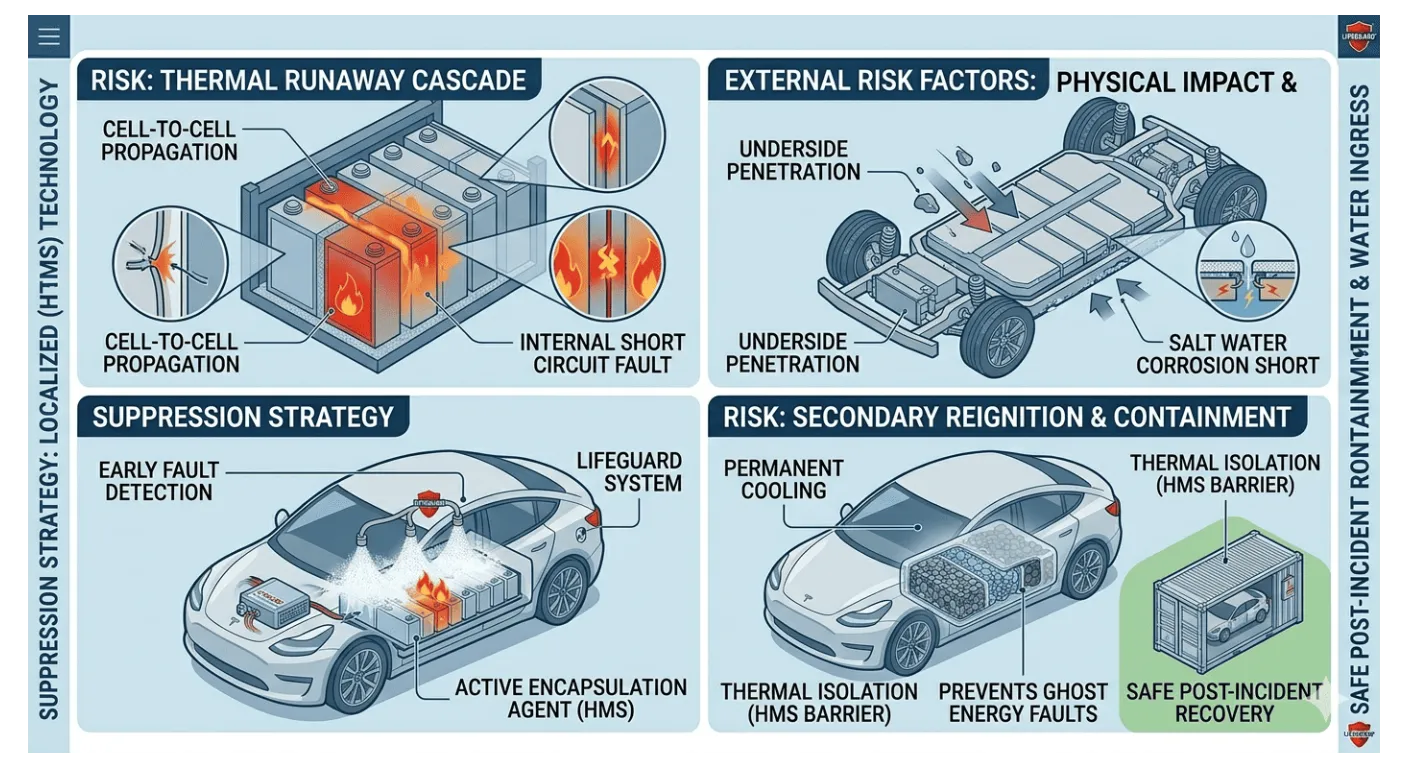
Thermal Runaway in Lithium-Ion Batteries
Thermal runaway is one of the most serious EV battery fire hazards.
It occurs when:
- Battery cells overheat uncontrollably
- Internal chemical reactions accelerate
- Heat spreads between cells
- Flammable gases are released
- Fire propagates rapidly
Once initiated, thermal runaway can continue even after visible flames are extinguished.
Overcharging & Charging System Failures
Improper charging equipment or excessive charging voltage may cause:
- Battery overheating
- Electrical arcing
- Internal short circuits
- Battery instability
Charging stations therefore require dedicated fire safety planning and monitoring systems.
Mechanical Damage & Vehicle Accidents
Battery packs damaged during collisions or physical impact may experience:
- Cell rupture
- Internal short circuits
- Thermal instability
- Fire ignition
Electrical System Failures
High-voltage EV systems can develop:
- Wiring defects
- Insulation breakdown
- Arc faults
- Connector failures
These electrical issues can increase fire risks significantly.
Battery Manufacturing Defects
Poor battery quality or defective components may lead to:
- Internal battery failure
- Heat buildup
- Chemical instability
- Unexpected fire incidents
Key Risks Associated with EV Fires
Re-Ignition Risks
EV battery fires can reignite even after initial suppression due to residual heat and ongoing chemical reactions inside battery cells.
Toxic Gas Emissions
Lithium-ion battery fires release hazardous gases such as:
- Hydrogen fluoride
- Carbon monoxide
- Flammable vapors
These gases create serious health and environmental hazards.
Rapid Heat Generation
EV battery fires can generate extremely high temperatures capable of:
- Damaging nearby infrastructure
- Spreading fire rapidly
- Weakening structural components
Complex Fire Suppression Challenges
Traditional firefighting methods may not adequately:
- Cool battery cells
- Stop thermal runaway
- Prevent fire propagation
- Eliminate hidden hotspots
Areas Requiring EV Fire Risk Assessment
EV Charging Stations
Charging equipment and electrical systems require advanced fire safety planning.
EV Parking Areas & Basements
Enclosed parking spaces increase smoke accumulation and fire spread risks.
EV Service Centers
Battery maintenance operations create additional fire hazards.
Battery Manufacturing Facilities
Large-scale battery production environments require specialized suppression systems.
Commercial EV Fleets
Fleet depots and charging infrastructure require centralized fire protection management.
Importance of Advanced EV Fire Protection Systems
Early Fire Detection
Thermal sensors, smoke detection systems, and gas monitoring technologies help identify abnormal conditions early.
Thermal Runaway Protection
Advanced systems help:
- Control battery temperatures
- Limit fire spread
- Prevent catastrophic battery failure
Specialized Fire Suppression
Modern EV fire suppression systems are designed for:
- Rapid cooling
- Heat absorption
- Battery fire containment
- Re-ignition prevention
LIFEGUARD® EV Fire Protection Solutions
LIFEGUARD® offers advanced fire safety solutions for EV environments including:
- Lithium battery fire extinguishers
- EV battery fire suppression systems
- Thermal runaway protection systems
- Watermist suppression systems
- ESS fire protection solutions
- Industrial fire detection technologies
Our systems are engineered to provide reliable protection for evolving electric mobility infrastructure.
Benefits of EV Fire Risk Analysis
Improved Infrastructure Safety
Reduces fire hazards across EV installations.
Protection of High-Value Assets
Safeguards EV charging systems, battery storage units, and industrial equipment.
Reduced Operational Downtime
Minimizes business interruptions caused by fire incidents.
Better Emergency Preparedness
Supports efficient fire response planning and personnel training.
Regulatory Compliance
Helps organizations meet fire safety standards and operational guidelines.
EV Fire Safety Best Practices
- Install specialized EV fire suppression systems
- Conduct regular battery inspections
- Use certified charging equipment
- Monitor battery temperatures continuously
- Maintain proper ventilation
- Train staff for EV fire emergencies
- Isolate damaged batteries immediately
- Implement thermal monitoring systems
Industries Benefiting from EV Fire Risk Analysis
- Electric Vehicle Manufacturing
- EV Charging Infrastructure
- Commercial Transportation Fleets
- Energy Storage Facilities
- Data Centers
- Industrial Manufacturing Plants
- Warehousing & Logistics
- Smart Infrastructure Projects
Why Choose LIFEGUARD®?
ISI Certified Fire Safety Equipment
Trusted manufacturer of high-quality fire protection systems.
Expertise in EV & Battery Fire Protection
Specialized solutions for lithium-ion battery hazards and thermal management.
Customized Fire Safety Solutions
Tailored systems designed according to infrastructure requirements.
Reliable Technical Support
Professional guidance for fire safety planning, installation, and maintenance.
Commitment to Innovation & Safety
Focused on delivering dependable fire protection technologies for modern industries.
Future of EV Fire Safety in India
India’s electric mobility sector is expanding rapidly, increasing the need for advanced fire protection technologies capable of managing battery fire risks effectively.
As EV adoption grows, fire risk analysis and specialized suppression systems will become essential for ensuring safe and sustainable transportation infrastructure.
LIFEGUARD® continues to support this transformation with innovative and reliable EV fire protection solutions designed for modern industrial and infrastructure applications.
Conclusion
EV fire risk analysis is essential for identifying and controlling the complex fire hazards associated with lithium-ion battery systems and electric mobility infrastructure. Thermal runaway, toxic gas emissions, re-ignition risks, and high-voltage electrical systems require specialized fire protection strategies.
LIFEGUARD® provides advanced EV fire safety solutions engineered to protect electric vehicle infrastructure, battery systems, and industrial operations with dependable fire suppression and thermal management technologies.
Contact LIFEGUARD®
LIFEGUARD®
United Fire Equipments Pvt. Ltd.
Manufacturer of ISI Certified Fire Safety Equipment
📞 8048034226
📧 ufe126@gmail.com | info@lifeguardindia.in
Keywords






