
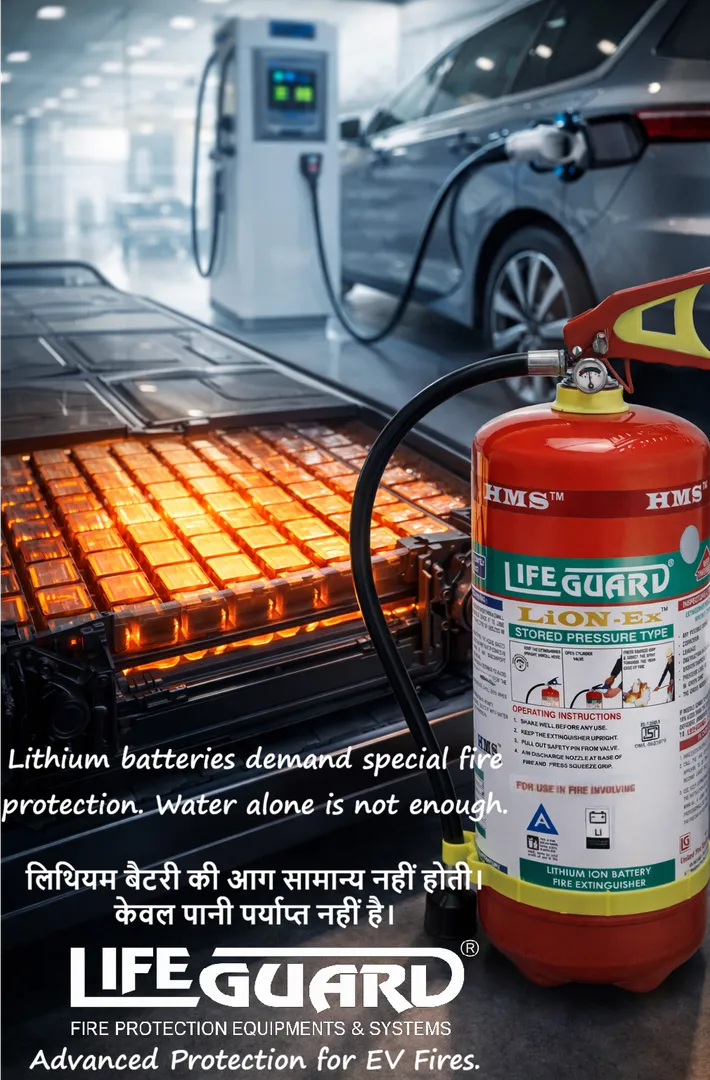
Lithium Batteries Demand Special Fire Protection
Water Alone Is Not Enough
Lithium-ion batteries are powering the modern world—from electric vehicles (EVs) and energy storage systems (ESS/BESS) to buses, railways, hospitals, high-rise buildings, data centers, UPS rooms, consumer electronics and public charging infrastructure.
But with this transition comes a new class of fire risk—one that traditional firefighting methods were never designed to handle.
At LIFEGUARD® (United Fire Equipments Pvt. Ltd.), we emphasize a critical safety truth:
Lithium batteries demand special fire protection. Water alone is not enough.
Why Lithium Battery Fires Are Fundamentally Different
Unlike conventional fires, lithium-ion battery fires involve electrochemical reactions that continue internally even after visible flames appear to be extinguished.
Key challenges include:
- Thermal runaway (self-sustaining heat generation)
- Re-ignition hours later, even after cooling
- High flame jet temperatures
- Electrical energy still present in cells
- Release of flammable and toxic gases
Pouring water may temporarily cool the surface—but it does not stop the internal reaction.
The Dangerous Myth: “Just Use Water”
Water is often assumed to be a universal fire solution. In lithium battery fires, this assumption is dangerous.
❌ Limitations of Water Alone
- Cannot penetrate sealed battery cells effectively
- Does not encapsulate or isolate damaged cells
- May spread burning electrolytes
- Does not prevent delayed re-ignition
- Large water volumes needed—often impractical
In confined spaces like buses, buildings, hospitals or battery rooms, relying on water alone can worsen the situation.
Where Lithium Battery Fire Risks Exist Today
🏢 High-Rise Buildings
- EV parking basements
- Residential & commercial charging points
- UPS & backup battery rooms
🚌 Buses & Electric Mobility
- Electric buses & coaches
- Battery compartments & charging depots
- E-bikes, e-scooters and fleet vehicles
🚆 Railways & Metro Systems
- Battery-powered rolling stock
- Signalling & UPS systems
- Station backup power units
🏥 Hospitals & Healthcare
- Life-saving equipment batteries
- UPS systems for ICUs & OTs
- EV ambulances and charging bays
🏟️ Public Gathering Places
- Malls, airports, stadiums
- Public charging stations
- Telecom & data infrastructure
Why Special Fire Protection Is Mandatory for Lithium Batteries
Effective lithium fire protection must address four critical needs:
- Rapid cooling of overheated cells
- Encapsulation of battery surfaces to cut oxygen and heat transfer
- Electrical insulation for responder safety
- Re-ignition resistance over time
Traditional agents fail to meet all four simultaneously.
The LIFEGUARD® Solution: Specialized Lithium Fire Protection
LIFEGUARD provides application-specific lithium fire safety solutions, including:
🔹 HMS – Hydrated Mica Suspension
A specialized extinguishing agent engineered specifically for lithium-ion battery fires.
What HMS does:
- Absorbs heat rapidly
- Forms a protective mica barrier over cells
- Electrically insulates battery surfaces
- Suppresses re-ignition effectively
HMS works where water, powder and CO₂ fall short.
Layered Fire Protection Strategy (Best Practice)
LIFEGUARD recommends a multi-layered approach:
Risk Area
Recommended Protection
EV & Battery Rooms
HMS-based extinguishers / fixed suppression
Passenger Areas
Watermist (people-safe)
Electrical Panels
Clean agent / Watermist
Large ESS/BESS
Automatic detection + local HMS suppression
This ensures early control, safe evacuation and long-term fire stability.
Compliance & Safety Guidance
Lithium fire protection should align with:
- National fire safety principles (NBC)
- Automotive & transport safety guidelines
- Global best practices (NFPA 855, UL 9540A – reference mapping)
- Manufacturer-recommended battery fire response protocols
LIFEGUARD supports clients with technical documentation, SOPs and compliance mapping.
Common Mistakes That Increase Lithium Fire Damage
❌ Treating lithium fires like ordinary electrical fires
❌ Using only water or ABC powder
❌ No post-extinguishment monitoring
❌ No dedicated lithium fire extinguishers
❌ No training for staff or drivers
Preparedness must evolve with technology.
Fire Safety Is Not Optional in the Lithium Era
Lithium batteries are here to stay. Fire safety must adapt accordingly.
Water may cool flames—but specialized protection prevents catastrophe.
How LIFEGUARD® Helps You Stay Ahead
- Specialized Lithium Battery Fire Extinguishers (HMS)
- Fixed and portable lithium fire suppression systems
- Fire detection & alarm integration
- Training, SOPs and fire safety audits
- Solutions for buildings, transport, healthcare & public infrastructure
SEO Keyword Bank
Primary Keywords
- Lithium battery fire protection
- Lithium batteries demand special fire protection
Secondary Keywords
- Lithium battery fire extinguisher
- EV battery fire safety
- Fire protection for lithium-ion batteries
Long-Tail Keywords
- Why water alone is not enough for lithium battery fires
- Special fire protection for EV batteries
- Lithium battery fire suppression system for buildings
- Fire safety solutions for lithium battery risks
Meta Title & Meta Description (SEO Optimized)
Meta Title:
Lithium Batteries Demand Special Fire Protection | Water Alone Is Not Enough – LIFEGUARD
Meta Description:
Lithium batteries demand special fire protection. Water alone is not enough. Learn why lithium-ion battery fires require specialized suppression for buildings, buses, hospitals, railways and public places.
Act Before an Incident Occurs
United Fire Equipments Pvt. Ltd.
Manufacturer of ISI Certified Fire Safety Equipment
📞 8048034226
📧 ufe126@gmail.com, info@lifeguardindia.in
📌 Upgrade Lithium Fire Protection | Request Risk Assessment | Train Your Team
Keywords






