
FIRE STOP MATERIAL
Powered by Agni-Rodhak | A LIFEGUARD Passive Fire Protection Solution
STOP THE PATH. CONTAIN THE FIRE. PROTECT WHAT MATTERS.
https://youtu.be/E_qhgD_o34g?si=xACjhXO89tnh7uaR
Fire rarely respects boundaries.
It travels through the very openings created to make modern buildings functional—cable penetrations, service shafts, pipe openings, ducts, joints and construction gaps. When these openings are left inadequately protected, a localized fire can rapidly migrate from one compartment to another.
LIFEGUARD Fire Stop Material, powered by Agni-Rodhak®, is developed as a specialized passive fire protection material for suitable building and industrial applications where openings and service penetrations need to be addressed as part of a comprehensive fire-containment strategy.
It forms an important layer between fire initiation and fire propagation, helping create protected compartmentation around critical penetrations and service pathways.
What is Fire Stop Material?
Fire Stop Material is a passive fire protection material used to seal, protect or treat designated openings, joints, gaps and service penetrations in fire-resisting assemblies.
The fundamental objective is simple:
Where fire can find a pathway, fire stopping creates a barrier.
A properly designed and installed fire-stop system can help limit the movement of flames, hot gases and smoke through protected openings, thereby supporting the fire-resistance and compartmentation strategy of the building.
Fire stopping is therefore not merely a construction detail—it is a critical component of passive fire protection engineering.
Agni-Rodhak® Powered Fire Stop Material
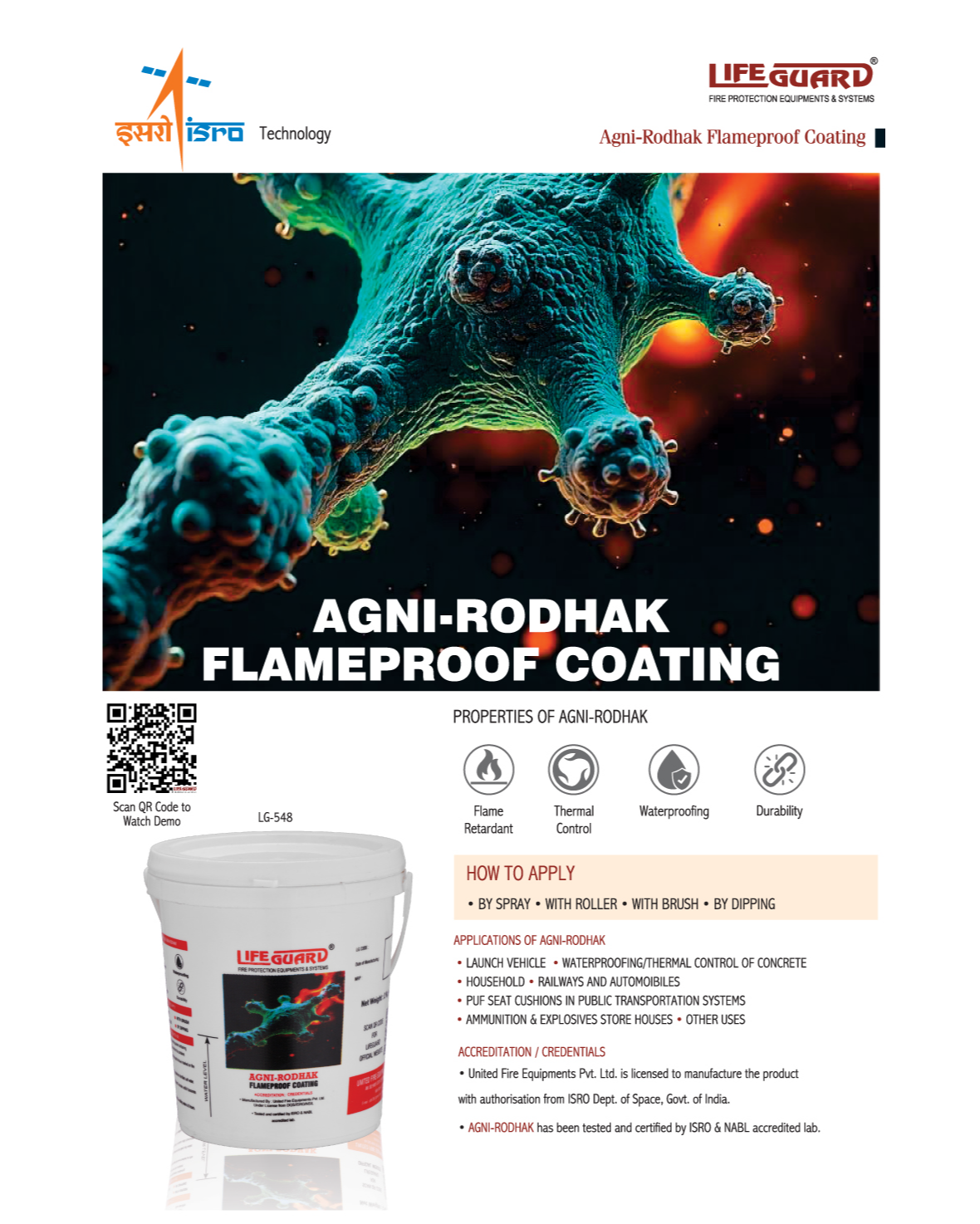
LIFEGUARD combines its fire-protection expertise with Agni-Rodhak® technology to provide a specialized material platform for fire-stop applications.
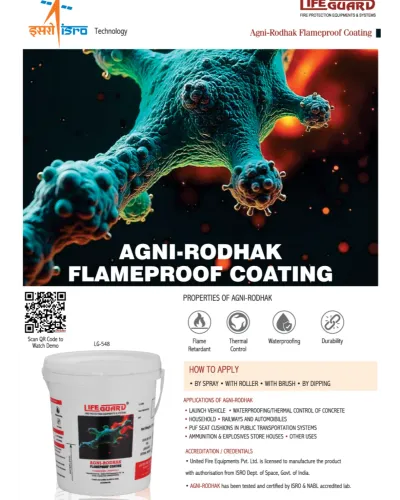
Agni-Rodhak® is designed around a mineral-based fire-protection approach, making it suitable for consideration in applications where passive fire protection is required around selected construction and service penetrations.
The solution is intended to work without relying on active intervention, electrical activation or manual operation.
Once correctly installed, passive fire protection remains continuously present, ready to perform its intended protective function when exposed to fire conditions.
Why Fire Stopping is Critical
Modern buildings and industrial facilities are filled with interconnected services.
Electrical cables, communication cables, pipes and other utilities frequently pass through walls, floors and fire-rated partitions.
Every penetration can potentially become a weak point in compartmentation.
Without appropriate fire stopping, a fire may move through:
- Cable penetrations
- Pipe penetrations
- Service shafts
- Electrical openings
- Utility ducts
- Wall and floor openings
- Construction joints
- Gaps around services
- Cable tray penetrations
- Mechanical service openings
Therefore, fire compartmentation is only as effective as its weakest unprotected opening.
How Fire Stop Material Supports Passive Fire Protection
A properly engineered fire-stop installation is intended to restore or maintain the fire-resistance function of the penetrated assembly.
The protection strategy focuses on:
1. Closing the Path
Sealing designated openings and gaps through which fire, smoke or hot gases could otherwise travel.
2. Supporting Compartmentation
Helping maintain separation between protected fire compartments.
3. Protecting Service Penetrations
Addressing vulnerable areas created when electrical, mechanical or utility services pass through fire-resisting construction.
4. Limiting Fire Spread
Helping restrict fire movement from the compartment of origin into adjoining spaces, subject to the tested/approved system configuration.
5. Enhancing Passive Fire Safety
Providing a continuous passive layer that complements active fire protection systems.
Typical Fire Stop Material Applications
LIFEGUARD Fire Stop Material powered by Agni-Rodhak® can be considered for suitable applications including:
Electrical Cable Penetrations
Used around designated cable penetrations passing through fire-resisting walls and floors.
Potential applications include:
- Power cables
- Control cables
- Instrumentation cables
- Communication cables
- Data cables
- Electrical service penetrations
Cable Tray & Cable Ladder Penetrations
Modern electrical installations often require large cable trays and ladders to pass through compartment walls.
Fire-stop treatment can be incorporated around suitable penetrations to help maintain the integrity of the fire-resisting barrier.
Applications may include:
- Cable tray openings
- Cable ladder openings
- Multi-cable penetrations
- Electrical service openings
Pipe Penetrations
Fire stopping can also be required around suitable pipe penetrations passing through fire-resisting construction.
Applications may include:
- Utility pipes
- Service pipes
- Electrical conduit
- Metallic pipe penetrations
- Other appropriately engineered service penetrations
The correct fire-stop system must be selected according to the pipe material, diameter, insulation, wall/floor construction and required performance.
Fire Stop for Walls & Floors
Fire-rated walls and floors are designed to provide separation between fire compartments.
When these assemblies are penetrated for services, the penetration must be addressed as part of the overall fire-resistance design.
Agni-Rodhak® powered Fire Stop Material can be considered for suitable:
- Concrete walls
- Masonry walls
- Fire-resisting partitions
- Concrete floors
- Service floors
- Utility openings
- Penetration zones
Application must always follow the appropriate engineered system configuration.
Fire Stop for Service Shafts
Vertical service shafts can create a particularly important fire-propagation pathway.
Electrical, communication, plumbing and mechanical services can extend across multiple floors.
An appropriately engineered fire-stopping strategy can help compartmentalize these pathways and reduce the possibility of fire and smoke migration between floors.
Fire Stop for Electrical & Data Infrastructure
Today's critical facilities depend on dense electrical and communication infrastructure.
This includes:
- Data centres
- Server rooms
- Telecom facilities
- Control rooms
- Electrical rooms
- Industrial plants
- Commercial buildings
- Infrastructure facilities
Fire stopping around penetrations becomes an essential part of protecting the building compartmentation surrounding mission-critical services.
Fire Stop Material for Data Centres
Data centres require exceptionally careful consideration of passive fire protection because they contain:
- High-density cable networks
- Power distribution systems
- UPS systems
- Battery systems
- Communication infrastructure
- Cooling services
- Multiple service penetrations
Fire-stop systems can be incorporated around suitable cable and service penetrations to support compartmentation and limit potential fire and smoke migration.
For battery-related hazards, however, fire stopping is not a substitute for dedicated battery fire detection and suppression systems.
Fire Stop Material for Industrial Facilities
Industrial environments can contain extensive service networks passing through walls, floors and process areas.
Fire-stop applications can support passive fire protection in:
- Manufacturing plants
- Process industries
- Power facilities
- Oil & gas infrastructure
- Warehouses
- Utility buildings
- Electrical substations
- Control buildings
- Infrastructure projects
Project-specific fire hazards, construction types and applicable requirements should determine the appropriate fire-stop design.
Fire Stop Material + Agni-Rodhak®
Passive Protection Engineered Around the Pathways of Fire
Agni-Rodhak® brings a distinctive material technology approach to passive fire protection.
Instead of waiting for a fire detection signal or mechanical activation, passive fire stopping is built into the structure itself.
No Alarm Required.
No Manual Activation Required.
No Electrical Trigger Required.
It is there continuously as part of the building's passive fire protection architecture.
Passive Fire Protection vs Active Fire Protection
A comprehensive fire safety strategy uses both.
Passive Fire ProtectionActive Fire ProtectionFire Stop MaterialFire DetectionFire BarriersAutomatic SuppressionCompartmentationFire AlarmPenetration SealingFire ExtinguishersFire-Resistant CoatingsSprinkler SystemsStructural Fire ProtectionSpecialized Suppression Systems
Agni-Rodhak® Fire Stop Material
Contains the pathway.
Active Fire Protection
Detects and responds to the fire.
Together, they create a stronger and more resilient fire protection architecture.
Key Features
Agni-Rodhak® Powered
Advanced fire-protection material technology from LIFEGUARD.
Passive Fire Protection
Designed to provide continuous protection without active operation.
Penetration Protection
Suitable for engineered protection of designated service penetrations.
Compartmentation Support
Helps maintain the continuity of fire-resisting construction when properly incorporated into a tested/engineered assembly.
Versatile Application
Can be considered for suitable electrical, mechanical and utility penetration applications.
Building & Industrial Applications
Suitable application areas can extend across commercial, industrial and infrastructure environments.
Integrated Fire Safety
Can complement active fire detection and suppression systems.
Benefits of Agni-Rodhak® Powered Fire Stop Material
- Helps reduce pathways for fire and smoke spread
- Supports fire compartmentation
- Protects vulnerable service penetrations
- Provides passive, continuously present protection
- Supports safer building design
- Complements active fire protection systems
- Suitable for consideration in new construction and selected retrofit applications
- Helps create a more comprehensive fire protection strategy
Where Can Fire Stop Material Be Used?
Commercial Buildings
Offices, malls, hotels and large commercial complexes.
Residential Buildings
High-rise residential and multi-storey developments.
Hospitals
Critical healthcare facilities where compartmentation is particularly important.
Data Centres
Cable-dense and mission-critical environments.
Industrial Plants
Manufacturing and process facilities.
Power & Electrical Infrastructure
Electrical rooms, substations and utility buildings.
Telecommunication Facilities
Communication and network infrastructure.
Transportation Infrastructure
Suitable service and utility areas in major infrastructure projects.
Warehouses & Logistics Facilities
Fire compartmentation and service penetration protection.
Fire Stop Material for Cable Penetrations
Electrical cables are among the most common services crossing fire-resisting barriers.
A high-quality fire-stop strategy should consider:
- Cable type
- Number of cables
- Cable diameter
- Cable tray configuration
- Penetration dimensions
- Wall/floor construction
- Required fire-resistance performance
- Installation environment
- Future cable additions
- Maintenance accessibility
The fire-stop material should therefore never be selected solely on the basis of appearance or generic material properties.
The complete fire-stop assembly and installation methodology matter.
Fire Stop Material is a System, Not Just a Product
This is one of the most important principles in professional passive fire protection.
The performance of a fire-stop installation depends upon the complete configuration, including:
Substrate + Opening + Service + Fire Stop Material + Installation Method
Therefore, LIFEGUARD recommends that the final specification be based on:
- Project-specific fire-risk assessment
- Construction details
- Penetration configuration
- Service type
- Required fire performance
- Applicable codes and standards
- Tested/assessed system configuration, where applicable
- Manufacturer's installation requirements
This approach transforms fire stopping from a construction afterthought into a properly engineered life-safety measure.
Agni-Rodhak for a Layered Fire Protection Strategy
For complex infrastructure, fire protection should not depend upon one product.
LIFEGUARD promotes a layered approach:
PREVENT
Good design, installation and maintenance.
PROTECT
Agni-Rodhak® passive fire protection and fire stopping.
DETECT
Early fire and smoke detection.
SUPPRESS
Appropriate active fire suppression technology.
CONTAIN
Compartmentation and fire barriers.
RESPOND
Emergency procedures and trained response.
Every layer has a purpose. Every pathway deserves attention.
Why Choose LIFEGUARD?
LIFEGUARD approaches fire safety from an engineering perspective—recognizing that modern buildings and infrastructure contain increasingly complex electrical, mechanical and energy systems.
With Agni-Rodhak® technology, LIFEGUARD provides a platform for passive fire protection applications designed around the principle of containing fire before it becomes a pathway to the next compartment.
Our fire protection ecosystem can include:
- Agni-Rodhak Passive Fire Protection
- Fire Stop Materials
- Fire-Resistant Coating Solutions
- Cable Fire Protection
- BESS Fire Protection
- HMS Active Fire Suppression Technology
- Electrical Fire Protection
- Industrial Fire Safety Solutions
This enables passive and active fire protection technologies to be considered together within a project's overall fire safety strategy.
The LIFEGUARD Philosophy
A Fire Barrier is Only as Strong as Its Weakest Opening.
Walls and floors may be designed as fire-resisting barriers.
But every cable, pipe, duct and service penetration creates a potential discontinuity.
Fire stopping closes that vulnerability.
With Agni-Rodhak Powered Fire Stop Material, LIFEGUARD brings passive fire protection directly to the pathways through which fire could otherwise travel.
STOP THE PATH.
CONTAIN THE FIRE.
PROTECT THE STRUCTURE.
PROTECT THE PEOPLE.
Technical Disclaimer
Fire-stop performance is dependent on the complete tested, assessed or engineered assembly, substrate, penetration configuration, service type, dimensions, installation method and applicable project requirements. Agni-Rodhak® powered Fire Stop Material should be specified and installed in accordance with the applicable technical documentation and project-specific fire safety requirements. Product suitability, fire-resistance ratings and code compliance should not be assumed without the relevant supporting documentation.
SEO Meta Title
Fire Stop Material Powered by Agni-Rodhak® | LIFEGUARD
SEO Meta Description
LIFEGUARD Fire Stop Material powered by Agni-Rodhak® for passive fire protection, penetration sealing and fire compartmentation across electrical, cable, pipe and service openings.
Primary SEO Keywords
Fire Stop Material, Firestop Material, Fire Stopping Material, Fire Stop System, Firestop System, Passive Fire Protection, Fire Stop Material India, Firestop Material India, Agni-Rodhak Fire Stop Material, Agni-Rodhak Passive Fire Protection, Fire Penetration Seal, Fire Penetration Sealing, Fire Rated Penetration Protection, Cable Penetration Fire Stop, Cable Fire Stop Material, Cable Tray Fire Stop, Cable Tray Penetration Protection, Electrical Penetration Fire Stop, Electrical Cable Fire Stopping, Pipe Penetration Fire Stop, Pipe Fire Stop Material, Fire Stop for Cables, Fire Stop for Cable Trays, Fire Stop for Pipes, Fire Stop for Walls, Fire Stop for Floors, Fire Compartmentation, Fire Barrier Material, Fire Resistant Sealant, Passive Fire Stop, Passive Fire Protection Material, Building Fire Protection, Industrial Fire Protection, Data Centre Fire Stop, Data Centre Passive Fire Protection, Electrical Room Fire Protection, Service Shaft Fire Protection, Fire Rated Wall Penetration, Fire Rated Floor Penetration, Fire and Smoke Sealing, Fire Compartment Sealing, Fire Safety Material, Fire Protection Material, Agni-Rodhak, LIFEGUARD Fire Protection, LIFEGUARD Fire Stop Material.