
Future of Battery Safety: Innovations, Regulations & Fire Protection Trends
The future of battery safety is becoming one of the most important priorities in the global energy transition. With the rapid expansion of electric vehicles (EVs), renewable energy storage systems, portable electronics, industrial automation, and AI-powered infrastructure, batteries are now at the center of modern technology. However, increasing battery usage also raises concerns about fire hazards, thermal runaway, explosion risks, and energy storage safety.
As industries continue adopting advanced lithium-ion and next-generation battery technologies, the focus is shifting toward smarter, safer, and regulation-driven battery ecosystems. Companies worldwide are investing heavily in fire-resistant battery chemistries, AI-powered monitoring systems, solid-state batteries, and advanced fire suppression technologies to reduce battery-related incidents.
At LIFEGUARD® United Fire Equipments Pvt. Ltd., we recognize the growing demand for reliable battery fire safety solutions. As a leading manufacturer of ISI-certified fire safety equipment, we provide advanced protection systems designed for EV infrastructure, lithium battery storage, data centers, renewable energy plants, and industrial facilities.
Why Battery Safety Will Define the Future
Battery-powered systems are becoming essential across nearly every industry. From electric mobility and smart grids to AI data centers and consumer electronics, the demand for high-capacity batteries is increasing exponentially.
However, conventional lithium-ion batteries still face major safety challenges, including:
- Thermal runaway
- Overheating
- Fire propagation
- Toxic gas emissions
- Electrical short circuits
- Mechanical damage risks
- Improper charging hazards
Global fire experts and regulators are increasingly concerned about lithium battery fires due to their complexity and rapid escalation potential.
The future of battery safety will therefore depend on a combination of:
- Safer battery chemistry
- Intelligent monitoring systems
- Stronger regulations
- Advanced cooling systems
- Early fire detection
- Automated suppression technologies
Rise of Solid-State Batteries
One of the biggest advancements shaping the future of battery safety is the development of solid-state batteries.
Unlike traditional lithium-ion batteries that use flammable liquid electrolytes, solid-state batteries replace liquid materials with solid electrolytes, significantly reducing fire risks and improving thermal stability.
Advantages of Solid-State Batteries
- Lower fire and explosion risk
- Improved thermal resistance
- Higher energy density
- Faster charging capability
- Longer battery lifespan
- Reduced leakage hazards
Many global battery manufacturers are now accelerating research and commercial production of solid-state technologies for EVs and energy storage systems.
Sodium-Ion Batteries: A Safer Alternative
Another major innovation in battery safety is sodium-ion battery technology.
Sodium-ion batteries are gaining popularity because they offer improved safety characteristics compared to traditional lithium-ion systems. They are less dependent on critical raw materials and perform better under low-temperature conditions.
Benefits of Sodium-Ion Batteries
- Lower thermal runaway risk
- Safer transportation
- Improved environmental sustainability
- Better cold-weather performance
- Reduced lithium dependency
- Cost-effective manufacturing
Experts believe sodium-ion technology may become highly suitable for large-scale energy storage and industrial backup applications.
AI-Powered Battery Monitoring Systems
Artificial Intelligence (AI) is transforming battery safety management.
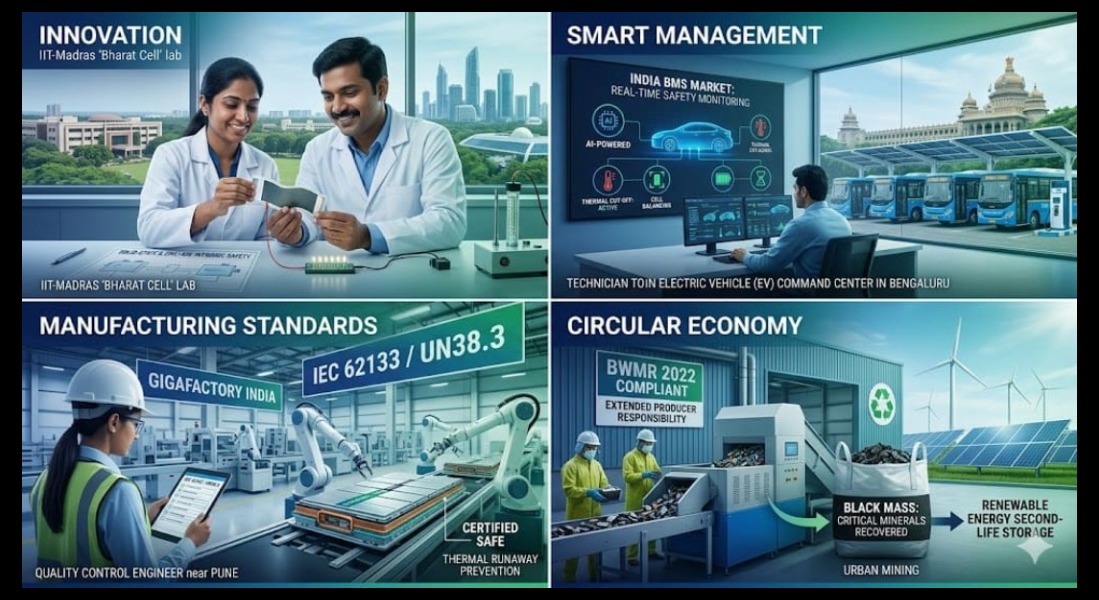
Modern Battery Management Systems (BMS) are evolving into intelligent platforms capable of predicting failures before they occur. AI-powered systems continuously monitor:
- Temperature fluctuations
- Voltage irregularities
- Charge-discharge cycles
- Internal resistance
- Thermal behavior
These systems can automatically trigger alarms, cooling mechanisms, or emergency shutdowns when abnormal conditions are detected.
Future Role of AI in Battery Safety
- Predictive failure analysis
- Real-time thermal monitoring
- Smart energy balancing
- Automated emergency response
- Remote battery diagnostics
- Enhanced fire prevention
AI-driven monitoring will become essential for EV fleets, battery energy storage systems (BESS), telecom infrastructure, and data centers.
Advanced Cooling & Thermal Management
Thermal runaway remains one of the most dangerous battery failure mechanisms.
Future battery systems will increasingly use advanced thermal management technologies such as:
- Immersion cooling
- Liquid cooling systems
- Phase-change materials
- Smart ventilation
- Heat-resistant separators
Companies are also introducing immersion cooling technologies that prevent battery cells from overheating and reduce fire propagation risks.
Future Battery Fire Suppression Technologies
Traditional fire suppression methods are often insufficient for lithium battery fires. Future battery protection strategies will rely on specialized suppression technologies designed specifically for energy storage environments.
Emerging Fire Protection Solutions
Clean Agent Suppression Systems
Designed for electrical and sensitive battery installations without causing equipment damage.
Water Mist Fire Systems
Provide rapid cooling to control thermal runaway and prevent fire spread.
Aerosol Suppression Systems
Effective for enclosed battery cabinets and EV charging systems.
Smart Fire Detection
AI-based smoke and gas sensors capable of identifying early-stage battery failure.
Integrated Emergency Shutdown Systems
Automatically disconnect battery systems during hazardous conditions.
These technologies will become critical for EV charging infrastructure, battery warehouses, energy storage plants, and industrial facilities.
Stricter Global Battery Safety Regulations
Governments and regulatory authorities are strengthening battery safety standards worldwide.
Recent regulations are increasingly focusing on:
- Thermal runaway containment
- Fire-resistant battery design
- Emergency ventilation systems
- Battery enclosure protection
- Fire suppression requirements
- Transportation safety compliance
India’s Central Electricity Authority (CEA) has also introduced new Battery Energy Storage System (BESS) safety regulations, including fire safety audits and advanced fault tolerance requirements for large installations.
Sustainable & Water-Based Battery Technologies
Researchers are developing environmentally friendly battery technologies using water-based electrolytes and non-flammable materials.
Some emerging battery systems claim to offer:
- Extremely low fire risk
- Non-toxic electrolytes
- Ultra-long lifespan
- Reduced environmental hazards
These innovations may significantly improve battery safety for large-scale renewable energy storage applications.
Future Applications Requiring Advanced Battery Safety
As battery adoption grows, safety systems will become mandatory across multiple sectors.
Key Industries Driving Battery Safety Demand
- Electric Vehicles (EVs)
- Renewable energy storage
- Data centers
- Telecom infrastructure
- Smart cities
- Industrial automation
- Defense and aerospace
- Marine applications
- Healthcare equipment
- Robotics and AI systems
Each industry requires customized fire protection and regulatory compliance strategies.
Importance of Fire Safety Infrastructure
The future of battery safety is not limited to battery design alone. Comprehensive fire safety infrastructure will play a major role in preventing catastrophic incidents.
Organizations must invest in:
- Fire extinguishers for electrical fires
- Automatic suppression systems
- Fire hydrant systems
- Smoke and gas detection systems
- Thermal imaging technology
- Emergency evacuation planning
- Fire safety training
Integrated safety planning will become a mandatory requirement for high-capacity battery installations.
Why LIFEGUARD® is Ready for the Future of Battery Safety
LIFEGUARD® United Fire Equipments Pvt. Ltd. delivers advanced fire protection solutions designed to meet the evolving safety challenges of battery-powered industries.
Our expertise includes:
- ISI-certified fire extinguishers
- Clean agent suppression systems
- Industrial fire hydrant systems
- Fire detection and alarm systems
- Electrical fire protection solutions
- Customized battery fire safety planning
- Industrial compliance support
We help businesses strengthen safety infrastructure for modern battery technologies and energy storage systems.
Contact LIFEGUARD®
LIFEGUARD® United Fire Equipments Pvt. Ltd.
Manufacturer of ISI Certified Fire Safety Equipment
📞 8048034226
📧 ufe126@gmail.com | info@lifeguardindia.in