
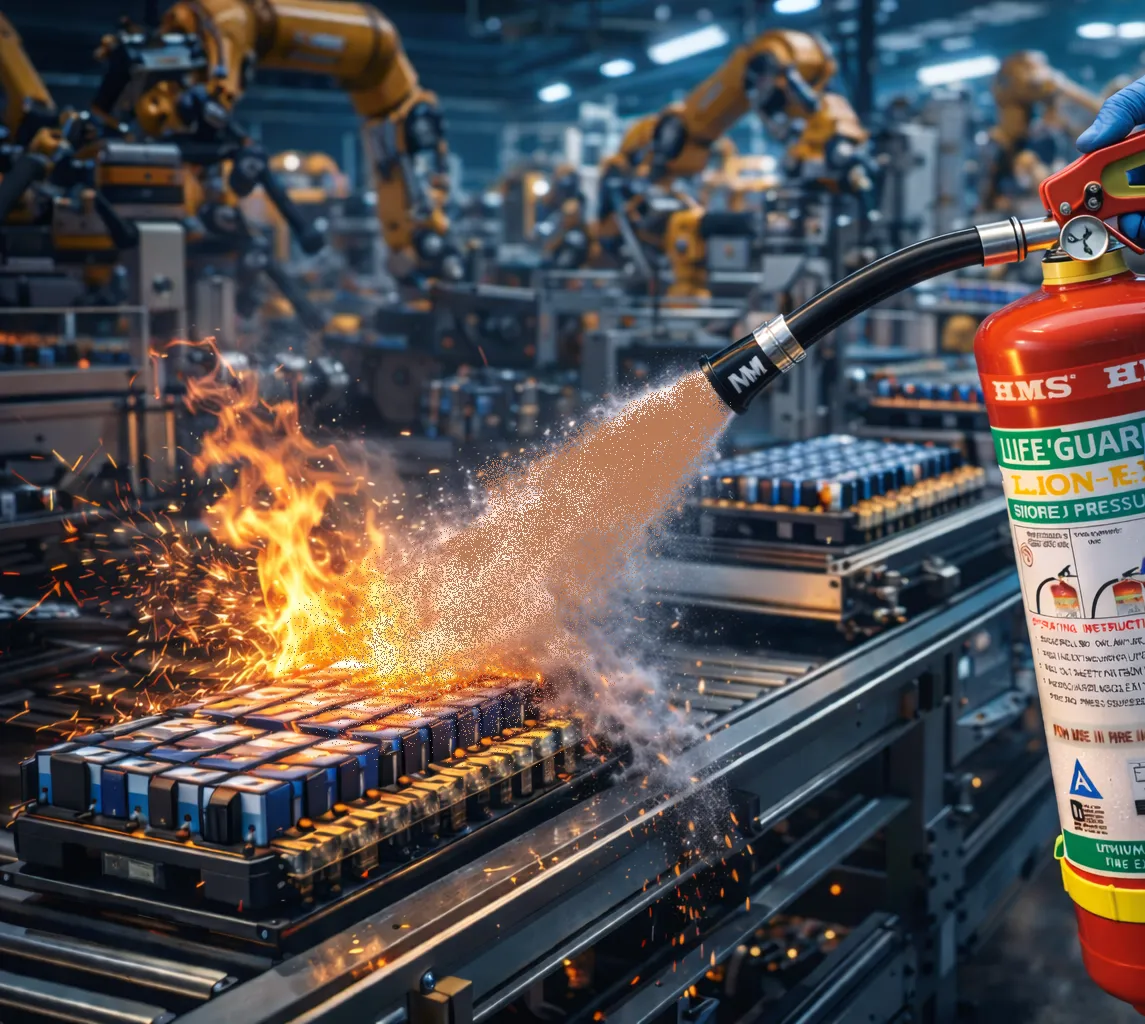
HMS for Battery Manufacturing Units – Advanced Fire Protection for Lithium Battery Production Facilities
The global demand for Lithium-ion batteries is growing rapidly with the expansion of electric vehicles, energy storage systems, consumer electronics, and renewable energy infrastructure. As a result, battery manufacturing units are becoming critical industrial facilities requiring highly specialized safety systems.
However, lithium battery production environments also involve significant fire risks, including thermal runaway, electrolyte fires, chemical reactions, and high-energy battery failures. Conventional firefighting methods are often inadequate for addressing these unique hazards.
To provide a dedicated solution for such high-risk environments, LIFEGUARD introduces HMS (Hydrated Mica Suspension) — an advanced fire suppression technology designed to control lithium battery fires in battery manufacturing and assembly facilities.
What is HMS for Battery Manufacturing Units?
HMS (Hydrated Mica Suspension) is an innovative mineral-based fire suppression agent developed specifically to tackle fires associated with Lithium-ion battery cells, modules, and packs during manufacturing processes.
Unlike conventional extinguishing agents that primarily suppress surface flames, HMS works by addressing the underlying thermal runaway reactions occurring inside battery cells.
When applied, HMS forms a heat-resistant mineral barrier that helps absorb heat, isolate the fire source, and prevent the propagation of thermal runaway between adjacent cells or battery modules.
This makes HMS for Battery Manufacturing Units a highly effective fire protection solution for modern lithium battery production facilities.
Fire Risks in Lithium Battery Manufacturing Facilities
Battery manufacturing units involve several stages where fire hazards may arise, including:
- Cell production and electrolyte filling
- Battery module assembly
- Formation and testing processes
- Battery charging and discharging cycles
- Storage of lithium battery cells and materials
In such environments, a single battery failure can trigger thermal runaway, leading to:
- Extremely high temperatures
- Rapid fire propagation between cells
- Release of flammable and toxic gases
- Explosion risks in enclosed environments
- Potential damage to production lines and equipment
Because lithium battery fires behave differently from conventional industrial fires, specialized fire suppression technologies are essential for effective protection.
How HMS Works in Battery Manufacturing Fire Suppression
The Hydrated Mica Suspension technology provides a multi-layered suppression mechanism designed for lithium battery incidents.
Thermal Insulation Barrier
HMS forms a protective mineral layer around the affected battery area, helping to isolate heat and slow down thermal runaway propagation.
Heat Absorption
The suspension absorbs large amounts of heat generated by battery failure, assisting in stabilizing the surrounding environment.
Flame Suppression
By covering the burning surface, HMS helps limit oxygen supply, which supports rapid flame suppression.
Re-Ignition Prevention
Lithium battery fires have a high risk of re-ignition. HMS creates a durable protective barrier that helps reduce this risk and enhances fire containment.
Applications of HMS in Battery Manufacturing Facilities
HMS technology can be implemented across multiple areas within lithium battery manufacturing units, including:
- Lithium battery cell production lines
- Battery module and pack assembly areas
- Battery testing and formation rooms
- Battery charging and discharge stations
- Raw material and electrolyte storage areas
- Lithium battery storage warehouses
- Research and development laboratories
- Battery recycling and refurbishment facilities
These environments require advanced fire protection strategies capable of addressing lithium battery hazards effectively.
Advantages of HMS for Battery Manufacturing Fire Protection
The LIFEGUARD HMS technology offers several advantages for lithium battery production facilities:
- Designed specifically for Lithium-ion battery fire suppression
- Helps control thermal runaway propagation
- High heat absorption capability
- Forms a protective insulating mineral barrier
- Helps reduce re-ignition risks
- Suitable for high-energy battery production environments
- Mineral-based and environmentally responsible formulation
- Supports modern industrial fire safety requirements
LIFEGUARD HMS – Enhancing Safety in Battery Manufacturing
As the battery industry continues to expand globally, ensuring effective fire protection systems within manufacturing facilities becomes increasingly important.
LIFEGUARD HMS Fire Suppression Technology provides an innovative approach to protecting battery production plants, assembly lines, and energy storage manufacturing units from lithium battery fire hazards.
By combining advanced mineral-based suppression science with industrial fire protection expertise, LIFEGUARD helps manufacturers maintain safe and resilient production environments.
Advancing Fire Protection for the Battery Industry
Battery manufacturing is a cornerstone of the modern electric mobility and renewable energy ecosystem. With increasing production capacities, the need for specialized lithium battery fire protection technologies continues to grow.
HMS for Battery Manufacturing Units represents a next-generation fire suppression solution designed to help safeguard personnel, production infrastructure, and critical industrial operations.
Through continuous innovation and engineering excellence, LIFEGUARD remains committed to advancing fire safety solutions for the evolving battery manufacturing industry.
United Fire Equipments Pvt. Ltd. – Manufacturer of ISI Certified Fire Safety Equipment
📞 8048034226
📧 ufe126@gmail.com | info@lifeguardindia.in
🌐 www.lifeguardindia.in
Keywords






