
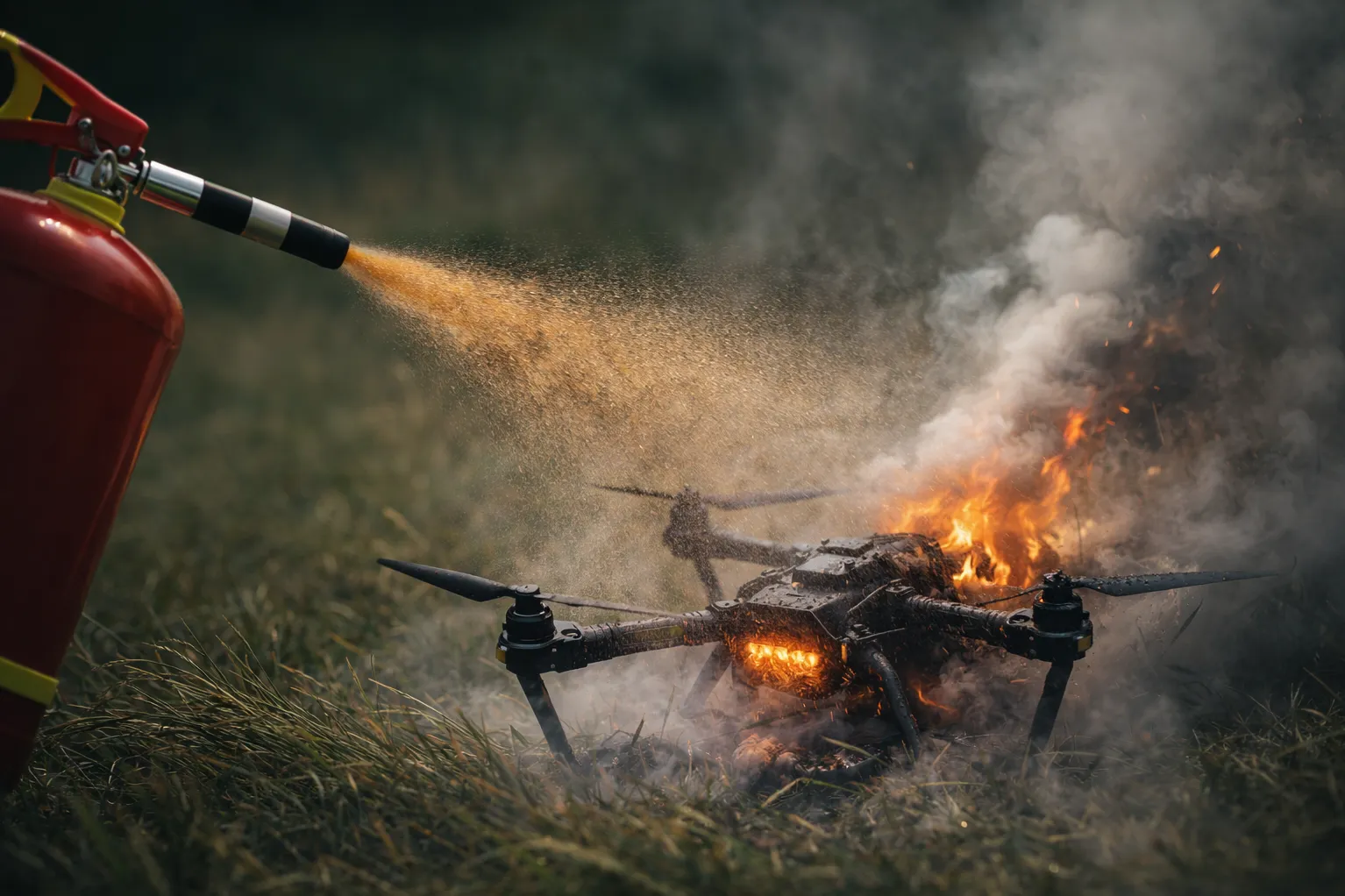
HMS for Drone Fires – Advanced Fire Suppression Technology for Lithium Battery Powered Drones
The rapid expansion of drone technology has transformed industries including logistics, surveillance, agriculture, infrastructure inspection, emergency response, and aerial mapping. Modern drones rely heavily on high-performance Lithium-ion and Lithium Polymer (LiPo) batteries, which provide the power density required for flight operations.
However, these high-energy batteries can also introduce serious fire hazards. Battery defects, physical damage, overcharging, or electrical malfunctions can trigger thermal runaway, leading to intense fires capable of spreading quickly across equipment, facilities, or storage environments.
To address these emerging risks, LIFEGUARD introduces HMS (Hydrated Mica Suspension) — an advanced fire suppression technology specifically engineered to control lithium battery fires in drones and unmanned aerial systems (UAS).
What is HMS for Drone Fire Protection?
HMS (Hydrated Mica Suspension) is an innovative mineral-based fire suppression technology designed to combat fires originating from Lithium-ion and LiPo batteries used in drones.
Unlike conventional extinguishing agents that primarily suppress visible flames, HMS works by addressing the root cause of lithium battery fires — the thermal runaway reaction occurring inside battery cells.
When applied during a drone battery fire incident, HMS forms a heat-resistant mineral barrier that:
- Absorbs extreme heat generated by the battery
- Isolates burning cells from surrounding materials
- Prevents thermal runaway propagation
- Suppresses flames effectively
- Reduces the risk of re-ignition
This specialized mechanism makes HMS for Drone Fires a highly effective fire protection solution for the rapidly growing drone industry.
Fire Risks Associated with Drone Batteries
Drones rely on high-capacity lithium batteries designed for lightweight and high power output. While these batteries provide excellent flight performance, they can pose significant fire risks under certain conditions.
Common causes of drone battery fires include:
- Battery damage from crashes or impact
- Overcharging or faulty charging equipment
- Internal short circuits within battery cells
- Exposure to extreme temperatures
- Improper battery storage or transportation
Once a drone battery enters thermal runaway, it can produce:
- Temperatures exceeding 800–1000°C
- Rapid flame jets
- Flammable gas emissions
- Persistent combustion reactions
- Potential re-ignition even after initial suppression
Because of these unique characteristics, drone battery fires require specialized fire suppression technology.
How HMS Technology Controls Drone Battery Fires
The Hydrated Mica Suspension suppression mechanism operates through multiple layers of fire control designed specifically for lithium battery incidents.
Thermal Insulation Barrier
HMS forms a protective mineral layer around the burning battery, isolating heat and preventing the fire from spreading to nearby drone components or equipment.
Heat Absorption and Cooling
The suspension absorbs significant heat generated during battery failure, helping stabilize the surrounding environment.
Flame Suppression
By covering the burning battery surface, HMS reduces oxygen availability and helps suppress flames rapidly.
Re-Ignition Prevention
Lithium battery fires often have a high probability of re-ignition. HMS forms a durable protective barrier that significantly reduces this risk.
Applications of HMS for Drone Fire Protection
The LIFEGUARD HMS fire suppression technology can protect a wide range of drone-related environments, including:
- Drone manufacturing facilities
- Drone battery charging stations
- Drone maintenance and repair centers
- Logistics drone fleet operations
- Military and defense drone facilities
- Agricultural drone storage areas
- Drone testing and research laboratories
- Drone battery transport and storage facilities
As the drone industry expands globally, these environments increasingly require specialized fire safety systems capable of managing lithium battery hazards.
Advantages of HMS for Drone Fire Protection
The LIFEGUARD HMS technology offers several key benefits for drone battery safety:
- Designed specifically for Lithium-ion and LiPo battery fires
- Helps control thermal runaway reactions
- Excellent heat absorption capability
- Forms a protective insulating mineral barrier
- Helps minimize re-ignition risks
- Suitable for high-energy portable battery systems
- Mineral-based and environmentally responsible formulation
- Supports modern drone safety and risk management strategies
LIFEGUARD HMS – Protecting the Future of Drone Technology
As drones become increasingly integrated into modern industries, ensuring effective fire protection for lithium battery powered systems becomes essential.
LIFEGUARD HMS Fire Suppression Technology provides an advanced solution designed to protect drone equipment, operational facilities, and critical infrastructure from lithium battery fire hazards.
By combining innovative mineral suppression science with practical fire protection engineering, LIFEGUARD contributes to safer drone operations across multiple industries.
Advancing Fire Safety in the Drone Industry
The rapid growth of drone technology has created new fire safety challenges associated with high-performance lithium battery systems.
HMS for Drone Fires represents a next-generation fire protection solution capable of managing these risks while supporting safe and reliable drone operations.
Through continuous innovation and engineering excellence, LIFEGUARD remains committed to advancing fire protection technologies for the evolving lithium battery ecosystem and the future of unmanned aerial systems.
United Fire Equipments Pvt. Ltd. – Manufacturer of ISI Certified Fire Safety Equipment
📞 8048034226
📧 ufe126@gmail.com | info@lifeguardindia.in
🌐 www.lifeguardindia.in
Keywords






