
Hospital Fire Extinguisher System Provider Europe – LIFEGUARD®
Hospitals and healthcare facilities require a highly reliable fire protection strategy because they operate continuously, accommodate patients with limited mobility, contain sensitive medical equipment, and often include oxygen systems, laboratories, electrical installations, commercial kitchens, pharmacies, storage rooms, and critical care areas.
LIFEGUARD® – United Fire Equipments Pvt. Ltd. provides comprehensive fire extinguisher and fire protection solutions for hospitals, healthcare centres, diagnostic facilities, nursing homes, laboratories, medical colleges, and related infrastructure.
As a trusted hospital fire extinguisher system provider Europe, LIFEGUARD® supports healthcare projects with suitable fire extinguisher selection, system planning, technical coordination, equipment supply, and application-specific fire safety solutions.
Our approach is focused on matching the correct type of extinguisher and fire protection solution with the actual risk present in each hospital area.
Comprehensive Hospital Fire Extinguisher System Provider for Europe
Hospitals cannot depend on a single type of fire extinguisher because different departments may involve completely different fire hazards.
A typical hospital may contain:
- Combustible materials
- Electrical equipment
- Sensitive electronic systems
- Medical gases
- Flammable liquids
- Laboratory chemicals
- Cooking oils and fats
- Battery and UPS installations
- Medical equipment
- Server and communication systems
LIFEGUARD® provides a range of fire extinguisher systems suitable for these diverse risk environments.
Our solutions can support:
- Government hospitals
- Private hospitals
- Super-speciality hospitals
- Multi-speciality hospitals
- Medical colleges
- Nursing homes
- Diagnostic centres
- Pathology laboratories
- Blood banks
- Medical research centres
- Rehabilitation centres
- Dental hospitals
- Pharmaceutical facilities
- Healthcare warehouses
- Ambulance facilities
- Medical equipment rooms
- Hospital utility buildings
Importance of Fire Extinguisher Systems in Hospitals
Fire safety in a hospital requires special attention because immediate evacuation may not always be possible.
Patients in intensive care units, operation theatres, recovery rooms, neonatal departments, and general wards may be dependent on medical equipment or assisted evacuation.
For this reason, hospital fire safety should focus on:
- Early detection
- Rapid first response
- Correct extinguisher selection
- Reliable fire protection equipment
- Clearly marked escape routes
- Suitable equipment placement
- Staff awareness
- Regular inspection and maintenance
- Integration with overall building fire safety systems
A properly designed fire extinguisher arrangement can enable trained personnel to respond to a developing fire before it escalates.
Types of Fire Extinguishers for Hospitals
LIFEGUARD® provides multiple categories of portable and wheeled fire extinguishers according to the application.
ABC Dry Powder Fire Extinguishers
ABC dry powder extinguishers are versatile fire extinguishers suitable for several common fire risks.
They can be considered for areas such as:
- Hospital corridors
- General utility areas
- Maintenance rooms
- Store rooms
- Administrative sections
- Parking areas
- Mechanical rooms
- Service areas
Different capacities can be selected according to the intended location and fire risk.
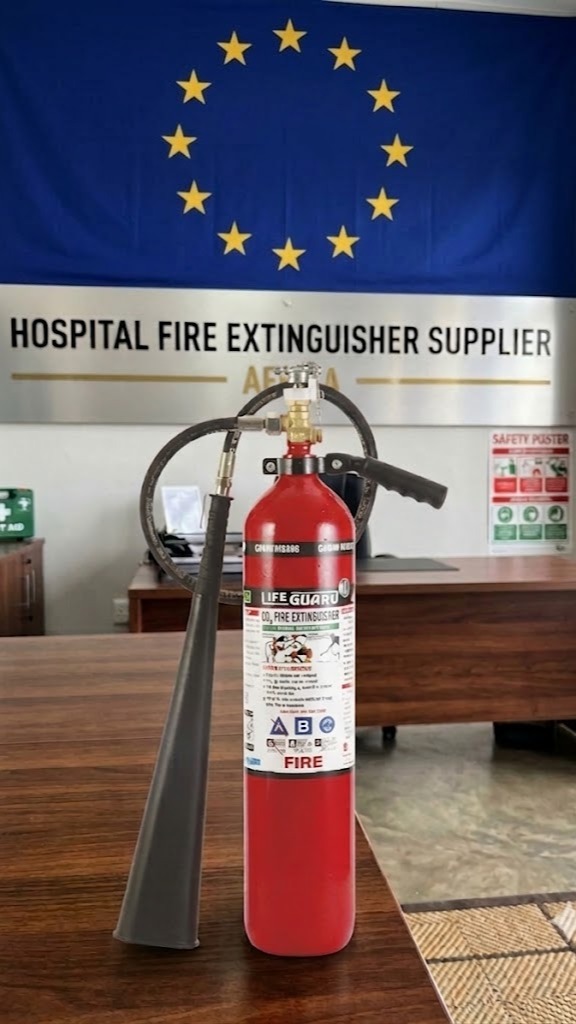
CO₂ Fire Extinguishers
CO₂ extinguishers are widely used for electrical and electronic equipment because the extinguishing medium is non-conductive and does not leave powder residue.
They can be suitable for:
- Electrical panel rooms
- Server rooms
- UPS areas
- Computer rooms
- Control rooms
- Communication centres
- Diagnostic equipment areas
- Medical equipment rooms
- Technical departments
This makes CO₂ extinguishers particularly useful in locations containing expensive electronic equipment.
Clean Agent Fire Extinguishers
Clean agent extinguishers may be preferred where residue from dry powder or other extinguishing media could affect sensitive equipment.
Typical applications include:
- Data rooms
- Server rooms
- Medical equipment rooms
- Laboratories
- Diagnostic areas
- Control rooms
- Communication equipment rooms
Clean agent extinguishers can provide fire protection while helping minimise post-discharge cleanup.
Water-Based Fire Extinguishers
Water-based extinguishers are generally suitable for ordinary combustible materials such as:
- Paper
- Wood
- Fabric
- Furniture
- Certain solid combustible materials
They may be considered for offices, records areas, storage locations, and other suitable hospital spaces where electrical risks have been properly assessed.
Foam Fire Extinguishers
Foam extinguishers can be considered for selected solid combustible and flammable liquid fire risks.
They may be used in certain:
- Service areas
- Maintenance sections
- Utility rooms
- Storage areas
Selection should always be based on the specific hazard.
Wet Chemical Fire Extinguishers
Hospital kitchens and cafeterias may contain large quantities of cooking oil and fat.
Wet chemical extinguishers can be considered for:
- Hospital kitchens
- Canteens
- Cafeterias
- Commercial cooking areas
- Food preparation facilities
These extinguishers are specifically intended for suitable cooking-oil-related fire hazards.
Hospital Department-Wise Fire Extinguisher Planning
A professional hospital fire extinguisher system should consider individual departments separately.
Patient Wards
Hospital wards normally contain beds, mattresses, furniture, electrical medical devices, and combustible materials.
Fire extinguishers should be positioned so that trained staff can access them quickly without restricting corridors or escape routes.
Intensive Care Units
ICUs contain:
- Medical monitors
- Ventilators
- Electrical equipment
- Oxygen systems
- Battery-powered equipment
- Sensitive electronics
The fire protection strategy should therefore consider both patient safety and equipment sensitivity.
Operation Theatres
Operation theatres contain complex medical equipment and may involve electrical, chemical, and medical-gas-related hazards.
Fire extinguisher selection should be coordinated with the hospital's risk assessment and operating procedures.
Diagnostic and Imaging Departments
MRI, CT, X-ray, ultrasound, and other diagnostic facilities may contain sophisticated electronic equipment.
Fire protection in these areas should consider:
- Equipment sensitivity
- Electrical hazards
- Residue control
- Restricted operating environments
Suitable extinguishers should therefore be selected carefully.
Laboratories
Hospital laboratories can contain:
- Flammable liquids
- Chemicals
- Electrical equipment
- Test instruments
- Combustible packaging
Different fire extinguisher types may be required depending on the laboratory activity.
Pharmacy and Medicine Stores
Hospital pharmacies and storage areas may contain:
- Medicines
- Cartons
- Paper packaging
- Plastic containers
- Other combustible materials
Fire extinguisher planning should consider both stored materials and electrical equipment.
Electrical and UPS Rooms
Hospital electrical rooms may contain:
- Electrical distribution boards
- UPS systems
- Battery banks
- Switchgear
- Control panels
CO₂ or other appropriate extinguishing solutions may be selected according to the identified risk and local requirements.
Server and IT Rooms
Hospital IT infrastructure supports:
- Patient records
- Communication
- Medical systems
- Billing
- Monitoring
- Data storage
Sensitive electronic equipment may therefore require residue-conscious extinguishing solutions such as CO₂ or suitable clean agent systems.
Hospital Kitchens
Hospital kitchens present different risks from medical areas.
The fire extinguisher arrangement may need to address:
- Cooking oils
- Fryers
- Electrical appliances
- LPG or other fuel systems
- General combustible materials
Wet chemical and other appropriate extinguishing equipment may therefore form part of the kitchen protection strategy.
Parking and Ambulance Bays
Hospital parking facilities may include:
- Petrol vehicles
- Diesel vehicles
- Electric vehicles
- Ambulances
- Charging infrastructure
Fire extinguisher selection should be based on the specific vehicle and facility risks.
Complete Hospital Fire Extinguisher System Solutions
LIFEGUARD® can support hospital fire safety requirements through a combination of equipment and engineering coordination.
Depending on the project, our offering can include:
- Portable fire extinguishers
- Wheeled fire extinguishers
- Fire extinguisher stands
- Fire extinguisher cabinets
- Fire extinguisher brackets
- Fire detection systems
- Fire alarm equipment
- Clean agent suppression systems
- Specialised fire suppression systems
- Associated fire safety accessories
This enables hospitals and contractors to source multiple fire safety requirements through a coordinated solution provider.
Hospital Fire Extinguisher System Design Considerations
A hospital fire extinguisher arrangement should be developed after considering important project parameters.
These may include:
- Building size
- Number of floors
- Occupancy
- Hospital department layout
- Fire load
- Type of electrical equipment
- Medical equipment locations
- Laboratory risks
- Kitchen facilities
- Storage areas
- Exit routes
- Accessibility
- Applicable fire codes
- Local authority requirements
- Fire classification
- Required extinguisher capacities
- Travel distance
- Equipment maintenance requirements
The objective should be to position suitable firefighting equipment where it can be quickly identified and safely accessed.
Fire Extinguisher Placement in Hospitals
Correct extinguisher placement is just as important as selecting the correct extinguisher type.
Fire extinguishers are typically considered near:
- Exit routes
- Corridors
- Staircases
- Electrical rooms
- Utility areas
- Laboratories
- Kitchens
- Server rooms
- Storage areas
- Maintenance rooms
- Parking facilities
- Technical areas
Final quantity, location, and spacing should always be determined according to applicable fire safety regulations, risk assessments, and project requirements.
Hospital Fire Extinguisher System Provider for European Healthcare Projects
LIFEGUARD® can support healthcare projects, fire protection contractors, importers, distributors, consultants, and institutional buyers serving different European markets.
Potential markets include:
United Kingdom | Germany | France | Italy | Spain | Netherlands | Belgium | Portugal | Poland | Austria | Sweden | Denmark | Finland | Ireland | Greece | Czech Republic | Romania | Hungary | Croatia and other European countries
Product certification, pressure equipment requirements, installation standards, transport rules, and fire safety regulations can differ between European countries. Buyers and project authorities should therefore verify the specific requirements applicable at the destination before procurement and installation.
Why Choose LIFEGUARD® as a Hospital Fire Extinguisher System Provider Europe?
Extensive Fire Safety Experience
LIFEGUARD® is backed by United Fire Equipments Pvt. Ltd., an experienced manufacturer of fire protection equipment for commercial, institutional, industrial, infrastructure, and specialised applications.
Wide Fire Extinguisher Range
We provide a broad selection of portable and wheeled fire extinguishers suitable for various hospital risk categories.
Application-Specific Solutions
Instead of selecting one extinguisher for an entire facility, LIFEGUARD® supports area-wise product selection based on:
- Fire risk
- Equipment sensitivity
- Occupancy
- Hazard type
- Application requirements
OEM Manufacturing Support
LIFEGUARD® can support OEM and project-specific fire extinguisher requirements subject to commercial terms, specifications, required documentation, and order quantity.
Bulk Project Supply
We support requirements from:
- Hospitals
- Healthcare groups
- EPC contractors
- Fire protection companies
- Project consultants
- Facility management companies
- Importers
- Distributors
- Institutional buyers
- Healthcare infrastructure developers
Technical Coordination
Our team can assist with product selection, project documentation, specifications, quantities, and application-related technical coordination.
Export Supply Support
International customers can approach LIFEGUARD® for project-oriented supply and export requirements based on destination, product configuration, and applicable compliance conditions.
Benefits of a Properly Planned Hospital Fire Extinguisher System
A properly planned fire extinguisher strategy can provide several benefits:
- Faster response to incipient fires
- Better protection of hospital assets
- Improved staff preparedness
- Appropriate equipment for different hazards
- Protection of sensitive medical equipment
- Support for emergency response planning
- Better coverage of high-risk locations
- Reduced dependence on a single extinguisher type
- Improved coordination with overall fire safety systems
Fire extinguishers should always be treated as one part of the hospital's complete fire prevention, detection, suppression, evacuation, and emergency management strategy.
Inspection and Maintenance of Hospital Fire Extinguishers
Hospitals should maintain a regular inspection and servicing programme for their fire extinguishers.
Typical checks may include:
- Proper location
- Accessibility
- Pressure condition
- Safety seal
- Hose condition
- Nozzle condition
- Cylinder condition
- Corrosion
- Leakage
- Label visibility
- Service status
- Mounting arrangement
Inspection and maintenance intervals should follow applicable regulations and manufacturer recommendations.
Integrated Hospital Fire Safety Solutions
Large hospitals may require more than portable fire extinguishers.
A complete fire safety strategy can involve:
- Fire detection and alarm
- Portable fire extinguishers
- Automatic suppression
- Clean agent systems
- Emergency communication
- Fire compartmentation
- Evacuation planning
- Fire signage
- Emergency lighting
- Staff training
- Inspection and maintenance
LIFEGUARD® can support selected fire protection requirements as part of a coordinated hospital fire safety approach.
Your Trusted Hospital Fire Extinguisher System Provider Europe
Healthcare facilities require fire safety solutions that are dependable, carefully selected, and suited to individual risk areas.
For customers searching for a hospital fire extinguisher system provider Europe, hospital fire extinguisher supplier Europe, hospital fire extinguisher manufacturer Europe, or hospital fire protection system provider Europe, LIFEGUARD® offers a broad portfolio of fire safety products and project-oriented technical support.
We welcome enquiries from hospitals, contractors, distributors, healthcare infrastructure companies, consultants, and institutional buyers for both new projects and existing facility upgrades.
Contact LIFEGUARD®
United Fire Equipments Pvt. Ltd.
Manufacturer of ISI Certified Fire Safety Equipment
📞 8048034226
📧 ufe126@gmail.com | info@lifeguardindia.in
SEO Meta Title
Hospital Fire Extinguisher System Provider Europe | LIFEGUARD®
SEO Meta Description
Looking for a hospital fire extinguisher system provider in Europe? LIFEGUARD® provides ABC, CO₂, clean agent, water, foam and wet chemical fire extinguisher solutions for hospitals and healthcare facilities.
Suggested SEO Keywords
hospital fire extinguisher system provider Europe, hospital fire extinguisher supplier Europe, hospital fire extinguisher manufacturer Europe, hospital fire protection system provider Europe, healthcare fire extinguisher system Europe, hospital fire safety equipment Europe, medical facility fire protection Europe, hospital CO2 extinguisher Europe, hospital clean agent fire extinguisher Europe, healthcare fire safety system provider Europe
Frequently Asked Questions
What is a hospital fire extinguisher system?
A hospital fire extinguisher system is a planned arrangement of suitable portable or wheeled extinguishers positioned throughout different hospital areas according to their specific fire hazards.
Does LIFEGUARD® provide hospital fire extinguisher systems for European projects?
Yes. LIFEGUARD® supports healthcare project requirements through fire extinguisher supply, product selection, technical coordination, and project-oriented solutions, subject to applicable destination requirements.
Which fire extinguishers are commonly required in hospitals?
Depending on the risks present, hospitals may require ABC dry powder, CO₂, clean agent, water-based, foam, and wet chemical extinguishers.
Which extinguisher is suitable for hospital electrical rooms?
CO₂ and other appropriately selected extinguishing solutions are commonly considered for electrical hazards because they can be suitable for energized electrical equipment and sensitive electronics, subject to the applicable risk assessment.
Can LIFEGUARD® support complete hospital projects?
Yes. LIFEGUARD® can support bulk and project-specific requirements according to hospital layout, extinguisher types, capacities, quantities, specifications, and documentation needs.
Can LIFEGUARD® provide fire protection for hospital server rooms?
Yes. Appropriate CO₂, clean agent, or other suitable fire protection solutions can be considered according to the protected equipment, room risk, and applicable project requirements.
Can fire extinguisher solutions be supplied for hospital kitchens?
Yes. Wet chemical and other suitable extinguisher types can be provided according to the cooking fire hazards and applicable requirements.
Does LIFEGUARD® support OEM and distributor requirements?
Yes. OEM, distributor, institutional, and bulk project enquiries can be considered based on specifications, quantity, certification requirements, and commercial terms.