
Hospital Fire Safety Equipment System Provider Europe – LIFEGUARD® Healthcare Fire Protection Solutions
Hospitals are among the most complex buildings to protect from fire. Unlike conventional commercial facilities, healthcare environments operate continuously and accommodate patients who may be immobile, critically ill, dependent on life-support equipment or unable to evacuate without assistance. At the same time, hospitals contain sophisticated electrical installations, diagnostic equipment, medical gases, pharmaceuticals, laboratories, kitchens, battery backup systems and critical IT infrastructure.
For these reasons, choosing an experienced hospital fire safety equipment system provider in Europe requires more than simply purchasing firefighting products. Hospitals need a coordinated fire safety strategy integrating early detection, alarm, suppression, firefighting equipment, passive protection, emergency response and maintenance.
LIFEGUARD® – United Fire Equipments Pvt. Ltd. provides fire safety equipment and engineered fire protection solutions for hospitals, healthcare institutions, medical facilities and associated infrastructure. As a project-oriented hospital fire safety equipment system provider for Europe, LIFEGUARD® can support customers, consultants, contractors and system integrators with appropriate equipment selection, technical documentation and specialised fire protection solutions based on project requirements.
Our portfolio can support fire protection requirements for patient areas, critical care facilities, electrical and server rooms, diagnostic facilities, laboratories, hospital kitchens, medical storage areas, utility infrastructure and other specialised healthcare environments.
Professional Hospital Fire Safety Equipment System Provider in Europe
Modern hospitals require multiple fire protection technologies working together as an integrated system.
A comprehensive hospital fire protection strategy may include:
- Portable fire extinguishers
- Fire detection and alarm systems
- Smoke and heat detectors
- Multi-criteria detection
- Aspirating smoke detection
- Clean-agent fire suppression
- Automatic sprinkler systems
- Water mist fire suppression
- Fire hydrant systems
- Hose reel systems
- Kitchen fire suppression
- Fire pumps and water storage arrangements
- Emergency warning devices
- Manual call points
- Gas release control panels
- Emergency release and abort switches
- Fire safety signage
- Specialised protection for electrical and battery risks
LIFEGUARD® aims to provide project-specific solutions rather than treating every hospital area as an identical fire hazard.
Why Hospitals Require Specialised Fire Protection Systems
Healthcare facilities present a unique combination of life-safety and property-protection challenges.
Limited Patient Mobility
Patients in intensive care units, operating theatres, recovery rooms and wards may not be able to evacuate independently. Fire safety systems must therefore provide early warning and support an organised response before conditions become critical.
Continuous Occupancy
Hospitals operate 24 hours a day, seven days a week. Fire detection and suppression systems must remain dependable throughout continuous operations.
Critical Medical Equipment
Hospitals contain high-value medical technology such as:
- MRI systems
- CT scanners
- X-ray equipment
- Patient monitoring systems
- Ventilators
- Laboratory instruments
- Surgical equipment
- IT and communication infrastructure
Selecting the correct suppression technology can help minimise secondary damage to sensitive equipment.
Medical Oxygen and Gases
Hospitals routinely use oxygen and other medical gases. Oxygen-enriched environments can increase the intensity of combustion, making ignition control, storage practices, ventilation and emergency procedures extremely important.
Electrical and Electronic Hazards
Hospitals depend on uninterrupted electrical infrastructure, including:
- Main electrical panels
- Distribution boards
- Transformers
- Generator systems
- UPS equipment
- Battery banks
- Data centres
- Communication rooms
Each area requires an appropriate fire-risk assessment.
Multiple Types of Fire Risk
A hospital may contain ordinary combustible materials, electrical risks, cooking oils, chemicals, pharmaceuticals, batteries and specialised medical equipment. A single extinguishing technology cannot address every hazard effectively.
Complete Hospital Fire Safety Equipment Solutions for Europe
1. Portable Fire Extinguishers for Hospitals
Portable fire extinguishers remain an essential first-response component of hospital fire protection.
Depending on the hazard and project specification, fire extinguisher options may include:
- ABC dry chemical powder extinguishers
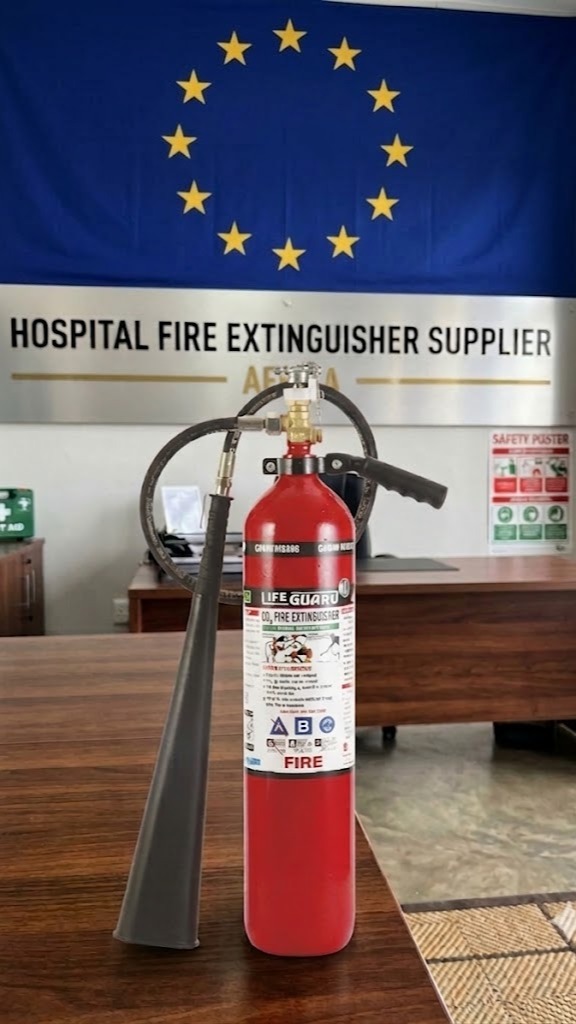
- Carbon dioxide fire extinguishers
- Water-based extinguishers
- Foam extinguishers
- Clean-agent extinguishers
- Wet chemical fire extinguishers
- Wheeled and trolley-mounted extinguishers
The correct extinguisher should be selected according to the expected fire class, location, electrical risk and applicable regulatory requirements.
For projects requiring European-standard equipment, portable fire extinguishers may need to satisfy relevant EN 3 series requirements, subject to the individual product specification, certification and destination-country regulations.
2. Hospital Fire Detection and Alarm Systems
Early detection is particularly important in hospitals because evacuation can be slower than in most other buildings.
A hospital fire alarm system can incorporate:
- Addressable fire alarm panels
- Conventional fire alarm panels
- Smoke detectors
- Heat detectors
- Multi-criteria detectors
- Manual call points
- Sounders
- Visual alarm devices
- Hooter-cum-flashers
- Repeater panels
- Input/output modules
- Monitoring interfaces
- Power supply units
- Emergency notification devices
European projects may specify components designed and tested according to applicable parts of the EN 54 series for fire detection and alarm systems.
System design should also consider the requirements of the individual hospital, local authority requirements and country-specific fire regulations.
3. Aspirating Smoke Detection for Critical Healthcare Areas
Conventional smoke detection may not always provide the earliest possible warning required for highly sensitive or mission-critical hospital spaces.
Aspirating smoke detection continuously draws air samples through a pipe network and analyses them for signs of smoke.
Applications may include:
- Hospital data centres
- Server rooms
- Communication rooms
- Electrical control rooms
- Critical equipment rooms
- Medical IT infrastructure
- Archive and record storage areas
- Selected diagnostic equipment environments
Very early smoke detection can allow hospital personnel to investigate abnormal conditions before a developing incident becomes a major fire.
4. Clean Agent Fire Suppression Systems
Hospitals contain many areas where water, foam or powder discharge could damage expensive electronic equipment or disrupt healthcare operations.
Clean-agent fire suppression may be suitable for selected enclosed risks such as:
- Hospital server rooms
- Data centres
- Electrical control rooms
- UPS rooms
- Communication rooms
- Medical records rooms
- Control centres
- Sensitive electronic equipment areas
Depending on the project requirements, technologies such as FK-5-1-12 or other approved gaseous fire extinguishing agents may be considered.
A complete clean-agent suppression system may incorporate:
- Agent storage cylinders
- Cylinder valves
- Discharge piping
- Engineered nozzles
- Pressure monitoring
- Detection devices
- Gas release control panel
- Manual release station
- Abort switch
- Audible and visual warning devices
- System interface modules
For European applications, gaseous suppression systems may be specified according to relevant EN 15004 requirements, applicable national regulations and the specific agent/system approval.
5. Automatic Sprinkler Systems for Hospitals
Automatic sprinkler systems can help control or suppress a developing fire before it spreads to additional areas of the healthcare facility.
Potential applications include:
- Storage rooms
- Basements
- Administrative areas
- Hospital warehouses
- General building areas
- Parking facilities
- Utility areas
- Service buildings
- Selected clinical support spaces
European sprinkler projects may refer to EN 12845, which addresses the design, installation and maintenance of automatic sprinkler systems.
Sprinkler engineering must consider:
- Hazard classification
- Available water supply
- Pump capacity
- Pipe sizing
- Sprinkler spacing
- Building configuration
- Water storage
- System testing
- Maintenance requirements
6. Water Mist Fire Suppression Systems
Water mist systems generate fine water droplets using specially engineered nozzles.
Depending on system design and tested application, water mist can contribute to fire control through cooling, radiant heat reduction and interaction with the fire environment while using comparatively small quantities of water.
Potential hospital applications may include selected:
- Machinery spaces
- Generator areas
- Utility rooms
- Technical installations
- Specialised equipment areas
European water mist projects may reference applicable parts of the EN 14972 series, depending on the specific application and approved fire-test protocol.
Water mist should always be selected and engineered according to the actual hazard and system approval.
7. Hospital Fire Hydrant Systems
Large hospital campuses and healthcare complexes may require comprehensive water-based firefighting infrastructure.
A hydrant installation can include:
- Landing valves
- Hydrant valves
- Fire hoses
- Hose boxes
- Branch pipes
- Nozzles
- Fire brigade connections
- Associated piping
- Fire pumps
- Water storage tanks
Hydrant arrangements allow trained firefighting personnel and responding fire services to access a dependable water supply during an emergency.
System design should be based on applicable local regulations, fire authority requirements and building characteristics.
8. Fire Hose Reel Systems
Fire hose reels can provide a continuous water supply for suitable ordinary combustible fires.
They can be installed at strategically accessible locations such as:
- Hospital corridors
- Staircases
- Building entrances
- Service areas
- Utility corridors
- Administrative zones
Clear visibility, correct signage and unobstructed access are essential for emergency use.
9. Hospital Kitchen Fire Suppression Systems
Hospital kitchens can create significant fire hazards because commercial cooking equipment often operates for extended periods.
Common hazards include:
- Cooking oils
- Deep-fat fryers
- Hot surfaces
- Grease accumulation
- Electrical cooking appliances
- Exhaust hoods
- Extraction ducts
A kitchen fire suppression arrangement may provide protection for:
- Fryers
- Cooking ranges
- Hoods
- Plenums
- Extraction ducts
- Cooking appliances
Wet chemical suppression is commonly selected for cooking-oil and fat hazards because it can help extinguish the fire and reduce the possibility of re-ignition.
10. Fire Protection for Hospital Electrical Rooms
Hospitals depend heavily on electrical equipment and uninterrupted power.
Important electrical fire-risk areas include:
- Main LV panels
- Distribution boards
- Transformer areas
- Generator rooms
- UPS rooms
- Inverter rooms
- Electrical control rooms
- Switchgear rooms
Depending on the hazard, protection may involve:
- Smoke detection
- Heat detection
- Portable CO₂ extinguishers
- Clean-agent suppression
- Aspirating detection
- Emergency isolation arrangements
- Alarm monitoring
The extinguishing medium should be chosen carefully to protect both people and critical electrical infrastructure.
Hospital Fire Safety for Battery and UPS Installations
Healthcare facilities increasingly depend on batteries for emergency and uninterrupted power systems.
Different battery chemistries can create different fire and thermal risks.
A battery or UPS room risk assessment may consider:
- Battery chemistry
- Battery capacity
- Charging arrangements
- Ventilation
- Temperature
- Electrical isolation
- Smoke generation
- Potential thermal runaway
- Gas generation
- Fire propagation between battery modules
Protection strategies may incorporate suitable detection, ventilation, temperature monitoring and specialised suppression systems where required.
Lithium-ion battery installations require particular consideration because a thermal runaway event may behave differently from a conventional electrical fire.
Hospital Fire Safety for Medical Oxygen Areas
Medical oxygen is widely used throughout modern hospitals. While oxygen itself is not combustible, elevated oxygen concentrations can make other materials burn more rapidly and intensely.
Hospital oxygen safety should therefore consider:
- Secure cylinder storage
- Ventilation
- Elimination of ignition sources
- Proper separation
- Cylinder handling practices
- Clearly displayed warning signage
- Medical gas piping integrity
- Emergency shut-off arrangements
- Staff training
- Routine inspection
Fire protection systems must be coordinated with the healthcare facility's medical gas safety programme.
Fire Safety for Hospital Intensive Care Units
Intensive Care Units require particularly careful fire safety planning because patients may be critically ill and connected to medical equipment.
Important ICU fire safety considerations include:
- Reliable early smoke detection
- Alarm notification
- Fire compartmentation
- Safe electrical systems
- Medical oxygen controls
- Accessible portable extinguishers
- Staff emergency training
- Horizontal evacuation arrangements
- Clear escape routes
The emphasis should be on preventing fire growth and enabling hospital staff to respond before patient evacuation becomes necessary.
Fire Safety for Operating Theatres
Operating theatres contain sensitive electrical and medical systems and may involve oxygen-rich conditions.
Risk assessment should consider:
- Medical gas installations
- Electrical equipment
- Surgical devices
- Combustible materials
- Equipment power supplies
- Emergency shutdown procedures
- Detection arrangements
- Compartmentation
Protection should be selected according to the theatre's actual configuration and applicable healthcare requirements.
Fire Safety for MRI, CT and Diagnostic Areas
Diagnostic facilities can contain extremely high-value and specialised medical equipment.
Fire protection strategies should minimise the possibility of unnecessary secondary damage while ensuring reliable detection and suppression.
Areas can include:
- MRI suites
- CT scan rooms
- X-ray rooms
- Cath labs
- Diagnostic laboratories
- Imaging control rooms
The selected equipment must also account for special environmental limitations associated with medical technology.
Hospital Laboratory Fire Protection
Medical and research laboratories may contain:
- Flammable liquids
- Chemicals
- Electrical appliances
- Compressed gases
- Biological materials
- Combustible packaging
A laboratory fire risk assessment should identify the exact materials and processes involved before determining the correct detector, extinguisher or fixed suppression solution.
Pharmacy and Pharmaceutical Storage Fire Safety
Hospital pharmacies and medicine stores may contain significant quantities of packaging materials and pharmaceutical stock.
Protection measures can include:
- Automatic smoke detection
- Suitable portable extinguishers
- Sprinkler protection where required
- Compartmentation
- Controlled storage practices
- Emergency signage
- Regular housekeeping
Special storage requirements should be evaluated for flammable or temperature-sensitive materials.
Hospital Server Room and Data Centre Fire Suppression
Healthcare IT systems support:
- Electronic patient records
- Diagnostic information
- Medical imaging
- Communication
- Patient monitoring
- Hospital management software
- Building management systems
Fire damage in a hospital data centre can therefore affect the entire healthcare operation.
A comprehensive server-room solution may combine:
Early Detection + Alarm Verification + Automatic Suppression + Emergency Warning + System Monitoring
Clean-agent systems are often considered for these areas because they can suppress fire without leaving powder or water residue.
Integrated Hospital Fire Safety System Architecture
Hospital fire safety should be treated as an integrated process rather than a collection of independent products.
A typical system philosophy can follow:
Fire Detection → Alarm → Verification → Notification → Suppression → Evacuation/Containment → Emergency Response
Depending on the project, different systems may communicate through:
- Fire alarm control panels
- Building management systems
- Gas release control panels
- Monitoring modules
- Emergency interfaces
- Fire pump controls
- Smoke control systems
- Access control interfaces
- Lift interfaces
- HVAC shutdown systems
Correct cause-and-effect programming helps ensure that different systems respond appropriately during an emergency.
Fire Compartmentation and Hospital Life Safety
Fire safety equipment alone cannot provide complete protection.
Passive fire protection helps restrict the spread of smoke and flames and can provide hospital staff with additional time to relocate patients.
Important measures include:
- Fire-rated doors
- Fire-resistant walls
- Smoke barriers
- Protected shafts
- Fire stopping around cable penetrations
- Compartmentation
- Protected escape routes
- Fire-resistant service penetrations
In hospitals, horizontal movement into an adjacent protected compartment can be an important component of evacuation strategy.
Hospital Fire Evacuation Planning
Hospital evacuation presents special challenges because patients may be:
- Bedridden
- Disabled
- Under sedation
- Connected to life-support equipment
- Receiving oxygen
- In surgery
- Located in critical care areas
Emergency planning may therefore consider:
- Progressive horizontal evacuation
- Stretcher evacuation
- Wheelchair evacuation
- Protected refuge zones
- Emergency communication
- Staff responsibilities
- Safe patient transfer
- Emergency-service coordination
Fire safety system design should support the overall hospital emergency response plan.
Emergency Signage for Hospitals
Clear signage enables hospital staff, visitors and emergency responders to identify critical fire protection equipment quickly.
Typical signage can identify:
- Fire extinguishers
- Hose reels
- Hydrant points
- Manual call points
- Fire exits
- Emergency staircases
- Assembly points
- Medical gas areas
- Restricted zones
- Emergency shutdown points
Signs should remain visible and unobstructed throughout the facility.
Hospital Fire Safety Training
Equipment is only one element of emergency preparedness.
Hospital personnel should understand how to react if a fire is detected.
Training may include:
- Raising the alarm
- Fire extinguisher awareness
- Patient evacuation procedures
- Medical gas emergency procedures
- Fire door awareness
- Emergency communication
- Electrical isolation
- Location of firefighting equipment
- Responsibilities during evacuation
Periodic drills can help hospitals assess readiness and identify areas for improvement.
Preventive Maintenance of Hospital Fire Safety Systems
Reliable fire protection depends on regular inspection and maintenance.
A preventive maintenance programme may include:
- Extinguisher inspection
- Cylinder pressure verification
- Detector testing
- Fire alarm panel testing
- Manual call point testing
- Sounder testing
- Visual alarm testing
- Fire pump testing
- Hose reel inspection
- Hydrant inspection
- Suppression cylinder inspection
- Discharge piping inspection
- Nozzle inspection
- Release panel testing
- Abort switch testing
- Fire door inspection
- Emergency signage inspection
Maintenance frequency should comply with the applicable equipment instructions, system specification and local regulations.
European Fire Safety Standards and Project Compliance
Hospital fire protection requirements differ across European countries. Projects can therefore require combinations of European standards, national regulations, building rules, fire authority requirements and consultant specifications.
Depending on the system and project, commonly referenced European standards can include:
- EN 54 series – fire detection and fire alarm system components
- EN 3 series – portable fire extinguishers
- EN 12845 – automatic sprinkler systems
- EN 15004 series – gaseous fire extinguishing systems
- EN 14972 series – water mist systems
The exact standard, edition, certification and approval requirements must be established for each project and destination country.
LIFEGUARD® does not assume that a product approved in one jurisdiction is automatically acceptable throughout Europe. Product and system compliance should be verified against the customer's technical specification and local regulatory requirements before supply.
Hospital Fire Safety Solutions for European Markets
LIFEGUARD® can support eligible healthcare fire protection enquiries for European projects, including requirements associated with markets such as:
- Germany
- France
- Italy
- Spain
- Portugal
- Netherlands
- Belgium
- Poland
- Austria
- Switzerland
- Czech Republic
- Romania
- Hungary
- Greece
- Denmark
- Sweden
- Norway
- Finland
- Ireland
- United Kingdom
- Other European markets
Because individual countries can impose different regulatory and approval requirements, equipment selection should always be verified for the specific destination.
Fire Safety Solutions for New Hospital Projects
For newly constructed hospitals, early coordination of fire protection systems with architectural, MEP and healthcare infrastructure design can improve system integration.
Project support may include:
- Equipment selection
- Technical specification review
- System layout inputs
- Suppression design
- Pipe and nozzle arrangements
- Equipment schedules
- Bill of quantities
- Technical data sheets
- Product documentation
- Commercial proposals
Early planning can also reduce clashes between fire protection infrastructure and other building services.
Fire Safety Upgrades for Existing European Hospitals
Existing hospitals may require system modification because of:
- Expansion
- New clinical departments
- Equipment upgrades
- Updated risk assessments
- Ageing fire alarm infrastructure
- Change in occupancy
- New server rooms
- New UPS or battery installations
- Regulatory requirements
Fire safety upgrades can involve replacement or extension of detectors, alarm panels, suppression systems, extinguishers, sprinklers and firefighting equipment.
Hospital Fire Safety System Provider for EPC Contractors
LIFEGUARD® can work with:
- EPC contractors
- MEP contractors
- Fire protection contractors
- Healthcare consultants
- Architects
- System integrators
- Facility management companies
- Procurement organisations
- Project management consultants
Support may include:
- Technical submittals
- Product data sheets
- Equipment schedules
- Compliance documentation
- Commercial quotations
- BOQ support
- Suppression design inputs
- Project-specific equipment selection
Hospital Fire Protection Support for Consultants
Healthcare consultants often require detailed technical information before approving equipment.
LIFEGUARD® can support suitable projects with documentation such as:
- Technical specifications
- Product catalogues
- Drawings
- Data sheets
- Material details
- System descriptions
- Compliance information
- Inspection documents
- Test documentation where applicable
The exact documentation package depends on the product and contractual requirements.
Hospital Fire Safety Equipment for Institutional Procurement
Large healthcare organisations frequently procure fire safety systems through structured procurement processes.
Requirements may include:
- Technical specifications
- Compliance statements
- Manufacturer information
- Product literature
- Inspection requirements
- Test certificates
- Country-of-origin documentation
- Commercial offers
- Packaging information
- Export documentation
LIFEGUARD® can support eligible international procurement enquiries with project-specific technical and commercial submissions.
OEM Hospital Fire Safety Equipment Solutions
LIFEGUARD® is associated with manufacturing and supplying fire safety products under the LIFEGUARD® brand.
Our OEM capability can assist customers requiring selected firefighting equipment together with technical documentation, project packaging and export support.
Any claim regarding EN approval, CE marking, third-party certification or other European conformity requirements should be based on the certification status of the specific product offered for the project.
Why Choose LIFEGUARD® as a Hospital Fire Safety Equipment System Provider for Europe?
Comprehensive Fire Protection Portfolio
Multiple categories of hospital fire safety equipment can be coordinated through a single project-oriented organisation.
Engineering-Oriented Approach
Fire protection solutions can be selected based on the hazard rather than using a one-product-fits-all approach.
Critical-Area Protection
Specialised solutions can be developed for:
- Server rooms
- Electrical rooms
- UPS areas
- Battery installations
- Laboratories
- Medical equipment rooms
- Kitchens
- Utility spaces
Technical Documentation Support
Project teams can receive appropriate supporting documents according to the scope and product availability.
Export Project Capability
LIFEGUARD® can evaluate suitable international healthcare projects and prepare technical and commercial proposals based on destination requirements.
Customised Project Support
Hospitals vary significantly in size, clinical use and infrastructure. Solutions can therefore be configured according to project-specific requirements.
Applications of LIFEGUARD® Hospital Fire Safety Solutions
Our fire protection equipment and solutions can be considered for:
- General hospitals
- Multispeciality hospitals
- University hospitals
- Government hospitals
- Private hospitals
- Medical colleges
- Cancer hospitals
- Children's hospitals
- Maternity hospitals
- Rehabilitation hospitals
- Trauma centres
- Emergency care facilities
- Diagnostic centres
- Pathology laboratories
- Blood banks
- Medical research facilities
- Pharmaceutical departments
- Hospital data centres
- Hospital utility buildings
- Healthcare campuses
Building a Safer Healthcare Environment
Effective hospital fire safety depends on several layers of protection working together.
A robust approach includes:
Prevention + Detection + Alarm + Containment + Suppression + Evacuation + Maintenance + Training
When correctly coordinated, these layers can help:
- Detect developing fires earlier
- Alert hospital personnel
- Protect patients and visitors
- Reduce smoke and fire spread
- Protect valuable medical equipment
- Limit business interruption
- Support continuity of healthcare services
- Assist emergency responders
- Reduce property damage
LIFEGUARD® – Hospital Fire Safety Equipment System Provider Europe
Hospitals cannot treat fire safety simply as an equipment-purchasing exercise. Protecting healthcare facilities requires an integrated strategy considering patients, staff, medical technology, infrastructure, building configuration and emergency procedures.
LIFEGUARD® – United Fire Equipments Pvt. Ltd. provides firefighting equipment, fire detection systems and specialised suppression solutions for healthcare projects.
Whether the requirement is for a new hospital, healthcare campus, hospital expansion, fire system upgrade, electrical-room protection, server-room suppression or specialised medical facility, LIFEGUARD® can support suitable international projects with technical and commercial solutions according to the specified requirements.
For European hospital projects, product selection, system design and regulatory compliance should always be reviewed against the specific destination-country requirements and applicable approvals.
Frequently Asked Questions – Hospital Fire Safety Equipment System Provider Europe
What fire safety equipment is required in a hospital?
The requirement depends on hospital size, building design, occupancy and local regulations. Systems can include fire alarms, smoke detectors, extinguishers, sprinklers, hydrants, hose reels, clean-agent suppression and specialised protection for kitchens, electrical rooms and critical infrastructure.
Which fire suppression system is suitable for hospital server rooms?
Clean-agent fire suppression is often considered for server and IT rooms because appropriately designed systems can suppress fire without leaving powder or water residue. Final system selection must follow the hazard, room conditions and applicable approval requirements.
Are fire extinguishers sufficient for hospital fire protection?
No. Portable fire extinguishers provide first-response protection but should form part of a wider strategy incorporating early detection, alarm, compartmentation, fixed firefighting systems and emergency procedures.
Why is early smoke detection important in hospitals?
Early detection provides additional response time, which is particularly valuable when patients cannot evacuate independently.
Do hospitals require special fire protection for oxygen?
Yes. Oxygen can significantly increase combustion intensity. Medical oxygen areas require appropriate storage, ventilation, ignition-source control, signage and emergency procedures.
Can LIFEGUARD® provide fire protection systems for European hospital projects?
LIFEGUARD® can evaluate suitable European healthcare project enquiries and provide equipment, technical information and system solutions based on project specifications. Specific European or national approval requirements must be verified for each product and destination.
What European standards are commonly considered for hospital fire protection?
Depending on the scope, projects may refer to EN 54 for fire detection and alarm components, EN 3 for portable extinguishers, EN 12845 for sprinkler systems, EN 15004 for gaseous suppression and EN 14972 for water mist systems, along with applicable national requirements.
SEO Keyword Strategy
Primary Keyword:
Hospital Fire Safety Equipment System Provider Europe
Secondary Keywords:
- hospital fire safety system provider Europe
- hospital fire protection system provider Europe
- hospital firefighting system provider Europe
- healthcare fire safety equipment Europe
- hospital fire suppression system Europe
- hospital fire alarm system provider Europe
- hospital fire extinguisher system Europe
- healthcare fire protection solutions Europe
- hospital clean agent suppression system Europe
- hospital sprinkler system provider Europe
- hospital water mist system Europe
- medical facility fire protection Europe
- hospital server room fire suppression Europe
- healthcare fire detection system Europe
- hospital fire protection equipment company Europe
- hospital fire safety solutions Europe
- healthcare fire suppression company Europe
- hospital fire protection OEM Europe
- hospital firefighting equipment provider Europe
- integrated hospital fire protection system Europe
Suggested SEO Meta Title
Hospital Fire Safety Equipment System Provider Europe | LIFEGUARD®
Suggested Meta Description
LIFEGUARD® provides hospital fire safety equipment and integrated fire protection systems for European healthcare projects, including fire detection, extinguishers, clean-agent suppression, sprinklers, water mist and specialised hospital fire safety solutions.
Suggested URL Slug
/hospital-fire-safety-equipment-system-provider-europe/
Suggested H1
Hospital Fire Safety Equipment System Provider Europe
Suggested Image Alt Text
Hospital fire safety equipment system provider Europe – LIFEGUARD® healthcare fire protection solutions
Contact LIFEGUARD®
LIFEGUARD® – United Fire Equipments Pvt. Ltd.
Manufacturer of ISI Certified Fire Safety Equipment
For enquiries related to hospital fire safety equipment, fire detection systems, clean-agent suppression, water mist, firefighting equipment and integrated healthcare fire protection solutions for European projects, contact LIFEGUARD® for technical and commercial assistance.