


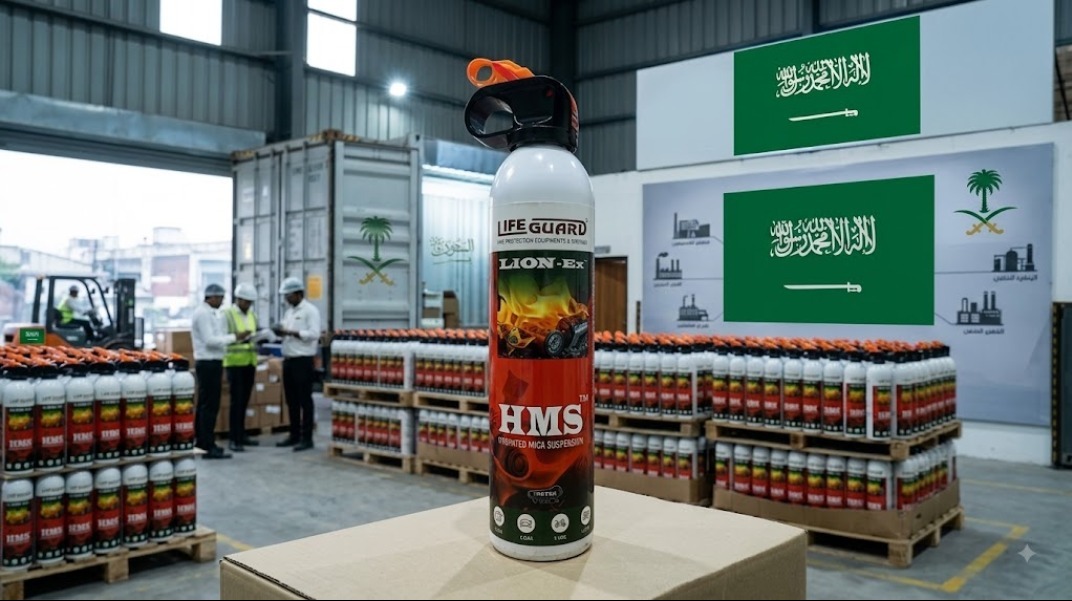
Lithium Battery Battery Cooling System Exporter Saudi Arabia
Advanced Lithium Battery Cooling & Thermal Management Solutions for Saudi Arabia
The rapid adoption of lithium-ion battery technology across electric mobility, Battery Energy Storage Systems (BESS), renewable energy, UPS systems, telecom infrastructure, industrial equipment, data centers, and backup-power applications has increased the importance of effective battery thermal management.
Lithium-ion batteries generate heat during charging, discharging, fast charging, high-current operation, and repeated cycling. In hot climates, ambient conditions can add to the thermal load, making appropriate temperature management an important consideration for battery-system design.
LIFEGUARD® – United Fire Equipments Pvt. Ltd. provides battery thermal-management and battery-safety solutions for modern lithium battery applications.
As a lithium battery cooling system exporter to Saudi Arabia, LIFEGUARD® can support suitable cooling and thermal-management requirements for domestic and international battery projects, subject to application-specific engineering, product specifications, logistics, and destination requirements.
What Is a Lithium Battery Cooling System?
A lithium battery cooling system is a thermal-management solution designed to remove excess heat from lithium-ion battery cells, modules, packs, racks, or cabinets.
Heat may be generated through:
- Charging
- Discharging
- Fast charging
- High-current operation
- Internal electrical resistance
- Repeated charge-discharge cycles
- High ambient temperatures
- Battery aging
- Electrochemical processes
An appropriately designed cooling system transfers excess thermal energy away from the battery and helps maintain suitable operating conditions.
For high-energy battery systems, thermal management can also help control temperature differences between cells and modules.
Why Lithium Battery Cooling Is Important in Saudi Arabia
Saudi Arabia presents demanding environmental conditions for many outdoor and industrial battery installations. High ambient temperatures can increase the cooling load of battery systems and associated equipment.
Appropriate thermal management can help address:
- Excessive battery temperatures
- Heat accumulation inside enclosures
- Temperature variations between battery modules
- Charging-related heat
- High-load operating conditions
- Thermal stress
- Battery degradation
Cooling requirements should be determined using actual site conditions, battery specifications, enclosure design, operating profile, and expected heat generation.
LIFEGUARD® – Lithium Battery Cooling System Exporter to Saudi Arabia
LIFEGUARD® – United Fire Equipments Pvt. Ltd. provides fire-safety and battery-protection solutions for modern lithium-ion battery applications.
Battery thermal-management solutions can be considered for:
- Lithium-ion battery packs
- EV battery systems
- Battery modules
- Battery cabinets
- Battery racks
- BESS containers
- Solar energy storage
- UPS battery systems
- Telecom batteries
- Industrial battery systems
- Battery testing facilities
- Battery manufacturing applications
The final cooling-system configuration should be established through application-specific engineering and according to the battery manufacturer's technical requirements.
Battery Thermal Management System for Saudi Arabian Projects
A Battery Thermal Management System (BTMS) is designed to control battery temperature during different operating conditions.
These can include:
- Charging
- Discharging
- Fast charging
- High-power operation
- Standby
- Repeated cycling
A simplified process is:
Heat Generation → Heat Transfer → Heat Removal → Temperature Monitoring → Thermal Control
Depending on the application, a BTMS may include:
- Temperature sensors
- Cooling plates
- Fans
- Blowers
- Pumps
- Coolant circuits
- Heat exchangers
- Thermal interface materials
- HVAC systems
- Control valves
- Thermal controllers
- BMS communication interfaces
The appropriate system depends on battery chemistry, thermal load, energy capacity, enclosure configuration, operating conditions, and environmental requirements.
Types of Lithium Battery Cooling Systems
1. Air-Cooled Lithium Battery System
Air cooling uses natural or forced airflow to remove heat from battery cells and modules.
A forced-air system may incorporate:
- Fans
- Blowers
- Air channels
- Ducting
- Temperature sensors
- Control equipment
Air cooling may be suitable for selected battery applications where the thermal load is within the capabilities of the cooling arrangement.
Benefits
- Simple configuration
- No liquid coolant circuit
- Relatively straightforward maintenance
- Lower mechanical complexity
- Suitable for selected battery applications
2. Liquid-Cooled Lithium Battery System
Liquid cooling transfers heat away from battery cells or modules using a circulating coolant.
A liquid-cooled system may include:
- Cooling plates
- Pumps
- Coolant piping
- Heat exchangers
- Temperature sensors
- Control valves
- Expansion components
- Thermal controllers
Liquid cooling can provide efficient heat transfer and is commonly considered for high-power and high-energy-density battery systems.
3. Lithium Battery Cooling Plates
Cooling plates provide a thermal path between battery cells or modules and the cooling circuit.
Coolant flows through internal channels in the plate, transferring heat away from the battery.
Cooling plates can be considered for:
- EV battery packs
- Battery modules
- BESS racks
- High-power battery systems
- Industrial energy-storage systems
Proper thermal contact, coolant flow, and temperature uniformity are important design considerations.
4. HVAC-Based Battery Cooling System
Battery rooms, battery cabinets, and BESS containers may use HVAC equipment as part of their thermal-management strategy.
HVAC-based battery cooling can help manage:
- Ambient temperature
- Battery enclosure temperature
- Air circulation
- Heat accumulation
- Environmental conditions
For Saudi Arabian installations, HVAC capacity should account for battery-generated heat as well as external environmental and solar heat loads where applicable.
5. Hybrid Lithium Battery Cooling System
Some battery installations may benefit from combining multiple thermal-management technologies.
A hybrid approach may combine:
Air Cooling + Liquid Cooling + Temperature Monitoring
This can be considered where thermal loads vary or different areas of a battery installation require different cooling arrangements.
EV Battery Cooling System Exporter Saudi Arabia
Electric mobility is creating increasing demand for efficient battery thermal management.
EV battery packs can generate heat during:
- Fast charging
- High-power acceleration
- High-speed operation
- Regenerative braking
- Repeated cycling
- High-temperature operation
An appropriately engineered cooling system can help manage battery temperature and thermal uniformity.
LIFEGUARD® solutions can be considered for:
- Electric cars
- Electric buses
- Electric commercial vehicles
- Electric two-wheelers
- EV battery packs
- EV battery testing
- EV charging infrastructure
- Battery service facilities
BESS Cooling System Exporter Saudi Arabia
Battery Energy Storage Systems (BESS) are increasingly important for energy-storage and renewable-energy applications.
BESS installations can contain multiple battery modules, racks, and enclosures. Thermal management is therefore an important part of system design.
A BESS cooling strategy may incorporate:
- Air cooling
- Liquid cooling
- HVAC systems
- Cooling plates
- Temperature sensors
- Thermal monitoring
- BMS integration
Cooling requirements should be determined according to:
- Battery chemistry
- Energy capacity
- Heat generation
- Charge/discharge profile
- Rack configuration
- Container configuration
- Ambient conditions
- Required operating temperature
- Battery manufacturer's specifications
Lithium Battery Cooling for Solar Energy Storage
Saudi Arabia has substantial solar-energy potential, making battery energy storage an important consideration for renewable-energy projects.
Solar battery systems may experience repeated:
Charging → Storage → Discharging → Recharging
cycles.
Thermal management can help maintain suitable battery operating conditions throughout these cycles.
LIFEGUARD® solutions can be considered for:
- Solar BESS
- Commercial energy storage
- Industrial energy storage
- Renewable-energy projects
- Microgrids
- Backup-power systems
- Energy-storage facilities
Lithium Battery Cooling for Data Centers in Saudi Arabia
Data centers require dependable backup power to support critical IT infrastructure.
Lithium-ion UPS battery systems can provide high energy density, but thermal management remains an important design consideration.
Battery cooling can be considered for:
- UPS battery rooms
- Lithium battery cabinets
- Data-center energy-storage systems
- Critical power systems
- Backup-power installations
Battery thermal management should be coordinated with the facility's overall HVAC and environmental-control strategy.
Lithium Battery Cooling for Telecom Infrastructure
Telecommunication facilities depend on reliable backup power to maintain network availability.
Battery thermal management can be considered for:
- Telecom battery rooms
- Outdoor battery cabinets
- Communication centers
- Network facilities
- Remote telecom sites
- Backup-power systems
Outdoor Saudi Arabian installations should consider ambient temperature, solar exposure, enclosure design, ventilation, heat dissipation, and environmental protection.
Lithium Battery Cooling for Industrial Applications
Lithium-ion batteries are increasingly used in industrial applications such as:
- Automated Guided Vehicles
- Electric forklifts
- Robotics
- Industrial vehicles
- Material-handling equipment
- Backup power
- Renewable-energy storage
- Automated industrial systems
High-current operation and repeated cycling can increase heat generation, making thermal management an important design consideration.
Battery Cooling for Battery Manufacturing & Testing
Battery manufacturing and testing facilities may require controlled thermal conditions for:
- Cell testing
- Module testing
- Battery-pack testing
- Charge-discharge testing
- Performance testing
- Battery validation
- Research and development
- Battery assembly
Testing requirements can vary depending on battery chemistry, test protocol, equipment, and required temperature accuracy.
Key Components of a Lithium Battery Cooling System
Temperature Sensors
Temperature sensors monitor battery temperature and provide information to the thermal-control system.
Cooling Plates
Cooling plates provide a thermal path between battery cells or modules and the cooling circuit.
Pumps
Liquid-cooled systems use pumps to circulate coolant.
Heat Exchangers
Heat exchangers transfer thermal energy from the battery coolant to another cooling medium.
Fans & Blowers
Air-cooled systems use fans or blowers to circulate air through battery modules or enclosures.
Coolant Circuit
Liquid cooling requires suitable coolant, piping, pumps, valves, and heat-transfer components.
Thermal Interface Materials
Thermal interface materials can improve heat transfer between battery surfaces and cooling components.
Control System
A thermal controller can regulate fans, pumps, valves, or other cooling equipment according to temperature and operating conditions.
BMS Integration
Where appropriate, the thermal-management system can communicate with the Battery Management System to coordinate cooling with battery operation.
Battery Cooling and Thermal Runaway Suppression
Battery cooling and thermal runaway suppression are different technologies.
Battery Cooling
Battery cooling primarily manages heat generated during normal charging, discharging, fast charging, and high-load operation.
Thermal Runaway Suppression
Thermal runaway suppression addresses an abnormal battery thermal event and is designed to control fire, heat, or propagation according to the protection-system design.
Therefore:
Battery Cooling ≠ Fire Suppression
For high-energy lithium battery installations, thermal management should be considered alongside broader battery-safety measures.
A comprehensive strategy may include:
BMS + Thermal Management + Temperature Monitoring + Fire Detection + Fire Suppression + Emergency Shutdown
Can Battery Cooling Prevent Thermal Runaway?
Battery cooling should not be described as a guaranteed method of preventing thermal runaway.
Effective thermal management can help control operating temperature and thermal gradients, but lithium battery safety requires multiple layers of protection.
Depending on the application, these may include:
- Battery Management System
- Electrical protection
- Temperature monitoring
- Thermal management
- Battery enclosure design
- Fire detection
- Fire suppression
- Emergency isolation
- Ventilation
- Preventive maintenance
- Emergency response procedures
The final protection strategy should be based on battery manufacturer's recommendations and a project-specific risk assessment.
Benefits of Lithium Battery Cooling Systems
Improved Thermal Control
Cooling helps remove excess heat generated by battery cells and modules.
Better Temperature Uniformity
An appropriately engineered cooling system can help reduce excessive temperature differences between cells and modules.
Support for Battery Performance
Maintaining suitable operating temperatures can support consistent battery operation.
Support for Battery Service Life
Excessive temperatures can accelerate battery degradation. Appropriate thermal management can help maintain favorable operating conditions.
Support for Fast Charging
Fast charging can generate significant heat. Suitable cooling can help manage the associated thermal load.
Improved System Reliability
Controlled thermal conditions can contribute to predictable battery performance and system operation.
Why Choose LIFEGUARD® as a Lithium Battery Cooling System Exporter to Saudi Arabia?
Application-Specific Engineering
Battery thermal requirements differ between EVs, BESS, UPS systems, telecom batteries, and industrial installations.
LIFEGUARD® focuses on application-specific evaluation before determining the appropriate thermal-management approach.
Battery Safety Expertise
LIFEGUARD® operates in the fire-safety sector, allowing battery thermal-management requirements to be considered alongside broader lithium battery protection strategies.
International Project Support
LIFEGUARD® can evaluate international battery-project requirements and support suitable export opportunities from India, subject to product specifications, destination requirements, documentation, logistics, and applicable regulations.
Solutions for Modern Battery Applications
Solutions can be considered for:
- EV batteries
- BESS
- Solar energy storage
- UPS systems
- Telecom
- Battery manufacturing
- Industrial battery systems
Lithium Battery Cooling System Applications in Saudi Arabia
LIFEGUARD® can evaluate battery cooling requirements for projects in major Saudi Arabian commercial and industrial locations, including:
- Riyadh
- Jeddah
- Dammam
- Dhahran
- Khobar
- Jubail
- Yanbu
- NEOM
- Mecca
- Medina
Potential applications include:
- EV infrastructure
- Battery energy storage
- Solar energy storage
- Data centers
- Telecom infrastructure
- Industrial facilities
- Warehouses
- Logistics centers
- Manufacturing facilities
- Critical infrastructure
- UPS installations
Saudi Arabia Battery Cooling Design Considerations
High Ambient Temperatures
Site temperature conditions can significantly influence cooling capacity and equipment selection.
Solar Heat Gain
Outdoor enclosures and containerized BESS systems may experience additional heat from solar exposure.
Battery Heat Generation
Charging, discharging, and high-current operation determine the battery's thermal load.
Enclosure Configuration
Battery cabinets and containers should be evaluated for airflow, heat transfer, insulation, environmental protection, and service access.
Temperature Monitoring
Temperature sensors and alarm functions can help identify abnormal thermal conditions.
Energy Efficiency
Cooling-system energy consumption should be considered, particularly for large BESS and industrial installations.
Maintenance
Fans, pumps, filters, coolant circuits, sensors, heat exchangers, and other components should be inspected and maintained according to manufacturer requirements.
Complete Lithium Battery Thermal Management Process
A professional project can follow:
Battery Assessment → Thermal Load Calculation → Cooling Technology Selection → Engineering Design → Temperature Monitoring → Control Integration → Testing → Commissioning → Export & Delivery → Maintenance
1. Battery Assessment
Evaluate battery chemistry, cell configuration, energy capacity, operating profile, and environmental conditions.
2. Thermal Load Calculation
Determine heat generation during normal and peak charging and discharging.
3. Cooling Technology Selection
Select air cooling, liquid cooling, HVAC, cooling plates, or a hybrid approach.
4. Engineering Design
Develop airflow, coolant circulation, heat-exchanger capacity, sensors, controls, and system interfaces.
5. Temperature Monitoring
Install suitable temperature sensors and alarm functions.
6. BMS & Facility Integration
Where appropriate, integrate thermal control with the BMS and facility-management systems.
7. Testing & Commissioning
Verify cooling performance, temperature control, sensor operation, alarms, and control interfaces.
8. Export Documentation
International shipments may require technical documentation, commercial documents, packing information, and destination-specific compliance documentation.
9. Maintenance
Conduct periodic inspection and servicing according to manufacturer requirements.
Industries Served by LIFEGUARD®
LIFEGUARD® battery thermal-management solutions can be considered for:
- Electric Vehicle Manufacturers
- EV Charging Infrastructure
- Battery Manufacturers
- Battery Assembly Plants
- BESS Facilities
- Renewable Energy Projects
- Solar Energy Storage
- Data Centers
- UPS Installations
- Telecom Facilities
- Industrial Plants
- Logistics Centers
- Warehouses
- Battery Testing Laboratories
- Automotive Facilities
- Commercial Buildings
- Critical Infrastructure
Frequently Asked Questions
What is a lithium battery cooling system?
A lithium battery cooling system is a thermal-management solution designed to remove excess heat from lithium-ion battery cells, modules, packs, racks, or cabinets and help maintain suitable operating temperatures.
Why do lithium-ion batteries need cooling?
Lithium-ion batteries generate heat during charging and discharging. Excessive temperatures can affect battery performance, degradation, charging capability, and safety. Cooling helps manage this heat.
What type of cooling is best for lithium batteries?
There is no universal cooling technology. Air cooling, liquid cooling, cooling plates, HVAC, and hybrid systems can be suitable depending on battery architecture, thermal load, operating conditions, and manufacturer requirements.
Is liquid cooling suitable for EV batteries?
Liquid cooling can provide efficient heat transfer and is commonly considered for high-power and high-energy-density battery systems. The exact configuration depends on the battery pack and manufacturer's specifications.
Can LIFEGUARD® export lithium battery cooling systems to Saudi Arabia?
LIFEGUARD® provides battery thermal-management and fire-safety solutions for domestic and international applications. Export arrangements depend on the specific product, project requirements, destination, logistics, documentation, and applicable regulations.
Can battery cooling systems be used for BESS?
Yes. BESS installations can use air cooling, liquid cooling, HVAC, or other thermal-management technologies depending on system architecture, energy density, ambient conditions, and manufacturer's requirements.
Does battery cooling replace fire suppression?
No. Battery cooling manages thermal conditions during normal operation, while fire suppression addresses fire and thermal events. They should be considered complementary layers within a broader battery-safety strategy.
Can LIFEGUARD® support large Saudi Arabian battery projects?
LIFEGUARD® can evaluate project-specific requirements for EV, BESS, renewable-energy, UPS, telecom, industrial, and other lithium battery applications, subject to technical and commercial feasibility.
LIFEGUARD® – Your Lithium Battery Cooling System Exporter to Saudi Arabia
As lithium-ion batteries become increasingly important in electric mobility, renewable energy, BESS, data centers, telecommunications, industrial automation, and backup-power systems, effective thermal management is becoming an important part of modern battery-system design.
LIFEGUARD® – United Fire Equipments Pvt. Ltd. provides specialized battery thermal-management and fire-safety solutions for modern lithium battery applications.
Whether you require a lithium battery cooling system for an EV battery pack, BESS project, solar energy-storage system, UPS installation, telecom battery, industrial battery, or battery testing facility in Saudi Arabia, LIFEGUARD® can evaluate the appropriate thermal-management requirements based on your application.
LIFEGUARD® – Advanced Battery Thermal Management for Safer and More Reliable Energy Storage.
Contact LIFEGUARD®
LIFEGUARD®
United Fire Equipments Pvt. Ltd.
Manufacturer of ISI Certified Fire Safety Equipment
Phone: 8048034226
Email: ufe126@gmail.com | info@lifeguardindia.in
Website: www.lifeguardindia.in