
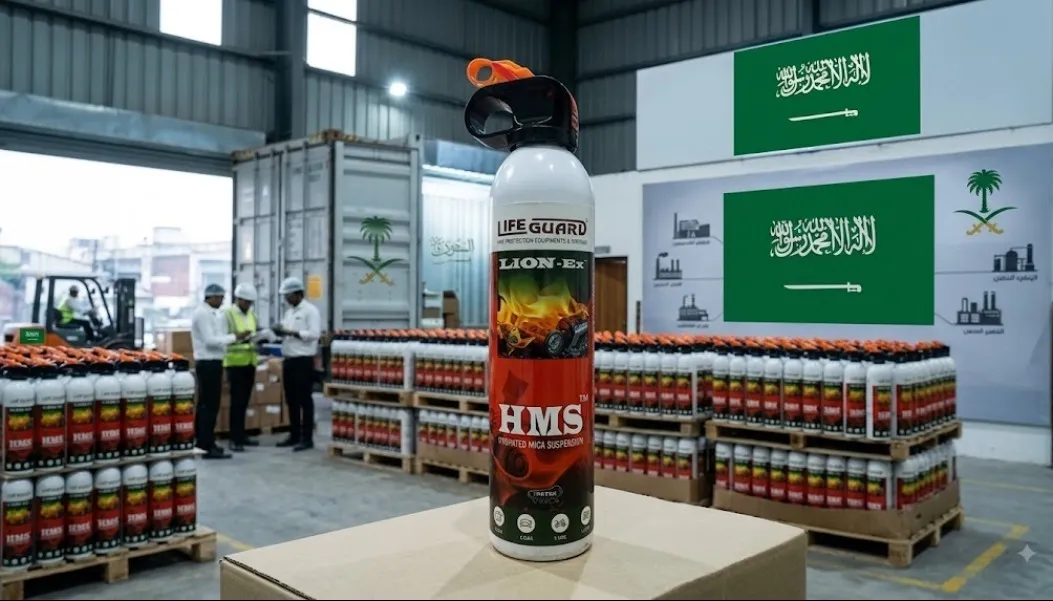
Lithium Battery Battery Cooling System OEM Manufacturer Saudi Arabia
Lithium Battery Cooling System OEM Manufacturer in Saudi Arabia
The growing adoption of lithium-ion batteries across electric vehicles, Battery Energy Storage Systems (BESS), renewable energy projects, UPS systems, telecom infrastructure, data centers, industrial automation, and advanced energy-storage applications has increased the importance of effective battery thermal management.
Lithium batteries generate heat during charging, discharging, fast charging, high-current operation, and repeated cycling. Proper thermal management helps control this heat and supports suitable operating conditions for battery cells, modules, packs, racks, and cabinets.
LIFEGUARD® – United Fire Equipments Pvt. Ltd. provides battery thermal-management and battery-safety solutions for modern lithium battery applications.
As a lithium battery cooling system OEM manufacturer for Saudi Arabia, LIFEGUARD® can support battery manufacturers, EV companies, BESS developers, system integrators, EPC contractors, industrial equipment manufacturers, UPS companies, telecom operators, and energy-storage businesses with customized cooling and thermal-management solutions.
What Is a Lithium Battery Cooling System?
A lithium battery cooling system is a thermal-management solution designed to remove excess heat generated by lithium-ion battery cells, modules, packs, racks, cabinets, or containers.
Heat can be produced during:
- Battery charging
- Battery discharging
- Fast charging
- High-current operation
- High-power applications
- Repeated charge-discharge cycles
- Internal electrical resistance
- Battery aging
- High ambient-temperature conditions
A properly engineered cooling system transfers excess heat away from the battery and helps maintain suitable operating conditions.
For high-energy-density battery systems, thermal management can also help manage temperature differences between individual cells and modules.
Why Lithium Battery Cooling Is Important in Saudi Arabia
Saudi Arabia presents challenging environmental conditions for battery installations, particularly because of high ambient temperatures, outdoor equipment exposure, solar heat loads, and demanding industrial operating environments.
Battery thermal-management requirements may therefore be especially important for:
- Electric vehicles
- BESS installations
- Solar energy storage
- Telecom infrastructure
- Data centers
- Industrial facilities
- UPS systems
- Remote battery installations
- Oil and gas support infrastructure
- Warehousing and logistics
The cooling system should be appropriately selected according to battery chemistry, thermal load, installation conditions, enclosure design, operating profile, and manufacturer specifications.
LIFEGUARD® – OEM Lithium Battery Cooling System Manufacturer for Saudi Arabia
LIFEGUARD® – United Fire Equipments Pvt. Ltd. provides fire-safety and battery-protection solutions for modern energy-storage applications.
Our OEM-oriented approach can support customized requirements for:
- Lithium-ion battery packs
- EV battery systems
- Battery modules
- Battery racks
- Battery cabinets
- BESS containers
- Solar battery-storage systems
- UPS battery systems
- Telecom batteries
- Industrial battery systems
- Battery testing facilities
- Battery manufacturing applications
OEM cooling solutions can be evaluated around the customer's battery architecture, thermal load, dimensions, environmental conditions, control requirements, and integration requirements.
What Is an OEM Lithium Battery Cooling System?
OEM (Original Equipment Manufacturer) cooling solutions are developed for integration into another manufacturer's equipment, battery system, product, or engineering platform.
OEM manufacturing may involve:
- Customized cooling configurations
- Application-specific engineering
- Mechanical modifications
- Electrical interface customization
- Sensor integration
- BMS integration
- PLC integration
- Control-system customization
- Packaging requirements
- Technical documentation
- Private-label manufacturing where commercially and technically appropriate
This allows battery manufacturers and system integrators to incorporate thermal-management technology into their own products.
Customized Lithium Battery Cooling System OEM Solutions
Battery cooling requirements differ significantly between applications.
LIFEGUARD® can evaluate OEM projects based on:
Battery Capacity
Battery capacity influences the overall heat-management requirement.
Power Rating
High-power battery systems can produce significant heat during operation.
Charging Profile
Fast charging may create higher thermal loads and require more effective cooling.
Battery Architecture
Cell, module, pack, rack, cabinet, and container configurations affect cooling design.
Ambient Conditions
Outdoor and indoor Saudi Arabian installations may have significantly different cooling requirements.
Installation Space
OEM products often have strict dimensional, weight, and mounting limitations.
Control Requirements
Cooling systems may need to communicate with the BMS, PLC, HVAC controller, or facility-management system.
Types of Lithium Battery Cooling Systems
1. Air-Cooled Lithium Battery System
Air cooling uses natural or forced airflow to remove heat from battery cells and modules.
Typical components include:
- Fans
- Blowers
- Air channels
- Ducting
- Temperature sensors
- Fan controllers
- Thermal controls
Air cooling can be appropriate for selected applications where the thermal load and power density remain within the cooling system's capabilities.
Benefits
- Simple architecture
- No liquid coolant circuit
- Relatively straightforward maintenance
- Lower mechanical complexity
- Suitable for selected battery applications
2. Liquid-Cooled Lithium Battery System
Liquid cooling uses a circulating coolant to transfer heat away from battery cells or modules.
A liquid cooling system may contain:
- Cooling plates
- Coolant pumps
- Coolant piping
- Heat exchangers
- Temperature sensors
- Flow sensors
- Control valves
- Expansion components
- Thermal controllers
Liquid cooling can provide efficient heat transfer and is often considered for high-power and high-energy-density battery systems.
3. Lithium Battery Cooling Plates
Cooling plates provide a thermal path between battery cells or modules and a cooling circuit.
They can be designed around the battery manufacturer's mechanical and thermal requirements.
Potential applications include:
- EV battery packs
- Battery modules
- BESS racks
- Industrial batteries
- High-power battery systems
- Energy-storage systems
Important engineering factors include:
- Thermal contact
- Coolant flow
- Pressure drop
- Temperature uniformity
- Mechanical integration
- Serviceability
4. HVAC-Based Battery Cooling
Large BESS containers, battery rooms, and battery cabinets may use HVAC equipment as part of their thermal-management strategy.
HVAC-based cooling can help manage:
- Ambient temperature
- Battery enclosure temperature
- Internal air circulation
- Battery-generated heat
- Environmental conditions
For Saudi Arabian installations, cooling design may need to consider both battery-generated heat and external environmental heat loads.
5. Hybrid Lithium Battery Cooling System
Some applications may benefit from combining multiple thermal-management technologies.
A hybrid configuration may combine:
Air Cooling + Liquid Cooling + Temperature Monitoring
The appropriate configuration depends on the battery architecture, thermal load, environmental conditions, and application requirements.
EV Battery Cooling System OEM Manufacturer Saudi Arabia
Saudi Arabia is investing in electric mobility, charging infrastructure, sustainable transportation, and advanced energy technologies.
EV batteries generate heat during:
- Fast charging
- High-power acceleration
- High-speed operation
- Regenerative braking
- Repeated cycling
- High-load operation
Appropriate battery cooling can help manage operating temperature and thermal uniformity.
LIFEGUARD® can evaluate OEM cooling requirements for:
- Electric passenger vehicles
- Electric buses
- Electric commercial vehicles
- Electric delivery fleets
- Electric two-wheelers
- EV battery packs
- EV battery modules
- Battery testing facilities
BESS Cooling System OEM Manufacturer Saudi Arabia
Battery Energy Storage Systems (BESS) are becoming increasingly important for renewable energy, grid-support applications, commercial energy storage, and industrial power management.
A BESS can contain numerous battery modules and racks, resulting in significant thermal loads during charging and discharging.
LIFEGUARD® can evaluate cooling requirements for:
- Utility-scale BESS
- Commercial BESS
- Industrial BESS
- Solar battery storage
- Containerized energy storage
- Microgrids
- Renewable-energy projects
Possible Cooling Technologies
- Air cooling
- Liquid cooling
- HVAC cooling
- Cooling plates
- Hybrid cooling
- Temperature monitoring
Solar Battery Cooling System OEM Manufacturer Saudi Arabia
Saudi Arabia's strong solar-energy potential is supporting the development of renewable-energy and energy-storage projects.
Lithium battery storage can be used for:
- Solar power storage
- Commercial energy storage
- Industrial energy storage
- Microgrids
- Renewable-energy integration
- Backup power
- Hybrid energy systems
Battery cooling can help manage thermal conditions during repeated charging and discharging cycles.
UPS Battery Cooling System OEM Manufacturer Saudi Arabia
Lithium-ion UPS batteries are increasingly being considered for critical-power applications.
Thermal management can be important for:
- Data centers
- Server facilities
- Telecom infrastructure
- Industrial UPS systems
- Commercial buildings
- Critical infrastructure
- Backup-power systems
OEM cooling systems can be designed around battery cabinet dimensions, thermal loads, environmental conditions, and required control architecture.
Telecom Lithium Battery Cooling Solutions Saudi Arabia
Telecom infrastructure requires reliable backup power, often under demanding outdoor conditions.
Battery cooling solutions can be considered for:
- Telecom battery cabinets
- Communication towers
- 5G infrastructure
- Remote telecom sites
- Network facilities
- Outdoor battery enclosures
For outdoor installations, OEM thermal-management design may need to account for:
- High ambient temperature
- Solar radiation
- Enclosure heat accumulation
- Ventilation
- Environmental protection
- Maintenance access
Data Center Battery Cooling System Saudi Arabia
Data centers require reliable UPS and backup-power infrastructure.
Lithium battery cooling solutions can be considered for:
- UPS battery rooms
- Battery cabinets
- Data-center backup systems
- Critical power systems
- Server infrastructure
Battery cooling should be coordinated with the facility's overall HVAC and environmental-control strategy.
Industrial Lithium Battery Cooling OEM Solutions
Lithium batteries are increasingly used in industrial equipment and material-handling systems.
Potential applications include:
- Automated Guided Vehicles
- Electric forklifts
- Robotics
- Industrial vehicles
- Material-handling equipment
- Automated warehouses
- Industrial energy storage
- Backup power
LIFEGUARD® can evaluate customized OEM cooling requirements according to battery capacity, duty cycle, thermal load, operating conditions, and available installation space.
Battery Manufacturing & Testing Cooling Systems
Battery manufacturing and testing facilities may require controlled thermal conditions for:
- Cell testing
- Module testing
- Battery-pack testing
- Charge-discharge testing
- Performance validation
- Research and development
- Battery assembly
Cooling requirements should be established according to battery chemistry, test procedures, equipment requirements, thermal load, and desired temperature conditions.
Key Components of an OEM Lithium Battery Cooling System
Temperature Sensors
Temperature sensors monitor battery temperatures and provide information to the thermal-control system.
Cooling Plates
Cooling plates provide a thermal path between battery cells or modules and the coolant circuit.
Pumps
Liquid-cooled systems use pumps to circulate coolant.
Heat Exchangers
Heat exchangers transfer heat from the battery coolant to another cooling medium.
Fans & Blowers
Air-cooled systems use fans or blowers to circulate air through battery modules and cabinets.
Coolant Circuit
Liquid cooling requires suitable coolant, piping, pumps, valves, and heat-transfer components.
Thermal Interface Materials
Thermal interface materials can improve thermal contact between battery surfaces and cooling components.
Control System
The control system can regulate fans, pumps, valves, and other cooling components based on temperature and operating conditions.
BMS Interface
Where technically appropriate, the cooling system can interface with the Battery Management System to coordinate thermal management with battery operation.
OEM Design & Customization Capabilities
LIFEGUARD® can evaluate OEM cooling-system customization in several areas.
Mechanical Design
- Dimensions
- Mounting arrangement
- Brackets
- Cooling connections
- Enclosure integration
- Service access
Electrical Design
- Power supply
- Sensor wiring
- Control signals
- Alarm outputs
- Communication interfaces
Thermal Design
- Cooling capacity
- Airflow
- Coolant flow
- Cooling-plate configuration
- Heat-exchanger capacity
Control Design
- Temperature thresholds
- Fan control
- Pump control
- Alarm logic
- BMS communication
- PLC interface
Final specifications should be confirmed through application-specific engineering.
Lithium Battery Cooling OEM Manufacturing Process
A structured OEM development process can include:
Requirement Analysis → Battery Assessment → Thermal Calculation → Concept Design → Engineering → Prototype → Testing → Optimization → Production → Quality Inspection → Delivery
1. Requirement Analysis
Review the customer's battery architecture, application, thermal requirements, environmental conditions, available space, and control requirements.
2. Battery Assessment
Evaluate battery chemistry, cell configuration, energy capacity, power rating, and operating profile.
3. Thermal Calculation
Determine expected heat generation during normal and peak operation.
4. Cooling Technology Selection
Select air cooling, liquid cooling, cooling plates, HVAC, or a hybrid solution.
5. Engineering Design
Develop the mechanical, thermal, electrical, and control interfaces.
6. Prototype Development
Where necessary, develop a prototype or sample configuration for evaluation.
7. Testing
Evaluate cooling performance, temperature distribution, sensor operation, controls, alarms, and interfaces.
8. Optimization
Modify the design according to test results and customer requirements.
9. Production
Manufacture the approved OEM configuration.
10. Quality Inspection
Perform applicable quality checks before dispatch.
Battery Cooling System Testing
Depending on the application, testing may include:
- Temperature monitoring
- Cooling-performance verification
- Airflow testing
- Coolant-flow verification
- Pressure testing where applicable
- Sensor verification
- Fan testing
- Pump testing
- Alarm testing
- Control-interface testing
- BMS communication verification
- Operational testing
Testing should be based on the approved technical specification, customer requirements, battery manufacturer's requirements, and applicable standards.
Battery Cooling and Thermal Runaway Suppression
Battery cooling and fire suppression serve different functions.
Battery Cooling
Battery cooling manages heat generated during normal battery operation.
Thermal Runaway Protection
Thermal runaway protection addresses abnormal battery events and may involve:
- Detection
- Electrical isolation
- Cooling
- Fire suppression
- Ventilation
- Emergency shutdown
Therefore:
Battery Cooling ≠ Fire Suppression
For high-energy lithium battery installations, a layered protection strategy may include:
BMS + Electrical Protection + Thermal Management + Temperature Monitoring + Fire Detection + Fire Suppression + Emergency Shutdown
The final safety strategy should be based on project-specific risk assessment and battery/system requirements.
Can Battery Cooling Prevent Thermal Runaway?
Battery cooling should not be represented as a guaranteed method of preventing thermal runaway.
Appropriate thermal management can help maintain suitable operating temperatures and manage thermal gradients, but lithium battery safety requires multiple layers of protection.
These may include:
- Battery Management System
- Electrical protection
- Temperature monitoring
- Thermal management
- Battery enclosure design
- Fire detection
- Fire suppression
- Emergency isolation
- Ventilation
- Maintenance
- Emergency response procedures
Benefits of OEM Lithium Battery Cooling Systems
Customized Integration
OEM cooling systems can be designed around the customer's battery architecture.
Improved Thermal Management
Cooling can help remove excess heat generated during normal operation.
Temperature Uniformity
An appropriately engineered system can help manage temperature differences between cells and modules.
Product Integration
Cooling components can be integrated into battery packs, cabinets, racks, containers, or larger OEM systems.
Scalable Manufacturing
OEM projects can support prototype development and, where feasible, repeat production requirements.
Application-Specific Engineering
Cooling technology can be selected according to thermal load, operating profile, environmental conditions, and system architecture.
Why Choose LIFEGUARD® as a Lithium Battery Cooling System OEM Manufacturer for Saudi Arabia?
OEM-Focused Engineering
LIFEGUARD® can evaluate customized thermal-management requirements for battery manufacturers and system integrators.
Battery Safety Expertise
Our fire-safety background allows battery cooling requirements to be considered alongside broader battery-protection strategies.
Customized Solutions
Solutions can be evaluated around:
- Battery dimensions
- Thermal load
- Cooling capacity
- Installation space
- Sensors
- Controls
- BMS integration
International Supply Capability
LIFEGUARD® can evaluate export-oriented OEM requirements from India to Saudi Arabia, subject to product specifications, technical feasibility, documentation, logistics, and applicable destination requirements.
Project-Oriented Approach
Every battery cooling project should be evaluated according to its specific battery architecture and operating environment rather than relying on a one-size-fits-all configuration.
Lithium Battery Cooling System OEM Manufacturer for Saudi Arabian Projects
LIFEGUARD® can evaluate OEM requirements for projects in major Saudi Arabian markets and industrial regions, including:
- Riyadh
- Jeddah
- Dammam
- Al Khobar
- Dhahran
- NEOM
- Jubail
- Yanbu
- Mecca
- Medina
Potential applications include:
- EV infrastructure
- Battery manufacturing
- BESS
- Solar energy storage
- Data centers
- Telecom infrastructure
- Industrial facilities
- Logistics centers
- Warehouses
- Renewable-energy projects
Industries Served
LIFEGUARD® can evaluate lithium battery thermal-management requirements for:
- EV Manufacturers
- Battery Manufacturers
- BESS Manufacturers
- Energy-Storage Companies
- Solar EPC Companies
- UPS Manufacturers
- Telecom Companies
- Data Centers
- Industrial Equipment Manufacturers
- Automotive Companies
- Robotics Manufacturers
- Battery Testing Facilities
- System Integrators
- EPC Contractors
Important Factors When Selecting an OEM Battery Cooling System
Battery Chemistry
Different battery chemistries can have different thermal characteristics.
Battery Capacity
Higher-capacity systems can generate greater thermal loads.
Peak Power
High-power operation may significantly increase heat generation.
Charging Speed
Fast charging can increase thermal loads.
Operating Temperature
The required temperature range should be established according to battery specifications.
Cooling Capacity
Cooling capacity should be determined from the calculated thermal load.
Temperature Uniformity
The system should be designed to manage temperature differences where required.
Environmental Conditions
Saudi Arabian installations may require careful consideration of ambient temperature, solar exposure, enclosure design, and heat rejection.
Maintenance
Fans, pumps, filters, sensors, coolant circuits, and other components require appropriate maintenance.
Safety
Thermal management should be integrated into a broader battery-safety strategy.
Frequently Asked Questions
What is a lithium battery cooling system?
A lithium battery cooling system is a thermal-management solution designed to remove excess heat from lithium-ion battery cells, modules, packs, racks, or cabinets and help maintain suitable operating temperatures.
Why is battery cooling important in Saudi Arabia?
High ambient temperatures can increase the thermal-management demands of battery installations. Appropriate cooling helps manage battery-generated heat and environmental heat loads.
Can LIFEGUARD® provide customized OEM cooling systems?
LIFEGUARD® can evaluate customized OEM cooling requirements based on battery architecture, thermal load, dimensions, environmental conditions, control requirements, and application specifications.
Which cooling technology is suitable for lithium batteries?
Air cooling, liquid cooling, cooling plates, HVAC-based cooling, and hybrid solutions can all be considered depending on the application.
Can the cooling system communicate with a BMS?
Where technically appropriate, the cooling-control system can be designed to interface with a Battery Management System or other control architecture.
Can LIFEGUARD® supply battery cooling systems to Saudi Arabia?
LIFEGUARD® can evaluate export and OEM requirements for Saudi Arabian projects, subject to technical specifications, commercial terms, documentation, logistics, and applicable regulations.
Can battery cooling replace fire suppression?
No. Battery cooling manages thermal conditions during normal operation, whereas fire suppression addresses fire and abnormal thermal events. They have different functions.
Can LIFEGUARD® support BESS projects in Saudi Arabia?
Yes. LIFEGUARD® can evaluate thermal-management requirements for commercial, industrial, renewable-energy, and utility-scale battery-storage applications.
LIFEGUARD® – Your Lithium Battery Cooling System OEM Manufacturer for Saudi Arabia
The increasing deployment of lithium-ion batteries across electric mobility, BESS, renewable energy, industrial automation, UPS systems, telecom infrastructure, data centers, and advanced energy storage makes effective thermal management an important part of modern battery-system design.
LIFEGUARD® – United Fire Equipments Pvt. Ltd. provides battery thermal-management and fire-safety solutions for modern lithium battery applications.
As a lithium battery cooling system OEM manufacturer for Saudi Arabia, LIFEGUARD® can evaluate customized requirements for battery manufacturers, EV companies, BESS developers, system integrators, EPC contractors, industrial customers, and energy-storage companies.
From air-cooled and liquid-cooled systems to cooling plates, temperature monitoring, thermal controls, and customized OEM integration, solutions can be evaluated according to the customer's battery architecture, thermal requirements, and project conditions.
LIFEGUARD® – Supporting Safer, Smarter and More Reliable Lithium Battery Thermal Management.
Contact LIFEGUARD®
LIFEGUARD®
United Fire Equipments Pvt. Ltd.
Manufacturer of ISI Certified Fire Safety Equipment
Phone: 8048034226
Email: ufe126@gmail.com | info@lifeguardindia.in
Website: www.lifeguardindia.in
Keywords






