

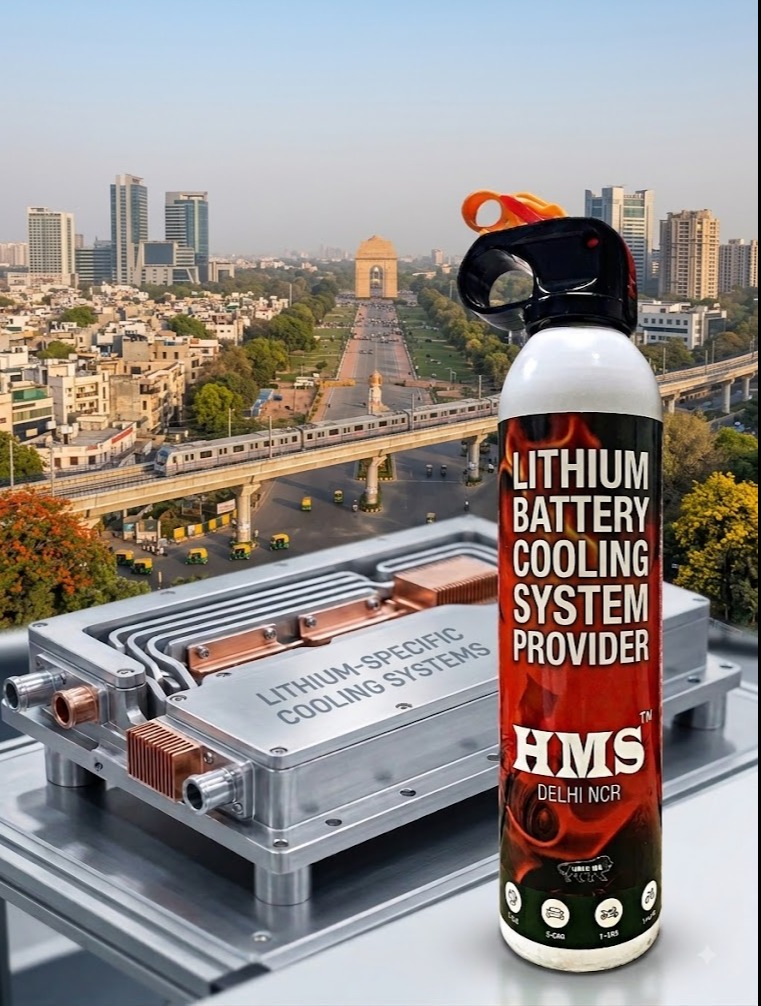
Lithium Battery Cooling System Provider in Delhi NCR
Advanced Lithium Battery Cooling, Thermal Management & Fire Safety Solutions by LIFEGUARD®
The rapid adoption of electric vehicles, lithium-ion battery packs, battery energy storage systems (BESS), solar energy storage, industrial batteries, telecom backup systems, and data-center power infrastructure has made lithium battery thermal management an increasingly important requirement.
For businesses searching for a lithium battery cooling system provider in Delhi NCR, LIFEGUARD® offers advanced battery safety solutions focused on thermal management, heat control, early detection, and fire protection for lithium-ion battery applications.
Delhi NCR presents particular challenges for battery installations because battery systems may operate in demanding ambient conditions, including periods of high summer temperatures. Proper thermal management should therefore be considered an important part of battery-system design, installation, and safety planning.
LIFEGUARD® provides solutions designed to help organizations manage lithium battery thermal risks and develop a more comprehensive battery safety strategy.
Why Lithium Battery Cooling Is Important
Lithium-ion batteries generate heat during charging and discharging. Heat generation can become more significant during:
- Fast charging
- High-current discharge
- High-power operation
- Repeated charge-discharge cycles
- Elevated ambient temperatures
- Battery overload
- Abnormal electrical conditions
If excessive heat is not effectively managed, it can contribute to accelerated battery degradation, reduced performance, temperature imbalance, and potentially serious safety incidents.
A Battery Thermal Management System (BTMS) is designed to control battery temperature and help maintain appropriate thermal conditions.
Modern battery thermal-management research continues to explore advanced approaches such as liquid cooling, thermoelectric cooling, dielectric immersion cooling, and hybrid systems for high-performance battery applications.
LIFEGUARD® – Lithium Battery Cooling System Provider Delhi NCR
LIFEGUARD® specializes in battery fire-safety and thermal-management solutions for lithium-ion battery environments.
Our approach goes beyond conventional fire protection by considering the different stages of a potential battery thermal event—from abnormal temperature rise and early detection through cooling, suppression, and thermal-runaway mitigation.
LIFEGUARD® solutions can be considered for:
- Lithium-ion battery packs
- Electric vehicle batteries
- Battery Energy Storage Systems (BESS)
- Solar battery storage
- Industrial battery systems
- Telecom batteries
- UPS battery systems
- Data-center battery systems
- Battery cabinets
- Battery rooms
- Battery storage warehouses
- Energy-storage facilities
LIFEGUARD® also offers HMS-based independent detection and suppression technology designed for lithium battery storage systems, with unit-level protection intended to help control thermal events before they propagate through adjacent battery modules.
What Is a Lithium Battery Cooling System?
A lithium battery cooling system is a thermal-management solution designed to remove or control heat generated by battery cells, modules, or packs.
The objective is to help maintain a controlled temperature across the battery system and reduce excessive thermal stress.
Depending on the application, battery cooling can involve:
Air Cooling
Air cooling uses natural or forced airflow to transfer heat away from battery cells or modules.
It can be suitable for applications where thermal loads are relatively moderate and the system requires a straightforward cooling architecture.
Liquid Cooling
Liquid cooling uses a coolant circuit to transfer heat away from battery cells or modules.
It can provide efficient heat transfer and is commonly considered for demanding applications such as high-power EV batteries and energy-storage systems.
Refrigerant Cooling
Refrigerant-based cooling can provide high cooling capacity for demanding battery applications and may be integrated with other vehicle or energy-system thermal-management infrastructure.
Phase-Change Cooling
Phase-change materials absorb heat during a phase transition and can provide passive thermal buffering.
Hybrid Cooling
Hybrid systems combine multiple thermal-management technologies to achieve improved temperature control and thermal uniformity.
The right cooling technology depends on the battery chemistry, capacity, pack architecture, operating profile, heat generation, ambient conditions, and safety requirements.
Why Battery Cooling Matters in Delhi NCR
Delhi NCR includes Delhi, Noida, Greater Noida, Gurugram, Ghaziabad, Faridabad, and surrounding industrial and commercial areas. The region supports significant activity in automotive, manufacturing, logistics, data centers, renewable energy, telecom, and industrial infrastructure.
Battery systems operating in such environments must be designed with their actual operating conditions in mind.
High ambient temperatures can increase the thermal load that a battery cooling system needs to manage. This makes effective thermal monitoring and appropriate thermal management particularly relevant for lithium battery installations.
For this reason, companies searching for a lithium battery cooling system provider in Delhi NCR should evaluate not only the battery capacity but also the installation environment and expected operating conditions.
Lithium Battery Cooling and Thermal Runaway
One of the most significant safety concerns associated with lithium-ion batteries is thermal runaway.
Thermal runaway is an uncontrolled battery thermal event in which increasing temperature can trigger further heat-generating reactions. If not effectively managed, an event can result in intense heat, fire, gas generation, and propagation to neighbouring cells or modules.
LIFEGUARD®'s battery thermal-runaway protection approach emphasizes early detection, control, and suppression of lithium-ion battery fire hazards.
A comprehensive battery protection strategy may include:
- Temperature monitoring
- Heat detection
- Gas or smoke detection where appropriate
- Battery Management System integration
- Automatic cooling
- Early warning
- Fire suppression
- Thermal-runaway containment
- Protection against propagation
- Re-ignition mitigation
Cooling is an important safety measure, but it should not be considered a standalone guarantee against thermal runaway. Battery safety should be designed as an integrated system based on the specific battery installation.
LIFEGUARD® Battery Cooling & Fire Protection Approach
A modern lithium battery safety system can combine multiple protective layers.
Layer 1 – Monitoring
Continuous monitoring can help identify abnormal battery temperature and operating conditions.
Layer 2 – Early Detection
Detecting abnormal heat, smoke, gases, or other indicators at an early stage can allow intervention before an incident escalates.
Layer 3 – Cooling
Cooling technologies can help reduce excessive temperature and manage heat generated during battery operation.
Layer 4 – Suppression
If a fire or thermal event occurs, a suitable suppression system can help control the incident and reduce propagation.
Layer 5 – Thermal Runaway Mitigation
Specialized battery protection technologies can be used to help limit the spread of thermal events between battery cells and modules.
LIFEGUARD®'s HMS technology is designed around heat absorption, thermal insulation, flame suppression, thermal-runaway containment, and re-ignition mitigation.
Applications of Lithium Battery Cooling Systems in Delhi NCR
1. Electric Vehicle Battery Systems
The EV industry requires effective battery thermal management to control heat generated during driving, charging, and high-power operation.
LIFEGUARD® can support the broader safety requirements associated with EV battery environments through battery cooling and fire-protection technologies.
2. Battery Energy Storage Systems
BESS installations can contain large numbers of interconnected lithium-ion cells and modules.
A battery protection strategy can combine thermal management, detection, monitoring, and specialized fire suppression to help manage potential thermal events.
3. Solar Energy Storage
Solar power installations increasingly use lithium batteries to store electricity for later use.
Thermal management can help support stable operation of these energy-storage systems.
4. Data Centers
Data centers require highly reliable backup power infrastructure. Lithium battery systems used for UPS and energy storage require careful attention to thermal conditions and fire safety.
5. Telecom Infrastructure
Telecom facilities use battery systems for backup power and continuity of operations. Appropriate battery monitoring and thermal protection can help address battery-related risks.
6. Industrial Battery Installations
Factories, warehouses, automated facilities, logistics centers, and industrial equipment increasingly rely on rechargeable lithium batteries.
Battery cooling and thermal protection can form part of the overall safety architecture.
7. Lithium Battery Warehouses
Battery storage and distribution facilities can contain large concentrations of lithium-ion batteries.
LIFEGUARD®'s battery safety approach includes early detection, specialized fire suppression, and thermal-management concepts for lithium battery storage environments.
Benefits of Effective Lithium Battery Thermal Management
A properly designed battery cooling system can help provide:
Better Temperature Control
Maintaining controlled temperatures can help support stable battery operation.
Improved Thermal Uniformity
Reducing excessive temperature differences between cells can support more consistent battery performance.
Reduced Thermal Stress
Effective heat management can help reduce thermal stress on battery components.
Support for Battery Life
Excessive heat can accelerate battery aging. Proper thermal management can help manage one of the factors contributing to battery degradation.
High-Power Operation
Advanced cooling systems can be considered where batteries experience high charging or discharge rates.
Fast-Charging Support
Fast charging can generate significant heat, making thermal management an important design consideration.
Improved Safety Strategy
Cooling, monitoring, detection, and suppression can work together as multiple layers of battery protection.
How to Select a Lithium Battery Cooling System Provider in Delhi NCR
Choosing the right lithium battery cooling system provider in Delhi NCR requires an understanding of the complete battery installation.
Businesses should consider:
Battery chemistry: Different lithium battery chemistries have different thermal characteristics.
Battery capacity: Higher-capacity systems may require more sophisticated thermal management.
Charging and discharge rates: Higher power can result in increased heat generation.
Operating environment: Ambient temperature and installation conditions influence cooling requirements.
Battery configuration: Cells, modules, racks, cabinets, and containers may require different approaches.
Temperature monitoring: A cooling system should be considered alongside appropriate monitoring and detection.
Fire protection: Cooling should form part of an overall lithium battery fire-safety strategy.
System integration: The solution should be evaluated for compatibility with the battery management and safety architecture.
Why Choose LIFEGUARD®?
LIFEGUARD® brings together battery safety, fire protection, cooling, detection, and suppression concepts for lithium-ion battery applications.
Our solutions are intended to help customers address battery-related thermal and fire risks through an integrated safety approach.
Key strengths include:
- Lithium battery thermal protection solutions
- Battery cooling and thermal-management technologies
- Early detection and monitoring concepts
- Lithium battery fire suppression
- Thermal-runaway protection
- Battery storage safety solutions
- BESS fire protection
- EV battery safety applications
- Industrial battery protection
- Unit-level battery protection solutions
- Solutions for high-density lithium battery environments
For lithium battery storage systems, LIFEGUARD®'s HMS technology is designed to provide independent detection and suppression for individual battery modules or storage compartments, helping localize an incident and reduce the potential for propagation.
LIFEGUARD® for Delhi, Noida, Gurugram, Ghaziabad & Faridabad
Businesses across the Delhi NCR region can consider LIFEGUARD® solutions for lithium battery applications in:
- Delhi
- Noida
- Greater Noida
- Gurugram (Gurgaon)
- Ghaziabad
- Faridabad
- Manesar
- Sonipat
- Industrial areas across NCR
Whether the requirement involves a battery cabinet, EV battery facility, BESS installation, warehouse, data center, telecom site, or industrial battery system, the appropriate cooling and safety solution should be selected according to the actual battery configuration and risk profile.
Why an Integrated Battery Safety Solution Is Better
Cooling by itself addresses heat management. Fire suppression addresses fire. Detection identifies abnormal conditions.
An integrated approach brings these functions together.
For lithium battery applications, a comprehensive safety architecture can therefore include:
Monitor → Detect → Cool → Suppress → Contain → Prevent Re-Ignition
This approach can help organizations move from reactive firefighting toward proactive battery-risk management.
Frequently Asked Questions
What is a lithium battery cooling system?
A lithium battery cooling system is designed to remove or manage heat generated by lithium-ion battery cells, modules, or packs during charging and operation.
Why is battery cooling important in Delhi NCR?
Delhi NCR can experience high ambient temperatures, making thermal management an important consideration for battery installations. The cooling requirement depends on the battery system, operating conditions, enclosure, charging profile, and heat generation.
What type of battery cooling system is best?
There is no single cooling technology suitable for every application. Air, liquid, refrigerant, phase-change, and hybrid systems can be considered depending on the battery's thermal load and design.
Can cooling prevent lithium battery thermal runaway?
Cooling can help manage battery temperature and may form an important part of a thermal-safety strategy, but it should not be considered a complete standalone solution for thermal runaway. Detection, monitoring, suppression, containment, and appropriate battery-system design may also be necessary.
Does LIFEGUARD® provide lithium battery fire protection?
Yes. LIFEGUARD® provides lithium battery fire-safety technologies, including specialized HMS-based detection and suppression solutions for lithium battery storage applications.
Where can lithium battery cooling systems be used?
They can be considered for EV batteries, BESS, solar energy storage, industrial battery systems, telecom backup systems, UPS systems, data centers, battery warehouses, and other lithium-ion battery applications.
Choose LIFEGUARD® for Lithium Battery Cooling & Safety in Delhi NCR
As lithium-ion battery adoption accelerates across electric mobility, energy storage, industrial applications, and backup power infrastructure, effective thermal management is becoming increasingly important.
A properly designed lithium battery cooling system can help manage heat, while integrated detection and suppression technologies can provide additional protection against serious battery incidents.
If you are searching for a lithium battery cooling system provider in Delhi NCR, LIFEGUARD® can help you explore appropriate battery cooling, thermal-management, detection, and fire-suppression solutions based on your application.
Contact LIFEGUARD® to discuss your lithium battery cooling and fire-safety requirements in Delhi NCR.
Contact LIFEGUARD®
United Fire Equipments Pvt. Ltd.
Manufacturer of ISI Certified Fire Safety Equipment
📞 8048034226