
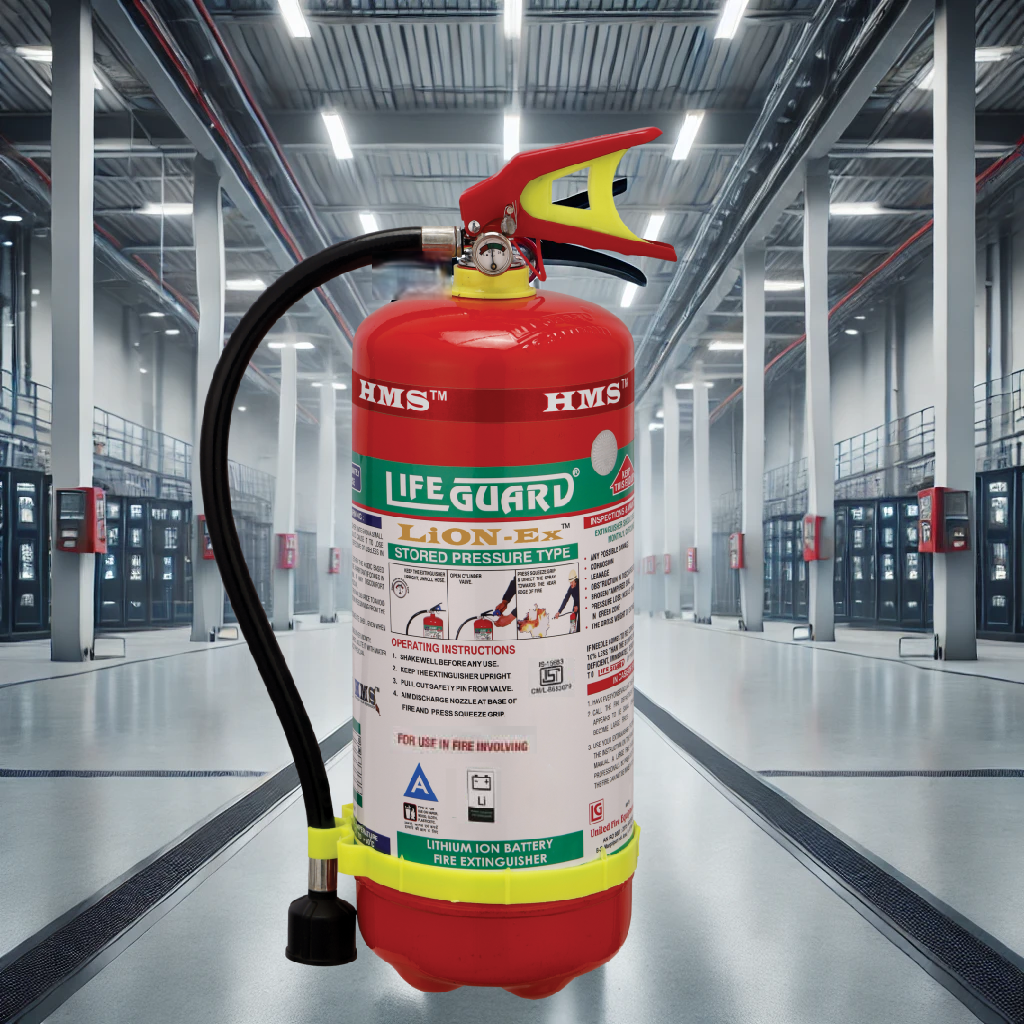
LITHIUM BATTERY FIRE EXTINGUISHER
📢 Page 1 & 2: The Hidden Danger – Lithium-Ion Battery Fires
🔥 Page 1: Lithium-Ion Battery Fires – An Increasing Threat
🚨 Why Lithium-Ion Battery Fires Are Different?
- Lithium-ion batteries, widely used in electric vehicles (EVs), data centers, solar power systems, and consumer electronics, pose significant fire hazards due to their high energy density and volatile nature.
- Thermal runaway occurs when a battery cell overheats, triggering a chain reaction that leads to:
- 📈 Uncontrollable Temperature Rise – Cells rapidly heat up, exceeding 1,000°C.
- 💥 Venting of Toxic Gases – Release of highly flammable electrolytes and hazardous fumes.
- ⚡ Explosion and Reignition – Once ignited, lithium-ion batteries continue burning even without an external oxygen supply.
❗ Conventional Extinguishing Agents Fail to Mitigate Lithium Fires
- Water – Reacts with lithium compounds, creating hydrogen gas, which fuels the fire further.
- CO₂ and Dry Powder – Ineffective in cooling and preventing thermal runaway.
- Foam Extinguishers – Designed for liquid fires but unable to prevent lithium cell reignition.
💡 Why You Should Care?
- Lithium fires lead to property damage, environmental hazards, and safety risks.
- Growing EV adoption and battery storage facilities make understanding these risks essential for industries.
⚡ Page 2: Understanding Thermal Runaway – The Core of Lithium Battery Fires
🔥 What is Thermal Runaway?
- Thermal runaway is a catastrophic process where a lithium-ion battery self-heats uncontrollably, escalating into a fire or explosion.
- How It Happens:
- Internal Short Circuit – Damage or defects cause internal heating.
- Electrolyte Decomposition – Release of flammable gases.
- Ignition & Explosion – Gas ignition results in intense heat and fire.
📊 Shocking Statistics:
- EV battery fires can reach temperatures exceeding 1,000°C within seconds.
- Lithium-ion battery-related incidents have surged by >20% year-over-year globally.
🔍 Real-World Implications:
- Battery fires in EVs, data centers, and warehouses can lead to massive economic and ecological damage.
- Failure to address thermal runaway risks puts lives, property, and the environment in danger.
👉 Coming Next: Discover How HMS is Revolutionizing Lithium-Ion Fire Safety!
📢 Page 3 & 4: HMS – Innovation Beyond Fire Suppression
🌱 Page 3: What Makes HMS Different?
💡 HMS (Hydrated Mica Suspension): The Future of Lithium-Ion Fire Safety
HMS is an indigenously developed fire suppression technology designed specifically to mitigate lithium-ion battery fires effectively.
✅ Superior Cooling & Heat Absorption:
- Rapidly absorbs heat, preventing the propagation of thermal runaway.
- Ensures cooling efficiency by bringing battery temperatures below the critical threshold.
✅ Encapsulation for Safety:
- Forms a protective layer around battery cells, cutting off oxygen supply.
- Prevents reignition by sealing volatile gases.
✅ Non-Conductive & Dielectric Safe:
- HMS is non-conductive, making it safe for use in high-voltage environments such as:
- EV batteries
- Solar power systems
- Energy storage systems
✅ Zero Corrosion, Zero Toxicity:
- Leaves no harmful residue, ensuring minimal post-fire cleanup.
- Safe for equipment, electronics, and surrounding environments.
💡 Why HMS Outperforms Conventional Extinguishers:
- Conventional media like water, CO₂, and foam fail to address thermal runaway and post-fire reignition.
- HMS targets the root cause by stopping heat propagation and preventing reignition.
🚀 Page 4: Real-World Applications of HMS Technology
🏭 Where Can HMS Be Applied?
✅ Electric Vehicles (EVs):
- Protects EV batteries, reducing the risk of fire in case of collision or cell failure.
- Ensures passenger safety and minimizes environmental impact.
✅ Battery Energy Storage Systems (BESS):
- Safeguards high-capacity battery storage in data centers, renewable energy grids, and backup power stations.
- Prevents large-scale explosions and potential loss of infrastructure.
✅ Warehouses & Industrial Facilities:
- Provides fire protection in lithium battery storage environments.
- Critical for preventing mass-scale disasters and economic losses.
✅ Solar Power Systems:
- Secures photovoltaic installations with battery backup by preventing thermal runaway.
- Ensures uninterrupted energy flow while reducing fire hazards.
🔍 Case Study:
In a leading EV manufacturing plant, HMS successfully extinguished a thermal runaway incident, preventing potential catastrophic damage and ensuring zero ecological impact.
📢 Page 5 & 6: Eco-Friendly Solution – Supporting Biodiversity
🌏 Page 5: Protecting Nature with Every Use of HMS
🌱 Why HMS is Eco-Friendly & Sustainable?
HMS offers a green solution to combat lithium-ion battery fires without compromising environmental integrity.
✅ Derived from Natural Mica:
- Mica is a naturally occurring mineral that requires minimal processing.
- Low carbon footprint compared to synthetic alternatives.
✅ Biodegradable & Non-Toxic:
- HMS degrades harmlessly, leaving no harmful chemicals behind.
- Does not contaminate water bodies or soil post-application.
✅ No Harmful Residue:
- Unlike traditional extinguishing agents, HMS does not produce corrosive by-products.
- Post-fire cleanup is easy and safe for the environment.
💧 Water Conservation Advantage:
- Traditional fire suppression methods consume large quantities of water, adding to environmental degradation.
- HMS minimizes the use of resources while maximizing safety.
🌿 Page 6: Impact on Biodiversity – A Greener Tomorrow
🌍 Safeguarding Ecosystems with HMS
HMS actively contributes to preserving biodiversity by preventing the spread of hazardous fires and toxic by-products.
✅ Prevents Groundwater Contamination:
- Conventional extinguishers introduce chemicals that leach into soil and water.
- HMS leaves no residual contaminants, ensuring eco-safety.
✅ Protects Wildlife from Toxic Fallout:
- Post-fire residues from conventional extinguishers harm nearby flora and fauna.
- HMS’s non-toxic formulation keeps ecosystems intact.
✅ Reduces CO₂ Emissions from Fires:
- By preventing thermal runaway, HMS curtails the release of CO₂ and other greenhouse gases.
- Fewer emissions, less environmental damage.
🌱 Did You Know?
Every lithium-ion battery fire prevented using HMS saves tons of harmful emissions, making a direct impact on climate change mitigation.
👉 Choose HMS – A Sustainable, Safe, and Responsible Choice!
📢 Page 7 & 8: Why HMS is the Future of Fire Safety?
🚀 Page 7: Why Industries Are Switching to HMS
🔥 Key Reasons to Choose HMS
✅ Unmatched Effectiveness:
- HMS outperforms all conventional extinguishers in controlling lithium-ion battery fires.
- Verified by industry-leading thermal runaway suppression tests.
✅ AIS-135 & IS 2190 Compliance:
- Fully compliant with India's strictest fire safety standards.
- Ensures safe operation in automotive, industrial, and residential settings.
✅ Long Shelf Life & Easy Maintenance:
- Minimal maintenance with a longer shelf life than conventional extinguishers.
- Ensures reliability during critical moments.
✅ Saves Lives, Protects Assets:
- Reduces economic and environmental damage caused by lithium battery fires.
🔍 Customer Testimonial:
“Since switching to HMS-based Lion-Ex Extinguishers, we’ve had zero safety incidents and 100% reliability in our EV fleet protection.” – Leading EV Manufacturer
🌟 Page 8: Future-Proof Your Safety with HMS Technology
⚡ The Future of Fire Suppression is Here
✅ Versatile Applications:
- Protect EVs, data centers, battery storage, and solar systems.
- Ideal for both industrial and consumer applications.
✅ Scalable for Large Deployments:
- Suitable for widespread use in battery manufacturing plants and energy grids.
✅ Made in India, Built for the World:
- Promoting the ‘Make in India’ vision by introducing indigenous innovation.
- Strengthening India’s fire safety infrastructure with globally competitive solutions.
🎯 Join the Revolution in Fire Safety.
💡 Secure Your Assets & Protect the Environment with HMS-Powered Lion-Ex Fire Extinguishers.
👉 Contact Us Today for Demos and Bulk Orders!