
Lithium Battery Fire Extinguisher Solutions India
Specialised Lithium-Ion Battery Fire Protection from LIFEGUARD®
LIFEGUARD® provides specialised lithium battery fire extinguisher solutions in India for commercial, industrial, automotive, renewable-energy, logistics and infrastructure applications.
Manufactured by United Fire Equipments Pvt. Ltd., LIFEGUARD® fire safety equipment is designed to support organisations managing the growing fire risks associated with lithium-ion batteries and battery-powered equipment.
Lithium-ion batteries are now widely used in:
- Electric cars and electric buses
- E-bikes and electric scooters
- Mobile phones and laptops
- Power tools and portable equipment
- Solar energy-storage systems
- Data centre UPS systems
- Telecom backup installations
- Automated industrial machinery
- Material-handling equipment
- Battery cabinets and battery rooms
- Battery Energy Storage Systems
- Warehouses and logistics facilities
Lithium-ion batteries offer high energy density, compact construction and reliable performance. However, batteries that are damaged, overheated, defective, overcharged or incorrectly handled can present a serious fire hazard.
A lithium-ion battery incident may involve rapid heat generation, flammable gases, dense smoke, cell rupture, fire propagation and re-ignition. For this reason, an ordinary fire extinguisher should not automatically be assumed to provide complete protection for every lithium battery application.
LIFEGUARD® helps customers identify a suitable fire extinguisher or integrated fire protection solution based on the battery chemistry, energy capacity, battery quantity, installation conditions and expected fire scenario.
Complete Lithium Battery Fire Protection Solutions
Lithium battery fire safety is not limited to installing a portable extinguisher. The most suitable solution depends on the size and nature of the battery hazard.
A small mobile-phone battery, an e-bike battery, an electric vehicle traction battery and a large Battery Energy Storage System require different protection strategies.
Depending on the application, LIFEGUARD® can support enquiries for:
- Portable lithium battery fire extinguishers
- Trolley-mounted lithium battery extinguishers
- Battery cabinet fire suppression systems
- Battery room fire suppression systems
- Smoke and heat detection systems
- Aspirating smoke detection
- Linear heat detection
- Battery off-gas detection
- Automatic fire alarm systems
- Fire alarm and releasing control panels
- Emergency power-isolation arrangements
- Ventilation shutdown integration
- Manual release and abort stations
- Fixed fire suppression systems
- Battery fire containment solutions
- BESS fire protection systems
- Technical support for project-based requirements
The proposed solution should be selected after reviewing the actual battery specifications and protected environment.
What Is a Lithium Battery Fire Extinguisher?
A lithium battery fire extinguisher is a specialised firefighting unit intended to assist in controlling an early-stage fire involving lithium-ion batteries or battery-powered equipment.
Depending on its extinguishing medium and design, the extinguisher may help to:
- Suppress visible flames
- Absorb heat from the affected battery
- Reduce battery temperature
- Cool neighbouring battery cells
- Limit the spread of fire
- Reduce thermal propagation
- Minimise the possibility of re-ignition
- Provide additional time for evacuation
- Support an organised emergency response
Portable units may be considered for small and accessible battery hazards involving electronic equipment, power tools, small battery packs, e-bikes or charging stations.
Larger hazards involving electric vehicles, industrial battery rooms, warehouses or BESS installations normally require a wider protection strategy involving early detection, alarm, electrical isolation, cooling, containment and fixed suppression.
Why Lithium-Ion Battery Fires Are Different
Lithium-ion battery fires can behave differently from ordinary combustible-material fires because the heat-producing reaction may continue inside the battery cells.
Thermal Runaway
Thermal runaway is an uncontrolled self-heating process inside a battery cell.
It can be initiated by:
- Internal short circuit
- Mechanical impact or crushing
- Overcharging
- Excessive ambient temperature
- Manufacturing defects
- Incorrect charging equipment
- Electrical failure
- Exposure to an external fire
- Improper storage
- Physical damage during transportation
Once thermal runaway begins, the battery cell may generate heat faster than it can release it.
Rapid Heat Generation
A battery experiencing thermal runaway may continue to produce intense heat even after the visible flames have been reduced.
This remaining heat may affect neighbouring battery cells, equipment, wiring, structures and combustible materials.
Flammable Gas Release
Overheating lithium-ion cells may release flammable gases and vapours. In enclosed battery cabinets, rooms, vehicles or containers, these gases can create an additional fire or explosion hazard.
Cell-to-Cell Propagation
Heat from one affected battery cell may initiate thermal runaway in nearby cells. The incident can then spread through a battery pack, module, rack or storage area.
Re-Ignition
A lithium-ion battery may appear extinguished while internal cells remain hot. If the battery is not cooled, isolated and monitored, it may re-ignite.
Dense and Hazardous Smoke
Battery incidents may generate dense smoke and potentially harmful decomposition products. Personnel should avoid smoke exposure and follow the applicable emergency evacuation plan.
Portable Lithium Battery Fire Extinguisher Solutions
Portable lithium battery fire extinguishers may form part of the emergency protection arrangement for small battery-powered equipment and localised charging hazards.
Typical applications include:
- Mobile phone service centres
- Laptop repair shops
- Electronics workshops
- Power-tool charging stations
- E-bike battery charging areas
- Electric scooter charging rooms
- Battery testing laboratories
- Small battery storage facilities
- Educational institutions
- Research laboratories
- Medical equipment workshops
- Electronics retail outlets
- Telecom maintenance centres
Portable extinguishers should be placed in visible and easily accessible locations.
Personnel should attempt firefighting only when:
- The fire is small and at an early stage
- The correct extinguisher is available
- The person has received suitable training
- A safe escape route remains open
- Smoke and heat do not make intervention unsafe
A portable extinguisher should not be presented as a complete solution for a fully developed electric vehicle or large-scale battery fire.
Trolley-Mounted Lithium Battery Fire Extinguisher Solutions
Trolley-mounted extinguishers may be considered where a larger quantity of extinguishing medium is required.
Potential applications include:
- Battery storage warehouses
- Electric vehicle workshops
- Electric bus depots
- Industrial battery charging stations
- Battery assembly facilities
- Logistics centres
- Forklift charging areas
- Battery recycling facilities
- Large maintenance workshops
- Industrial manufacturing plants
- Renewable-energy facilities
The required extinguisher capacity should be selected according to the battery size, total stored energy, battery quantity and site-specific risk assessment.
EV Battery Fire Extinguisher Solutions India
Electric vehicles contain high-capacity lithium-ion battery packs. Fire protection may be required at:
- EV charging stations
- Electric vehicle workshops
- Electric bus depots
- Fleet charging facilities
- Vehicle showrooms
- Battery replacement centres
- Vehicle testing facilities
- Automobile manufacturing plants
- Commercial parking areas
- Residential parking facilities
- EV research and development centres
A portable extinguisher may assist with a small external or early-stage fire. However, it should not be considered the only protection for a developed traction-battery incident.
An EV facility fire protection plan may include:
- Emergency power isolation
- Smoke and heat detection
- Automatic fire alarm
- Suitable ventilation
- Vehicle separation
- Battery quarantine arrangements
- Emergency evacuation procedures
- Fire service access
- Fire containment measures
- Post-incident temperature monitoring
E-Bike and E-Scooter Battery Fire Protection
E-bikes and electric scooters are widely used by delivery companies, rental businesses, logistics operators, commercial organisations and private users.
Lithium battery fire protection may be considered for:
- E-bike charging rooms
- Electric scooter storage areas
- Delivery fleet centres
- Courier hubs
- Commercial kitchens
- Battery replacement shops
- Vehicle repair workshops
- Warehouses
- Residential parking areas
- Rental facilities
- Educational campuses
Batteries showing swelling, leakage, deformation, physical damage, excessive heating or unusual odour should be removed from normal service and placed in an appropriate isolation area.
Only compatible chargers should be used, and charging activities should be managed according to the battery manufacturer’s instructions and the facility’s fire-risk assessment.
Lithium Battery Charging Station Fire Protection
Battery charging areas require particular attention because charging faults, damaged connectors, incompatible chargers and poor ventilation may increase fire risk.
A charging-area protection strategy may include:
- Suitable portable extinguishers
- Smoke and heat detection
- Emergency electrical isolation
- Clear separation from combustible materials
- Adequate ventilation
- Controlled charging points
- Battery-condition inspection
- Dedicated damaged-battery quarantine
- Emergency signage
- Trained personnel
- Clear evacuation routes
Charging batteries in staircases, corridors or escape routes should be avoided where this could obstruct evacuation or expose occupants to smoke and heat.
Lithium Battery Warehouse Fire Protection India
Warehouses may store lithium-ion batteries separately or inside consumer and industrial products.
Common stored products include:
- Mobile phones
- Laptops
- Power tools
- Toys
- E-bikes
- Electric scooters
- Medical equipment
- Solar equipment
- Industrial machinery
- Consumer electronics
The warehouse fire risk depends on:
- Battery chemistry
- Total stored quantity
- Battery state of charge
- Packaging method
- Storage-rack height
- Separation distance
- Battery condition
- Warehouse ventilation
- Smoke and heat detection
- Sprinkler or suppression arrangements
- Damaged-battery quarantine procedures
- Fire service access
Portable extinguishers should be considered one element of the warehouse fire safety strategy and not a substitute for engineered building protection.
Battery Cabinet Fire Suppression Solutions
Battery cabinets may require early detection and automatic suppression because a fire developing inside a closed cabinet may not be immediately visible.
A battery cabinet protection arrangement may include:
- Smoke detection
- Heat detection
- Off-gas detection
- Linear heat detection
- Internal temperature monitoring
- Fire alarm output
- Automatic electrical isolation
- Ventilation shutdown
- Local fire suppression
- Manual release controls
- External alarm indication
- Battery-condition monitoring
The solution should be selected according to the battery chemistry, capacity, cabinet dimensions, ventilation and charging activity.
Battery Room Fire Protection Solutions India
Battery rooms used in data centres, telecom facilities, industrial plants and renewable-energy projects require a coordinated protection strategy.
A battery room protection system may include:
- Aspirating smoke detection
- Conventional smoke detection
- Heat detection
- Off-gas or vapour detection
- Fire alarm and releasing panel
- Automatic electrical shutdown
- Fixed fire suppression
- Emergency ventilation
- Pressure-relief arrangements
- Manual release and abort controls
- Portable fire extinguishers
- Emergency signage
- Post-discharge monitoring
The following information should be reviewed before selecting a system:
- Battery chemistry
- Battery capacity
- Number of batteries or racks
- Room dimensions
- Battery layout
- Charging arrangement
- Normal room temperature
- Ventilation details
- Fire alarm interface
- Shutdown requirements
- Tender or consultant specifications
BESS Fire Suppression Solutions India
Battery Energy Storage Systems are increasingly used in:
- Solar power installations
- Renewable-energy projects
- Grid-support systems
- Industrial backup power
- Data centres
- Commercial buildings
- Microgrids
- Utility projects
- Telecom infrastructure
- Critical facilities
A BESS may contain multiple battery modules, racks, skids or containers. Fire protection should therefore address the complete installation rather than only an individual cell.
A comprehensive BESS fire protection strategy may include:
- Aspirating smoke detection
- Heat detection
- Off-gas detection
- Thermal monitoring
- Battery Management System integration
- Automatic fire alarm
- Emergency shutdown
- Electrical isolation
- Ventilation control
- Fixed fire suppression
- Water-based cooling where technically suitable
- Fire compartmentation
- Explosion-risk assessment
- Emergency responder access
- Post-fire temperature monitoring
LIFEGUARD® can review available project details such as:
- Battery chemistry
- Total storage capacity in kWh or MWh
- Number of modules and racks
- Room or container dimensions
- Battery arrangement
- Ventilation conditions
- Detection philosophy
- Suppression requirements
- Cause-and-effect sequence
- Tender specifications
- Required standards and certificates
Solar Battery Fire Protection Solutions
Lithium-ion batteries are commonly used with solar and renewable-energy installations.
Fire protection may be required for:
- Residential solar energy-storage systems
- Commercial solar installations
- Industrial solar facilities
- Solar farms
- Telecom solar backup systems
- Containerised energy-storage units
- Microgrid projects
- Remote power installations
- Utility-scale battery systems
The fire protection strategy should consider battery capacity, enclosure design, ambient temperature, ventilation, separation from nearby equipment and emergency response requirements.
Data Centre and UPS Battery Fire Protection
Lithium-ion batteries are increasingly used in UPS systems and critical backup-power installations.
Protection may be required in:
- Data centres
- Server rooms
- UPS rooms
- Battery rooms
- Network operation centres
- Telecom facilities
- Electrical control rooms
- Critical communication centres
A suitable data centre battery protection strategy may include:
- Very early smoke detection
- Heat detection
- Battery monitoring
- Fire alarm integration
- Emergency shutdown
- Ventilation control
- Fixed fire suppression
- Portable lithium battery extinguishers
- Documented emergency procedures
Early warning is important because a small battery fault may affect sensitive equipment, business continuity and critical services.
Industrial Lithium Battery Fire Protection
LIFEGUARD® lithium battery fire extinguisher solutions may be considered for:
- Automobile manufacturing plants
- Battery manufacturing facilities
- Electronics factories
- Industrial automation facilities
- Robotics centres
- Automated warehouses
- Forklift charging stations
- Research laboratories
- Product testing facilities
- Railway workshops
- Solar equipment plants
- Battery recycling centres
- Medical equipment facilities
- Power-tool service centres
- Engineering facilities
Every industrial installation should be evaluated separately because the battery capacity, quantity, enclosure and environmental conditions may differ.
Lithium-Ion and Lithium-Metal Batteries Are Different
Lithium-ion and lithium-metal batteries should not automatically be treated as the same fire hazard.
Rechargeable lithium-ion batteries generally contain lithium as part of the cell chemistry. Lithium-metal batteries contain metallic lithium and may require a different extinguishing method.
A Class D metal-fire extinguisher should not automatically be recommended for every rechargeable lithium-ion battery application.
Before selecting the extinguisher, confirm:
- Battery chemistry
- Rechargeable or non-rechargeable construction
- Presence of metallic lithium
- Battery capacity
- Stored energy
- Number of cells
- Battery enclosure
- Equipment application
- Battery manufacturer’s emergency instructions
- Applicable project requirements
Can an ABC Fire Extinguisher Be Used on Lithium Batteries?
A standard ABC dry-powder extinguisher may control visible flames involving surrounding combustible materials.
However, dry powder may not provide the cooling required to control thermal runaway inside lithium-ion cells.
If internal heat remains, the battery may continue reacting and may re-ignite.
A suitable lithium battery fire solution should consider:
- Visible flame suppression
- Heat absorption
- Battery cooling
- Cell-to-cell propagation
- Re-ignition risk
- Battery isolation
- Continued temperature monitoring
No portable extinguisher should be described as universally suitable for every battery size, chemistry and application.
Key Benefits of LIFEGUARD® Lithium Battery Fire Solutions
Application-Based Product Selection
Products and systems are considered after reviewing the actual battery chemistry, capacity, quantity and installation environment.
Portable and Fixed-System Options
Solutions may range from portable extinguishers to engineered battery cabinet, battery room and BESS protection systems.
Early-Stage Fire Control
Portable extinguishers may assist trained personnel in controlling a small and accessible incident before it spreads.
Cooling and Thermal-Propagation Consideration
The selected protection method should consider heat removal and the possibility of fire spreading between battery cells.
Detection and Alarm Integration
Battery protection can include smoke, heat, linear heat or off-gas detection, depending on the project requirement.
Technical Project Support
Our team can review battery specifications, room dimensions, layouts, tender documents and required operating sequences.
Bulk and Project Supply
LIFEGUARD® accepts commercial enquiries for industrial projects, distributors, government tenders and private-sector requirements.
OEM and Private-Label Support
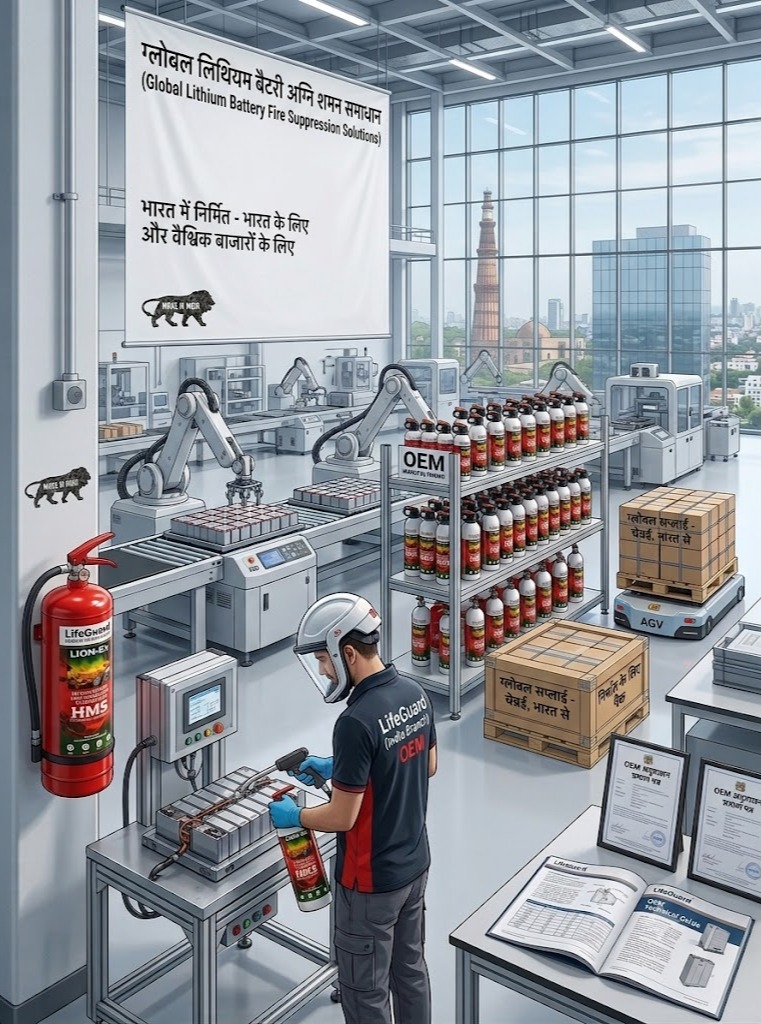
OEM and private-label enquiries may be considered subject to product configuration, minimum order quantity and technical feasibility.
Why Choose LIFEGUARD®?
Established Fire Safety Equipment Manufacturer
LIFEGUARD® fire safety equipment is manufactured by United Fire Equipments Pvt. Ltd., an established Indian manufacturer of firefighting equipment and fire protection systems.
Manufacturer of ISI-Certified Fire Safety Equipment
United Fire Equipments Pvt. Ltd. manufactures ISI-certified fire safety equipment for applicable product categories.
ISI certification applies only to products and models covered under a valid BIS licence. The exact certification and test status of a lithium battery extinguisher should be verified against the specific product offered.
Technical Assistance
Our team can review:
- Battery chemistry
- Battery capacity
- Battery quantity
- Charging arrangement
- Room dimensions
- Battery layout
- Detection requirements
- Suppression requirements
- Project specifications
- Required documentation
Commercial and Documentation Support
Depending on the product and order, available documentation may include:
- Commercial quotation
- Proforma invoice
- Technical data sheet
- Product catalogue
- Operating instructions
- Maintenance information
- Safety Data Sheet
- Available test certificates
- Packing list
- Warranty details
- Country-of-origin documentation for exports
Supply Across India
LIFEGUARD® accepts lithium battery fire extinguisher and project enquiries from:
- Delhi NCR
- Mumbai
- Pune
- Bengaluru
- Chennai
- Hyderabad
- Kolkata
- Ahmedabad
- Surat
- Vadodara
- Jaipur
- Lucknow
- Chandigarh
- Gurugram
- Noida
- Faridabad
- Ghaziabad
- Indore
- Bhopal
- Nagpur
- Kochi
- Coimbatore
- Bhubaneswar
- Guwahati
- Patna
- Visakhapatnam
We also support OEM, bulk-supply and export enquiries for international markets.
Information Required for a Quotation
For an accurate technical and commercial offer, please provide:
- Battery chemistry
- Battery manufacturer and model
- Battery capacity in Ah, Wh, kWh or MWh
- Number of batteries, modules or racks
- Application of the battery
- Indoor or outdoor installation
- Portable, trolley-mounted or fixed-system requirement
- Protected-area dimensions
- Charging arrangement
- Required extinguisher capacity
- Required quantity
- Detection-system requirements
- Project or tender specifications
- Required test standard
- Required certification
- Delivery location
- Required delivery schedule
Complete battery and application details help ensure that the proposed solution is appropriate for the intended hazard.
Lithium Battery Fire Safety Recommendations
A lithium battery fire extinguisher should form part of a complete fire safety programme.
Recommended precautions include:
- Use batteries from reliable manufacturers
- Use only compatible chargers
- Avoid overcharging batteries
- Do not use damaged or swollen batteries
- Keep batteries away from excessive heat
- Maintain adequate ventilation
- Keep charging areas clear of combustible materials
- Avoid charging batteries in escape routes
- Inspect batteries, cables and chargers regularly
- Establish a damaged-battery isolation procedure
- Provide a battery quarantine area
- Install suitable smoke and heat detection
- Provide emergency power isolation
- Train personnel in emergency procedures
- Maintain clear evacuation routes
- Inspect firefighting equipment periodically
- Conduct emergency drills
- Monitor damaged batteries after an incident
- Contact emergency services during a developed fire
Personnel should attempt firefighting only when:
- The fire is small and at an early stage
- The correct extinguisher is available
- The operator is trained
- A safe escape route remains open
- Smoke and heat do not make intervention unsafe
Frequently Asked Questions
Who provides lithium battery fire extinguisher solutions in India?
LIFEGUARD® provides lithium battery fire extinguisher and fire protection solutions for EVs, e-bikes, battery rooms, warehouses, data centres, solar projects and BESS installations.
Which extinguisher is suitable for a lithium-ion battery?
The correct extinguisher depends on battery chemistry, capacity, stored energy, number of cells and application. Battery specifications should be reviewed before product selection.
Can ABC dry powder extinguish a lithium-ion battery fire?
ABC powder may suppress visible flames involving surrounding materials, but it may not provide sufficient cooling to stop thermal runaway inside the battery cells.
Is a Class D extinguisher suitable for lithium-ion batteries?
Class D extinguishers are generally intended for combustible-metal fires. Lithium-ion and lithium-metal batteries are different hazards. The battery chemistry should be confirmed before selecting an extinguisher.
Can a lithium-ion battery re-ignite?
Yes. A damaged battery may retain internal heat and re-ignite after the visible flames have been controlled. Cooling, isolation and continued monitoring may be required.
Do you provide fire extinguishers for e-bike batteries?
LIFEGUARD® accepts enquiries for e-bike, electric scooter and small electric-vehicle battery fire protection applications.
Do you offer fire protection for EV charging stations?
Portable and trolley-mounted firefighting equipment may be considered as part of a wider EV charging-station fire protection arrangement.
Do you provide battery cabinet fire suppression?
Battery cabinet fire protection requirements can be reviewed after receiving the battery capacity, cabinet dimensions, ventilation details and charging arrangement.
Do you provide battery room fire suppression systems?
LIFEGUARD® can review battery room fire detection, alarm, isolation and suppression requirements based on the room and battery details.
Do you provide BESS fire protection solutions?
Technical enquiries for Battery Energy Storage Systems can be reviewed based on battery chemistry, capacity, layout, detection requirements and project specifications.
Are lithium battery fire extinguishers ISI certified?
Certification applies only to specific product categories and models covered by a valid licence or recognised test standard. The exact certification status of the offered lithium battery extinguisher should be confirmed before making a compliance claim.
Do you provide OEM or private-label supply?
OEM and private-label enquiries may be considered subject to product configuration, branding requirements, technical feasibility and minimum order quantity.
Contact LIFEGUARD®
Contact us for lithium battery fire extinguisher prices, technical specifications, project solutions, OEM supply, bulk requirements and distributor enquiries.
Contact LIFEGUARD®
United Fire Equipments Pvt. Ltd.
Manufacturer of ISI Certified Fire Safety Equipment
📞 8048034226