
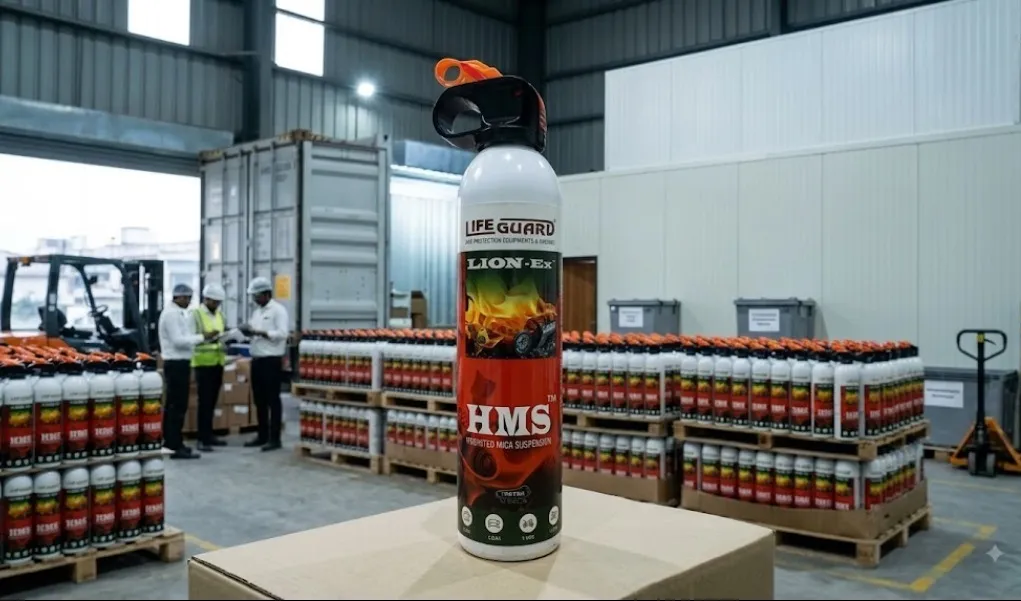
Lithium Battery Fire Protection Exporter Germany
Advanced Lithium Battery Fire Protection Solutions for Germany
The rapid adoption of lithium-ion batteries, electric vehicles (EVs), battery energy storage systems (BESS), renewable-energy storage, data centers, industrial automation and battery manufacturing has increased the importance of specialized lithium battery fire protection in Germany.
Lithium-ion batteries can present hazards including thermal runaway, rapid temperature rise, gas generation, fire and thermal propagation. German fire-protection guidance also emphasizes that lithium batteries require specific consideration because their failure can produce high temperatures, gases, flames and thermal runaway. (BAuA)
LIFEGUARD® – United Fire Equipments Pvt. Ltd. provides fire-safety equipment and application-focused solutions for suitable lithium battery fire-protection requirements.
As a lithium battery fire protection exporter to Germany, LIFEGUARD® can support suitable requirements from battery manufacturers, EV companies, BESS integrators, EPC contractors, distributors, system integrators, warehouses, data centers, laboratories and industrial facilities.
What Is Lithium Battery Fire Protection?
Lithium battery fire protection is a combination of technologies and safety measures designed to:
- Detect abnormal battery conditions
- Identify smoke or excessive heat
- Provide cooling where appropriate
- Control or suppress fire
- Reduce thermal propagation
- Isolate affected electrical equipment
- Support containment
- Improve emergency response
A simplified battery-fire sequence is:
Battery Fault → Temperature Rise → Thermal Runaway → Gas/Smoke → Fire → Thermal Propagation
Because battery chemistry, capacity, cell construction and enclosure design vary, the fire-protection strategy should be application-specific rather than a one-size-fits-all solution.
LIFEGUARD® – Lithium Battery Fire Protection Exporter Germany
LIFEGUARD® – United Fire Equipments Pvt. Ltd. supplies fire-safety equipment and supports application-focused lithium battery fire-protection requirements.
Depending on the project, the protection concept can include:
- Smoke detection
- Heat detection
- Temperature monitoring
- Flame detection where appropriate
- Fire alarm and control systems
- BMS interface
- Electrical isolation
- Battery cooling
- Watermist suppression
- Suitable suppression technologies
- Emergency shutdown
- Thermal propagation management
- Fire containment
The final configuration should be selected according to the battery chemistry, energy capacity, enclosure, installation environment, fire scenario and applicable project requirements.
Why Lithium Battery Fire Protection Is Important in Germany
Germany has a significant ecosystem involving:
- Automotive manufacturing
- Electric mobility
- Battery production
- Battery energy storage
- Renewable energy
- Data centers
- Logistics
- Warehousing
- Industrial automation
- Electronics
- Research and development
German fire-protection guidance recognizes lithium-ion batteries as a specific fire-safety challenge. VdS notes that technical fire-protection measures may be required alongside preventive and organizational measures, particularly for storage and production applications. (VDS)
This makes a carefully engineered battery fire-protection strategy important for German facilities.
Lithium Battery Fire Protection for EVs in Germany
The growth of electric mobility creates applications for battery fire protection in:
- Electric cars
- Electric buses
- Commercial EVs
- EV battery packs
- Battery assembly plants
- EV service centers
- Battery testing facilities
- Charging infrastructure
- Battery storage areas
A suitable protection concept may follow:
Battery Monitoring → Early Detection → Alarm → Electrical Isolation → Cooling/Suppression → Continued Monitoring
LIFEGUARD® can support suitable EV battery fire-protection requirements according to the battery architecture and project specifications.
Lithium Battery Fire Protection for BESS
Battery Energy Storage Systems are increasingly used for:
- Solar energy storage
- Renewable-energy integration
- Backup power
- Commercial energy storage
- Industrial energy management
- Microgrids
- Critical infrastructure
A typical BESS configuration is:
Cell → Module → Rack → Cabinet → Container
A comprehensive protection strategy can incorporate:
- Smoke detection
- Heat detection
- Temperature monitoring
- BMS integration
- Fire alarm integration
- Electrical isolation
- Cooling
- Watermist or other suitable suppression
- Emergency shutdown
- Fire containment
For stationary lithium-ion energy-storage installations in Germany, applicable requirements can include relevant VDE rules, building regulations and project-specific fire-safety requirements. VdS guidance also highlights protected installation areas, fire-resistant separation and integration with fire detection for certain energy-storage applications. (VdS Webshop)
Lithium Battery Fire Protection for Battery Manufacturing
Battery manufacturing facilities can include:
- Cell production
- Cell assembly
- Module assembly
- Battery-pack assembly
- Formation
- Charging
- Electrical testing
- Quality-control areas
- Battery storage
- R&D laboratories
Different process areas can have different hazards.
A suitable protection strategy should therefore consider:
- Battery chemistry
- Energy capacity
- Production process
- Equipment layout
- Detection
- Cooling
- Suppression
- Ventilation
- Fire compartmentation
- Emergency shutdown
VdS reports that newer fire-protection guidance for lithium-ion battery manufacturing and storage addresses not only extinguishing systems but also structural and organizational measures, demonstrating the importance of a layered protection approach. (VDS)
Lithium Battery Fire Protection for Warehouses
Lithium battery warehouses can present significant fire-protection challenges.
Important factors include:
- Battery chemistry
- State of charge
- Energy content per storage unit
- Storage quantity
- Storage height
- Packaging
- Rack configuration
- Ventilation
- Fire compartmentation
- Detection
- Suppression
- Emergency access
VdS 3856 classifies lithium batteries by energy content per storage unit, with higher-energy storage requiring greater consideration. VdS also emphasizes cooling of batteries not involved in a fire as an important issue in managing thermal runaway. (VdS Webshop)
Therefore, fire-protection systems for German warehouses should be designed around the actual storage configuration.
Lithium Battery Watermist Fire Protection
Watermist can be considered for suitable lithium battery applications where cooling and heat absorption are important objectives.
Fine water droplets can absorb heat as they warm and evaporate. However, watermist should not be marketed as a universal solution for all lithium battery incidents.
Potential applications include:
- Battery rooms
- Battery cabinets
- BESS containers
- Battery racks
- Battery testing areas
- Suitable EV battery applications
Important engineering parameters include:
- Nozzle characteristics
- Nozzle positioning
- Water flow
- Operating pressure
- Discharge duration
- Coverage
- Detection response
- Battery configuration
The suitability of a watermist system should be established through application-specific engineering and appropriate testing/validation.
Lithium Battery Cooling & Thermal Runaway Protection
Cooling is an important component of many battery fire-protection strategies.
A layered thermal-runaway protection concept can include:
1. Monitoring
Monitor battery temperature and operating parameters.
2. Early Detection
Identify abnormal temperature, smoke or other warning indicators.
3. Alarm
Send an alarm to the fire alarm/control system.
4. Electrical Isolation
Where appropriate, isolate affected equipment.
5. Cooling & Suppression
Apply the engineered cooling or suppression method where appropriate.
6. Containment
Limit the spread of heat and fire.
7. Continued Monitoring
Monitor for residual heat and possible re-ignition.
This approach is especially relevant for high-energy battery installations.
Lithium Battery Fire Protection for German Data Centers
Data centers depend on battery systems for:
- UPS
- Backup power
- Critical infrastructure
- Energy storage
Battery rooms and battery cabinets require careful assessment because protection must address the battery hazard while also considering sensitive electronic equipment and business continuity.
A suitable strategy can integrate:
Detection → Alarm → Electrical Isolation → Cooling/Suppression → Emergency Response
Lithium Battery Fire Protection for Renewable Energy
Germany's renewable-energy infrastructure increasingly relies on energy-storage technologies.
Potential applications include:
- Solar BESS
- Commercial storage
- Industrial storage
- Hybrid renewable systems
- Microgrids
- Backup energy systems
Fire protection should consider the complete battery installation, including:
- Battery enclosure
- Capacity
- Ventilation
- Detection
- Thermal propagation
- Emergency shutdown
- Suppression/cooling
Lithium Battery Fire Protection Exporter for OEM Projects
LIFEGUARD® can support suitable OEM, EPC and system-integrator requirements for international projects.
Potential support includes:
- Application assessment
- Product selection
- System configuration
- Detection integration
- Control integration
- Cooling/suppression integration
- Technical documentation
- Project coordination
OEM solutions should be developed according to the customer's battery design and intended application.
Why Choose LIFEGUARD® for Lithium Battery Fire Protection Export to Germany?
Indian Fire-Safety Manufacturer
LIFEGUARD® – United Fire Equipments Pvt. Ltd. provides fire-safety equipment and solutions from India.
Application-Focused Approach
Battery fire protection is considered according to the actual hazard rather than a generic configuration.
Customized Solutions
Solutions can consider:
- Battery chemistry
- Capacity
- Enclosure
- Rack configuration
- Detection
- Cooling
- Suppression
Integrated Protection
Detection, alarm, control, cooling and suppression can be coordinated into an appropriate system architecture.
OEM & EPC Support
LIFEGUARD® can support suitable OEMs, EPC contractors, distributors and system integrators.
International Export Capability
LIFEGUARD® can support suitable international requirements for lithium battery fire-protection equipment and solutions.
Lithium Battery Fire Protection Applications in Germany
LIFEGUARD® can support suitable applications in major German industrial markets, including:
Munich
Automotive, EV, battery technology and industrial applications.
Stuttgart
Automotive manufacturing, EV batteries and battery development.
Frankfurt
Data centers, logistics and critical infrastructure.
Berlin
Technology, energy storage and commercial applications.
Hamburg
Logistics, industrial facilities and renewable-energy applications.
Düsseldorf
Industrial, commercial and logistics applications.
Cologne
Manufacturing, logistics and commercial infrastructure.
Leipzig & Dresden
Battery manufacturing, automotive, electronics and industrial technology.
The final fire-protection configuration should be based on the actual site, battery system and applicable German requirements.
German Fire-Safety & Compliance Considerations
Lithium battery projects in Germany may need to consider:
- Applicable German fire-safety requirements
- Local building regulations
- Fire authority requirements
- Applicable DIN standards
- Applicable EN standards
- Relevant VdS requirements
- Applicable VDE requirements
- Manufacturer instructions
- Project specifications
- Insurance requirements
- Authority Having Jurisdiction (AHJ) requirements
For stationary lithium battery energy-storage systems, VdS information references VDE-AR-E 2510-50 and other relevant battery-safety standards and installation requirements. (VdS Webshop)
For lithium battery storage, VdS publications also provide specific guidance concerning separation, detection, storage conditions and extinguishing systems. (VdS Webshop)
Important: the exact compliance requirements depend on the battery type, application, building, location and authority. Product certification should only be claimed for certifications actually held by the specific product/system.
Lithium Battery Fire Protection System Design Process
Step 1 – Application Assessment
Identify battery chemistry, capacity, configuration and operating environment.
Step 2 – Hazard Assessment
Evaluate thermal runaway, fire and thermal-propagation scenarios.
Step 3 – Detection Strategy
Select appropriate smoke, heat and temperature-monitoring technologies.
Step 4 – Protection Strategy
Evaluate suitable cooling, watermist and/or other suppression technologies.
Step 5 – Control Integration
Integrate detection, alarm, shutdown and suppression functions.
Step 6 – Engineering
Develop the system according to the approved application and relevant requirements.
Step 7 – Testing & Validation
Conduct application-specific testing and validation where required.
Step 8 – Installation & Commissioning
Install and commission according to the approved design.
Step 9 – Maintenance
Establish periodic inspection, testing and maintenance procedures.
Maintenance of Lithium Battery Fire Protection Systems
Regular maintenance helps maintain system readiness.
Maintenance may include:
- Smoke detector testing
- Heat detector testing
- Temperature-monitoring checks
- Alarm testing
- Control-panel inspection
- Nozzle inspection
- Pipework inspection
- Valve inspection
- Water-supply checks
- Pressure checks
- Functional testing
- Emergency-shutdown testing
- Documentation review
Maintenance should follow the approved system design, manufacturer's instructions and applicable standards.
Frequently Asked Questions
What does a lithium battery fire protection exporter do?
A lithium battery fire-protection exporter supplies suitable fire-safety equipment and solutions to international customers for battery-related applications.
Why is lithium battery fire protection important in Germany?
Lithium-ion batteries are increasingly used in EVs, energy storage, electronics and industrial applications, while German fire-safety guidance recognizes their specific thermal runaway and fire risks. (VDS)
Can LIFEGUARD® export lithium battery fire protection equipment to Germany?
LIFEGUARD® can support suitable international customer and project requirements for lithium battery fire-protection equipment and systems.
Can watermist be used for lithium batteries?
Watermist may be suitable for selected applications where cooling is a key objective. Its suitability must be established through engineering and appropriate testing.
Can LIFEGUARD® support BESS fire protection?
Yes, suitable BESS protection concepts can be developed according to the battery configuration, enclosure, detection requirements and project specifications.
Can the system integrate with a fire alarm panel?
Yes. Compatible detection, alarm, shutdown and suppression functions can be integrated according to the approved system architecture.
Conclusion
The expansion of electric vehicles, lithium battery manufacturing, BESS, renewable energy, data centers and industrial automation is increasing the demand for specialized battery fire protection in Germany.
LIFEGUARD® – United Fire Equipments Pvt. Ltd. provides application-focused lithium battery fire-protection equipment and solutions for export to Germany, supporting suitable requirements for EV batteries, BESS, battery manufacturing, warehouses, data centers, laboratories and industrial facilities.
A comprehensive strategy can combine early detection, temperature monitoring, cooling, suppression, electrical isolation, containment and emergency response according to the specific battery hazard.
For organizations searching for a lithium battery fire protection exporter in Germany, LIFEGUARD® can support project-oriented solutions based on battery chemistry, configuration, installation environment and customer requirements.
Contact LIFEGUARD®
United Fire Equipments Pvt. Ltd.
Manufacturer of ISI Certified Fire Safety Equipment
📞 Phone: 8048034226
📧 Email: ufe126@gmail.com | info@lifeguardindia.in
🌐 Website: www.lifeguardindia.in
Contact LIFEGUARD® for lithium battery fire protection systems, battery cooling systems, watermist suppression, thermal runaway protection, EV battery fire protection and BESS fire-safety solutions for Germany and international markets.
SEO Keyword Suggestions
- lithium battery fire protection exporter Germany
- lithium battery fire protection system exporter Germany
- lithium ion battery fire protection exporter Germany
- lithium battery fire suppression exporter Germany
- lithium battery fire safety exporter Germany
- lithium battery fire protection company Germany
- lithium battery fire protection supplier Germany
- lithium battery fire protection solutions Germany
- lithium battery thermal runaway protection Germany
- lithium battery thermal runaway suppression Germany
- EV battery fire protection exporter Germany
- EV battery fire suppression system Germany
- BESS fire protection exporter Germany
- BESS fire suppression system Germany
- lithium battery watermist suppression exporter Germany
- lithium battery cooling system exporter Germany
- battery energy storage fire protection Germany
- lithium battery fire safety equipment exporter Germany
- lithium battery fire protection OEM exporter Germany
- lithium battery fire protection system provider Germany
- lithium battery fire protection Munich
- lithium battery fire protection Stuttgart
- lithium battery fire protection Frankfurt
- lithium battery fire protection Berlin
- lithium battery fire protection Hamburg
- lithium battery fire protection Düsseldorf
- lithium battery fire protection Cologne
- lithium battery fire protection Leipzig
- lithium battery fire protection Dresden
Suggested SEO Title
Lithium Battery Fire Protection Exporter Germany | LIFEGUARD®
Meta Description
LIFEGUARD® is a lithium battery fire protection exporter to Germany, providing application-focused fire protection, cooling and suppression solutions for EV batteries, BESS, battery manufacturing, warehouses, data centers and industrial applications.
Suggested URL Slug
/lithium-battery-fire-protection-exporter-germany
Keywords






