
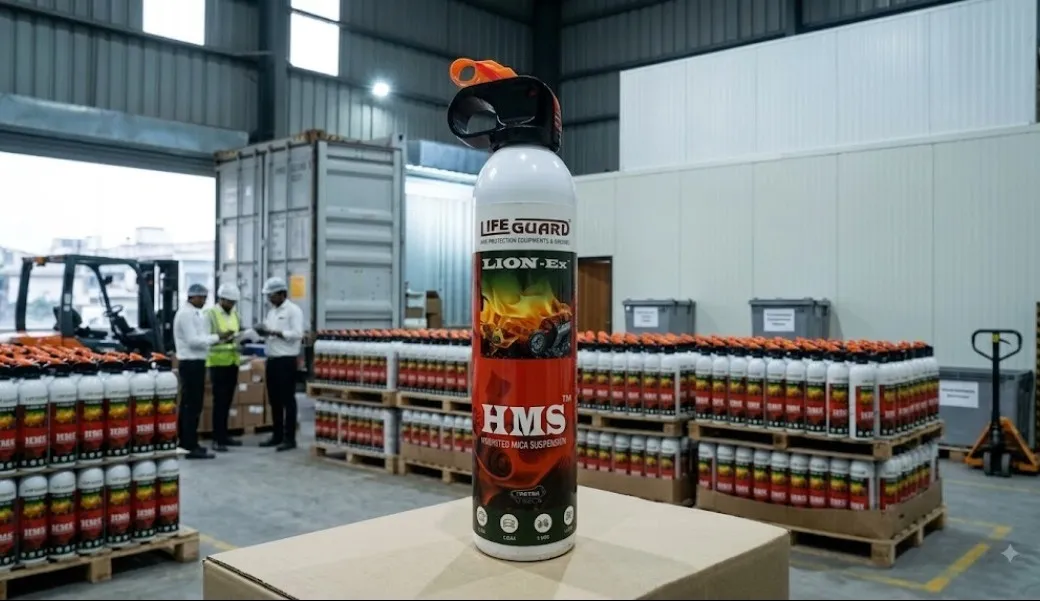
Lithium Battery Fire Protection OEM Manufacturer Germany
Advanced Lithium Battery Fire Protection Solutions for German Industries
The rapid adoption of lithium-ion batteries in electric vehicles, energy storage systems, industrial automation, robotics, electronics, data centres and renewable-energy applications has created a growing requirement for specialized fire protection. Unlike conventional fire hazards, lithium battery incidents can involve thermal runaway, rapid temperature escalation, flammable gas generation, cell-to-cell propagation and possible re-ignition.
LIFEGUARD® – United Fire Equipments Pvt. Ltd. provides lithium battery fire protection OEM solutions for Germany, supporting battery manufacturers, energy-storage companies, system integrators, distributors and industrial customers with application-oriented fire protection products and customized configurations.
Our objective is to help customers develop a practical protection strategy combining early detection, alarm, suppression, cooling, isolation and monitoring, depending on the characteristics of the battery installation.
Lithium Battery Fire Protection OEM Manufacturer for Germany
As an OEM-focused fire protection company, LIFEGUARD® can support businesses looking for customized lithium battery fire protection equipment for the German market.
Our OEM solutions can be considered for:
- Lithium-ion battery manufacturers
- Battery pack and module manufacturers
- EV battery applications
- Battery Energy Storage Systems (BESS)
- Battery cabinets
- Battery containers
- UPS battery systems
- Robotics and AGV systems
- Forklift battery applications
- Battery charging areas
- Battery testing laboratories
- Industrial energy storage
- Electronics and electrical equipment
- Renewable-energy storage applications
OEM projects can be developed according to the customer's application, battery configuration, enclosure design, required detection method and suppression strategy.
Why Lithium Battery Fire Protection Requires a Specialized Approach
Lithium-ion batteries can experience thermal runaway when a cell undergoes uncontrolled self-heating. Depending on the battery design and circumstances, thermal runaway can produce substantial heat and gases and may propagate to neighbouring cells.
Therefore, simply extinguishing visible flames may not address the complete hazard.
An effective lithium battery fire protection strategy should consider:
1. Early Detection
Early detection can provide valuable time for alarms, shutdown procedures and emergency response. Depending on the application, detection technologies may include:
- Temperature detection
- Heat detection
- Smoke detection
- Aspirating smoke detection
- Gas or off-gas detection
- Multi-parameter detection
The appropriate technology should be selected according to the battery system and installation.
2. Thermal Runaway Detection
Monitoring abnormal temperature or other indicators of battery failure can help identify potentially dangerous conditions before the event develops into a larger incident.
3. Fire Suppression
The suppression system should be selected based on the battery configuration, enclosure, available installation space, fire scenario and project requirements.
4. Cooling
Cooling can be a critical consideration because suppressing flames does not necessarily eliminate residual heat inside damaged battery cells.
5. Propagation Control
A battery fire protection system should consider the possibility of thermal propagation between cells, modules and racks.
6. Post-Incident Monitoring
Depending on the battery system, continued monitoring after an incident may be necessary because residual heat can present an ongoing risk.
LIFEGUARD® Lithium Battery Fire Protection OEM Solutions
LIFEGUARD® provides configurable fire protection solutions for different lithium battery applications.
Battery Cabinet Fire Protection
Battery cabinets are widely used for energy storage, UPS systems and industrial applications. A cabinet protection system may incorporate:
- Early-warning detection
- Heat/smoke detection
- Alarm indication
- Automatic suppression
- Cooling provisions
- Electrical shutdown interface
- Manual release
- Emergency indication
- Control-panel integration
- Monitoring and fault indication
The final configuration should be engineered according to cabinet size, battery capacity, chemistry, ventilation and installation conditions.
BESS Fire Protection
Battery Energy Storage Systems require careful consideration because large quantities of stored electrical energy can create complex fire and thermal-propagation hazards.
LIFEGUARD® can support protection requirements for:
- Containerized BESS
- Battery racks
- Energy storage cabinets
- Indoor BESS rooms
- Commercial energy storage
- Industrial energy storage
- Solar battery storage
- Utility-scale battery installations
A BESS fire protection concept may combine detection, alarm, suppression, cooling, ventilation, shutdown and emergency-response interfaces.
Battery Room Fire Protection
For dedicated battery rooms, the protection strategy can be developed around:
Battery Monitoring → Early Detection → Alarm → Equipment Shutdown → Fire Suppression/Cooling → Continued Monitoring
Room volume, battery energy capacity, ventilation, battery chemistry, occupancy and emergency procedures should all be considered during system design.
OEM & Private Label Lithium Battery Fire Protection
German distributors and manufacturers may require products supplied under their own brand or integrated into their own equipment.
LIFEGUARD® can evaluate OEM and private-label requirements such as:
- Customized product configuration
- Customer branding
- Private-label manufacturing
- Product labels
- Packaging requirements
- Technical documentation
- Installation instructions
- Bulk supply
- System integration
- Project-specific engineering
OEM requirements should be evaluated individually to ensure that the selected equipment is appropriate for the intended application and that applicable European/German conformity and documentation requirements are addressed.
Applications for Lithium Battery Fire Protection in Germany
Electric Vehicle & Automotive Industry
Germany has a major automotive and industrial ecosystem, making battery safety important for:
- EV battery manufacturing
- Battery assembly
- Battery testing
- EV service facilities
- Battery storage
- Automotive component manufacturing
Energy Storage
Lithium battery fire protection can be applied to:
- BESS
- Solar energy storage
- Commercial battery systems
- Industrial energy storage
- UPS systems
- Microgrid storage
Warehousing & Logistics
Lithium batteries are increasingly present in:
- Automated warehouses
- AGVs
- Forklifts
- Battery charging stations
- Material-handling equipment
- Logistics centres
Industrial Automation
Protection requirements may arise for:
- Robotics
- Automated production equipment
- Industrial battery systems
- Mobile robots
- Battery-powered machinery
Research & Development
Specialized battery fire protection may also be required in:
- Battery laboratories
- Testing centres
- R&D facilities
- Prototype battery areas
- Battery performance testing installations
Battery Cooling and Thermal Runaway Protection
One of the important aspects of lithium battery safety is managing heat.
A battery that has entered thermal runaway may continue generating heat even after visible flames have been suppressed. Consequently, cooling and thermal management can be important elements of a complete fire safety strategy.
LIFEGUARD® can evaluate requirements for battery fire protection and cooling based on:
- Cell arrangement
- Module construction
- Battery capacity
- Cabinet dimensions
- Rack configuration
- Thermal characteristics
- Installation environment
- Required response time
The final solution should always be validated for the specific battery technology and application.
Lithium Battery Fire Protection for German OEMs
LIFEGUARD® works with customers seeking OEM solutions rather than generic off-the-shelf fire protection.
For an OEM project, our technical team can evaluate:
Battery Details → Risk Assessment → Detection → Control Logic → Suppression → Cooling → Alarm → Shutdown → Monitoring
This approach helps manufacturers integrate fire protection into their equipment from the design stage.
Standards and Compliance Considerations
For projects in Germany, the applicable European, German and project-specific requirements should be identified before final product selection.
Depending on the application, customers may need to consider relevant standards, testing methods and guidance relating to:
- Lithium battery safety
- Battery energy storage
- Fire detection
- Fire suppression
- Electrical safety
- Machinery safety
- EMC
- CE conformity
- German fire-safety requirements
- Requirements of the local authority having jurisdiction
Standards and certification requirements vary according to product and application. Therefore, customers should verify the exact compliance requirements for the final installation rather than assuming that one certification applies to every lithium battery fire protection system.
Why Choose LIFEGUARD®?
OEM Capability
LIFEGUARD® can evaluate customized OEM and private-label requirements for manufacturers, distributors and system integrators.
Application-Focused Design
Rather than applying the same configuration to every battery, the protection strategy can be developed around the actual battery and installation.
Complete Protection Concept
Detection, alarm, suppression, cooling, shutdown and monitoring can be considered as interconnected parts of the overall safety system.
International Supply
LIFEGUARD® supports international enquiries and can review OEM and export requirements for customers in Germany.
Technical Support
Customers can share battery specifications, drawings and application information so that the required protection concept can be evaluated.
What Information Is Required for an OEM Enquiry?
For faster technical evaluation, customers can provide:
- Battery chemistry – LFP, NMC or other
- Battery manufacturer and model
- Cell/module/pack specifications
- Battery capacity
- Total energy capacity
- Number of battery modules
- Number of racks
- Cabinet/container dimensions
- Battery-room dimensions
- Charging conditions
- Indoor or outdoor installation
- Ventilation arrangement
- Operating temperature
- Required detection method
- Required suppression method
- Quantity required
- OEM/private-label requirements
- Required documentation
- Delivery location in Germany
These details help the manufacturer evaluate the actual fire risk and recommend a suitable configuration.
Lithium Battery Fire Protection Manufacturer Serving Germany
LIFEGUARD® can accept enquiries from companies across Germany, including customers in:
- Berlin
- Hamburg
- Munich
- Frankfurt
- Stuttgart
- Düsseldorf
- Cologne
- Leipzig
- Dortmund
- Bremen
- Hanover
- Nuremberg
- Dresden
- Essen
- Bonn
- Mannheim
- Karlsruhe
- Wolfsburg
- Ingolstadt
- Aachen
Our solutions can be considered for battery manufacturers, BESS companies, EV businesses, industrial manufacturers, distributors, system integrators and OEMs.
Frequently Asked Questions
Who is a lithium battery fire protection OEM manufacturer for Germany?
LIFEGUARD® – United Fire Equipments Pvt. Ltd. provides lithium battery fire protection solutions and evaluates OEM requirements for German industrial, battery, energy-storage and system-integration applications.
Can LIFEGUARD® provide customized lithium battery fire protection?
Yes. Customized solutions can be evaluated based on battery chemistry, capacity, enclosure, installation conditions, detection requirements and suppression strategy.
Does LIFEGUARD® support BESS fire protection requirements?
Yes. BESS requirements can be evaluated for battery cabinets, racks, rooms and containerized systems. The final fire protection strategy should be based on the specific BESS design and risk assessment.
Is the same fire suppression system suitable for every lithium battery?
No. Battery chemistry, energy capacity, enclosure design, thermal characteristics and installation conditions can differ substantially. The protection system should therefore be selected for the specific application.
Can German companies request OEM/private-label products?
Yes. LIFEGUARD® can evaluate OEM and private-label enquiries involving customized configurations, branding, packaging and documentation requirements.
SEO Keywords
Primary Keyword:
Lithium battery fire protection OEM manufacturer Germany
Secondary Keywords:
- Lithium battery fire protection manufacturer Germany
- Lithium battery fire protection OEM Germany
- Lithium battery fire suppression OEM Germany
- Lithium battery fire protection supplier Germany
- Lithium-ion battery fire protection Germany
- Battery fire protection system Germany
- Lithium battery thermal runaway protection Germany
- Lithium battery fire suppression system Germany
- BESS fire protection Germany
- Battery cabinet fire protection Germany
- Lithium battery fire safety manufacturer Germany
- Lithium battery protection system Germany
- Lithium battery fire protection company Germany
Suggested SEO Meta Title
Lithium Battery Fire Protection OEM Manufacturer Germany | LIFEGUARD®
Suggested Meta Description
LIFEGUARD® is a lithium battery fire protection OEM manufacturer serving Germany with customized solutions for battery cabinets, BESS, EV, industrial and energy-storage applications.
Suggested URL Slug
/lithium-battery-fire-protection-oem-manufacturer-germany/
Contact LIFEGUARD®
LIFEGUARD®
United Fire Equipments Pvt. Ltd.
Manufacturer of ISI Certified Fire Safety Equipment
Phone: 8048034226
Email: ufe126@gmail.com | info@lifeguardindia.in
Website: www.lifeguardindia.in
Get a Lithium Battery Fire Protection OEM Solution for Germany
Are you looking for a lithium battery fire protection OEM manufacturer in Germany for a battery cabinet, BESS, EV application, industrial battery system or private-label product?
Contact LIFEGUARD® – United Fire Equipments Pvt. Ltd. with your battery specifications, application details and project requirements. Our team can evaluate the application and develop a suitable technical and commercial proposal for your lithium battery fire protection requirement.
Keywords






