
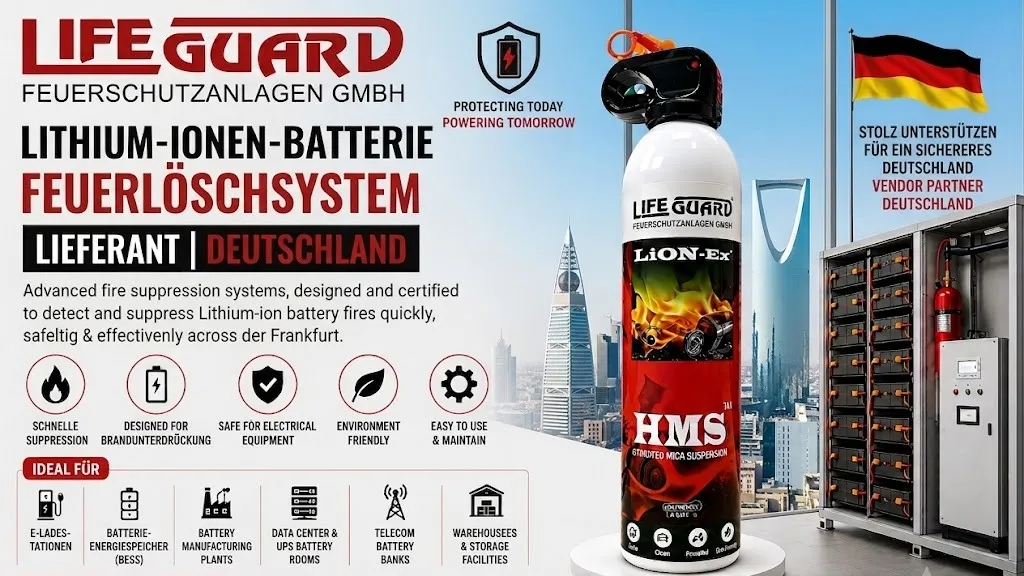
Lithium Battery Fire Safety Company in Germany
Lithium-ion batteries are increasingly used wherever efficient electrical storage, electrification or uninterrupted power is required. Battery applications range from relatively compact UPS cabinets to large multi-megawatt BESS installations.
LIFEGUARD® follows a project-specific approach to lithium battery fire safety. Instead of applying one standard suppression arrangement to every application, the system concept can be developed around battery chemistry, battery capacity, voltage, module configuration, rack geometry, enclosure dimensions, ventilation and the required protection objective.
This approach is suitable for German EPC contractors, BESS developers, battery manufacturers, EV companies, renewable-energy organizations, consultants, system integrators, data-centre contractors and industrial users seeking specialized lithium-ion battery protection.
Why Lithium-Ion Batteries Require Specialized Fire Protection
A lithium-ion battery stores both electrical and chemical energy inside a compact cell. Under normal operating conditions, this makes lithium-ion technology highly efficient for modern energy-storage applications.
However, battery failure may be initiated by internal short circuits, overcharging, mechanical damage, excessive temperature, electrical faults, charging-system malfunction, manufacturing defects or battery degradation.
Under severe conditions, the battery cell may enter thermal runaway. During thermal runaway, internal reactions generate additional heat, and the cell can potentially release smoke, gases and hot material. Ignition may occur, and the heat can influence nearby cells.
The event can potentially progress from an individual cell to a module, from a module to a battery rack and from the rack to a larger cabinet or BESS enclosure.
This is why lithium battery fire protection needs to consider much more than extinguishing a visible flame.
Integrated Lithium Battery Fire Safety Strategy
An effective lithium-ion battery protection philosophy should incorporate multiple layers of safety.
A typical engineered sequence may be:
Early Detection → Alarm → Equipment Isolation → Fire Suppression → Propagation Control → Continued Monitoring
Depending on the project configuration, the system may also interface with the Battery Management System, electrical shutdown, ventilation systems, fire alarm system or other emergency-control functions.
The final sequence should always be coordinated with the battery manufacturer's recommendations, risk assessment, consultant requirements and applicable German and European project requirements.
Complete Lithium Battery Fire Safety Solutions Germany
Depending upon the protected application, LIFEGUARD® can support a combination of the following technologies and equipment:
- Very early or aspirating smoke detection, Linear Heat Sensing, temperature monitoring, suitable gas detection, flame detection, automatic suppression, local application suppression, battery rack suppression, lithium battery cabinet protection, BESS container fire protection, detection and releasing panels, suppression cylinders, distribution piping or stainless-steel tubing, flexible discharge connections, rack manifolds, discharge nozzles, manual release facilities, abort switches, audible/visual alarms, equipment shutdown interfaces and system monitoring.
The appropriate combination should be selected according to the identified battery hazard rather than by using a generic fire protection package.
BESS Fire Safety Company Germany
Battery Energy Storage Systems (BESS) are an important part of modern energy infrastructure because they enable electrical energy to be stored and delivered when required.
A typical BESS contains lithium-ion cells assembled into modules. Multiple modules are installed in racks, and racks may be positioned within cabinets, dedicated battery rooms or containerized energy-storage units.
In simplified form:
Battery Cell → Module → Battery Rack → Cabinet → BESS Container
Because significant stored energy may be concentrated within a relatively compact space, fire detection, control and emergency response require careful engineering.
LIFEGUARD® can support fire protection concepts for utility-scale BESS, commercial battery storage, industrial energy storage, renewable-energy projects, solar-plus-storage, wind-energy storage, microgrids and backup-energy installations.
BESS Fire Suppression System Germany
An effective BESS fire suppression system should be developed around the actual battery architecture rather than selected solely according to container or room volume.
The engineering team should consider battery chemistry, battery make and model, operating voltage, total energy capacity in kWh or MWh, module quantity, number of racks, rack dimensions, equipment spacing, enclosure configuration, ventilation, detection philosophy, suppression objectives and emergency shutdown requirements.
These inputs help determine the appropriate detection arrangement, distribution network, nozzle positioning and system activation philosophy.
Lithium Battery Thermal Runaway Protection Germany
Thermal runaway is one of the most important hazards associated with lithium-ion battery technology.
Once an affected cell enters an unstable condition, internal reactions can continue producing heat. Depending upon the battery design and failure scenario, this can lead to rapid temperature increase, off-gassing, smoke production, ignition, heat transfer to neighbouring cells and possible propagation.
Another important consideration is the possibility of re-ignition, because internal heat generation may continue even when an external flame has initially been controlled.
For this reason, lithium battery safety should focus strongly on early warning and timely intervention.
Early Thermal Runaway Detection
Detecting abnormal battery conditions at an early stage can provide valuable additional response time.
A layered detection philosophy can potentially combine smoke, heat and suitable gas-detection technologies. Once the predetermined detection criteria are reached, the control system can initiate alarms and other approved safety actions.
The response may include equipment isolation, ventilation control, electrical shutdown or suppression activation depending on the approved cause-and-effect philosophy.
Aspirating Smoke Detection for BESS
Aspirating smoke detection continuously draws air samples from the protected environment and analyses them for developing smoke conditions.
This technology can be particularly useful in critical areas such as BESS containers, lithium-ion battery rooms, data centres, UPS battery areas, EV battery testing laboratories and electrical equipment rooms.
Earlier detection can provide additional time for alarm initiation and appropriate emergency actions.
Linear Heat Sensing for Lithium Battery Racks
Linear Heat Sensing can be routed close to lithium-ion battery modules, racks and cabinets.
Unlike a single point-type heat detector, a sensing cable can follow the geometry of the protected equipment and provide heat-related detection across an extended area.
This makes it useful for individual battery racks, rack rows, BESS cabinets, battery modules, cable routes and other locations where localized heat detection is required.
Linear Heat Sensing can also be integrated with the fire alarm or suppression releasing controls according to the approved system logic.
Gas Detection for Lithium-Ion Battery Safety
Certain abnormal lithium-ion battery conditions can be accompanied by the release of gases before or during thermal runaway.
Where justified by the battery chemistry and project risk assessment, appropriate gas detection can provide an additional layer of early warning.
The gas-detection system may be integrated with alarms, ventilation control, emergency shutdown, fire suppression controls or building-management interfaces.
Detector selection should be based on the expected gases, required sensitivity and operating environment.
Flame Detection for Lithium Battery Applications
Flame detection can provide another detection layer in selected applications where rapid identification of an established flame is important.
Typical applications can include EV battery test laboratories, battery R&D facilities, industrial testing areas and battery manufacturing environments.
The detector type and positioning should be selected according to the expected flame characteristics, viewing angle, potential obstructions and environmental conditions.
Automatic Lithium Battery Fire Suppression System Germany
LIFEGUARD® can develop suppression systems for different levels of battery protection.
Depending on the application, fire suppression may be considered at battery cabinet level, individual rack level, multi-rack level or BESS container/battery-room level.
The selected approach should consider battery chemistry, energy capacity, module arrangement, rack construction, enclosure size, ventilation, detection technology and the required fire protection objective.
This application-oriented engineering approach is important because the protection requirements of a compact UPS battery cabinet can be significantly different from those of a utility-scale BESS installation.
Battery Rack Fire Suppression System Germany
Battery racks contain several lithium-ion modules positioned relatively close together. Localized rack protection can therefore provide suppression close to the identified hazard.
A typical arrangement can follow:
Detection System → Releasing Panel → Suppression Cylinder → Distribution Piping → Flexible Connection → Battery Rack Manifold → Discharge Nozzles
The final nozzle arrangement should consider the battery rack dimensions, module locations, openings, airflow paths, spacing and required discharge coverage.
For larger BESS installations, rack-specific or zoned suppression arrangements can be evaluated depending upon the approved protection philosophy.
Lithium Battery Cabinet Fire Suppression Germany
Lithium-ion battery cabinets are increasingly used in data centres, telecom infrastructure, UPS installations, renewable-energy applications and commercial or industrial energy-storage systems.
A compact cabinet suppression arrangement can incorporate automatic detection, suppression storage, distribution tubing, strategically positioned nozzles, alarm indication, releasing controls and manual activation facilities.
Because cabinet designs vary considerably, nozzle positioning and detection arrangement should be developed around the actual internal battery configuration.
HMS Fire Suppression Solutions for Lithium Batteries
LIFEGUARD® also works with specialized HMS – Hydrated Mica Suspension based fire suppression solutions for lithium-ion battery applications.
HMS-based solutions can be evaluated for battery racks, battery cabinets, BESS installations, battery rooms, EV battery test facilities and selected industrial battery applications.
Depending on the project design, the system may incorporate HMS extinguishing agent, suppression cylinders, Linear Heat Sensing, detection tubing, stainless-steel distribution tubing or piping, flexible connections, rack manifolds, discharge nozzles, detection/releasing controls, manual release, abort facilities and audible/visual alarms.
The final arrangement should be engineered according to the battery configuration and the project's defined protection objectives.
EV Battery Fire Safety Company Germany
Germany's extensive automotive and engineering sector makes lithium-ion battery fire protection particularly relevant to electric mobility.
Specialized protection can be considered for EV battery production, battery module assembly, pack assembly, battery testing, EV research laboratories, charging facilities, vehicle workshops, battery storage and damaged-battery isolation areas.
Each of these environments has a different operating condition and fire-risk profile.
LIFEGUARD® therefore develops protection concepts according to the actual battery activity and facility configuration.
EV Battery Testing Laboratory Fire Protection Germany
Battery test laboratories may subject lithium-ion cells, modules and complete packs to demanding electrical, thermal and environmental conditions.
Testing can involve charging and discharging, thermal evaluation, battery performance testing, environmental simulation, prototype development and product validation.
An engineered fire protection approach can incorporate early detection, localized heat sensing, automatic alarms, suppression and emergency shutdown interfaces.
Battery Manufacturing Plant Fire Safety Germany
Battery manufacturing and assembly operations can involve different fire risks at different stages of production.
Cell handling, module assembly, pack assembly, formation and charging, testing, finished-battery storage, research laboratories and damaged-battery quarantine areas may each need a different protection strategy.
A project-specific assessment allows detection and suppression to be designed according to the process rather than using identical protection throughout the facility.
Data Centre Lithium Battery Fire Safety Germany
Lithium-ion batteries are increasingly used for UPS and backup-energy applications within data centres and mission-critical facilities.
A battery-related incident can potentially affect UPS systems, electrical distribution, server infrastructure, network availability and overall business continuity.
A suitable lithium battery fire protection strategy can incorporate very early smoke detection, localized heat monitoring, battery cabinet suppression, battery-room protection, alarms, equipment shutdown interfaces and system monitoring.
Renewable Energy & BESS Fire Protection Germany
Lithium-ion battery storage is particularly important to renewable-energy applications because electrical energy generated from solar or wind sources can be stored and used when required.
BESS fire protection can therefore be relevant to solar-plus-storage projects, wind-energy storage, utility-scale energy storage, commercial BESS, microgrids and industrial energy-management installations.
The safety system should reflect the total battery capacity and physical arrangement of the installation.
Lithium Battery Warehouse Fire Safety Germany
Battery warehouses can contain significant quantities of lithium-ion cells, modules or complete battery packs.
Fire safety planning should consider battery chemistry, state of charge, total quantity, packaging, rack height, storage configuration, ventilation, damaged-battery segregation and emergency access.
An effective warehouse strategy can combine early detection, appropriate suppression provisions, emergency equipment and clear procedures for identifying and isolating damaged or unstable batteries.
Lithium Battery Charging Area Fire Safety
Battery charging can introduce additional thermal and electrical stresses.
Specialized protection can therefore be considered for EV charging facilities, industrial battery charging rooms, battery swap areas, forklift charging installations, lithium-ion battery charging cabinets and battery laboratories.
Where required, the fire detection system can interface with electrical isolation or other emergency shutdown functions.
Lithium Battery Fire Safety Company Berlin
LIFEGUARD® can support lithium battery fire protection enquiries associated with Berlin, including BESS installations, data centres, commercial battery storage, R&D applications and industrial lithium-ion battery systems.
Lithium Battery Fire Safety Hamburg
Projects in Hamburg can involve energy storage, industrial installations, warehouses, logistics operations, renewable energy and critical electrical infrastructure.
Project-specific detection and suppression concepts can be evaluated according to battery specifications and facility layout.
EV Battery Fire Safety Stuttgart
The automotive ecosystem around Stuttgart makes EV battery fire protection particularly relevant to manufacturing, research, testing, module and pack assembly, and battery storage applications.
Lithium Battery Fire Safety Munich
For Munich and Bavaria, LIFEGUARD® can support technical enquiries involving BESS, EV applications, industrial battery systems, commercial energy storage and lithium-ion battery cabinets.
Data Centre Battery Fire Protection Frankfurt
Projects around Frankfurt involving data centres, UPS lithium-ion battery systems and mission-critical infrastructure can require specialized early detection and suppression.
Lithium Battery Fire Safety Düsseldorf & Cologne
LIFEGUARD® can also evaluate requirements associated with industrial, commercial, logistics and energy-storage projects in Düsseldorf, Cologne and surrounding German regions.
Customized Lithium Battery Fire Safety Engineering
For preparation of an appropriate technical solution, customers should provide battery chemistry, battery manufacturer and model, voltage, total energy capacity in kWh/MWh, module and rack quantity, rack dimensions, cabinet dimensions, BESS container or room layout, ventilation details, detection philosophy, suppression requirements, BOQ and technical specifications.
Detailed project information allows the detection, control and suppression arrangement to be developed more accurately.
Why Choose LIFEGUARD® as a Lithium Battery Fire Safety Company for Germany?
LIFEGUARD® – United Fire Equipments Pvt. Ltd. combines fire safety manufacturing capabilities with application-oriented engineering support.
We can support BESS developers, battery manufacturers, EV companies, renewable-energy organizations, EPC contractors, engineering consultants, system integrators, data-centre contractors, industrial users, distributors and specialist fire protection companies.
Our approach focuses on evaluating the actual lithium-ion battery hazard and developing a suitable fire safety concept instead of applying one generic suppression solution to every battery project.
For projects in Germany, final product selection, certification and system engineering should be reviewed against the applicable German and European regulatory requirements, project specifications, consultant requirements and approval criteria.
Lithium Battery Fire Safety Manufacturer, Supplier & Export Support for Germany
LIFEGUARD® can support German customers requiring engineered lithium-ion battery fire detection and suppression solutions from India.
Customers can submit their BESS drawings, battery rack layouts, technical specifications, battery information, quantities and project location for technical and commercial evaluation.
Product compliance and certifications should be verified against the exact requirements of the German project before final procurement.
Looking for a Lithium Battery Fire Safety Company in Germany?
Whether your project involves a BESS container, lithium-ion battery rack, EV battery laboratory, battery cabinet, data centre, warehouse, charging area or renewable-energy installation, LIFEGUARD® can assist with suitable detection and suppression solutions.
Share your battery specifications, BOQ and layout drawings for technical evaluation.
Contact LIFEGUARD®
United Fire Equipments Pvt. Ltd.
Manufacturer of ISI Certified Fire Safety Equipment
📞 8048034226
Keywords






