
Lithium Battery Fire Safety Solutions in Saudi Arabia
Lithium-ion technology is increasingly used throughout modern electrical and energy infrastructure.
Typical applications include:
- Battery Energy Storage Systems
- Containerized BESS
- Solar energy storage
- Renewable-energy projects
- EV charging infrastructure
- Electric vehicle service facilities
- Battery test laboratories
- Data centres
- UPS lithium-ion battery installations
- Telecom infrastructure
- Industrial energy storage
- Battery warehouses
- Lithium battery racks
- Battery cabinets
- Research and development facilities
Every battery application has a different capacity, chemistry and configuration. Fire safety should therefore be developed around the actual installation rather than relying on one standard protection arrangement.
Why Lithium-Ion Batteries Require Specialized Fire Protection
Lithium-ion batteries store significant electrical and chemical energy within compact cells.
A battery may become unstable because of:
- Internal short circuit
- External electrical fault
- Overcharging
- Mechanical damage
- Excessive temperature
- Charging-system malfunction
- Manufacturing defect
- Battery ageing
- Abnormal operating conditions
Under severe conditions, the cell may enter thermal runaway.
Thermal runaway is a self-heating process in which internal reactions cause a rapid rise in battery temperature. Depending upon battery chemistry and failure conditions, heat, smoke and gases may be released and ignition can occur.
Heat generated by one cell can potentially affect adjacent cells and create a progressive event such as:
Battery Cell → Module → Battery Rack → Cabinet → BESS Installation
For this reason, lithium battery fire protection needs to consider more than visible flame extinguishment.
Integrated Lithium Battery Fire Safety Strategy
An engineered lithium battery safety philosophy can follow:
Early Detection → Alarm → Isolation/Shutdown → Suppression → Propagation Control → Continued Monitoring
The exact sequence should be determined according to the battery manufacturer's requirements, risk assessment, consultant specifications and applicable Saudi project requirements.
Complete Lithium Battery Fire Safety System Saudi Arabia
Depending upon the installation, LIFEGUARD® can support solutions incorporating:
- Very early smoke detection
- Aspirating smoke detection
- Linear Heat Sensing
- Temperature monitoring
- Gas detection
- Flame detection
- Automatic fire suppression
- Local application suppression
- Battery rack fire suppression
- Battery cabinet suppression
- BESS container protection
- Battery room fire protection
- Fire detection and releasing panels
- Fire suppression cylinders
- Distribution piping
- Stainless-steel tubing
- Flexible discharge connections
- Distribution manifolds
- Fire suppression nozzles
- Manual release facilities
- Abort switches
- Audible alarms
- Visual alarms
- System monitoring
- Equipment shutdown interfaces
The actual combination of technologies should be developed around the identified fire hazard and approved system philosophy.
BESS Fire Safety Solutions Saudi Arabia
Battery Energy Storage Systems (BESS) are becoming increasingly important for renewable-energy integration, backup power, industrial energy management and modern electrical infrastructure.
A typical BESS system can consist of:
Battery Cells → Battery Modules → Battery Racks → Cabinets → BESS Container / Battery Room
Large BESS projects can contain a significant concentration of stored electrical energy.
LIFEGUARD® can support fire protection requirements for:
- Utility-scale BESS
- Containerized BESS
- Industrial energy storage
- Commercial battery storage
- Solar-plus-storage projects
- Renewable-energy installations
- Microgrids
- Backup energy systems
- Battery rooms
- Multi-rack lithium battery systems
Customized BESS Fire Protection Engineering
Every BESS project has different technical parameters.
Important engineering inputs include:
- Battery chemistry
- Battery manufacturer/model
- Battery voltage
- Total energy capacity in kWh or MWh
- Number of battery modules
- Number of racks
- Battery rack dimensions
- Rack spacing
- Cabinet configuration
- Container dimensions
- Battery room dimensions
- Ventilation arrangement
- Detection philosophy
- Suppression objective
- Required activation sequence
- Project specifications
These inputs allow the fire protection concept to be developed around the actual BESS architecture.
Lithium Battery Thermal Runaway Protection Saudi Arabia
Thermal runaway is one of the key hazards associated with lithium-ion batteries.
Once thermal runaway begins, internal battery reactions may continue producing heat. This can potentially lead to:
- Rapid temperature rise
- Gas release
- Smoke production
- Ignition
- Heat transfer
- Cell-to-cell propagation
- Module-to-module propagation
- Potential re-ignition
Therefore, early identification of abnormal conditions is an important component of lithium battery fire safety.
The protection strategy should aim to detect and respond before the event develops into a larger multi-cell or multi-rack incident.
Aspirating Smoke Detection for Lithium Battery Applications
Aspirating smoke detection continuously samples air from the protected environment.
This technology can provide early warning of developing smoke conditions in:
- BESS containers
- Battery rooms
- Data centres
- EV battery laboratories
- Electrical facilities
- Battery manufacturing areas
- Telecom installations
- Critical infrastructure
An early warning signal can allow predetermined emergency actions such as alarm initiation, equipment shutdown or ventilation control.
Linear Heat Sensing for Battery Racks
Linear Heat Sensing can be routed close to battery racks, modules, cabinets and other critical battery equipment.
Because the sensing cable can follow the physical geometry of the installation, it can provide localized temperature-related detection over an extended area.
It can be particularly suitable for:
- Battery racks
- BESS cabinets
- Lithium-ion battery modules
- Battery rooms
- Cable routes
- Industrial battery installations
The sensing system can be integrated with the fire alarm or releasing panel according to the required control logic.
Gas Detection for Lithium Battery Safety
Lithium-ion cells can release gases during certain abnormal operating conditions and thermal runaway events.
Where suitable for the specific battery chemistry and risk assessment, gas detection can provide another layer of early warning.
Gas detection may interface with:
- Fire alarm systems
- Releasing panels
- Ventilation controls
- Emergency shutdown systems
- Building management systems
Detector selection should always be based on the expected gases and application requirements.
Flame Detection for Lithium Battery Facilities
Flame detectors can be considered for selected applications where rapid identification of an established flame is required.
Potential applications include:
- Battery testing laboratories
- EV R&D facilities
- Battery manufacturing
- Industrial testing areas
- High-risk battery installations
The detector technology should be selected according to the expected fire signature and surrounding environment.
Automatic Lithium Battery Fire Suppression System Saudi Arabia
LIFEGUARD® can develop automatic fire suppression arrangements around the actual lithium-ion battery installation.
Protection can potentially be engineered at:
Battery Cabinet Level → Individual Battery Rack Level → Multiple Rack Level → BESS Container / Battery Room Level
System engineering should consider:
- Battery chemistry
- Battery capacity
- Number of modules
- Number of battery racks
- Rack geometry
- Cabinet configuration
- Available installation space
- Container/room dimensions
- Ventilation
- Detection system
- Required discharge coverage
- Suppression objective
A customized engineering approach is important because different lithium battery installations present different hazard profiles.
Battery Rack Fire Suppression System Saudi Arabia
Battery racks may contain multiple lithium-ion modules located close together.
Localized rack-level suppression can provide targeted fire protection near the battery hazard.
A typical arrangement can include:
Detection System → Releasing Control Panel → Suppression Cylinder → Distribution Piping → Flexible Connection → Battery Rack Manifold → Discharge Nozzles
The nozzle quantity and positioning should be determined according to:
- Battery rack dimensions
- Module locations
- Rack openings
- Equipment spacing
- Required suppression coverage
- Protection objective
For installations containing several racks, individual or zoned rack-level protection can be evaluated.
Lithium Battery Cabinet Fire Suppression Saudi Arabia
Lithium battery cabinets are commonly used in:
- Data centres
- UPS systems
- Telecom applications
- Renewable-energy storage
- Industrial electrical equipment
- Commercial energy-storage installations
A compact cabinet fire suppression system can incorporate:
- Automatic detection
- Suppression cylinder
- Distribution tubing
- Discharge nozzles
- Releasing controls
- Alarm indication
- Manual activation
- System monitoring
The final system should be adapted to the internal battery arrangement and available cabinet space.
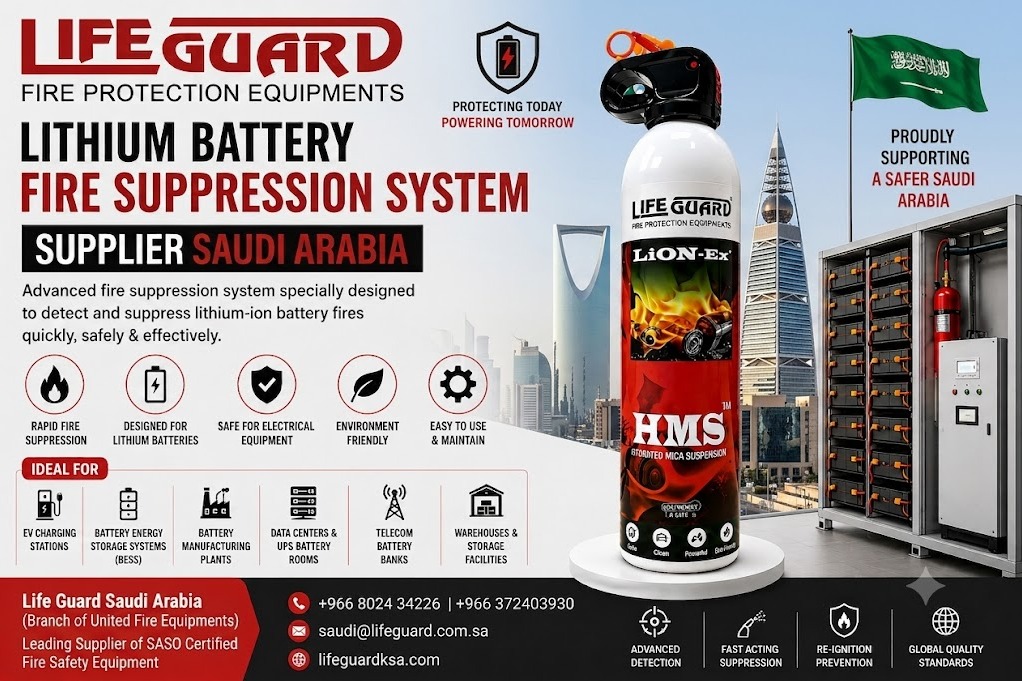
HMS Fire Suppression Solutions for Lithium Battery Applications
LIFEGUARD® also works with specialized HMS – Hydrated Mica Suspension based suppression solutions for lithium battery applications.
Depending upon project requirements, HMS-based solutions can be considered for:
- Lithium battery racks
- Battery cabinets
- BESS installations
- Battery rooms
- EV battery testing
- Industrial lithium battery applications
An engineered configuration may incorporate:
- HMS extinguishing agent
- Fire suppression cylinders
- Linear Heat Sensing
- Detection tubing
- Stainless-steel distribution tubing
- Piping networks
- Flexible discharge connections
- Battery rack manifolds
- Discharge nozzles
- Detection and releasing panel
- Manual release
- Abort switch
- Audible and visual alarms
Final engineering should be based on the actual battery layout and required fire-safety objective.
EV Battery Fire Safety Solutions Saudi Arabia
The continued development of electric mobility and charging infrastructure creates additional lithium battery fire safety requirements.
Specialized protection can be considered for:
- EV service centres
- Electric vehicle workshops
- EV battery storage
- Battery test laboratories
- Battery research centres
- EV charging facilities
- Battery repair locations
- Battery warehouses
- Damaged battery isolation areas
Each application requires a fire-safety solution appropriate to the specific battery operations performed within the facility.
EV Battery Testing Laboratory Fire Protection Saudi Arabia
Battery testing can subject lithium-ion cells, modules and complete packs to demanding electrical and thermal conditions.
Testing may involve:
- Charging and discharging
- Battery performance testing
- Thermal evaluation
- Environmental testing
- Prototype development
- Battery validation
- Research and development
An engineered safety strategy can incorporate early detection, localized heat monitoring, alarms, suppression and emergency equipment shutdown.
Solar and Renewable Energy Battery Fire Safety Saudi Arabia
Lithium battery storage is increasingly associated with renewable-energy infrastructure.
Battery systems can store power generated from solar and other renewable sources and make that electricity available when required.
Applications can include:
- Solar-plus-storage
- Utility-scale BESS
- Industrial solar storage
- Commercial battery storage
- Renewable-energy systems
- Microgrids
- Off-grid installations
Fire protection should be engineered according to battery capacity, rack arrangement, enclosure configuration and project requirements.
Data Centre Lithium Battery Fire Safety Saudi Arabia
Lithium-ion batteries are increasingly used for UPS and backup energy applications in data centres and mission-critical infrastructure.
A battery-related incident can potentially affect:
- UPS systems
- Electrical distribution
- IT equipment
- Critical servers
- Business continuity
- Backup power
A battery fire safety strategy can incorporate:
- Aspirating smoke detection
- Heat sensing
- Battery cabinet suppression
- Battery room protection
- Alarm integration
- Equipment shutdown interfaces
- System monitoring
Lithium Battery Warehouse Fire Safety Saudi Arabia
Lithium battery warehouses can contain substantial quantities of stored energy.
Important fire safety considerations include:
- Battery chemistry
- Battery quantity
- State of charge
- Packaging
- Rack configuration
- Storage height
- Ventilation
- Damaged battery segregation
- Emergency access
- Detection coverage
A comprehensive approach can combine early detection, suitable suppression provisions, firefighting equipment and procedures for identifying and segregating damaged batteries.
Lithium Battery Charging Area Fire Safety
Battery charging introduces additional electrical and thermal stresses.
Specialized fire protection can therefore be considered for:
- EV charging facilities
- Industrial battery charging rooms
- Battery swap stations
- Forklift charging areas
- Lithium battery charging cabinets
- Battery laboratories
- Energy-storage charging installations
Where required, fire detection may also interface with electrical shutdown or other emergency-control functions.
Industrial Lithium Battery Fire Safety Solutions Saudi Arabia
Industrial facilities increasingly use lithium batteries for:
- Backup power
- Automated equipment
- Industrial vehicles
- Material-handling systems
- Critical electrical systems
- Energy storage
The required fire protection can range from compact cabinet-level systems to larger multi-rack BESS installations.
A project-specific evaluation is therefore essential.
Lithium Battery Fire Safety Solutions Riyadh
LIFEGUARD® can support lithium-ion battery fire safety requirements associated with projects in Riyadh, including:
- Data centres
- Commercial BESS
- Battery rooms
- Critical infrastructure
- EV facilities
- Industrial energy storage
- Renewable-energy installations
Lithium Battery Fire Safety Solutions Jeddah
Lithium battery applications in Jeddah can include logistics facilities, commercial energy storage, EV infrastructure, telecom installations, industrial battery systems and warehouses.
Project-specific detection and suppression solutions can be evaluated according to the installation.
BESS Fire Safety Solutions Dammam & Eastern Province
Saudi Arabia's Eastern Province contains extensive industrial and energy infrastructure.
LIFEGUARD® can support BESS and lithium battery fire protection enquiries associated with Dammam, Al Khobar, Dhahran and surrounding industrial regions.
Applications can include energy storage, industrial backup batteries, lithium-ion battery rooms and critical electrical facilities.
Lithium Battery Fire Safety Jubail
Industrial projects around Jubail may require specialized battery fire protection for energy-storage systems, electrical backup installations and other industrial lithium-ion battery applications.
System designs can be evaluated according to the project's BOQ and technical specifications.
Customized Lithium Battery Fire Safety Engineering
For technical evaluation, customers can share:
- Battery chemistry
- Battery manufacturer/model
- Battery voltage
- Total capacity in kWh/MWh
- Number of battery modules
- Number of battery racks
- Rack dimensions
- Cabinet dimensions
- BESS container dimensions
- Battery room dimensions
- General arrangement drawings
- Ventilation details
- Detection requirements
- Suppression philosophy
- BOQ
- Technical specifications
- Saudi project location
- Required quantity
Accurate technical information helps in developing an appropriate project-specific solution.
Why Choose LIFEGUARD® for Lithium Battery Fire Safety Solutions Saudi Arabia?
LIFEGUARD® – United Fire Equipments Pvt. Ltd. combines fire safety manufacturing experience with application-oriented engineering support.
Our solutions can support:
- BESS developers
- Renewable-energy companies
- EPC contractors
- Consultants
- System integrators
- EV companies
- Data-centre contractors
- Fire protection companies
- Industrial customers
- Distributors
Our objective is to understand the actual lithium-ion battery hazard and develop an appropriate protection philosophy rather than applying one generic fire suppression design to every application.
Lithium Battery Fire Safety Supplier for Saudi Arabian Projects
LIFEGUARD® can support customers requiring lithium-ion battery fire safety equipment and engineered suppression solutions from India.
Customers can submit their:
- BOQ
- BESS drawings
- Battery rack layouts
- Battery specifications
- Required quantities
- Project location
- Delivery requirements
for technical and commercial evaluation.
All proposed equipment and system arrangements should be reviewed against applicable Saudi regulations, consultant requirements, project certification requirements and approving-authority expectations before final procurement.
Looking for Lithium Battery Fire Safety Solutions in Saudi Arabia?
Whether your requirement involves a BESS container, lithium battery rack, battery cabinet, EV facility, data centre, battery testing laboratory, warehouse or renewable-energy project, LIFEGUARD® can support suitable fire detection and suppression solutions.
Share your battery information, BOQ, drawings and project specifications for technical evaluation.
Contact LIFEGUARD®
United Fire Equipments Pvt. Ltd.
Manufacturer of ISI Certified Fire Safety Equipment
📞 8048034226