
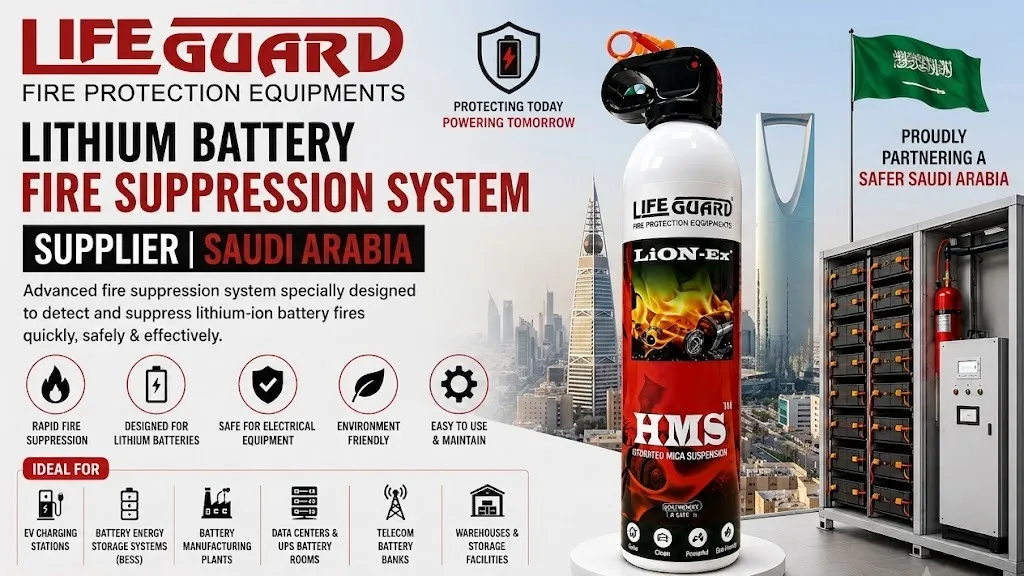
Lithium Battery Fire Safety System Provider in Saudi Arabia
Lithium battery fire protection requires more than the installation of conventional firefighting equipment. The safety system needs to take account of the characteristics of the batteries themselves, including battery chemistry, energy capacity, module construction, rack configuration, enclosure dimensions, ventilation and operating conditions.
LIFEGUARD® follows an application-oriented approach in which the detection, control and suppression architecture is developed around the actual battery installation.
Protection can be designed for a small battery cabinet, an individual battery rack, multiple BESS racks or a complete containerized energy-storage installation.
Why Lithium-Ion Batteries Require Specialized Fire Protection
A lithium-ion cell stores electrical and chemical energy inside a compact enclosure. Battery failure may result from an internal short circuit, external electrical fault, overcharging, mechanical damage, excessive temperature, charging-system malfunction, manufacturing defect, degradation or abnormal operation.
Under severe conditions, the affected cell may enter thermal runaway.
During thermal runaway, internal reactions can cause the cell temperature to increase rapidly. Depending on the battery chemistry and failure scenario, smoke and gases may be released, ignition may occur and heat may transfer to adjacent cells.
A potential progression can be represented as:
Battery Cell → Battery Module → Battery Rack → Cabinet → BESS Container / Battery Room
For this reason, an effective lithium battery fire safety system should consider early detection, rapid alarm, equipment isolation, suppression, propagation management and continued monitoring.
Integrated Lithium Battery Fire Safety Philosophy
A professionally engineered lithium-ion battery fire protection strategy can follow:
Early Detection → Alarm → Isolation / Shutdown → Automatic Suppression → Propagation Control → Continued Monitoring
The precise response sequence should be developed according to the battery manufacturer's information, project risk assessment, technical specifications and approved cause-and-effect philosophy.
Depending on the project, the fire safety system can also interface with the Battery Management System, ventilation equipment, electrical isolation, emergency shutdown systems, building fire alarm system and other safety controls.
Complete Lithium Battery Fire Safety System Saudi Arabia
As a lithium battery fire safety system provider, LIFEGUARD® can support integrated solutions involving very early smoke detection, aspirating smoke detection, Linear Heat Sensing, temperature monitoring, suitable gas detection, flame detection, automatic suppression, localized application, battery rack suppression, cabinet protection, BESS container protection, battery-room fire suppression, detection and releasing controls, suppression cylinders, distribution piping, stainless-steel tubing, flexible connections, manifolds, discharge nozzles, manual release, abort facilities, audible/visual alarms, equipment shutdown interfaces and system monitoring.
The correct combination of technologies should be determined according to the actual battery hazard and project requirements.
BESS Fire Safety System Provider Saudi Arabia
Battery Energy Storage Systems can contain large quantities of lithium-ion cells arranged in modules, racks and cabinets.
A simplified BESS architecture is:
Lithium-Ion Cells → Battery Modules → Battery Racks → Cabinets → BESS Container
Because a BESS can concentrate considerable stored energy inside a relatively compact installation, fire detection and emergency-response systems need careful coordination.
LIFEGUARD® can support fire protection concepts for utility-scale BESS, containerized BESS, industrial energy storage, commercial energy storage, solar-plus-storage, renewable-energy projects, microgrids, backup power systems and multi-rack battery rooms.
BESS Fire Suppression System Saudi Arabia
A BESS fire suppression system should not be selected solely according to the total room or container volume.
The design needs to consider battery chemistry, battery manufacturer and model, voltage, total energy capacity in kWh or MWh, quantity of modules, number and dimensions of racks, equipment spacing, cabinet configuration, BESS container dimensions, ventilation arrangement, detection strategy and required suppression objective.
Using this project information, protection zones, detector positions, piping or tubing routes, manifold arrangements and discharge nozzle locations can be evaluated more accurately.
Containerized BESS Fire Protection Saudi Arabia
Containerized BESS systems integrate batteries, electrical equipment, controls and often ventilation equipment within a compact enclosure.
The fire safety concept may therefore require coordinated detection at different locations, automatic alarm sequences, rack-level protection, suppression distribution and system interfaces.
A containerized BESS solution can potentially incorporate very early detection, heat sensing near battery racks, suppression cylinders, piping or tubing distribution, rack manifolds, discharge nozzles, releasing controls and equipment shutdown interfaces.
Final engineering should always be based on the actual BESS container layout.
Lithium Battery Thermal Runaway Protection Saudi Arabia
Thermal runaway is one of the principal hazards considered in lithium-ion battery fire safety.
Once an affected battery cell becomes thermally unstable, internal reactions may continue generating heat. The event can potentially involve smoke, off-gassing, ignition and transfer of heat to neighbouring cells.
If sufficient heat reaches adjacent batteries, the incident can develop from a single-cell failure into a multi-cell or multi-module event.
Another consideration is the possibility of re-ignition, because battery temperatures may remain elevated after the initial visible flame has been controlled.
For these reasons, battery protection strategies should emphasize early identification and timely intervention.
Lithium Battery Early Warning System
An early-warning strategy aims to identify abnormal conditions before they develop into a larger fire event.
Depending on the battery chemistry and project requirements, the detection philosophy can combine smoke detection, temperature-related detection and suitable gas detection.
Detection signals can be processed by the fire/releasing control system to initiate alarms and predetermined actions such as electrical isolation, ventilation control, equipment shutdown or suppression activation.
Aspirating Smoke Detection for BESS
Aspirating smoke detection continuously samples air from the protected environment and analyses it for developing smoke conditions.
This approach can be particularly useful for BESS containers, lithium battery rooms, data centres, UPS installations, EV battery testing laboratories and other critical electrical environments.
Early warning can provide additional time for predetermined emergency actions before the condition develops further.
Linear Heat Sensing for Lithium Battery Racks
Linear Heat Sensing can be routed close to battery modules, racks and electrical equipment.
Because the sensing cable can follow the actual geometry of the protected installation, it can provide localized heat-related detection over an extended area.
It can therefore be considered for individual battery racks, multiple rack rows, battery cabinets, BESS containers and critical cable routes.
The heat-sensing system can be integrated with fire alarm or suppression releasing controls according to the project's required sequence.
Gas Detection for Lithium Battery Applications
Certain abnormal lithium-ion battery conditions can be accompanied by gas release.
Where supported by battery chemistry and risk assessment, suitable gas detection can form an additional layer of early warning.
Gas-detection signals may be integrated with alarms, ventilation systems, electrical isolation, emergency shutdown and other control functions.
Detector selection should be based on the expected gas species and environmental conditions rather than assuming one detector is suitable for every lithium-ion battery chemistry.
Flame Detection for High-Risk Battery Facilities
Flame detection may be considered for selected environments where rapid identification of an established flame is required.
Potential applications include battery testing laboratories, EV battery R&D facilities, manufacturing areas, industrial battery testing and selected high-risk energy-storage applications.
Detector selection and positioning should take account of the expected fire signature, line of sight and potential physical obstructions.
Automatic Lithium Battery Fire Suppression System Saudi Arabia
LIFEGUARD® can support automatic fire suppression solutions at different levels of a battery system.
The protection hierarchy can be represented as:
Battery Cabinet Level → Individual Battery Rack Level → Multi-Rack Level → BESS Container / Battery Room Level
The correct level depends on battery chemistry, total stored energy, internal battery configuration, available installation space, ventilation and the required protection objective.
A customized system is therefore preferable to applying one standard suppression arrangement to every lithium battery application.
Battery Rack Fire Suppression System Saudi Arabia
Localized battery rack protection can allow suppression to be distributed closer to the identified battery hazard.
A typical architecture can be:
Detection System → Releasing Panel → Suppression Cylinder → Distribution Piping → Flexible Connection → Battery Rack Manifold → Discharge Nozzles
Nozzle location and distribution should be developed according to rack dimensions, battery module positions, spacing, equipment openings and required coverage.
For multi-rack BESS installations, individual or zoned protection can be evaluated according to the approved system philosophy.
Lithium Battery Cabinet Fire Suppression Saudi Arabia
Lithium-ion battery cabinets are used in data centres, telecom installations, UPS systems, renewable-energy systems and commercial or industrial energy-storage applications.
A localized cabinet protection system can incorporate automatic detection, suppression storage, distribution tubing, discharge nozzles, alarm indication, releasing controls and manual activation.
Because internal battery layouts vary, detector and nozzle positioning should be customized according to the actual cabinet arrangement.
HMS Fire Suppression System for Lithium Battery Applications
LIFEGUARD® also works with specialized HMS – Hydrated Mica Suspension based suppression solutions for lithium battery applications.
Depending upon project requirements, an HMS-based system can be evaluated for battery racks, lithium battery cabinets, BESS installations, battery rooms, EV battery testing facilities and selected industrial lithium-ion battery applications.
An engineered arrangement may incorporate an HMS extinguishing agent, suppression cylinder, suitable detection or Linear Heat Sensing, stainless-steel distribution tubing, flexible connections, battery rack manifolds, discharge nozzles, releasing controls, manual release, abort facilities and audible/visual alarm devices.
The final configuration should be based on the actual battery installation and defined project objective.
EV Battery Fire Safety System Provider Saudi Arabia
The growing use of electric mobility creates additional requirements for specialized lithium-ion battery fire protection.
LIFEGUARD® can support protection concepts for EV service centres, electric vehicle workshops, charging facilities, battery storage, EV battery testing laboratories, R&D facilities, battery pack areas, battery repair locations and damaged-battery quarantine areas.
Each application should be assessed individually because the battery condition, quantity and operating environment can differ substantially.
EV Battery Testing Laboratory Fire Protection
Battery test laboratories can subject lithium-ion cells, modules and complete battery packs to demanding electrical, thermal and environmental conditions.
Testing activities may involve charging and discharging, performance testing, thermal evaluation, prototype development, battery validation and R&D work.
An engineered protection concept can incorporate early detection, localized heat sensing, automatic alarm, appropriate suppression and equipment shutdown interfaces.
Data Centre Lithium Battery Fire Safety Saudi Arabia
Lithium-ion batteries can be used for UPS and backup-power applications within data centres and mission-critical infrastructure.
A battery-related incident may potentially affect UPS equipment, electrical distribution, servers, network infrastructure, operating continuity and backup power availability.
An appropriate data-centre battery protection strategy can integrate very early smoke detection, localized heat sensing, cabinet-level suppression, battery-room protection, alarm integration, equipment shutdown interfaces and monitoring.
Renewable Energy & Solar BESS Fire Safety Saudi Arabia
Battery storage plays an important role in renewable-energy systems because electricity generated by solar and other sources can be stored and supplied later.
Fire safety solutions can therefore be developed for solar-plus-BESS installations, utility battery storage, commercial energy storage, industrial BESS, microgrids and backup-energy systems.
The detection and suppression arrangement should reflect total battery capacity, rack geometry, container configuration and the project's protection requirements.
Lithium Battery Warehouse Fire Safety Saudi Arabia
Lithium battery warehouses may store cells, modules, battery packs or finished products containing significant quantities of stored electrical energy.
A fire safety assessment should consider battery chemistry, battery state of charge, quantity stored, packaging, rack configuration, storage height, ventilation, damaged-battery segregation and emergency access.
The overall safety strategy can combine suitable detection, fire suppression provisions, alarms, emergency equipment and procedures for identifying and isolating damaged batteries.
Lithium Battery Charging Area Fire Protection
Charging introduces additional electrical and thermal stresses to lithium-ion batteries.
Specialized fire safety can therefore be considered for EV charging facilities, industrial charging rooms, forklift battery charging, battery swap stations, lithium-ion charging cabinets and battery laboratories.
Where required, detection systems can also interface with electrical isolation and emergency shutdown functions.
Industrial Lithium Battery Fire Safety System Saudi Arabia
Industrial lithium-ion battery applications can include backup power, automation equipment, industrial vehicles, material-handling systems, critical electrical equipment and energy storage.
The protection requirement can range from a compact cabinet-level installation to a large multi-zone battery energy-storage system.
A project-specific engineering approach is therefore important.
Lithium Battery Fire Safety System Provider Riyadh
LIFEGUARD® can support technical enquiries for battery fire safety projects associated with Riyadh, including BESS installations, data centres, battery rooms, commercial energy storage, EV facilities and critical infrastructure.
System configurations can be evaluated from the customer's BOQ, battery details, project drawings and technical specification.
Lithium Battery Fire Safety System Provider Jeddah
Projects associated with Jeddah can involve commercial energy storage, logistics, warehouses, telecom infrastructure, EV applications and industrial lithium-ion battery installations.
A customized detection and suppression philosophy can be developed according to the actual battery configuration.
BESS Fire Safety System Provider Dammam & Al Khobar
For projects in Dammam, Al Khobar and surrounding Eastern Province locations, LIFEGUARD® can evaluate BESS, battery rack, industrial energy storage and critical electrical infrastructure fire protection requirements.
Lithium Battery Fire Protection Dhahran & Jubail
Projects associated with Dhahran and Jubail may involve industrial energy storage, backup battery installations, BESS and other critical lithium-ion battery applications.
Project-specific systems can be evaluated after reviewing the technical specifications and battery layouts.
End-to-End Lithium Battery Fire Safety System Approach
A complete lithium battery fire protection project requires coordination between detection, controls and suppression.
The engineering process can begin with understanding the battery chemistry and configuration, identifying protection zones and deciding the required detection philosophy.
The suppression storage, piping or tubing routes, manifolds and nozzles can then be coordinated around the equipment layout.
Alarm sequences and equipment interfaces are subsequently incorporated to create an integrated system rather than a collection of independent fire safety components.
Technical Information Required for System Design
For preparation of a suitable technical proposal, customers can share battery chemistry, battery manufacturer/model, voltage, total energy capacity in kWh/MWh, module and rack quantity, rack dimensions, cabinet dimensions, BESS container or battery-room layout, ventilation details, required detection philosophy, suppression requirements, BOQ, technical specifications, project location and required quantity.
Accurate project information helps determine protection zoning, detection locations, suppression distribution and system control philosophy.
Why Choose LIFEGUARD® as a Lithium Battery Fire Safety System Provider for Saudi Arabia?
LIFEGUARD® – United Fire Equipments Pvt. Ltd. combines fire safety manufacturing capabilities with project-oriented engineering support.
We can support BESS developers, renewable-energy companies, EV companies, EPC contractors, engineering consultants, system integrators, data-centre contractors, industrial organizations, fire protection contractors and distributors.
Our approach focuses on the complete protection system—detection, controls, suppression, distribution and integration—rather than merely supplying individual components.
For Saudi Arabian projects, the proposed system should always be reviewed against applicable project specifications, consultant requirements, required certifications and local approving-authority requirements before final approval and procurement.
Lithium Battery Fire Safety System Supplier & Export Support to Saudi Arabia
LIFEGUARD® can support customers in Saudi Arabia requiring engineered lithium battery fire detection and suppression equipment from India.
Customers can provide their BOQ, BESS drawings, battery rack layouts, battery specifications, quantities and delivery destination for technical and commercial evaluation.
This allows the proposed system architecture and equipment requirements to be reviewed before final supply.
Looking for a Lithium Battery Fire Safety System Provider in Saudi Arabia?
If your project involves a BESS container, lithium-ion battery rack, battery cabinet, EV battery test laboratory, data centre, warehouse, charging facility or renewable-energy installation, LIFEGUARD® can support project-specific fire detection and suppression solutions.
Share your battery information, BOQ, technical specifications and layout drawings for technical evaluation.
Contact LIFEGUARD®
United Fire Equipments Pvt. Ltd.
Manufacturer of ISI Certified Fire Safety Equipment
📞 8048034226
Keywords






