
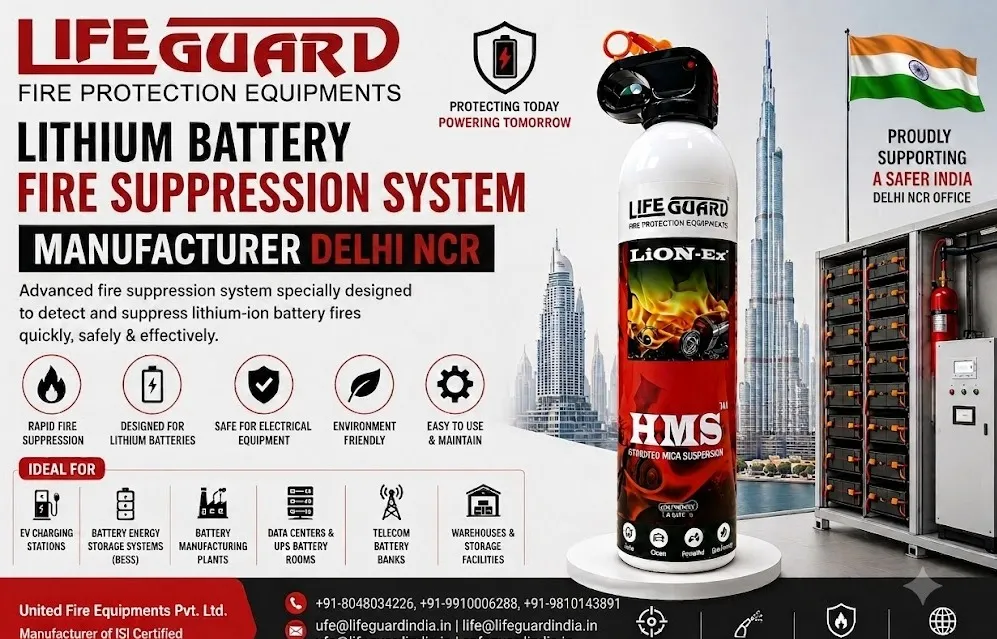
Lithium Battery Fire Suppression System Supplier Delhi NCR
Advanced Fire Protection Solutions for Lithium-Ion Battery Applications
The growing use of lithium-ion batteries in Battery Energy Storage Systems, electric vehicles, data centres, telecom facilities, industrial equipment and renewable-energy projects has created a need for specialised fire protection systems.
Lithium-ion battery fires differ from conventional fires because damaged or overheated cells may enter thermal runaway. This process can generate intense heat, smoke, flammable gases and rapid fire propagation from one cell or module to another. Even after visible flames are controlled, damaged battery cells may retain heat and create a risk of re-ignition.
United Fire Equipments Pvt. Ltd., under the LIFEGUARD brand, is a trusted lithium battery fire suppression system supplier in Delhi NCR, providing customised fire detection, alarm, control and suppression solutions for lithium-ion battery installations.
We support customers, consultants, EPC contractors, system integrators, battery manufacturers, renewable-energy developers and industrial organisations across:
- Delhi
- New Delhi
- Gurugram
- Noida
- Greater Noida
- Faridabad
- Ghaziabad
- Manesar
- Bahadurgarh
- Sonipat and nearby industrial regions
Our systems are selected and configured according to the battery chemistry, battery capacity, protected enclosure, installation layout, ventilation arrangement and project fire-safety requirements.
Reliable Lithium Battery Fire Suppression System Supplier in Delhi NCR
Selecting the right lithium battery fire suppression system supplier Delhi NCR is important for protecting personnel, valuable equipment and critical infrastructure.
A standard fire extinguisher alone may not provide complete protection for a large lithium-ion battery installation. An effective battery fire protection arrangement may require several coordinated systems, including:
- Early smoke detection
- Heat detection
- Battery off-gas detection
- Linear heat-sensing cable
- Automatic fire alarm
- Battery charging shutdown
- Electrical isolation
- Ventilation control
- Automatic suppression discharge
- Battery cooling
- Fire propagation control
- Remote alarm monitoring
- Manual emergency controls
- Post-fire temperature observation
LIFEGUARD provides project-specific solutions rather than recommending one standard system for every lithium battery application.
What Is a Lithium Battery Fire Suppression System?
A lithium battery fire suppression system is an engineered fire protection arrangement designed to identify and respond to abnormal conditions within lithium-ion battery cells, modules, racks, cabinets, rooms or containers.
Depending on the application, the system may perform the following functions:
- Detect smoke, heat, flame or battery off-gases.
- Generate an early warning alarm.
- Activate audible and visual notification devices.
- Transmit signals to a fire alarm or monitoring system.
- Stop battery charging or discharging.
- Isolate the affected battery rack or equipment.
- Control ventilation and air-conditioning systems.
- Release the selected extinguishing medium.
- Reduce heat and control visible flames.
- Limit propagation to nearby batteries and equipment.
- Continue monitoring for possible re-ignition.
The final design and operating sequence depend on the battery technology, fire risk and approved project requirements.
Understanding Lithium-Ion Battery Fire Risks
Lithium-ion batteries store a considerable amount of energy within a compact structure. When a battery cell is damaged or operated outside safe conditions, the internal temperature may increase rapidly.
Potential causes of lithium battery incidents include:
- Internal short circuit
- External short circuit
- Overcharging
- Excessive discharge
- Mechanical impact
- Cell puncture or crushing
- Manufacturing defects
- High ambient temperature
- Failure of the battery cooling system
- Improper electrical connections
- Battery Management System malfunction
- Incorrect charger selection
- Water ingress
- Transportation damage
- Ageing or defective cells
When thermal runaway begins, the affected cell can release heat, smoke and flammable decomposition gases. The heat may then spread to adjacent cells, causing a chain reaction known as thermal runaway propagation.
A complete lithium battery fire-safety strategy should therefore include:
- Battery condition monitoring
- Reliable Battery Management System
- Electrical protection
- Adequate ventilation
- Early fire detection
- Automatic shutdown
- Suitable fire suppression
- Emergency response procedures
- Post-incident monitoring
Lithium Battery Fire Suppression Applications in Delhi NCR
1. Battery Energy Storage Systems
Battery Energy Storage Systems, commonly known as BESS, are increasingly used for renewable-energy storage, backup power, grid support and commercial energy management.
LIFEGUARD provides fire protection solutions for:
- Containerised BESS units
- Indoor battery rooms
- Outdoor energy-storage enclosures
- Utility-scale storage projects
- Commercial energy-storage systems
- Solar-plus-storage projects
- Industrial backup-power systems
- Microgrid applications
- Renewable-energy installations
- Captive power facilities
A BESS fire protection solution may include:
- Aspirating smoke detection
- Heat detectors
- Battery off-gas sensors
- Linear heat-sensing cable
- Fire alarm and releasing control panel
- Automatic suppression system
- Battery Management System interface
- Ventilation shutdown
- Emergency exhaust activation
- Audible and visual alarms
- Remote monitoring outputs
- Manual release and abort controls
2. Lithium Battery Rooms
Lithium battery rooms may be installed in industrial plants, electrical substations, commercial buildings, data centres and renewable-energy facilities.
Important design considerations include:
- Room dimensions
- Ceiling height
- Battery chemistry
- Number of racks
- Rack dimensions
- Battery capacity
- State of charge
- Ventilation openings
- Air-conditioning arrangement
- Cable penetrations
- False ceiling or raised floor
- Existing fire alarm system
- Required shutdown sequence
- Occupancy and emergency access
LIFEGUARD can develop a detection and suppression system based on the actual room configuration.
3. BESS Container Fire Suppression
A containerised BESS normally contains battery racks, electrical panels, power-conversion equipment, control systems and cooling equipment within a limited enclosure.
A complete BESS container fire protection package may include:
- Very early smoke detection
- Off-gas detection
- Temperature monitoring
- Linear heat-sensing cable
- Automatic fire alarm panel
- Suppression-agent cylinders
- Distribution piping
- Discharge nozzles
- Pressure-monitoring devices
- Emergency shutdown contacts
- Ventilation interlocks
- Remote alarm transmission
- Manual activation controls
- Hooters and flashing strobes
The system design should consider rack obstructions, internal airflow, enclosure leakage, ventilation openings, cable routes and maintenance access.
4. Electric Vehicle Battery Manufacturing Plants
Delhi NCR is a major centre for automotive manufacturing, electric mobility, component production and industrial development.
LIFEGUARD provides fire protection solutions for:
- Lithium-ion cell manufacturing
- Battery module assembly
- Battery-pack production
- Charging stations
- Battery-testing rooms
- End-of-line testing
- Research and development laboratories
- Battery repair areas
- Prototype testing facilities
- Rejected-battery storage
- Damaged-battery quarantine zones
- Quality-control areas
Systems can be developed for individual machines, testing enclosures, production lines, battery racks or complete rooms.
5. EV Charging Stations
Electric vehicle charging installations may be located in:
- Commercial buildings
- Shopping centres
- Basement parking areas
- Residential societies
- Public parking facilities
- Corporate offices
- Electric bus depots
- Fleet charging yards
- EV service centres
- Battery-swapping stations
A suitable fire-safety arrangement may include:
- Smoke and heat detection
- Flame detection
- Electrical isolation
- Emergency shutdown
- Audible and visual alarms
- Local-application suppression
- Water-based protection
- Ventilation control
- Remote alarm communication
The protection concept should be developed according to the charging equipment, vehicle type, building configuration and emergency-response plan.
6. Data Centres and UPS Battery Rooms
Delhi NCR has a rapidly growing data-centre and digital infrastructure sector. Lithium-ion batteries are frequently used for uninterrupted power supply and backup-energy applications.
LIFEGUARD offers fire protection solutions for:
- UPS battery rooms
- Server rooms
- Data halls
- Network operation centres
- Electrical rooms
- Telecom rooms
- Modular data centres
- Edge data centres
- Control rooms
The system can be integrated with:
- Fire alarm systems
- Building Management Systems
- UPS controls
- Electrical shutdown systems
- Air-conditioning systems
- Access-control systems
- Emergency ventilation systems
Very early warning detection can help identify an abnormal condition before it develops into a larger fire incident.
7. Telecom Battery Banks
Telecommunication facilities depend on batteries for backup power and uninterrupted network operation.
Fire suppression systems may be designed for:
- Telecom battery rooms
- Mobile switching centres
- Remote telecom shelters
- Network equipment rooms
- Battery cabinets
- Communication towers
- Data transmission facilities
- Control and monitoring rooms
Compact automatic suppression systems may be suitable for individual cabinets, shelters or enclosed battery areas.
8. Lithium Battery Warehouses
Lithium battery warehouses require careful fire-risk assessment because the hazard depends on:
- Battery chemistry
- Battery quantity
- Storage height
- State of charge
- Packaging material
- Rack configuration
- Aisle spacing
- Fire compartmentation
- Damaged-battery handling
- Available water supply
- Smoke ventilation
LIFEGUARD can provide fire protection solutions for:
- New lithium battery storage
- Battery modules
- Finished battery packs
- Electric vehicle batteries
- Power-tool batteries
- Consumer-electronics batteries
- Industrial batteries
- Returned battery products
- Damaged or defective batteries
- Battery quarantine areas
Damaged batteries should be segregated and managed according to the facility’s safety procedures and risk assessment.
9. Battery Recycling Facilities
Used, damaged and rejected lithium batteries may have an unknown internal condition. They can create fire hazards during collection, sorting, dismantling and recycling.
Protection may be required for:
- Battery collection centres
- Battery recycling plants
- Waste battery storage
- Dismantling areas
- Material recovery facilities
- Returned-product warehouses
- Damaged-battery quarantine rooms
- Electronic waste processing facilities
The fire suppression arrangement should be coordinated with the facility’s storage method, waste-handling process and emergency-response procedure.
Components of a Lithium Battery Fire Suppression System
Early-Warning Fire Detection
Early detection is a critical part of lithium battery fire protection.
Depending on the application, detection equipment may include:
- Aspirating smoke detectors
- Addressable smoke detectors
- Conventional smoke detectors
- Fixed-temperature heat detectors
- Rate-of-rise heat detectors
- Linear heat-sensing cable
- Flame detectors
- Multi-criteria detectors
- Battery off-gas sensors
- Temperature-monitoring devices
- Thermal-camera integration
- Hydrogen or carbon monoxide sensors
Detector selection and placement depend on the battery layout, enclosure size, airflow, ceiling height, ventilation and environmental conditions.
Fire Alarm and Releasing Control Panel
The control panel receives signals from the detection devices and initiates the approved cause-and-effect sequence.
The panel may be programmed to:
- Generate an early warning
- Display the affected zone
- Activate sounders and strobes
- Transmit an alarm to the control room
- Stop battery charging
- Isolate the affected battery rack
- Shut down selected electrical equipment
- Stop air-conditioning
- Close fire dampers
- Control supply and exhaust fans
- Activate emergency ventilation
- Release the extinguishing medium
- Communicate with the Battery Management System
- Send signals to the Building Management System
- Provide remote monitoring contacts
Cross-zone detection logic may be used where a confirmed alarm is required before automatic suppression discharge.
Automatic Fire Suppression System
The appropriate extinguishing medium should be selected after evaluating the protected hazard.
Possible solutions may include:
- Water-mist systems
- Water-based cooling systems
- Local-application suppression systems
- Specialised liquid suppression media
- Hydrated mineral or mica-based suppression media
- Clean-agent systems for associated electrical equipment
- Inert-gas systems for suitable enclosed areas
- Condensed aerosol systems where technically appropriate
- Hybrid fire protection arrangements
No single extinguishing agent should be considered universally suitable for every lithium battery chemistry and installation.
Agent selection should consider:
- Cooling requirement
- Battery chemistry
- Cell and module construction
- Protected volume
- Rack arrangement
- Electrical conductivity
- Occupancy
- Ventilation
- Fire propagation risk
- Re-ignition risk
- Manufacturer test data
- Project approval requirements
Suppression Cylinders and Storage Tanks
Depending on the selected technology, the extinguishing medium may be stored in:
- Pressurised cylinders
- Modular suppression units
- Cabinet-mounted containers
- Skid-mounted cylinder banks
- Water-storage tanks
- Pump-operated systems
The required capacity is determined according to the protected volume, application density, agent quantity, piping arrangement and discharge duration.
Piping and Discharge Nozzles
The pipe network carries the extinguishing medium from the storage container to the protected area.
The design may consider:
- Pipe material
- Pipe diameter
- Pipe length
- Number of bends and fittings
- Pressure losses
- Nozzle flow rate
- Nozzle coverage
- Battery rack dimensions
- Equipment obstructions
- Number of suppression zones
- Discharge duration
- Minimum operating pressure
- Maintenance accessibility
Nozzles should be positioned to provide effective distribution without being obstructed by racks, cable trays, panels or structural members.
Manual Release and Abort Controls
The system may include:
- Manual release switch
- Abort switch
- Emergency stop button
- Electrical isolation switch
- System disable control
- Alarm acknowledgement switch
- Local status indicators
These controls should be clearly labelled and installed at accessible locations according to the approved system design.
Audible and Visual Warning Devices
Warning devices may include:
- Electronic hooters
- Sounders
- Sirens
- Flashing strobes
- Hooter-cum-flasher units
- Pre-discharge warning signs
- System-discharge indicators
These devices warn personnel before and during automatic suppression-system operation.
How the Lithium Battery Fire Suppression System Works
A typical system may operate through the following sequence:
Stage 1: Abnormal Condition Detection
A smoke, heat, gas, flame or temperature sensor detects an abnormal condition within the battery area.
Stage 2: Early Warning
The fire alarm panel generates a warning and sends the signal to responsible personnel or the central monitoring system.
Stage 3: Confirmed Fire Alarm
A second detector or cross-zone logic confirms the emergency condition.
Stage 4: Emergency Interlocks
The system may stop charging, isolate the battery rack, shut down electrical equipment and control ventilation.
Stage 5: Pre-Discharge Alarm
Audible and visual alarms warn personnel before automatic discharge, where required.
Stage 6: Suppression Discharge
The selected extinguishing medium is released through the designed pipe and nozzle network.
Stage 7: Fire Control and Cooling
The system works to control flames, reduce heat and limit propagation to nearby battery modules.
Stage 8: Continued Monitoring
The affected equipment remains isolated and monitored because damaged lithium-ion cells may retain heat and potentially re-ignite.
The actual operating sequence is established through the approved cause-and-effect matrix.
Customised Fire Suppression System Design
Every lithium battery installation is different. LIFEGUARD follows an application-specific engineering approach.
Technical Assessment
Our team may review:
- Battery chemistry
- Battery manufacturer
- Cell and module construction
- Battery capacity
- Number of racks
- State of charge
- Charging and discharging process
- Room or container dimensions
- Equipment layout
- Ventilation arrangement
- Ambient conditions
- Existing fire alarm system
- Existing firefighting system
- Available water supply
- Electrical shutdown requirements
- Consultant specification
- Tender requirements
- Project approval criteria
System Selection
The detection and suppression technology is selected after reviewing the actual fire risk and operating conditions.
Engineering Calculations
Depending on the selected system, engineering may include:
- Protected-volume calculation
- Agent quantity calculation
- Hydraulic flow calculation
- Pipe sizing
- Pressure-loss calculation
- Nozzle selection
- Coverage assessment
- Cylinder or tank sizing
- Discharge-time calculation
- Alarm and interlock logic
Project Documentation
Technical documentation may include:
- General arrangement drawings
- Fire detection layout
- Suppression-system layout
- Piping drawings
- Nozzle-location drawings
- Cylinder-bank arrangement
- Equipment data sheets
- Bill of quantities
- Cause-and-effect matrix
- Control-panel logic
- Installation instructions
- Testing procedures
- Operation and maintenance manual
Why Choose LIFEGUARD?
Delhi-Based Fire Safety Manufacturer
United Fire Equipments Pvt. Ltd. is based in Delhi and manufactures fire safety equipment and engineered fire protection systems under the LIFEGUARD brand.
Quick Support Across Delhi NCR
Our Delhi location enables efficient coordination and technical support for projects in Delhi, Gurugram, Noida, Greater Noida, Ghaziabad, Faridabad and surrounding industrial regions.
Application-Specific Engineering
We review the battery application and fire risk before recommending a detection and suppression arrangement.
Integrated Fire Protection Solutions
Our solutions can combine:
- Early detection
- Fire alarm
- Automatic suppression
- Electrical shutdown
- Battery isolation
- Ventilation control
- BMS integration
- Remote monitoring
Support for EPC and Tender Projects
We can support customers with:
- Budgetary quotations
- Technical offers
- Compliance statements
- Product data sheets
- Bills of quantities
- System drawings
- Tender documentation
- Consultant submissions
- Project coordination
Customised System Configuration
Systems can be developed for:
- Individual battery cabinets
- Battery racks
- Battery rooms
- BESS containers
- Charging stations
- Warehouses
- Manufacturing plants
- Complete energy-storage facilities
Technical and After-Sales Support
Depending on the agreed scope, support can be provided for system operation, installation guidance, inspection, testing, commissioning and maintenance planning.
Industries We Serve in Delhi NCR
Our lithium battery fire suppression solutions are suitable for:
- Battery Energy Storage Systems
- Solar power plants
- Electric vehicle manufacturing
- EV charging stations
- Electric bus depots
- Automotive plants
- Data centres
- Telecom facilities
- Battery warehouses
- Logistics centres
- Battery recycling plants
- Electrical substations
- Metro and railway projects
- Industrial manufacturing
- Research laboratories
- Defence facilities
- Commercial buildings
- Critical infrastructure
Benefits of a Lithium Battery Fire Suppression System
A properly engineered system can help:
- Detect abnormal conditions at an early stage
- Reduce emergency-response time
- Generate automatic fire alarms
- Stop battery charging
- Isolate affected equipment
- Control visible flames
- Reduce heat exposure
- Limit propagation to adjacent batteries
- Protect critical equipment
- Reduce operational interruption
- Support personnel evacuation
- Improve emergency preparedness
- Provide remote monitoring
- Support risk-management requirements
A fire suppression system does not replace safe battery design, preventive maintenance, electrical protection, ventilation or a reliable Battery Management System. It should be integrated into a complete lithium battery safety strategy.
Information Required for a Technical Proposal
To prepare a suitable lithium battery fire suppression proposal, please share:
- Project name
- Project location
- Battery application
- Battery chemistry
- Battery manufacturer
- Battery capacity
- Number of cells, modules and racks
- State of charge
- Room or container dimensions
- Battery layout
- Rack dimensions
- Ventilation details
- Existing fire alarm system
- Existing suppression arrangement
- Water availability
- Required standards
- Consultant specifications
- Tender documents
- Site photographs
- Required delivery schedule
Our technical team will review the available information and recommend an appropriate fire protection concept.
Frequently Asked Questions
Who supplies lithium battery fire suppression systems in Delhi NCR?
United Fire Equipments Pvt. Ltd., under the LIFEGUARD brand, supplies customised lithium battery fire detection and suppression systems for BESS installations, EV battery facilities, battery rooms, data centres, warehouses and industrial projects across Delhi NCR.
Which fire suppression system is best for lithium-ion batteries?
The appropriate system depends on the battery chemistry, capacity, enclosure, state of charge, rack arrangement, ventilation and project requirements. No single extinguishing medium is suitable for every lithium battery application.
Can the system protect a complete BESS container?
Yes. A detection and suppression solution can be designed after reviewing the container dimensions, battery layout, ventilation, electrical equipment and required shutdown sequence.
Can a system be installed inside an individual battery cabinet?
Yes. Compact automatic systems can be designed for battery cabinets, UPS cabinets, telecom cabinets and electrical enclosures.
Can the system connect with a Battery Management System?
Yes. Subject to compatible interfaces, the fire alarm or releasing panel can transmit signals for battery shutdown, charging interruption, rack isolation and alarm communication.
Is early detection possible before visible flames appear?
A combination of aspirating smoke detection, gas detection and temperature monitoring may provide early warning of an abnormal condition. Performance depends on the sensor type, installation location, airflow and battery configuration.
Is re-ignition possible after a lithium battery fire?
Yes. Damaged battery cells may retain heat and can potentially re-ignite. The affected batteries should remain isolated and monitored after the visible fire has been controlled.
Does LIFEGUARD provide drawings and technical documentation?
Depending on the project scope, LIFEGUARD can provide system layouts, piping drawings, nozzle details, equipment data sheets, bills of quantities and cause-and-effect logic.
Do you provide support in Gurugram and Noida?
Yes. We support lithium battery fire protection enquiries across Delhi NCR, including Gurugram, Manesar, Noida, Greater Noida, Faridabad, Ghaziabad and nearby regions.
Contact a Lithium Battery Fire Suppression System Supplier in Delhi NCR
Contact LIFEGUARD for:
- Lithium battery fire suppression systems
- BESS fire protection systems
- Battery-room suppression
- Battery-cabinet protection
- EV charging-station fire protection
- Aspirating smoke detection
- Battery off-gas detection
- Linear heat-sensing systems
- Automatic releasing control panels
- BMS and shutdown integration
- Technical quotations
- System drawings
- Tender support
- Bills of quantities
Contact Details
United Fire Equipments Pvt. Ltd.
Manufacturer of ISI Certified Fire Safety Equipment
📞 8048034226
📧 ufe126@gmail.com | info@lifeguardindia.in
Keywords






