
Lithium Battery Fire Suppression System Supplier Saudi Arabia
Advanced Lithium-Ion Battery Fire Protection Solutions for Saudi Arabia
Lithium-ion batteries are increasingly used across Saudi Arabia in renewable-energy projects, Battery Energy Storage Systems, electric vehicles, data centres, telecommunications, industrial facilities, warehouses and critical infrastructure.
These batteries offer high energy density, compact construction and dependable performance. However, they can create specialised fire hazards when exposed to overcharging, electrical faults, excessive temperatures, mechanical damage or manufacturing defects.
A damaged lithium-ion battery cell may enter thermal runaway, producing intense heat, smoke, flammable gases and rapid fire propagation. The incident may spread from one cell to neighbouring modules and battery racks. Damaged batteries may also retain heat and present a possible re-ignition risk after visible flames have been controlled.
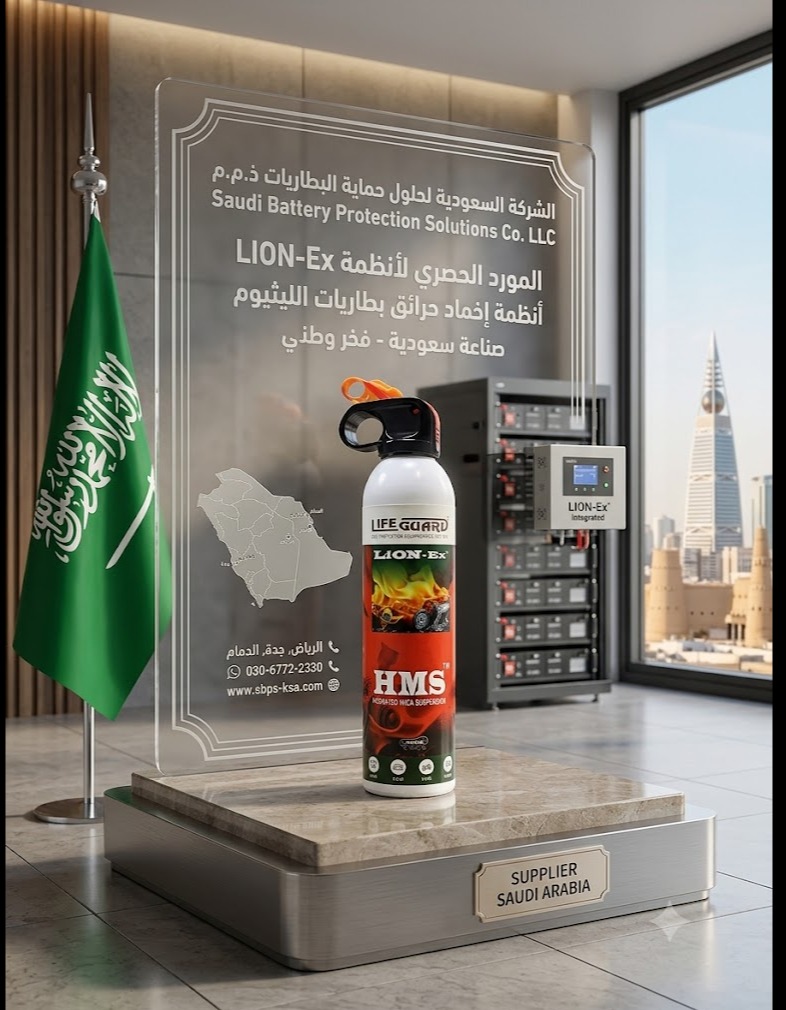
United Fire Equipments Pvt. Ltd., under the LIFEGUARD brand, is a reliable lithium battery fire suppression system supplier for Saudi Arabia, providing engineered fire detection, alarm, isolation and suppression solutions for lithium-ion battery applications.
We support project owners, consultants, EPC contractors, system integrators, renewable-energy developers, battery manufacturers and industrial organisations across Saudi Arabia, including:
- Riyadh
- Jeddah
- Dammam
- Al Khobar
- Jubail
- Yanbu
- Mecca
- Medina
- Tabuk
- NEOM project regions
- Ras Al Khair
- Abqaiq
- Dhahran and surrounding industrial areas
United Fire Equipments Pvt. Ltd. is an Indian manufacturer and international supplier of fire safety equipment. We support Saudi Arabian projects through export supply, engineering assistance, technical documentation and project coordination.
Trusted Lithium Battery Fire Suppression System Supplier in Saudi Arabia
Selecting an experienced lithium battery fire suppression system supplier Saudi Arabia is essential for protecting personnel, battery equipment, buildings and critical operations.
A conventional portable extinguisher may not provide comprehensive protection for a large lithium-ion battery installation. A properly engineered solution may require a coordinated combination of:
- Very early smoke detection
- Battery off-gas detection
- Heat and temperature monitoring
- Linear heat-sensing cable
- Automatic fire alarm
- Battery charging shutdown
- Electrical isolation
- Ventilation control
- Automatic suppression discharge
- Cooling and fire containment
- Remote alarm transmission
- Manual emergency controls
- Post-discharge monitoring
LIFEGUARD develops application-specific fire protection systems according to the battery type, protected enclosure, equipment arrangement, environmental conditions and project specifications.
What Is a Lithium Battery Fire Suppression System?
A lithium battery fire suppression system is an engineered arrangement designed to identify and respond to abnormal conditions within lithium-ion battery cells, modules, racks, cabinets, rooms or containers.
A complete system may be designed to:
- Detect smoke, heat, flame or battery off-gases.
- Generate an early warning alarm.
- Activate audible and visual warning devices.
- Communicate with the central fire alarm system.
- Stop battery charging and discharging.
- Isolate the affected battery rack or equipment.
- Shut down selected electrical systems.
- Control air-conditioning and ventilation.
- Release the selected suppression medium.
- Reduce heat and control visible flames.
- Limit fire propagation to adjacent batteries.
- Continue monitoring for possible re-ignition.
The final configuration depends on the battery chemistry, total energy capacity, installation layout, ventilation system and approval requirements.
Understanding Lithium-Ion Battery Fire Hazards
Lithium-ion batteries store a large amount of electrical energy within a compact structure. When a battery cell operates outside its safe limits, its internal temperature may increase rapidly.
Potential causes of lithium battery incidents include:
- Internal short circuits
- External short circuits
- Overcharging
- Excessive discharge
- Mechanical impact
- Cell puncture or crushing
- Manufacturing defects
- High ambient temperatures
- Battery cooling-system failure
- Loose or damaged electrical connections
- Battery Management System malfunction
- Incorrect charger selection
- Water or moisture ingress
- Transportation damage
- Ageing or defective battery cells
During thermal runaway, a battery cell may release heat, smoke and flammable decomposition gases. The heat can affect adjacent cells and initiate thermal runaway propagation.
An effective battery fire-safety strategy should therefore include prevention, early detection, shutdown, electrical isolation, suppression, cooling, ventilation control and emergency-response planning.
Importance of Battery Fire Protection in Saudi Arabia
Saudi Arabia’s climate and industrial environment create additional considerations for lithium battery installations.
Fire protection equipment may need to operate in:
- High ambient temperatures
- Dusty outdoor conditions
- Remote project locations
- Coastal and corrosive environments
- Oil and gas facilities
- Utility-scale solar installations
- Large industrial complexes
- Containerised energy-storage sites
- Continuously operating data centres
- Unmanned telecom installations
The fire suppression system should be selected according to the operating environment and protected against heat, dust, corrosion, vibration and other site-specific conditions.
Outdoor equipment may require suitable enclosures, weather protection and temperature-rated components. Marine, coastal and petrochemical projects may also require corrosion-resistant materials and specialised installation practices.
Applications of Lithium Battery Fire Suppression Systems
1. Battery Energy Storage Systems
Battery Energy Storage Systems, commonly known as BESS, store electrical energy for renewable-energy integration, grid support, peak-load management and backup power.
LIFEGUARD provides fire protection solutions for:
- Containerised BESS installations
- Indoor battery rooms
- Outdoor battery enclosures
- Utility-scale energy-storage projects
- Solar-plus-storage facilities
- Wind-energy storage systems
- Commercial energy-storage projects
- Industrial backup-power systems
- Microgrids
- Electrical substations
- Remote power installations
A BESS fire protection solution may include:
- Aspirating smoke detection
- Heat detection
- Battery off-gas sensors
- Linear heat-sensing cable
- Flame detection
- Automatic fire alarm panel
- Releasing control panel
- Suppression-agent cylinders
- Distribution piping and nozzles
- Battery Management System interface
- Ventilation shutdown
- Emergency exhaust integration
- Manual release and abort controls
- Audible and visual alarms
- Remote monitoring outputs
2. BESS Container Fire Suppression Systems
Containerised Battery Energy Storage Systems normally contain battery racks, electrical panels, power-conversion equipment, cooling units and control systems within a compact enclosure.
A BESS container protection package may include:
- Very early smoke detection
- Gas or off-gas monitoring
- Heat and temperature detection
- Linear heat-sensing cable
- Automatic releasing control panel
- Suppression-agent storage cylinders
- Distribution piping
- Discharge nozzles
- Pressure-monitoring devices
- Battery shutdown contacts
- Ventilation interlocks
- Remote alarm transmission
- Manual activation controls
- Hooters and flashing strobes
The system design should account for:
- Battery-rack obstructions
- Internal airflow
- Cooling-system operation
- Ventilation openings
- Cable penetrations
- Enclosure leakage
- High ambient temperature
- Maintenance access
- Separation between containers
3. Solar Energy Storage Projects
Saudi Arabia has extensive potential for solar-energy generation. Lithium battery storage can be used to store excess solar power and provide electricity during periods of low generation.
LIFEGUARD solutions are suitable for:
- Utility-scale solar projects
- Solar-plus-storage installations
- Commercial rooftop solar systems
- Industrial solar power plants
- Remote solar installations
- Microgrid projects
- Residential and commercial energy-storage systems
The fire protection system can be coordinated with solar inverters, power-conversion systems, Battery Management Systems and site monitoring platforms.
4. Electric Vehicle Charging Stations
Lithium-ion batteries are central to electric mobility. Fire protection may be required at charging locations where electric vehicles and high-power charging equipment are present.
LIFEGUARD provides solutions for:
- Indoor EV charging stations
- Basement parking facilities
- Commercial parking structures
- Shopping malls
- Hotels
- Residential towers
- Corporate offices
- Electric bus depots
- Fleet charging yards
- Electric truck charging stations
- Battery-swapping facilities
- EV maintenance workshops
The protection strategy may include smoke detection, heat detection, flame detection, electrical isolation, automatic alarm, local suppression, water-based protection and ventilation control.
5. Electric Vehicle Battery Manufacturing and Testing
Lithium batteries can present different risks during manufacturing, assembly, charging, testing and storage.
LIFEGUARD can develop systems for:
- Battery cell manufacturing
- Battery module assembly
- Battery-pack production
- End-of-line testing
- Charging stations
- Battery test chambers
- Research and development laboratories
- Prototype testing facilities
- Battery repair areas
- Rejected-battery storage
- Damaged-battery quarantine zones
- Quality-control facilities
Protection may be provided for individual machines, test enclosures, production lines, battery racks or complete rooms.
6. Data Centres and UPS Battery Rooms
Lithium-ion batteries are increasingly used in data centres for uninterrupted power supply and backup-energy applications.
LIFEGUARD provides protection solutions for:
- UPS battery rooms
- Server rooms
- Data halls
- Network operation centres
- Electrical rooms
- Telecom rooms
- Modular data centres
- Edge data centres
- Control and monitoring rooms
The fire protection system may be integrated with:
- Main fire alarm systems
- Building Management Systems
- UPS controls
- Electrical shutdown systems
- Air-conditioning systems
- Access-control systems
- Emergency ventilation
- Remote monitoring systems
Very early warning detection can provide additional time for investigation and emergency response before a serious fire develops.
7. Telecom Battery Banks
Telecommunication facilities rely on batteries for continuous and backup power. Many telecom sites are remotely located and may operate without permanent personnel.
Fire suppression systems can be designed for:
- Telecom battery rooms
- Mobile switching centres
- Remote telecom shelters
- Network equipment rooms
- Battery cabinets
- Communication towers
- Data transmission facilities
- Control rooms
Compact automatic suppression systems may be installed inside individual cabinets, telecom shelters or enclosed battery areas.
8. Lithium Battery Warehouses
Lithium battery warehouses require a risk-based fire protection strategy because the fire hazard depends on battery chemistry, packaging, state of charge, rack arrangement and storage height.
Protection may be required for:
- New lithium-ion cells
- Battery modules
- Finished battery packs
- Electric vehicle batteries
- Consumer-electronics batteries
- Power-tool batteries
- Telecom batteries
- Industrial battery systems
- Returned battery products
- Defective batteries
- Damaged-battery quarantine areas
Important design considerations include:
- Total battery quantity
- Battery state of charge
- Storage height
- Rack arrangement
- Aisle spacing
- Packaging material
- Fire compartmentation
- Water availability
- Smoke ventilation
- Emergency access
- Separation of damaged batteries
9. Battery Recycling and Waste-Handling Facilities
Used, defective or damaged lithium batteries may have an unknown internal condition. They can create fire hazards during collection, sorting, storage, transportation, dismantling and recycling.
LIFEGUARD can provide solutions for:
- Battery collection centres
- Battery recycling plants
- Waste battery storage
- Battery dismantling areas
- Material recovery facilities
- Electronic waste processing plants
- Returned-product warehouses
- Damaged-battery quarantine rooms
The fire protection arrangement should be coordinated with the facility’s handling procedures, storage practices and emergency-response plan.
10. Oil, Gas and Petrochemical Facilities
Lithium batteries may be used in backup-power systems, monitoring equipment, control systems, communications and industrial vehicles within oil, gas and petrochemical installations.
Protection solutions may be developed for:
- Control rooms
- Electrical rooms
- Telecom shelters
- Battery rooms
- Remote monitoring stations
- Offshore and onshore facilities
- Industrial equipment enclosures
- Emergency backup-power systems
System components should be selected according to the project’s environmental, hazardous-area and certification requirements.
11. Marine and Port Applications
Lithium battery systems are used in electric and hybrid vessels, port equipment and marine backup-power installations.
Fire protection may be required for:
- Marine battery rooms
- Electric or hybrid vessels
- Port handling equipment
- Navigation systems
- Communication equipment
- Offshore control systems
- Battery charging areas
The selected system should consider corrosion exposure, vibration, humidity, limited enclosure space and marine approval requirements.
Main Components of a Lithium Battery Fire Suppression System
Very Early Fire Detection
Early warning is one of the most important parts of lithium battery protection.
Depending on the application, detection equipment may include:
- Aspirating smoke detectors
- Addressable smoke detectors
- Conventional smoke detectors
- Fixed-temperature heat detectors
- Rate-of-rise heat detectors
- Linear heat-sensing cable
- Flame detectors
- Multi-criteria detectors
- Battery off-gas sensors
- Hydrogen or carbon monoxide sensors
- Temperature-monitoring devices
- Thermal-camera integration
The appropriate detector and installation location are selected according to the battery arrangement, enclosure size, airflow, ventilation and environmental conditions.
Fire Alarm and Releasing Control Panel
The control panel receives signals from detectors and initiates the programmed cause-and-effect sequence.
The panel may be configured to:
- Generate an early warning
- Display the affected zone
- Activate sounders and strobes
- Transmit an alarm to the control room
- Stop battery charging
- Isolate the affected rack
- Shut down selected electrical equipment
- Stop air-conditioning
- Close fire dampers
- Control supply and exhaust fans
- Activate emergency ventilation
- Release the suppression medium
- Communicate with the Battery Management System
- Send signals to the Building Management System
- Provide remote monitoring contacts
Where required, cross-zone detection logic can be used so that two independent alarm signals are necessary before automatic discharge.
Automatic Fire Suppression System
The extinguishing medium should be selected according to the battery hazard, installation type and project requirements.
Potential solutions may include:
- Water-mist systems
- Water-based cooling systems
- Local-application suppression
- Specialised liquid suppression media
- Hydrated mineral or mica-based suppression media
- Clean-agent systems for associated electrical equipment
- Inert-gas systems for suitable enclosed hazards
- Condensed aerosol systems where technically appropriate
- Hybrid fire protection arrangements
No single extinguishing agent is universally suitable for every battery chemistry and installation.
System selection should consider:
- Battery chemistry
- Cooling requirements
- Cell and module construction
- Protected volume
- Rack arrangement
- Electrical conductivity
- Occupancy
- Ventilation
- High ambient temperature
- Fire propagation risk
- Re-ignition risk
- Manufacturer test data
- Consultant and authority requirements
Suppression Cylinders and Storage Tanks
Depending on the system technology, the suppression medium may be stored in:
- Pressurised cylinders
- Modular suppression units
- Cabinet-mounted containers
- Skid-mounted cylinder banks
- Water-storage tanks
- Pump-operated systems
The required capacity is determined according to the protected volume, application rate, agent quantity, pipe network and required discharge duration.
Distribution Piping and Nozzles
The distribution network carries the extinguishing medium from the storage container to the protected area.
The design may consider:
- Pipe material
- Internal pipe diameter
- Total pipe length
- Bends and fittings
- Pressure losses
- Nozzle flow rate
- Nozzle coverage
- Battery-rack dimensions
- Equipment obstructions
- Number of suppression zones
- Minimum operating pressure
- Discharge duration
- Maintenance access
Nozzles should be positioned so that battery racks, electrical panels and cable trays do not obstruct the agent discharge pattern.
Manual Release and Abort Controls
The system may include:
- Manual release switch
- Abort switch
- Emergency stop button
- Electrical isolation control
- System-disable switch
- Alarm acknowledgement control
- Local status indicators
Manual controls should be clearly labelled and positioned at accessible locations according to the approved design.
Audible and Visual Warning Devices
Warning equipment may include:
- Electronic hooters
- Sounders
- Sirens
- Flashing strobes
- Hooter-cum-flasher units
- Pre-discharge warning signs
- System-discharge indicators
These devices alert personnel before and during suppression-system operation.
How the Lithium Battery Fire Suppression System Works
A typical lithium battery fire suppression system may operate through the following sequence.
Stage 1: Abnormal Condition Detected
A smoke, heat, gas, flame or temperature detector identifies an abnormal condition within the battery installation.
Stage 2: Early Warning Alarm
The control panel generates an alarm and communicates the condition to responsible personnel or a central monitoring system.
Stage 3: Fire Condition Confirmed
A second detector, cross-zone signal or programmed verification logic confirms the emergency condition.
Stage 4: Emergency Interlocks Activated
The system may stop charging, isolate the battery rack, shut down electrical equipment and control ventilation.
Stage 5: Pre-Discharge Warning
Audible and visual alarms warn personnel before automatic suppression discharge, where required.
Stage 6: Suppression Medium Released
The selected extinguishing medium is discharged through the engineered piping and nozzle network.
Stage 7: Fire Control and Cooling
The system works to control visible flames, reduce heat exposure and limit fire propagation.
Stage 8: Continued Monitoring
The affected battery equipment remains isolated and monitored because damaged cells may retain heat and potentially re-ignite.
The final sequence is established through the approved cause-and-effect matrix.
Customised System Design for Saudi Arabian Projects
Every lithium battery installation has different technical and environmental requirements. LIFEGUARD follows a project-specific engineering approach.
Technical Assessment
Our team may review:
- Battery chemistry
- Battery manufacturer
- Cell and module construction
- Total battery capacity
- Number of racks
- State of charge
- Charging and discharging process
- Room or container dimensions
- Battery layout
- Ventilation arrangement
- Maximum ambient temperature
- Dust and environmental exposure
- Existing fire alarm system
- Available water supply
- Electrical shutdown requirements
- Consultant specification
- Tender requirements
- Project approval criteria
System Selection
The detection, alarm and suppression technologies are selected according to the actual hazard and operating environment.
Engineering Calculations
Depending on the selected system, engineering may include:
- Protected-volume calculation
- Suppression-medium quantity
- Hydraulic flow calculation
- Pipe sizing
- Pressure-loss calculation
- Nozzle selection
- Nozzle coverage assessment
- Cylinder or tank sizing
- Discharge-time calculation
- Alarm and interlock logic
Project Documentation
Technical documentation may include:
- General arrangement drawings
- Detection-system layouts
- Suppression-system layouts
- Piping drawings
- Nozzle-location drawings
- Cylinder-bank arrangements
- Equipment data sheets
- Bill of quantities
- Cause-and-effect matrix
- Control-panel logic
- Installation instructions
- Testing procedures
- Operation and maintenance manuals
Saudi Arabia Compliance and Approval Considerations
Fire protection systems for Saudi Arabian projects should comply with the approved project specification and applicable local requirements.
The exact approval criteria may depend on:
- Project location
- Facility classification
- Battery installation type
- Suppression technology
- Saudi Civil Defence requirements
- Consultant specifications
- Main contractor requirements
- Industrial authority requirements
- Insurer recommendations
- Equipment certification
- Local installation and commissioning procedures
Depending on the project, the specification may reference applicable Saudi, international, IEC, NFPA, UL, FM or other recognised requirements.
LIFEGUARD can prepare a technical proposal based on the customer’s project documents. Final acceptance and approval remain subject to the client, consultant, local authority and other competent approving organisations.
Why Choose LIFEGUARD?
Experienced Fire Safety Manufacturer
United Fire Equipments Pvt. Ltd. manufactures fire safety equipment and engineered fire protection systems under the LIFEGUARD brand.
Application-Specific Engineering
We assess the battery application, protected enclosure and operating conditions before recommending a fire suppression system.
Integrated Fire Protection Solutions
Our solutions can combine:
- Early smoke detection
- Gas and off-gas monitoring
- Heat detection
- Fire alarm controls
- Automatic suppression
- Battery shutdown
- Electrical isolation
- Ventilation control
- BMS integration
- Remote monitoring
Support for EPC and Tender Projects
LIFEGUARD can support customers with:
- Budgetary quotations
- Technical proposals
- Compliance statements
- Product data sheets
- Bills of quantities
- System drawings
- Tender documentation
- Consultant submissions
- Project coordination
Export Supply for Saudi Arabian Projects
We can support Saudi Arabian requirements through export supply, technical documentation and coordination with customers, contractors and system integrators.
Customised System Configurations
Systems can be developed for:
- Individual battery cabinets
- Battery racks
- Battery rooms
- BESS containers
- EV charging stations
- Warehouses
- Manufacturing facilities
- Complete energy-storage plants
Technical and After-Sales Support
Subject to the agreed commercial scope, technical assistance may be provided for installation, testing, commissioning, operation and maintenance planning.
Industries We Serve in Saudi Arabia
LIFEGUARD lithium battery fire suppression systems are suitable for:
- Battery Energy Storage Systems
- Solar-energy projects
- Renewable-energy facilities
- Electric vehicle charging stations
- Automotive facilities
- Data centres
- Telecom installations
- Battery warehouses
- Logistics centres
- Industrial manufacturing plants
- Battery recycling facilities
- Electrical substations
- Oil and gas facilities
- Petrochemical plants
- Marine and port projects
- Commercial buildings
- Critical infrastructure
- Research laboratories
Benefits of a Lithium Battery Fire Suppression System
A properly engineered system can help:
- Detect abnormal battery conditions early
- Reduce emergency-response time
- Generate automatic alarms
- Stop battery charging
- Isolate affected equipment
- Control visible flames
- Reduce heat exposure
- Limit propagation to neighbouring batteries
- Protect valuable infrastructure
- Reduce equipment damage
- Support personnel evacuation
- Minimise operational interruption
- Improve emergency preparedness
- Provide remote alarm communication
- Support project risk-management requirements
A fire suppression system does not replace safe battery design, preventive maintenance, correct electrical protection, ventilation or a reliable Battery Management System. It should be integrated into a complete lithium battery safety strategy.
Information Required for a Technical Proposal
To prepare a lithium battery fire suppression system proposal for Saudi Arabia, please share:
- Project name and location
- Battery application
- Battery chemistry
- Battery manufacturer
- Total battery capacity
- Number of cells, modules and racks
- Battery state of charge
- Room or container dimensions
- Battery layout drawing
- Rack dimensions
- Ventilation details
- Maximum ambient temperature
- Existing fire alarm system
- Existing suppression arrangement
- Available water supply
- Required standards
- Consultant specifications
- Tender documents
- Site photographs
- Required delivery schedule
Our technical team will review the information and recommend an appropriate fire detection and suppression concept.
Frequently Asked Questions
Who supplies lithium battery fire suppression systems in Saudi Arabia?
United Fire Equipments Pvt. Ltd., under the LIFEGUARD brand, supplies customised lithium battery fire detection and suppression systems for BESS projects, EV charging facilities, data centres, battery rooms, warehouses and industrial applications in Saudi Arabia.
Is LIFEGUARD a Saudi Arabian manufacturer?
United Fire Equipments Pvt. Ltd. is an Indian fire safety equipment manufacturer and international supplier. We support Saudi Arabian projects through export supply, engineering assistance and project coordination.
Which fire suppression system is best for lithium-ion batteries?
The appropriate system depends on battery chemistry, battery capacity, enclosure, ventilation, state of charge and project approval requirements. No single extinguishing medium is suitable for every lithium battery application.
Can the system operate in high Saudi Arabian temperatures?
Systems can be configured with components suitable for the specified ambient conditions. The maximum and minimum operating temperatures must be confirmed during the design stage.
Can LIFEGUARD protect a complete BESS container?
Yes. A complete detection and suppression solution can be designed after reviewing the container dimensions, battery arrangement, ventilation system and required shutdown sequence.
Can the system protect an individual battery cabinet?
Yes. Compact automatic suppression systems can be developed for battery cabinets, UPS cabinets, telecom cabinets and electrical enclosures.
Can the fire suppression system connect with a Battery Management System?
Yes. Subject to compatible interfaces, the fire alarm or releasing panel can transmit signals for charging interruption, battery shutdown, rack isolation and emergency alarm communication.
Can the system detect a problem before flames appear?
A combination of aspirating smoke detection, battery off-gas detection and temperature monitoring may provide early warning. Detection performance depends on the selected sensors, positioning, airflow and battery design.
Is re-ignition possible after a lithium battery fire?
Yes. Damaged battery cells may retain heat and can potentially re-ignite. The affected equipment should remain isolated and monitored after visible flames have been controlled.
Does LIFEGUARD provide technical drawings?
Depending on the project scope, LIFEGUARD can provide system layouts, piping drawings, nozzle arrangements, equipment data sheets, bills of quantities and cause-and-effect logic.
Can LIFEGUARD supply systems to Riyadh, Jeddah and Dammam?
Yes. We support lithium battery fire suppression enquiries for Riyadh, Jeddah, Dammam, Al Khobar, Jubail, Yanbu, NEOM regions and other locations across Saudi Arabia.
Contact a Lithium Battery Fire Suppression System Supplier in Saudi Arabia
Contact LIFEGUARD for:
- Lithium battery fire suppression systems
- BESS fire protection systems
- Battery-room suppression systems
- Battery-cabinet fire protection
- EV charging-station fire protection
- Aspirating smoke detection
- Battery off-gas detection
- Linear heat-sensing systems
- Automatic releasing control panels
- Battery shutdown and BMS integration
- Technical quotations
- System drawings
- Tender support
- Bills of quantities
Contact Details
United Fire Equipments Pvt. Ltd.
Manufacturer of ISI Certified Fire Safety Equipment
📞 8048034226
📧 ufe126@gmail.com | info@lifeguardindia.in