

Lithium Battery Thermal Runaway Suppression Company Germany – LIFEGUARD®
Advanced Lithium-Ion Battery Thermal Runaway Detection & Fire Suppression Solutions for Germany
LIFEGUARD® provides specialized lithium battery thermal runaway suppression solutions in Germany for Battery Energy Storage Systems (BESS), electric vehicles, battery manufacturing facilities, data centres, UPS rooms, renewable-energy installations, industrial battery systems, warehouses, charging infrastructure, and other high-risk lithium-ion battery applications.
Lithium-ion batteries offer high energy density, compact construction and efficient energy storage. However, when a lithium-ion cell experiences an electrical, mechanical, thermal, or manufacturing failure, it may enter a condition known as thermal runaway.
Thermal runaway can cause rapid heat generation, release of flammable gases, smoke, fire, cell-to-cell propagation and possible re-ignition.
For this reason, conventional fire protection alone may not provide an adequate strategy for every lithium battery installation.
LIFEGUARD® develops integrated solutions combining:
Early Detection + Alarm + Automatic Suppression + Cooling + Propagation Control + System Integration
For businesses searching for a dependable lithium battery thermal runaway suppression company in Germany, LIFEGUARD® provides application-specific fire protection solutions engineered according to the battery configuration and project risk.
What Is Lithium Battery Thermal Runaway?
Lithium battery thermal runaway is an uncontrolled self-heating process inside a lithium-ion cell.
A battery cell may begin generating heat faster than that heat can be dissipated. When internal temperatures continue to rise, chemical reactions inside the battery can accelerate and produce still more heat.
Potential initiating causes include:
- Internal electrical short circuit
- Overcharging
- Deep discharge
- Mechanical impact
- Crushing or penetration
- Manufacturing defects
- Battery ageing
- Excessive external heat
- Cooling-system failure
- Battery Management System malfunction
- Improper charging
- Electrical faults
- Cell contamination
- Thermal exposure from neighbouring cells
Once thermal runaway begins, an affected cell may transfer heat to adjacent cells.
This can create a sequence such as:
Single Cell Failure → Thermal Runaway → Adjacent Cell Heating → Module Propagation → Rack Involvement → Large-Scale Battery Fire
Therefore, one of the major objectives of an effective lithium battery fire protection system is to detect abnormal conditions early and reduce the possibility of thermal runaway spreading through the battery system.
Lithium Battery Thermal Runaway Suppression Company in Germany
LIFEGUARD® provides engineered lithium-ion battery fire protection and thermal runaway suppression solutions for German industrial and commercial applications.
Our solutions can be developed for:
- Battery Energy Storage Systems
- BESS containers
- BESS rooms
- Lithium-ion battery racks
- Battery cabinets
- Battery modules
- EV battery packs
- Electric buses
- EV charging stations
- Battery swapping facilities
- Battery production plants
- Battery testing laboratories
- UPS battery rooms
- Data centres
- Telecom installations
- Renewable-energy projects
- Solar-plus-storage installations
- Industrial energy storage
- Electrical rooms
- Energy storage warehouses
- Lithium battery logistics facilities
Each lithium battery application presents a different fire hazard.
The protection system should therefore be engineered according to the battery chemistry, enclosure design, battery capacity, rack configuration, ventilation conditions, operating temperature, electrical architecture and required fire protection philosophy.
Why Lithium-Ion Battery Fires Need Specialized Fire Protection
Lithium battery fires can present challenges different from many conventional Class A or electrical fires.
Simply extinguishing visible flames may not always eliminate the underlying thermal reaction inside damaged cells.
A comprehensive thermal runaway protection strategy should therefore consider several stages of an incident.
Early Detection
Detection systems should identify abnormal heat, smoke, gases or other indications at the earliest practical stage.
Rapid Alarm
Personnel and control systems should be alerted quickly so that emergency procedures can begin.
Electrical Isolation
Where the system design allows, charging systems, battery equipment or electrical connections can be isolated after a confirmed abnormal condition.
Fire Suppression
An appropriate fire suppression or cooling medium can be discharged into the affected enclosure or hazard area.
Thermal Management
The system should consider how heat generated by damaged cells can be controlled.
Propagation Mitigation
Protecting neighbouring cells and modules from thermal exposure is particularly important in high-energy battery installations.
Re-Ignition Monitoring
Damaged lithium-ion cells may remain hazardous even after visible flames have been controlled.
Post-event monitoring and emergency-response procedures are therefore important parts of the overall safety strategy.
LIFEGUARD® Lithium Battery Thermal Runaway Suppression Solutions Germany
LIFEGUARD® can provide integrated lithium battery protection systems incorporating detection, alarm, suppression and control equipment.
Depending on the project, a system may include:
- Early warning heat detection
- Linear Heat Sensing
- Smoke detection
- Aspirating smoke detection
- Gas detection
- Multi-criteria detection
- Flame detection
- Fire suppression cylinders
- Specialized suppression medium
- Distribution piping
- Detection tubing
- Flexible hoses
- Discharge nozzles
- Pressure monitoring
- Control panels
- Manual release stations
- Audible alarms
- Visual alarms
- Electrical shutdown interfaces
- HVAC interfaces
- Battery Management System interfaces
- Building Management System interfaces
- Emergency ventilation controls
The actual configuration is determined through project-specific engineering.
1. Early Warning Detection for Lithium Batteries
Early detection is one of the most important elements of lithium battery thermal runaway protection.
By detecting abnormal conditions before extensive fire development occurs, the system can provide more time for alarm, shutdown and suppression actions.
Detection technologies may include:
Heat Detection
Heat detectors can identify abnormal temperature increases in battery rooms and equipment enclosures.
Linear Heat Detection
Linear heat sensing cable can be installed close to battery racks, modules, cabinets and electrical equipment.
Smoke Detection
Smoke detection provides warning when combustion products become present within the protected area.
Aspirating Smoke Detection
Very Early Warning Smoke Detection systems can continuously sample air from battery rooms and BESS enclosures.
Gas Detection
Selected gas sensors may be incorporated where project-specific battery hazard analysis identifies gas monitoring as part of the early warning strategy.
Flame Detection
For appropriate industrial environments, flame detection may provide an additional layer of protection.
A combination of detection technologies can provide a more comprehensive protection strategy than relying on a single detector type.
2. Linear Heat Detection for Battery Racks
Lithium-ion battery racks contain numerous cells and modules installed in relatively compact spaces.
Linear Heat Detection can be arranged close to potential thermal risk points around:
- Battery modules
- Battery racks
- Battery cabinets
- Electrical connections
- Cable compartments
- BESS enclosures
- UPS battery systems
The detection cable can monitor temperature conditions along its installed route.
Selection of detection temperature should be based on the battery's normal operating temperature, environmental conditions and fire protection design requirements.
3. Aspirating Smoke Detection for BESS and Battery Rooms
Early smoke detection can be particularly useful in enclosed battery installations.
An aspirating smoke detection system continuously draws air samples from multiple locations through a network of sampling pipes.
This approach can be suitable for:
- BESS containers
- Battery rooms
- Data centre battery spaces
- UPS rooms
- Battery manufacturing facilities
- Battery testing laboratories
- Energy storage enclosures
When incorporated into an overall suppression system, aspirating detection can provide an early alarm before a developing incident reaches an advanced stage.
4. Gas Detection for Lithium Battery Thermal Runaway
Certain lithium-ion battery failure conditions can involve the generation and release of gases.
Where identified through project-specific risk assessment, gas monitoring can therefore form part of the protection strategy.
Gas detectors may be interfaced with:
- Fire alarm panels
- Gas release panels
- BMS systems
- Battery Management Systems
- SCADA systems
- Emergency ventilation
- Audible alarms
- Visual alarms
- Electrical isolation controls
- Suppression systems
The appropriate detector technology should be selected according to the battery chemistry, application and expected hazard.
5. Automatic Lithium Battery Fire Suppression
When predetermined alarm conditions are confirmed, an automatic fire suppression system can initiate discharge into the protected hazard.
Depending on system design, the objective may be to:
- Control developing fire
- Reduce flame intensity
- Lower surrounding temperature
- Protect neighbouring battery modules
- Limit fire propagation
- Reduce exposure of adjacent equipment
- Support emergency intervention
The suppression technology should always be selected after assessing the actual battery installation.
There is no single suppression method that should automatically be assumed suitable for every lithium battery application.
6. HMS-Based Lithium Battery Suppression Solutions
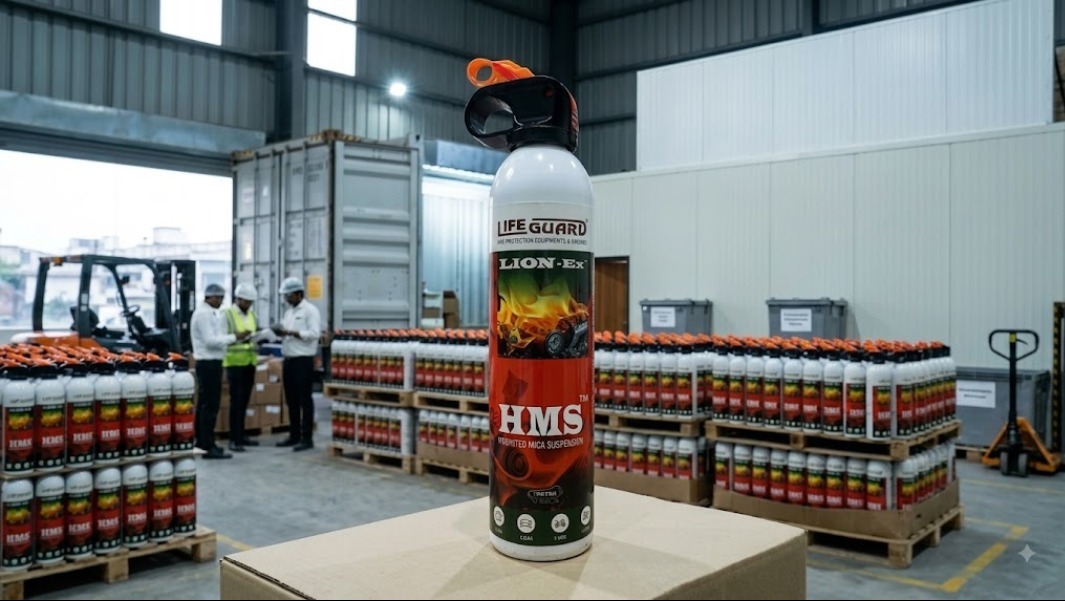
For selected battery and electrical equipment protection applications, LIFEGUARD® can offer Hydrated Mica Suspension (HMS) based fire suppression solutions.
An engineered HMS system may incorporate:
- HMS suppression cylinder
- Detection tubing
- Linear Heat Sensing
- Distribution tubing or piping
- Discharge nozzles
- Pressure monitoring
- Automatic actuation
- Manual activation
- Control interface
- Audible and visual alarm
Localized discharge can be arranged close to identified fire-risk areas.
The final design depends upon the specific battery hazard, enclosure volume and protection objective.
7. Battery Rack & Cabinet Fire Suppression
LIFEGUARD® can develop localized fire suppression arrangements for individual:
- Lithium battery racks
- Battery modules
- Battery cabinets
- UPS cabinets
- Electrical enclosures
- Energy storage compartments
- EV battery compartments
Localized protection can position detection and discharge devices close to the potential source of a thermal runaway event.
This approach can be useful where intervention at the earliest possible stage is required.
BESS Fire Suppression Systems Germany
Germany is a significant market for renewable energy, industrial electrification and battery energy storage.
Battery Energy Storage Systems can contain hundreds or thousands of interconnected lithium-ion cells.
A fire protection strategy for a BESS installation should therefore consider more than conventional fire extinguishing.
A layered BESS protection approach may include:
Battery Monitoring → Early Warning Detection → Alarm → Electrical Isolation → Ventilation Control → Automatic Suppression → Cooling → Emergency Response
LIFEGUARD® can support fire protection solutions for:
- Containerized BESS
- Indoor energy storage rooms
- Outdoor battery installations
- Commercial energy storage
- Industrial BESS
- Solar-plus-storage systems
- Utility-scale battery installations
- Renewable-energy storage facilities
- Microgrid battery systems
Thermal Runaway Propagation Protection for BESS
A major concern in BESS fire protection is preventing or slowing the transfer of heat from a failing cell or module to surrounding batteries.
A BESS protection study may therefore evaluate:
- Cell chemistry
- Battery technology
- Module capacity
- Number of modules
- Rack configuration
- Total battery capacity
- kWh/MWh rating
- Container volume
- Module spacing
- Rack spacing
- Ventilation
- Ambient temperature
- Cooling systems
- Electrical isolation
- Fire detection
- Gas generation
- Fire suppression
- Adjacent exposure
- Emergency access
- Firefighting strategy
LIFEGUARD® uses the available project information to develop an application-specific detection and suppression philosophy.
Lithium Battery Thermal Runaway Suppression for Electric Vehicles
Electric mobility creates another major requirement for lithium battery fire safety.
Lithium-ion battery systems are increasingly used in:
- Electric passenger vehicles
- Electric buses
- Commercial EVs
- Electric trucks
- Industrial vehicles
- Material handling equipment
- Battery swapping stations
- EV charging stations
LIFEGUARD® can provide compact detection and suppression arrangements for applicable vehicle and equipment environments.
Protection may be engineered around:
- Battery packs
- Battery compartments
- Charging equipment
- Electrical cabinets
- Engine/equipment compartments
- High-voltage equipment
The objective is to provide rapid detection and localized intervention where feasible.
EV Battery Manufacturing Fire Protection Germany
Battery manufacturing and EV component facilities can contain batteries at different stages of production, testing, charging and storage.
Potential protected areas include:
- Battery production lines
- Cell assembly areas
- Module assembly lines
- Battery pack manufacturing
- Battery testing laboratories
- Charging stations
- Formation areas
- Battery storage rooms
- Finished battery warehouses
- Damaged battery quarantine areas
Fire protection requirements should be established through a site-specific risk assessment.
LIFEGUARD® can support detection and suppression design for these specialized industrial environments.
Lithium Battery Warehouse Fire Protection
Warehouses containing lithium batteries can present a different risk profile from individual battery cabinets.
Factors requiring consideration can include:
- Battery quantity
- State of charge
- Packaging
- Storage density
- Rack height
- Battery chemistry
- Damaged product storage
- Charging activity
- Warehouse ventilation
- Fire compartmentation
- Detection coverage
- Emergency access
A comprehensive fire protection strategy may therefore combine conventional building fire protection with specialized lithium battery detection, monitoring and intervention systems.
Lithium Battery Fire Protection for Data Centres Germany
Lithium-ion batteries are increasingly used within modern data centres for UPS and backup power applications.
Data centre battery systems require a high level of reliability because an uncontrolled battery incident may threaten both personnel safety and critical IT infrastructure.
LIFEGUARD® can support integrated protection incorporating:
- Very Early Warning Smoke Detection
- Heat detection
- Battery monitoring
- Gas detection where applicable
- Fire alarm integration
- Gas release panels
- HVAC shutdown
- Emergency ventilation
- Electrical isolation
- Automatic suppression
- Alarm and control interfaces
The fire protection architecture can be coordinated with other facility safety systems.
Lithium Battery Fire Protection for Renewable Energy Projects
Lithium batteries play an important role in balancing intermittent renewable-energy generation.
Energy storage is commonly integrated with:
- Solar PV projects
- Wind farms
- Microgrids
- Industrial renewable-energy systems
- Utility power networks
- Commercial energy storage
LIFEGUARD® can provide detection and suppression solutions for battery storage installations associated with these projects.
Applications We Serve in Germany
LIFEGUARD® lithium battery thermal runaway protection solutions can support customers in industries such as:
- Battery manufacturing
- Automotive manufacturing
- Electric mobility
- Renewable energy
- Solar power
- Wind energy
- Battery Energy Storage Systems
- Power generation
- Utilities
- Data centres
- Telecommunications
- Industrial automation
- Logistics
- Warehousing
- Research laboratories
- Battery testing facilities
- Manufacturing plants
- Electrical infrastructure
- Critical facilities
Complete Lithium Battery Thermal Runaway Protection Solution
LIFEGUARD® focuses on delivering integrated fire protection rather than simply supplying individual suppression components.
Depending on project requirements, our scope can include:
Hazard Assessment Support
Evaluation of the battery configuration and potential fire-risk locations.
Detection System Selection
Selection of appropriate heat, smoke, gas or multi-criteria detection.
Suppression System Engineering
Development of the suppression arrangement according to protected equipment and hazard.
Piping & Nozzle Layout
Preparation of suitable distribution arrangements.
Control Philosophy
Development of alarm, discharge and shutdown sequences.
Technical Documentation
Preparation of drawings, datasheets and system information.
Installation Support
Technical guidance during installation.
Testing & Commissioning Support
Assistance with system testing and functional verification as applicable.
How a Lithium Battery Thermal Runaway Suppression System Works
A typical lithium battery protection system may operate through multiple stages.
Stage 1 – Abnormal Battery Condition
A cell experiences overheating, internal short circuit, overcharging or another failure.
Stage 2 – Early Detection
Heat, smoke, gas or another detection technology identifies the abnormal condition.
Stage 3 – Warning Alarm
The system provides an audible, visual or remote alarm.
Stage 4 – System Isolation
Where incorporated into the design, electrical charging or connected equipment is isolated.
Stage 5 – Automatic Suppression
After the required alarm logic is satisfied, the suppression system operates.
Stage 6 – Thermal Control
The suppression arrangement attempts to reduce fire intensity and limit thermal exposure to adjacent cells or equipment.
Stage 7 – Emergency Response
Site personnel and emergency responders manage the affected battery and surrounding area in accordance with established emergency procedures.
Stage 8 – Continued Monitoring
The damaged battery remains under observation because residual heat and re-ignition can remain concerns following a thermal event.
Importance of Thermal Runaway Propagation Control
Preventing or limiting propagation is one of the principal objectives of lithium battery fire protection.
A localized battery fault can become much more severe if the thermal energy from one failing cell causes neighbouring cells to fail.
The potential progression can be:
Cell Failure → Module Propagation → Rack Fire → Multiple Rack Involvement → BESS Fire
An effective strategy therefore emphasizes detection as close to the initial abnormal event as practical.
Combining early detection with rapid intervention provides a greater opportunity to reduce escalation.
Project Engineering Information Required
To recommend a suitable lithium battery suppression system, LIFEGUARD® may require information including:
- Battery manufacturer
- Battery model
- Battery chemistry
- Cell type
- Cell capacity
- Number of cells
- Number of modules
- Number of racks
- Total battery capacity
- kWh/MWh rating
- Battery rack drawings
- Enclosure dimensions
- Room dimensions
- Container dimensions
- Battery spacing
- Normal operating temperature
- Maximum expected temperature
- Ventilation details
- Cooling arrangement
- Battery Management System details
- Existing fire alarm system
- Existing suppression arrangement
- Electrical shutdown philosophy
- Required system interfaces
- Project specifications
This information allows a more appropriate protection philosophy to be developed.
Integration with BMS, SCADA & Fire Alarm Systems
An engineered lithium battery protection system can be designed to interface with the wider facility control architecture.
Possible integrations include:
- Fire Alarm Control Panel
- Battery Management System
- Building Management System
- SCADA
- HVAC
- Emergency ventilation
- Charging controls
- Electrical shutdown
- Plant emergency alarm
- Remote monitoring systems
Integration logic should be defined carefully so that each system performs the correct function at the appropriate stage of an incident.
Compliance-Oriented Fire Protection for Germany
Industrial and battery projects in Germany can be subject to demanding fire safety, electrical safety, insurance and authority requirements.
The final fire protection system should therefore be designed with consideration for:
- Applicable German requirements
- Relevant European requirements
- Project specifications
- Battery manufacturer's recommendations
- Fire risk assessment
- Local authority requirements
- Insurer requirements
- Customer engineering standards
Because requirements can vary significantly between battery chemistries and applications, system compliance should always be confirmed on a project-specific basis.
Why Choose LIFEGUARD® for Lithium Battery Fire Suppression in Germany?
Specialized Fire Protection Engineering
LIFEGUARD® focuses on engineered fire suppression solutions for critical and specialized hazards.
Integrated Detection & Suppression
Our approach combines detection, control, alarm and suppression into a coordinated protection strategy.
Application-Specific Design
Systems are selected according to the actual battery application rather than applying a single standard solution to every project.
Localized Thermal Runaway Protection
Protection can be developed around individual racks, cabinets, modules and equipment compartments.
BESS Protection Capability
Solutions can be developed for small commercial battery systems through to larger industrial energy storage installations.
Engineering Documentation
Project support can include:
- Technical Data Sheets
- System schematics
- General Arrangement drawings
- Equipment specifications
- Detection layouts
- Piping layouts
- Nozzle arrangements
- Control philosophy
- Installation recommendations
Industrial & International Project Support
LIFEGUARD® supports consultants, EPC contractors, system integrators, OEMs and industrial customers requiring specialized lithium-ion battery fire safety solutions.
Lithium Battery Thermal Runaway Suppression Solutions Across Germany
LIFEGUARD® can support enquiries for lithium battery and BESS fire protection projects throughout Germany, including:
- Berlin
- Hamburg
- Munich
- Frankfurt
- Stuttgart
- Düsseldorf
- Cologne
- Dortmund
- Leipzig
- Dresden
- Bremen
- Hanover
- Nuremberg
- Essen
- Mannheim
- Karlsruhe
- Wolfsburg
- Other industrial regions throughout Germany
We welcome enquiries from:
- Battery manufacturers
- Automotive manufacturers
- EPC contractors
- Renewable-energy developers
- BESS integrators
- Data centre developers
- Consultants
- Fire protection contractors
- System integrators
- Industrial end users
- Power utilities
- Engineering companies
LIFEGUARD® – Lithium Battery Thermal Runaway Suppression Company Germany
If you are developing a Battery Energy Storage System, EV battery facility, battery manufacturing plant, data centre, UPS battery room, renewable-energy project, lithium battery warehouse or industrial energy storage installation in Germany, LIFEGUARD® can assist with an engineered fire detection and suppression solution.
Our protection philosophy focuses on:
Detect Early → Alarm Quickly → Isolate Equipment → Suppress Fire → Control Heat → Reduce Propagation → Monitor the Hazard
Lithium-ion battery safety requires a coordinated engineering approach.
The objective should not only be to fight visible fire but also to address the underlying hazards associated with thermal runaway and propagation.
Contact LIFEGUARD®
LIFEGUARD®
United Fire Equipments Pvt. Ltd.
Manufacturer of Fire Safety Equipment & Engineered Fire Suppression Systems
Phone: +91 8048034226
Email: ufe126@gmail.com | info@lifeguardindia.in