
Lithium Battery Thermal Runaway Suppression Company Saudi Arabia – LIFEGUARD®
Advanced Lithium-Ion Battery Fire Protection & Thermal Runaway Suppression Solutions in Saudi Arabia
LIFEGUARD® offers specialized lithium battery thermal runaway suppression solutions in Saudi Arabia for industries where lithium-ion batteries are used for energy storage, electric mobility, backup power, industrial equipment, telecommunications, renewable energy, and critical infrastructure.
As lithium-ion battery deployment continues to expand across Saudi Arabia, effective protection against thermal runaway, battery fire propagation, extreme heat generation, flammable gases, and re-ignition has become an important part of modern fire safety engineering.
LIFEGUARD® provides engineered fire detection and suppression solutions designed to identify abnormal battery conditions at an early stage and initiate appropriate protective actions before a localized battery incident develops into a larger fire.
For organizations searching for a reliable lithium battery thermal runaway suppression company in Saudi Arabia, LIFEGUARD® provides application-specific solutions covering detection, control, suppression, cooling, alarm integration, piping, nozzles, cylinders, and associated fire protection equipment.
What Is Lithium Battery Thermal Runaway?
Thermal runaway is a dangerous condition in which the internal temperature of a lithium-ion cell increases uncontrollably due to an internal or external failure.
Potential initiating factors can include:
- Internal short circuit
- Mechanical damage
- Electrical overcharging
- Excessive discharge
- Cell manufacturing defects
- External heating
- Battery management system malfunction
- Poor ventilation
- Improper charging conditions
- Cell ageing or degradation
- Thermal exposure from an adjacent cell
Once the temperature reaches a critical level, internal chemical reactions can generate additional heat, which may accelerate the process further.
A single affected cell can potentially transfer heat to neighbouring cells and create cell-to-cell thermal runaway propagation.
Because lithium-ion battery incidents can involve heat, flammable gases and possible re-ignition, conventional fire extinguishing methods may not always provide sufficient protection on their own.
This makes properly engineered lithium battery thermal runaway suppression systems particularly important.
Lithium Battery Thermal Runaway Suppression Company in Saudi Arabia
LIFEGUARD® provides integrated solutions for lithium-ion battery hazards across Saudi Arabia.
Our systems can be engineered for:
- Battery Energy Storage Systems
- BESS containers
- Energy storage rooms
- Lithium-ion battery racks
- Battery cabinets
- Electric vehicle battery facilities
- EV charging infrastructure
- Battery testing laboratories
- Battery manufacturing plants
- UPS battery rooms
- Telecom battery installations
- Solar energy storage facilities
- Renewable-energy projects
- Industrial battery installations
- Data centres
- Server facilities
- Warehouses storing lithium batteries
- Battery charging stations
- Power and utility projects
Every lithium-ion battery application has a different risk profile. Therefore, fire protection should be selected based on the battery chemistry, capacity, enclosure configuration, ventilation conditions, fire load, detection strategy and project requirements.
Why Lithium Battery Fires Require Specialized Suppression
Lithium-ion battery fires behave differently from many conventional combustible-material fires.
One of the principal challenges is that stopping visible flames does not necessarily mean that the internal battery reaction has stopped.
Heat can remain trapped inside damaged cells or modules and potentially result in renewed combustion.
An effective lithium battery fire protection strategy may therefore need to consider:
Early Detection
Detection of abnormal conditions before major fire development can help enable earlier intervention.
Rapid Alarm Generation
The system should alert operators or the building fire alarm system when abnormal conditions are detected.
Automatic Suppression
Where appropriate, an automatic suppression system can discharge the selected extinguishing or cooling medium into the protected area.
Heat Control
Reducing heat around the affected battery can be an important consideration for limiting propagation.
Propagation Control
The overall design should seek to reduce the possibility of the incident spreading from one cell, module, rack or battery enclosure to another.
Re-Ignition Risk
Post-discharge monitoring and emergency procedures are important because damaged lithium-ion cells can remain hazardous.
LIFEGUARD® Lithium Battery Thermal Runaway Suppression Solutions
LIFEGUARD® can develop lithium battery protection systems based on the size, layout and operating conditions of the protected equipment.
A complete system may incorporate:
1. Early-Warning Detection
Suitable sensors and detection technologies can be selected for identifying abnormal conditions associated with a developing lithium battery event.
Depending on the application, the detection architecture may include:
- Heat detection
- Linear heat sensing
- Smoke detection
- Aspirating smoke detection
- Gas monitoring
- Multi-criteria detection
- Flame detection
- Localized battery enclosure detection
The objective is to provide the earliest practical indication of battery abnormality.
2. Linear Heat Detection for Battery Racks
Linear heat sensing can be particularly useful around:
- Battery racks
- Battery cabinets
- BESS modules
- Cable routes
- Electrical enclosures
- Battery storage areas
Heat-sensing cable can be routed close to potential risk points, allowing localized temperature abnormalities to be detected.
The actual selection of detection temperature and installation arrangement should be based on normal operating temperatures and expected hazard conditions.
3. Aspirating Smoke Detection
Very Early Warning Smoke Detection systems may be incorporated in enclosed battery rooms or BESS environments where early smoke detection is required.
Air-sampling pipework continuously transports air from the protected area to a sensitive detection device.
This can provide early indication of incipient combustion before conventional ceiling-mounted detectors may operate.
4. Gas Detection for Lithium Battery Applications
During lithium battery failure, gases may be released before or during thermal runaway.
Depending on the battery chemistry and project-specific hazard assessment, gas monitoring may therefore be incorporated into the overall safety strategy.
Gas detection can be integrated with:
- Fire alarm systems
- Suppression release panels
- Building Management Systems
- Emergency ventilation systems
- Audible alarms
- Visual alarms
- Plant shutdown controls
Selection of the appropriate sensors should always be based on the specific battery chemistry and hazard assessment.
5. Automatic Fire Suppression
Automatic suppression may be configured to discharge when predetermined detection and control criteria are satisfied.
Depending on the application and engineering assessment, a lithium battery fire protection arrangement may use specialized suppression or cooling technologies intended to:
- Control developing fire
- Reduce surrounding temperature
- Limit flame spread
- Protect adjacent battery modules
- Reduce propagation risk
- Support safe emergency response
The selection of suppression medium should be made after evaluating the actual battery configuration and application.
6. Hydrated Mica Suspension – HMS Based Solutions
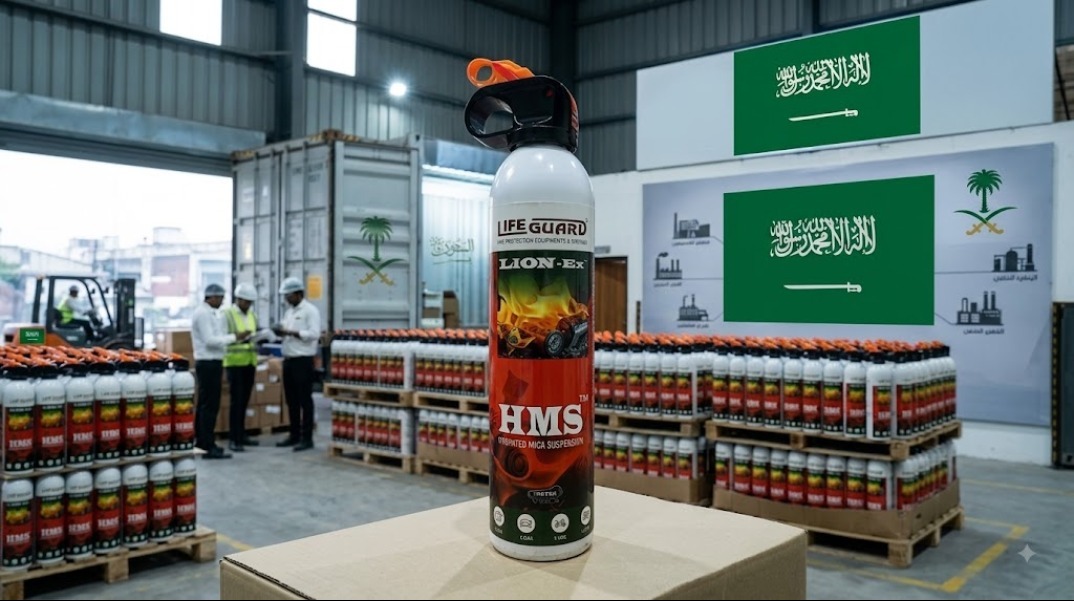
For selected lithium battery fire protection applications, LIFEGUARD® can provide Hydrated Mica Suspension (HMS) based fire suppression solutions designed for localized battery and electrical equipment protection.
An engineered HMS arrangement may include:
- HMS agent cylinder
- Detection tubing
- Linear heat sensing
- Distribution piping
- Discharge nozzles
- Pressure monitoring
- Actuation arrangement
- Control interface
- Alarm system
- Manual release arrangement
The final system configuration depends on the protected hazard and project design requirements.
7. Localized Battery Rack Suppression
Localized protection can be designed for individual:
- Battery cabinets
- Battery racks
- Battery modules
- Electrical panels
- Energy storage enclosures
- UPS battery cabinets
Detection and discharge points can be positioned close to the identified high-risk areas.
Localized suppression is particularly valuable where rapid response at the source of the incident is a key design objective.
8. BESS Container Fire Suppression Systems
Saudi Arabia's increasing use of renewable energy and large-scale battery storage creates a growing requirement for advanced BESS safety systems.
LIFEGUARD® can engineer fire detection and suppression solutions for:
- Indoor BESS rooms
- Outdoor BESS containers
- Modular energy storage systems
- Utility-scale battery installations
- Renewable-energy storage projects
- Solar-plus-storage facilities
- Industrial energy storage systems
A BESS fire protection architecture may include multiple layers of protection, such as:
Battery monitoring → early detection → alarm → equipment isolation → ventilation control → suppression/cooling → emergency response
This layered approach can provide significantly greater protection than relying upon a single fire protection measure.
Thermal Runaway Protection for Battery Energy Storage Systems in Saudi Arabia
Battery Energy Storage Systems contain large numbers of lithium-ion cells concentrated within a relatively small area.
The challenge is therefore not only extinguishing a fire but also preventing or slowing thermal runaway propagation between cells and modules.
Important factors considered during a BESS fire protection study include:
- Battery chemistry
- Cell capacity
- Module arrangement
- Rack dimensions
- Total stored energy
- BESS enclosure size
- Battery spacing
- Ventilation
- Ambient temperature
- Electrical isolation
- Detection arrangement
- Emergency shutdown logic
- Explosion/deflagration considerations
- Fire department accessibility
- Water availability
- Adjacent equipment exposure
LIFEGUARD® evaluates these parameters before recommending the appropriate protection approach.
Lithium Battery Fire Suppression for EV Applications
Electric mobility is another rapidly growing application for lithium-ion batteries.
LIFEGUARD® can provide fire detection and suppression solutions for:
- Electric buses
- Electric commercial vehicles
- EV battery compartments
- EV charging stations
- Battery swapping stations
- EV service workshops
- Battery test laboratories
- Electric vehicle manufacturing facilities
For vehicle or machinery applications, compact detection and suppression configurations can be developed according to available installation space and hazard characteristics.
Lithium Battery Fire Protection for Data Centres
Modern data centres increasingly use high-energy-density batteries for UPS and backup power applications.
Lithium battery protection in data centres may require integration with:
- Very early smoke detection
- Fire alarm systems
- Gas release systems
- Battery monitoring systems
- HVAC shutdown
- Emergency ventilation
- Electrical isolation
- Building Management Systems
LIFEGUARD® can support integrated fire protection engineering for battery rooms as well as associated server, electrical and control areas.
Industrial Applications We Serve in Saudi Arabia
Our lithium battery fire protection solutions are suitable for sectors including:
- Oil & gas
- Petrochemical
- Power generation
- Renewable energy
- Solar power
- Energy storage
- Utilities
- Data centres
- Telecommunications
- Electric mobility
- Transportation
- Logistics
- Manufacturing
- Defence facilities
- Warehousing
- Smart-city infrastructure
- Commercial complexes
- Industrial facilities
Complete Lithium Battery Fire Safety Solution
LIFEGUARD® focuses on delivering an integrated solution rather than supplying individual fire protection components without considering the overall hazard.
A complete system may include:
- Hazard evaluation
- Fire detection
- Linear heat sensing
- Aspirating smoke detection
- Gas detection
- Control panel
- Automatic suppression
- Manual release
- Abort facility
- Audible alarm
- Visual alarm
- Shutdown interfaces
- Suppression cylinders
- Distribution tubing
- SS piping
- Flexible hoses
- Discharge nozzles
- Pressure monitoring
- System drawings
- Technical data sheets
- Testing documentation
- Installation support
- Commissioning support
How a Lithium Battery Thermal Runaway Protection System Works
A typical system can operate in several stages.
Stage 1 – Abnormal Condition
A battery experiences abnormal heat, electrical failure or internal deterioration.
Stage 2 – Early Detection
Heat, smoke or selected gas detection systems identify the abnormal condition.
Stage 3 – Alarm
The control system activates warning devices and communicates with associated building or equipment controls.
Stage 4 – Isolation
Where engineered into the project, electrical charging, battery operation or connected equipment can be isolated.
Stage 5 – Suppression Activation
The selected suppression or cooling medium is discharged into the protected enclosure or designated hazard zone.
Stage 6 – Propagation Control
The system seeks to control fire development and reduce heat exposure to neighbouring cells or modules.
Stage 7 – Emergency Response
Operators and emergency responders inspect, isolate and manage the damaged battery according to the site's lithium battery emergency response procedures.
Importance of Cell-to-Cell Propagation Control
One of the most important considerations in lithium-ion battery fire protection is preventing a single failing cell from initiating failures in neighbouring cells.
Without sufficient heat management, the sequence may develop as:
Single cell failure → thermal runaway → adjacent cell heating → module involvement → rack propagation → large-scale battery fire
A properly engineered protection strategy attempts to intervene as early as practical within this sequence.
This is why LIFEGUARD® emphasizes early detection, localized intervention, thermal management and propagation control when designing lithium battery safety solutions.
Engineering Approach
Rather than providing a generic suppression package, LIFEGUARD® evaluates project-specific information before finalizing a system.
Typical information required includes:
- Battery manufacturer
- Battery chemistry
- Cell type
- Number of cells
- Number of modules
- Number of racks
- Battery capacity
- kWh/MWh rating
- Room dimensions
- Container dimensions
- Rack dimensions
- Battery spacing
- Ventilation details
- Normal operating temperature
- Maximum expected temperature
- Existing detection systems
- Existing fire suppression systems
- Electrical shutdown requirements
- Project specifications
- Applicable authority requirements
Based on this information, an appropriate detection and suppression philosophy can be developed.
System Integration
Lithium battery thermal runaway protection can be integrated with other plant safety systems.
Possible interfaces include:
- Fire Alarm Control Panel
- Building Management System
- Battery Management System
- Supervisory Control and Data Acquisition System
- HVAC systems
- Emergency ventilation
- Electrical shutdown
- Charging shutdown
- Power isolation
- Emergency alarm
- Remote monitoring
The control philosophy should be clearly defined during engineering so that each safety system responds in the required sequence.
Why Choose LIFEGUARD® for Lithium Battery Thermal Runaway Suppression in Saudi Arabia?
Fire Safety Expertise
LIFEGUARD® specializes in fire protection equipment and engineered fire suppression systems.
Application-Specific Engineering
Our lithium battery solutions are designed according to the actual protected equipment rather than using a one-size-fits-all approach.
Integrated Detection & Suppression
Detection, alarms, control, suppression and shutdown interfaces can be incorporated into a coordinated protection system.
Solutions for Small to Utility-Scale Applications
Systems can be developed for individual battery cabinets through to industrial and large BESS installations.
OEM Fire Protection Capabilities
LIFEGUARD® provides a comprehensive range of fire safety products and engineered suppression systems.
Technical Documentation
Project support can include:
- Technical data sheets
- System schematics
- Layout drawings
- Equipment details
- Compliance documentation
- Installation guidelines
- Testing documentation
International Project Support
LIFEGUARD® supports lithium battery fire protection requirements for clients in Saudi Arabia and other international markets.
Lithium Battery Thermal Runaway Suppression Solutions Across Saudi Arabia
LIFEGUARD® can support project enquiries from major industrial and commercial locations across the Kingdom, including:
- Riyadh
- Jeddah
- Dammam
- Al Khobar
- Dhahran
- Jubail
- Yanbu
- NEOM region
- Tabuk
- Makkah
- Madinah
- Abha
- Al Ahsa
- Ras Tanura
- Jazan
- Other industrial cities across Saudi Arabia
We support EPC contractors, consultants, system integrators, industrial end users, energy companies, developers and fire protection contractors looking for specialized lithium battery protection solutions.
LIFEGUARD® – Lithium Battery Thermal Runaway Suppression Company Saudi Arabia
If you are developing a BESS project, EV facility, battery room, lithium battery warehouse, renewable-energy storage plant, UPS battery installation or industrial lithium-ion battery application in Saudi Arabia, LIFEGUARD® can assist in developing an appropriate fire detection and suppression solution.
Our engineering approach focuses on:
Early Detection + Rapid Alarm + Automatic Suppression + Thermal Control + Propagation Mitigation + System Integration
Protecting lithium-ion batteries requires more than conventional firefighting equipment. It requires a coordinated system designed around the specific battery hazard.
Contact LIFEGUARD®
United Fire Equipments Pvt. Ltd.
LIFEGUARD® – Fire Safety & Suppression Solutions
Manufacturer of Fire Safety Equipment & Engineered Fire Suppression Systems
Phone: +91 8048034226
Email: ufe126@gmail.com | info@lifeguardindia.in
Website: www.lifeguardI