
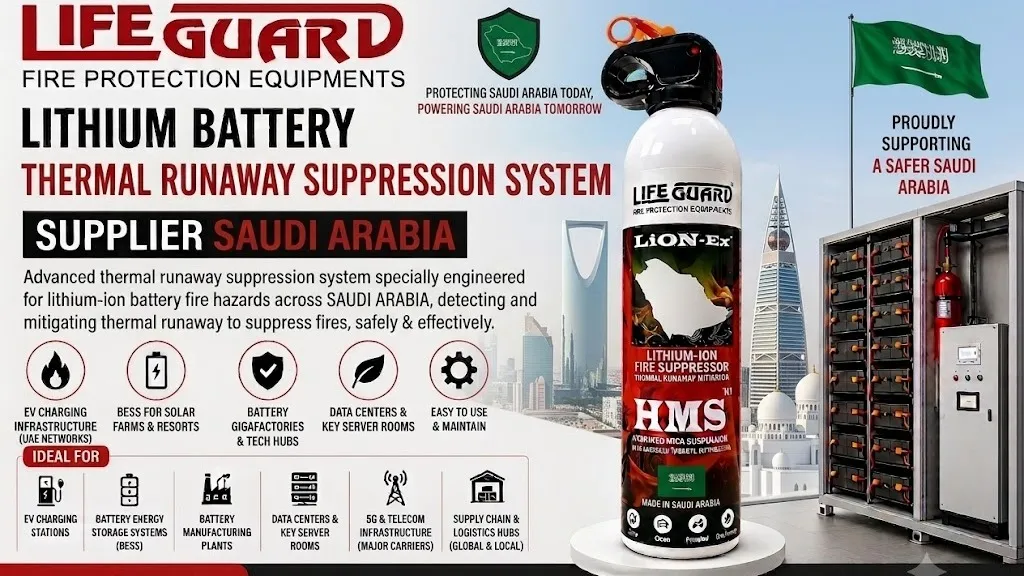
Lithium Battery Thermal Runaway Suppression Supplier Saudi Arabia
Advanced Lithium Battery Thermal Runaway Suppression Solutions in Saudi Arabia
The rapid adoption of lithium-ion batteries across electric vehicles, Battery Energy Storage Systems (BESS), renewable energy projects, data centers, telecommunications, UPS systems, industrial facilities, and energy-storage applications is increasing the importance of specialized lithium battery fire protection in Saudi Arabia.
LIFEGUARD®, from United Fire Equipments Pvt. Ltd., provides specialized lithium battery thermal runaway suppression solutions for Saudi Arabia. Our solutions are suitable for battery manufacturers, BESS developers, EV businesses, data centers, industrial facilities, warehouses, EPC contractors, OEMs, system integrators, and other high-energy battery applications.
Lithium-ion batteries offer high energy density, compact storage, and efficient power delivery. However, abnormal conditions such as overheating, overcharging, internal short circuits, mechanical damage, electrical faults, manufacturing defects, or abnormal operating conditions can potentially initiate thermal runaway.
A thermal runaway event can involve rapid temperature escalation, gas generation, smoke, fire, cell-to-cell propagation, module involvement, and possible re-ignition. Therefore, lithium battery fire protection should address more than visible flames.
A properly engineered protection strategy can combine early warning detection, temperature monitoring, fire alarm, emergency isolation, suppression, ventilation considerations, and post-event monitoring.
As a lithium battery thermal runaway suppression supplier in Saudi Arabia, LIFEGUARD® supports customers with application-specific fire safety solutions based on the battery installation, protected area, energy capacity, enclosure, and project requirements.
What Is Lithium Battery Thermal Runaway?
Thermal runaway is a self-accelerating failure condition in which heat generated within a lithium-ion battery cell exceeds its ability to dissipate that heat.
As the cell temperature rises, internal reactions can accelerate. Depending on battery chemistry, construction, condition, and operating environment, thermal runaway may potentially result in:
- Rapid temperature increase
- Internal cell failure
- Electrolyte decomposition
- Gas generation
- Smoke
- Fire
- Cell-to-cell propagation
- Module involvement
- Battery pack involvement
- Re-ignition
Potential contributing factors include:
- Overcharging
- Internal short circuits
- External short circuits
- Excessive temperature
- Mechanical damage
- Manufacturing defects
- Electrical faults
- Improper charging
- Battery management problems
- Abnormal operating conditions
Because battery thermal events can develop rapidly, early detection and coordinated emergency response are important elements of lithium battery fire safety.
LIFEGUARD® – Lithium Battery Thermal Runaway Suppression Supplier Saudi Arabia
LIFEGUARD®, a brand of United Fire Equipments Pvt. Ltd., provides fire safety equipment and specialized fire protection solutions for commercial, industrial, electrical, energy-storage, and battery applications.
Our lithium battery protection solutions can be considered for:
- Lithium-ion battery cabinets
- Battery Energy Storage Systems
- EV battery facilities
- Battery manufacturing plants
- Battery testing laboratories
- UPS battery systems
- Data centers
- Solar energy storage
- Battery warehouses
- Industrial battery systems
- Electrical equipment
- Research and development facilities
LIFEGUARD® follows an application-specific approach to lithium battery fire protection, recognizing that battery chemistry, stored energy, enclosure design, ventilation, operating conditions, and installation configuration influence the required protection strategy.
Why Lithium Battery Thermal Runaway Requires Specialized Fire Protection
Lithium-ion battery incidents can behave differently from conventional combustible-material fires.
Rapid Heat Generation
A damaged or failed battery cell can generate substantial heat within a short period.
Cell-to-Cell Propagation
Heat from an affected cell can potentially cause neighboring cells to become involved.
Gas Generation
Battery failure can produce gases that should be considered when developing detection, ventilation, and emergency-response strategies.
Electrical Hazards
Battery systems may remain electrically energized during an incident unless suitable isolation measures are implemented.
Re-Ignition
The disappearance of visible flames does not necessarily indicate that all thermal activity has stopped.
For this reason, lithium battery fire protection should consider the complete thermal event, including detection, alarm, isolation, suppression, and continued monitoring.
Lithium Battery Thermal Runaway Suppression System Saudi Arabia
A comprehensive protection strategy can incorporate several layers of safety.
1. Early Warning Detection
Early detection can provide additional time for emergency intervention.
Depending on the application, detection technologies may include:
- Smoke detection
- Heat detection
- Aspirating smoke detection
- Temperature monitoring
- Flame detection
- Gas/off-gas detection
- Multi-criteria detection
- Battery Management System signals
The appropriate detection method should be selected according to the battery installation and project risk assessment.
2. Battery Temperature Monitoring
Temperature monitoring can help identify abnormal thermal conditions.
Monitoring may be provided at:
- Cell level
- Module level
- Battery pack level
- Cabinet level
- Container level
- Battery room level
Where appropriate, relevant information from the Battery Management System can be coordinated with the fire safety system.
3. Fire Alarm and Control Panel
A fire alarm/control system can process signals from connected detection devices and initiate the programmed emergency response.
Potential functions include:
- Alarm indication
- Detector supervision
- Fault monitoring
- Audible warning
- Visual warning
- Suppression activation
- Emergency shutdown
- Ventilation control
- Remote monitoring
- System status indication
4. Fire Suppression
The appropriate suppression technology should be selected according to the actual battery application.
Important considerations include:
- Battery chemistry
- Battery configuration
- Energy capacity
- Protected enclosure
- Fire scenario
- Ventilation
- Project requirements
Potential approaches may include:
- Clean-agent suppression
- Aerosol-based suppression
- Water-based protection
- Localized suppression
- Enclosure-level suppression
- Specialized battery fire suppression technologies
There is no single suppression technology that is automatically suitable for every lithium-ion battery installation. Final technology selection should be based on application-specific engineering and the intended protection objective.
5. Electrical Isolation
Where appropriate, the fire protection system can interface with battery and electrical equipment.
Potential functions may include:
- Battery shutdown
- Charger shutdown
- Electrical isolation
- Equipment shutdown
- HVAC control
- Ventilation control
Emergency shutdown sequences should be engineered for the specific battery installation.
Lithium Battery Thermal Runaway Suppression for BESS Saudi Arabia
Battery Energy Storage Systems are increasingly important for renewable energy, grid support, backup power, commercial energy storage, and industrial applications.
BESS installations can contain multiple battery modules arranged within:
- Battery containers
- Battery rooms
- Battery cabinets
- Outdoor enclosures
- Industrial energy-storage facilities
A thermal event in one battery module may potentially affect neighboring modules. Therefore, BESS fire protection in Saudi Arabia should incorporate an integrated detection, alarm, isolation, suppression, and emergency-response strategy.
LIFEGUARD® can support fire safety requirements for:
- Containerized BESS
- Indoor BESS
- Outdoor battery storage
- Battery energy storage containers
- Commercial energy storage
- Industrial energy storage
- Solar-plus-storage projects
- Renewable energy storage facilities
A typical protection philosophy may include:
Battery Monitoring → Early Warning → Fire Alarm → Emergency Shutdown → Suppression → Thermal Monitoring → Emergency Response
The actual sequence should be established through project-specific engineering.
Lithium Battery Thermal Runaway Protection for EV Batteries in Saudi Arabia
The development of electric mobility and associated charging infrastructure is increasing the need for specialized EV battery fire safety.
EV battery protection may be considered for:
- EV battery manufacturing
- Battery assembly
- Battery testing
- Battery storage
- EV charging facilities
- EV service centers
- Battery logistics
- Battery recycling operations
Damaged, defective, overheated, or improperly handled battery packs can present additional fire safety challenges.
LIFEGUARD® can support organizations seeking EV battery fire protection and lithium battery thermal runaway suppression solutions in Saudi Arabia.
Lithium Battery Fire Protection for Battery Cabinets
Lithium-ion battery cabinets can be used in:
- Data centers
- UPS systems
- Telecommunications
- Solar energy systems
- Industrial facilities
- Backup power installations
- Electrical rooms
Battery cabinets can contain significant stored energy within a relatively compact enclosure.
Depending on the application, localized protection may incorporate:
- Temperature detection
- Smoke detection
- Gas detection
- Localized suppression
- Fire alarm
- Emergency shutdown
- Remote monitoring
The final configuration should be based on battery chemistry, cabinet construction, energy capacity, ventilation, and the intended protection objective.
Lithium Battery Thermal Runaway Protection for Data Centers
Data centers depend on reliable backup power to maintain critical IT infrastructure.
Lithium-ion batteries are increasingly used in UPS applications. Fire protection planning may therefore consider:
- UPS battery rooms
- Lithium battery cabinets
- Electrical rooms
- Critical power areas
- Energy storage systems
- Early detection
- Emergency isolation
- Suppression
- Post-event monitoring
LIFEGUARD® can support specialized lithium battery fire protection requirements for data centers and critical infrastructure projects in Saudi Arabia.
Thermal Runaway Suppression for Battery Manufacturing Facilities
Battery manufacturing and assembly facilities can contain:
- Lithium-ion cells
- Battery modules
- Battery packs
- Charging equipment
- Testing equipment
- Electrical systems
- Production machinery
- Stored batteries
Potential protection areas include:
- Cell production
- Module assembly
- Battery pack assembly
- Charging areas
- Battery testing rooms
- Battery storage
- Finished goods warehouses
- R&D laboratories
- Quality-control areas
Different production processes can present different hazards. Therefore, the fire protection strategy should be developed according to the specific production process, battery configuration, energy capacity, and facility risk assessment.
Lithium Battery Fire Protection for Solar Energy Storage in Saudi Arabia
Saudi Arabia's large-scale renewable-energy development and energy-storage requirements are increasing the importance of lithium battery fire protection.
Lithium battery energy storage systems may be used in:
- Solar projects
- Commercial buildings
- Industrial facilities
- Microgrids
- Renewable energy plants
- Battery storage facilities
- Backup power systems
LIFEGUARD® can support specialized fire safety requirements for lithium battery-based renewable-energy storage projects.
How Lithium Battery Thermal Runaway Suppression Works
A typical integrated protection sequence can operate through several stages.
Stage 1 – Battery Monitoring
The battery system monitors defined electrical and thermal parameters.
Stage 2 – Abnormal Condition Detection
Sensors or monitoring systems identify abnormal temperature, smoke, gas, flame, or another configured warning condition.
Stage 3 – Fire Alarm
The fire alarm/control system provides audible and visual warnings.
Stage 4 – Emergency Isolation
Where engineered, selected battery or electrical equipment can be isolated.
Stage 5 – Suppression
The selected suppression system activates according to its programmed sequence.
Stage 6 – Continued Monitoring
The affected battery or protected area remains under observation for continuing thermal activity or possible re-ignition.
Stage 7 – Emergency Response
Site personnel and emergency responders follow the approved emergency procedures.
Benefits of Lithium Battery Thermal Runaway Suppression Systems
Early Warning
Early detection can provide additional time for emergency intervention.
Layered Fire Protection
Detection, alarm, isolation, suppression, and monitoring can work as coordinated layers of protection.
Application-Specific Design
The protection system can be engineered around the actual battery configuration.
Equipment Protection
An appropriate strategy can help protect battery modules, cabinets, electrical equipment, and surrounding infrastructure.
Personnel Safety
Early alarm notification can support evacuation and emergency response.
Scalable Solutions
Protection can be developed for individual cabinets, rooms, containers, or larger battery facilities.
Business Continuity
Prompt intervention may help reduce the operational impact of battery-related fire incidents.
Factors to Consider Before Selecting a Thermal Runaway Suppression System in Saudi Arabia
Selecting a lithium battery suppression system requires an understanding of the actual installation.
Important factors include:
Battery Chemistry
Different lithium battery chemistries can exhibit different thermal and fire characteristics.
Energy Capacity
Total stored energy influences potential incident severity.
Battery Configuration
Cell, module, rack, cabinet, and container arrangements affect detection and suppression requirements.
Enclosure Volume
The dimensions and construction of the protected enclosure can influence system design.
Ventilation
Air movement can affect smoke, heat, and gas behavior.
Operating Conditions
Charging, discharging, ambient temperature, and battery usage patterns should be evaluated.
BMS Architecture
Battery Management System information can contribute to the overall safety strategy.
Emergency Shutdown
Electrical isolation requirements should be established during system engineering.
Re-Ignition Risk
Post-event monitoring should be considered because thermal activity can continue after visible flames are suppressed.
Lithium Battery Thermal Runaway Suppression Supplier and Manufacturer Saudi Arabia
LIFEGUARD® supports organizations searching for a lithium battery thermal runaway suppression supplier in Saudi Arabia.
Our potential customers include:
- EV manufacturers
- Lithium battery manufacturers
- BESS developers
- Renewable energy companies
- Data center operators
- Industrial companies
- Warehouses
- Logistics companies
- EPC contractors
- Electrical contractors
- Fire protection contractors
- System integrators
- OEMs
- Consultants
- Research organizations
We can support customers through:
- Technical evaluation
- System selection
- Project planning
- Product supply
- Installation assistance
- Testing
- Commissioning
- Maintenance planning
- Technical documentation
Lithium Battery Thermal Runaway Protection Across Saudi Arabia
LIFEGUARD® can support lithium battery fire protection requirements for projects across major Saudi Arabian locations, including:
Riyadh
Solutions for data centers, commercial facilities, warehouses, EV infrastructure, industrial facilities, and energy-storage projects.
Jeddah
Fire protection support for commercial buildings, logistics facilities, warehouses, industrial applications, and battery installations.
Dammam
Solutions for industrial facilities, energy projects, warehouses, and battery storage applications.
Dhahran
Specialized fire protection support for energy, industrial, electrical, and critical infrastructure applications.
Jubail
Fire safety solutions for industrial facilities, manufacturing, logistics, and energy-storage projects.
NEOM and Large-Scale Development Projects
Application-specific battery fire protection solutions can be evaluated for large renewable-energy, infrastructure, transportation, and energy-storage developments.
Key Components of a Lithium Battery Thermal Runaway Protection System
ComponentFunctionTemperature MonitoringIdentifies abnormal thermal conditionsSmoke DetectionDetects smoke at an early stageGas DetectionDetects battery off-gas where applicableFire Alarm PanelProcesses alarm and fault signalsSuppression SystemProvides the selected fire-control responseEmergency ShutdownIsolates selected equipment where engineeredAudible/Visual AlarmProvides personnel warningMonitoring InterfaceProvides system status and event informationVentilation ControlCoordinates ventilation functions where required
The final system configuration depends on battery technology, application, enclosure, operating conditions, and project requirements.
Why Choose LIFEGUARD® as Your Lithium Battery Thermal Runaway Suppression Supplier in Saudi Arabia?
Selecting the right fire protection supplier is important for high-energy lithium battery applications.
LIFEGUARD® offers:
- Fire safety industry experience
- Specialized lithium battery protection solutions
- Thermal runaway protection approach
- Early detection options
- Fire alarm integration
- Suppression system solutions
- Battery cabinet protection
- BESS fire protection support
- EV battery fire safety
- Customized project solutions
- Technical documentation
- OEM support
- Installation assistance
- Testing and commissioning support
- Maintenance planning
- International project support
Our objective is to help customers develop a layered lithium battery fire safety strategy based on the actual hazard and installation requirements.
Compliance and Engineering Considerations for Saudi Arabia
Lithium battery fire protection requirements can vary according to battery technology, energy capacity, installation configuration, building type, and applicable Saudi requirements.
Project planning may need to consider:
- Applicable Saudi fire safety requirements
- Local Civil Defense requirements
- Building requirements
- Electrical safety requirements
- Insurance requirements
- Battery manufacturer's recommendations
- Project specifications
- Equipment manufacturer's installation instructions
- Relevant fire protection standards
- Testing and commissioning requirements
Applicable regulations, standards, certifications, approvals, and local authority requirements should be verified for each individual project. A qualified fire protection professional should evaluate the installation before final system selection.
Frequently Asked Questions
What is lithium battery thermal runaway?
Thermal runaway is a self-accelerating battery failure condition involving rapid heat generation. Depending on the circumstances, it can result in smoke, gas release, fire, propagation, and re-ignition.
Why is thermal runaway suppression important?
Lithium battery incidents can involve rapid heat generation, cell propagation, electrical hazards, gas generation, and continuing thermal activity. A specialized protection strategy can address these risks through detection, isolation, suppression, and monitoring.
Does LIFEGUARD® supply lithium battery thermal runaway suppression systems in Saudi Arabia?
LIFEGUARD® supports lithium battery fire protection requirements through application-specific evaluation, system engineering, and product supply.
Can lithium battery cabinets have localized suppression?
Depending on cabinet design and the project risk assessment, localized detection and suppression can be considered.
Can a thermal runaway protection system integrate with a BMS?
Depending on the system architecture, relevant signals can potentially be exchanged between the fire safety system and Battery Management System.
What information is required for a quotation?
Useful information includes:
- Battery chemistry
- Battery capacity
- Number of cells/modules
- Cabinet or container dimensions
- Room dimensions
- Battery configuration
- Ventilation arrangements
- Operating conditions
- Required protection areas
- Existing fire alarm system
Is one suppression technology suitable for every lithium battery?
No. Battery chemistry, configuration, energy capacity, enclosure, ventilation, and expected fire scenario should be evaluated before selecting the suppression technology.
Does LIFEGUARD® provide customized lithium battery fire protection solutions?
Yes. LIFEGUARD® can support customized requirements for BESS, EV batteries, battery cabinets, UPS systems, industrial facilities, warehouses, renewable energy projects, and other lithium-ion battery applications.
Contact LIFEGUARD® – Lithium Battery Fire Safety Solutions
If you are searching for a reliable lithium battery thermal runaway suppression supplier in Saudi Arabia, LIFEGUARD® provides specialized fire safety solutions for lithium-ion batteries, BESS, EV batteries, battery cabinets, UPS systems, battery manufacturing facilities, warehouses, renewable energy projects, and industrial applications.
LIFEGUARD®
United Fire Equipments Pvt. Ltd.
Manufacturer of ISI Certified Fire Safety Equipment
Phone: 8048034226
Email: ufe126@gmail.com | info@lifeguardindia.in
Website: www.lifeguardindia.in
Keywords






