
Lithium Battery Thermal Runaway Suppression System Provider Germany – LIFEGUARD®
Engineered Lithium-Ion Battery Fire Detection, Thermal Runaway Control & Suppression Solutions
LIFEGUARD® is a specialized lithium battery thermal runaway suppression system provider in Germany, offering engineered fire detection and suppression solutions for lithium-ion battery installations across industrial, commercial, energy storage, automotive, data centre, renewable-energy and critical infrastructure applications.
Lithium-ion batteries have become essential for modern electrification because of their high energy density, compact design and ability to store large quantities of electrical energy. They are increasingly used in Battery Energy Storage Systems (BESS), electric vehicles, UPS systems, renewable-energy installations, telecom facilities, battery manufacturing plants and industrial equipment.
However, lithium-ion batteries introduce a specialized fire hazard known as thermal runaway.
An internal electrical fault, mechanical damage, overcharging, excessive temperature or cell defect may trigger rapid self-heating. If the condition continues, the battery may generate smoke, combustible gases, intense heat and fire. Heat from one failing cell may subsequently affect neighbouring cells, potentially resulting in cell-to-cell or module-to-module thermal runaway propagation.
LIFEGUARD® develops integrated battery fire protection solutions built around:
Early Detection → Rapid Alarm → Equipment Isolation → Automatic Suppression → Thermal Control → Propagation Mitigation → Continued Monitoring
For EPC contractors, battery manufacturers, BESS integrators, automotive companies, consultants and industrial customers searching for a dependable lithium battery thermal runaway suppression system provider Germany, LIFEGUARD® provides application-specific engineering support and suppression solutions.
What Is Lithium Battery Thermal Runaway?
Thermal runaway is a condition in which a lithium-ion battery cell generates heat faster than that heat can dissipate.
As internal cell temperature rises, chemical reactions inside the battery may accelerate and generate additional heat. This can create a self-sustaining temperature increase that may eventually lead to cell venting, fire or propagation to nearby batteries.
Thermal runaway may result from:
- Internal short circuit
- Battery overcharging
- Excessive discharge
- Electrical malfunction
- Mechanical impact
- Crushing or penetration
- Manufacturing defects
- Cell ageing
- High environmental temperature
- Cooling system failure
- Improper charging
- Battery Management System malfunction
- Damaged electrical connections
- Exposure to heat from adjacent cells
- Abnormal operating conditions
One of the most significant battery safety challenges is preventing a localized event from becoming a large-scale incident.
A possible escalation sequence is:
Single Cell Failure → Thermal Runaway → Adjacent Cell Heating → Battery Module Involvement → Rack Propagation → Major Battery Fire
Effective lithium battery fire protection must therefore consider both initial fire suppression and thermal runaway propagation control.
Lithium Battery Thermal Runaway Suppression System Provider in Germany
LIFEGUARD® can develop fire detection and suppression solutions for a wide range of lithium-ion battery hazards.
Applications include:
- Battery Energy Storage Systems
- BESS containers
- Indoor BESS rooms
- Outdoor BESS installations
- Lithium-ion battery racks
- Battery cabinets
- Battery modules
- EV battery systems
- Electric buses
- Electric commercial vehicles
- EV charging stations
- Battery manufacturing plants
- Battery assembly facilities
- Battery testing laboratories
- Battery R&D centres
- UPS battery rooms
- Data centres
- Telecom installations
- Renewable-energy projects
- Solar-plus-storage systems
- Industrial energy storage
- Lithium battery warehouses
- Critical electrical installations
No two battery applications are exactly the same.
System design should therefore be based on the actual battery chemistry, configuration, enclosure, stored energy, operating temperature, ventilation and fire-risk conditions.
Why Lithium-Ion Battery Fires Need Specialized Suppression Systems
Conventional fire protection systems are primarily designed around traditional fire hazards.
Lithium-ion batteries can present an additional challenge because energy and heat can remain within damaged cells even after visible flames have been reduced.
A comprehensive protection strategy should address several different functions.
Early Detection
Abnormal battery conditions should be identified before extensive fire development whenever practicable.
Rapid Notification
Personnel and control systems should receive immediate warning through suitable audible, visual or remote alarms.
Electrical Isolation
Where supported by the system architecture, affected charging circuits, battery equipment or electrical loads can be isolated.
Automatic Suppression
A suppression system can activate according to predetermined detection and release logic.
Heat Management
Limiting thermal exposure to surrounding cells, modules and equipment is an important part of battery protection.
Propagation Mitigation
The system strategy should aim to reduce the likelihood of thermal runaway spreading through the battery installation.
Post-Fire Monitoring
Damaged batteries may require continued observation because internal heat and re-ignition risks may remain after initial fire control.
LIFEGUARD® Lithium Battery Thermal Runaway Suppression System
Depending upon the application, LIFEGUARD® can develop an integrated protection package incorporating:
- Heat detection
- Linear Heat Detection
- Very Early Warning Smoke Detection
- Aspirating smoke detection
- Conventional smoke detection
- Gas detection
- Multi-criteria detectors
- Flame detection
- Automatic suppression system
- Suppression cylinders
- Distribution piping
- Stainless steel tubing
- Flexible hoses
- Detection tubing
- Discharge nozzles
- Pressure monitoring
- Fire suppression release panel
- Manual release station
- Audible alarms
- Visual alarms
- Electrical shutdown contacts
- HVAC shutdown
- Emergency ventilation interfaces
- Battery Management System interfaces
- Building Management System interfaces
- SCADA interfaces
- Remote alarm monitoring
The final system configuration depends upon the protection objective and battery hazard.
Early Warning Lithium Battery Detection
Early warning is one of the most valuable elements of lithium battery thermal runaway protection.
A battery abnormality detected during its early development offers more opportunity for intervention than a situation where several modules are already involved.
Different detection technologies may be combined depending upon the project.
Linear Heat Detection for Lithium Battery Racks
Linear Heat Detection can provide continuous temperature monitoring close to battery equipment.
Heat sensing cable may be installed around:
- Battery modules
- Battery racks
- Battery cabinets
- Cable compartments
- Electrical connections
- UPS battery banks
- BESS containers
- Energy storage enclosures
Locating heat sensing close to the battery equipment may allow abnormal temperature conditions to be detected earlier than relying exclusively on ceiling-mounted detection.
Detection thresholds and installation arrangements should be selected based on normal operating conditions and project requirements.
Aspirating Smoke Detection for Battery Rooms & BESS
Aspirating smoke detection systems continuously draw air through strategically positioned sampling points.
This provides sensitive smoke monitoring for critical battery installations.
Typical applications include:
- BESS containers
- Battery rooms
- Data centre battery rooms
- UPS areas
- Battery laboratories
- Battery manufacturing facilities
- Energy storage rooms
- Telecom installations
Early smoke detection can be interfaced with alarms, equipment isolation and suppression system controls.
Gas Detection for Lithium Battery Thermal Runaway
Lithium-ion cells may release gases during certain abnormal failure conditions.
Where identified by project-specific hazard assessment, appropriate gas monitoring can form an additional layer of early warning.
Gas detection may interface with:
- Battery Management Systems
- Fire Alarm Control Panels
- Suppression panels
- SCADA
- Building Management Systems
- Emergency ventilation
- Electrical isolation
- Audible alarms
- Visual alarms
- Remote monitoring
The type and location of sensors should be selected according to the battery chemistry and expected failure scenario.
Automatic Lithium Battery Fire Suppression System Germany
An automatic suppression system can be programmed to operate following confirmation of predetermined fire or abnormal battery conditions.
The suppression system may be designed to:
- Control developing fire
- Reduce flame intensity
- Reduce thermal exposure
- Protect adjacent batteries
- Protect electrical equipment
- Support propagation mitigation
- Limit damage to nearby assets
- Support emergency intervention
The suppression medium and system architecture must be selected according to the specific hazard.
There is no single suppression technology that should automatically be assumed suitable for every lithium-ion battery installation.
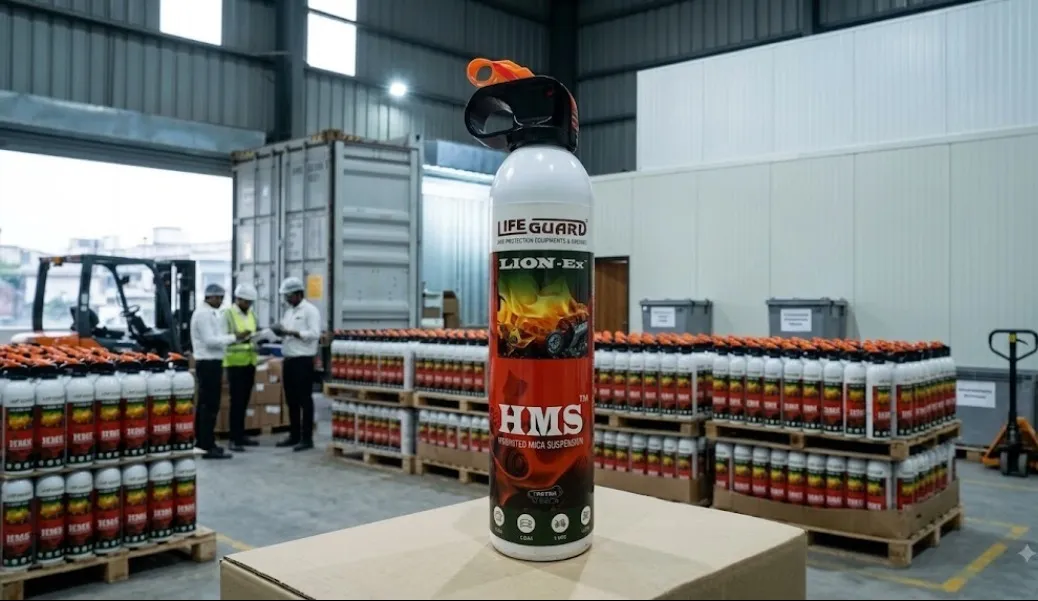
HMS Lithium Battery Thermal Runaway Suppression Solution
For selected battery and electrical applications, LIFEGUARD® can provide Hydrated Mica Suspension (HMS) based fire suppression solutions.
Depending upon the application, an HMS suppression arrangement may incorporate:
- HMS suppression cylinder
- Automatic actuation
- Linear Heat Detection
- Detection tubing
- Distribution tubing
- Stainless steel piping
- Flexible connections
- Discharge nozzles
- Pressure monitoring
- Manual release
- Alarm interface
- Control system interface
Localized suppression can be engineered around battery racks, cabinets or identified fire-risk zones.
System selection and final design should be based on the specific battery configuration and project hazard assessment.
Lithium Battery Rack Fire Suppression Germany
Battery racks contain multiple lithium-ion cells and modules installed close together.
This configuration creates a potential pathway for thermal runaway propagation if an individual battery failure is not controlled.
Localized rack protection can incorporate:
Battery Monitoring → Heat Detection → Alarm → Isolation → Automatic Suppression → Thermal Control
Protection can be developed for:
- Individual battery racks
- Battery modules
- Battery enclosures
- Electrical compartments
- Energy storage cabinets
- UPS battery racks
Detection and discharge devices can be positioned close to potential fire-risk areas to support rapid response.
Lithium Battery Cabinet Fire Suppression Germany
Lithium-ion battery cabinets are used extensively in distributed energy storage, telecom, UPS and industrial applications.
A cabinet fire protection system may include:
- Local heat detection
- Detection tubing
- Automatic suppression
- Agent cylinder
- Distribution piping
- Discharge nozzles
- Alarm contacts
- Pressure supervision
- Remote monitoring contacts
The design should be based on cabinet volume, battery arrangement, ventilation, module location and identified fire hazards.
BESS Fire Suppression System Provider Germany
Battery Energy Storage Systems can contain very high concentrations of stored energy.
Modern BESS installations may contain hundreds or thousands of interconnected cells installed in modules, racks and containers.
For this reason, BESS protection should typically use multiple safety layers.
A comprehensive strategy can include:
Battery Management System → Early Warning Detection → Alarm → Isolation → Ventilation Control → Automatic Suppression → Heat Management → Emergency Response
LIFEGUARD® can develop suppression solutions for:
- Containerized BESS
- Indoor battery energy storage
- Outdoor BESS
- Industrial energy storage
- Commercial BESS
- Utility-scale BESS
- Microgrids
- Solar-plus-storage
- Wind-energy storage
- Power infrastructure
- Renewable-energy facilities
BESS Thermal Runaway Protection Germany
Thermal runaway propagation is one of the most important issues in BESS fire safety.
A developing event may potentially progress through:
Cell → Module → Rack → Adjacent Rack → BESS Enclosure
A detailed BESS fire protection assessment should consider:
- Battery chemistry
- Cell construction
- Cell capacity
- Module arrangement
- Number of modules
- Number of racks
- Rack dimensions
- Total stored energy
- kWh/MWh capacity
- Battery spacing
- Rack spacing
- Container dimensions
- Ventilation
- HVAC
- Cooling system
- Ambient temperature
- Battery Management System
- Electrical isolation
- Fire detection
- Gas generation
- Suppression system
- Adjacent exposures
- Emergency access
These parameters influence detection placement, suppression design and emergency response philosophy.
EV Battery Thermal Runaway Suppression Germany
Germany has extensive automotive and electric-mobility infrastructure, making lithium-ion battery fire safety particularly relevant for EV applications.
LIFEGUARD® can support selected protection requirements for:
- Electric cars
- Electric buses
- Electric trucks
- Electric commercial vehicles
- EV battery packs
- Battery compartments
- Battery swapping facilities
- EV charging installations
- Electric industrial vehicles
Protection can be developed for identified battery compartments and associated electrical equipment where technically appropriate.
EV Battery Manufacturing Fire Protection
EV and battery manufacturing facilities may contain lithium-ion batteries throughout multiple stages of production.
Potential risk locations include:
- Cell manufacturing
- Battery module assembly
- Battery pack assembly
- Formation and ageing areas
- Charging stations
- Battery testing laboratories
- R&D facilities
- Finished battery storage
- Damaged battery storage
- Battery quarantine areas
Each zone can present a different fire hazard.
Detection and suppression should therefore be designed according to the process taking place in the protected area.
Battery Testing Laboratory Fire Suppression Germany
Lithium-ion battery laboratories can intentionally expose batteries to demanding conditions during development and certification activities.
Testing may include:
- Charge/discharge testing
- High-temperature testing
- Short-circuit testing
- Performance testing
- Environmental testing
- Mechanical testing
- Prototype testing
- Abuse testing
Fire protection for test laboratories should be specifically engineered around the expected battery failure scenarios.
LIFEGUARD® can support customized detection and suppression solutions for appropriate testing facilities.
Lithium Battery Warehouse Fire Protection Germany
Warehouses storing lithium-ion batteries present different challenges compared with individual battery rooms or equipment cabinets.
Important factors include:
- Total battery quantity
- Battery chemistry
- Battery state of charge
- Packaging
- Storage arrangement
- Rack height
- Storage density
- Returned batteries
- Damaged battery storage
- Charging activities
- Compartmentation
- Ventilation
- Detection
- Emergency response access
A dedicated hazard assessment is important for determining the appropriate warehouse protection philosophy.
Data Centre Lithium Battery Fire Suppression Germany
Lithium-ion batteries are increasingly used for UPS and critical backup applications.
Data centre battery fire protection may integrate:
- Aspirating smoke detection
- Heat detection
- Battery Management System alarms
- Gas detection where applicable
- Fire alarm systems
- Automatic suppression
- HVAC shutdown
- Emergency ventilation
- Electrical isolation
- Remote alarm monitoring
An integrated approach can help protect both the battery installation and surrounding mission-critical infrastructure.
Renewable Energy Battery Fire Suppression Germany
Lithium-ion energy storage is widely associated with renewable-energy projects.
Common applications include:
- Solar-plus-storage systems
- Wind-energy storage
- Grid energy storage
- Commercial renewable-energy projects
- Industrial renewable power
- Microgrids
- Utility-scale battery installations
LIFEGUARD® can provide specialized lithium battery thermal runaway detection and suppression solutions for these applications.
Complete Lithium Battery Fire Protection Engineering
LIFEGUARD® focuses on integrated fire protection rather than simply supplying individual components.
Our project support can include:
Hazard Review
Assessment of battery configuration, enclosure and identified fire-risk locations.
Detection Engineering
Selection and positioning of suitable fire and thermal runaway detection technologies.
Suppression System Engineering
Development of the appropriate discharge arrangement.
Piping & Nozzle Design
Engineering of distribution tubing, piping and discharge locations.
Cause-and-Effect Philosophy
Definition of alarm, shutdown, isolation and suppression sequences.
System Integration
Coordination with facility monitoring and safety systems.
Technical Documentation
Preparation of drawings, technical data sheets, layouts and specifications.
Installation Support
Technical assistance for correct installation.
Testing & Commissioning Support
Functional testing and commissioning guidance according to project scope.
Integration with Battery Management System, BMS & SCADA
An effective battery protection system should operate as part of the larger plant safety infrastructure.
Interfaces can potentially include:
- Battery Management System
- Building Management System
- Fire Alarm Control Panel
- SCADA
- HVAC controls
- Emergency ventilation
- Electrical shutdown
- Charging shutdown
- Remote alarm monitoring
- Plant emergency systems
System logic should be developed during the engineering stage to ensure coordinated operation.
How Does a Lithium Battery Thermal Runaway Suppression System Work?
A typical protection sequence may operate as follows:
Step 1 – Abnormal Battery Condition
A battery cell develops overheating or another electrical, thermal or mechanical abnormality.
Step 2 – Early Detection
Heat, smoke, gas or another monitoring technology identifies the developing condition.
Step 3 – Alarm
Local and remote alarms are generated.
Step 4 – Isolation
Where supported, charging systems or electrical equipment can be isolated.
Step 5 – Automatic Suppression
The suppression system activates after the required detection logic is satisfied.
Step 6 – Heat Control
The suppression arrangement seeks to limit fire intensity and thermal exposure.
Step 7 – Propagation Mitigation
The protection system supports efforts to prevent neighbouring batteries from becoming involved.
Step 8 – Emergency Response
Site personnel and emergency responders manage the affected batteries according to established procedures.
Step 9 – Continued Monitoring
The affected area remains under observation because residual battery heat may continue after the initial incident.
Information Required for Battery Suppression System Design
LIFEGUARD® may require the following project information:
- Battery manufacturer
- Battery model
- Battery chemistry
- Cell capacity
- Module capacity
- Number of cells
- Number of modules
- Number of racks
- Total energy storage capacity
- kWh/MWh rating
- Rack dimensions
- Battery layout
- Room dimensions
- Container dimensions
- Cabinet dimensions
- Battery spacing
- Normal operating temperature
- Maximum expected temperature
- HVAC details
- Ventilation
- Battery cooling arrangements
- Battery Management System information
- Existing fire alarm system
- Existing fire suppression system
- Electrical shutdown requirements
- Required interfaces
- Project specifications
Accurate project information enables a more appropriate suppression concept to be developed.
Why Choose LIFEGUARD® as Lithium Battery Thermal Runaway Suppression System Provider Germany?
Specialized Battery Fire Protection
LIFEGUARD® provides engineered solutions for specialized lithium-ion battery and electrical hazards.
Early Detection & Automatic Suppression
Detection, alarms and automatic suppression can be combined into an integrated protection strategy.
Application-Specific Design
System design is developed according to the actual battery configuration rather than using a generic package.
Localized Protection
Solutions can be engineered for individual cabinets, modules, racks and defined hazard zones.
BESS Fire Protection Capability
Protection can be developed for commercial, industrial and larger energy storage installations.
Engineering Documentation
LIFEGUARD® can provide:
- Technical Data Sheets
- System schematics
- Equipment specifications
- General Arrangement drawings
- Detection layouts
- Piping layouts
- Nozzle layouts
- Control philosophy
- Installation recommendations
- Technical documentation
OEM Fire Protection Capability
LIFEGUARD® is the fire safety brand of United Fire Equipments Pvt. Ltd., providing fire safety equipment and engineered suppression systems for industrial and specialized applications.
Lithium Battery Thermal Runaway Suppression Solutions Across Germany
LIFEGUARD® can support project enquiries from customers and partners throughout Germany, including:
- Berlin
- Munich
- Hamburg
- Frankfurt
- Stuttgart
- Düsseldorf
- Cologne
- Leipzig
- Dortmund
- Dresden
- Hanover
- Bremen
- Nuremberg
- Essen
- Mannheim
- Karlsruhe
- Wolfsburg
- Other industrial areas throughout Germany
Our solutions can support:
- BESS integrators
- Battery manufacturers
- Automotive manufacturers
- Renewable-energy developers
- EPC contractors
- Data centre developers
- Engineering consultants
- Fire protection contractors
- System integrators
- Utilities
- Industrial end users
- Facility owners
LIFEGUARD® – Lithium Battery Thermal Runaway Suppression System Provider Germany
For projects involving Battery Energy Storage Systems, EV batteries, lithium battery rooms, manufacturing facilities, battery laboratories, renewable-energy storage, data centres, UPS installations or lithium battery warehouses, LIFEGUARD® can provide an engineered fire protection approach.
Our philosophy is simple:
Detect Early → Alarm Quickly → Isolate → Suppress → Control Heat → Reduce Propagation → Monitor
Effective lithium-ion battery fire protection requires more than extinguishing visible flames.
A comprehensive strategy should address the complete battery hazard—from an initial abnormal condition to thermal runaway, propagation, fire suppression and post-incident monitoring.
Contact LIFEGUARD®
LIFEGUARD®
United Fire Equipments Pvt. Ltd.
Manufacturer of Fire Safety Equipment & Engineered Fire Suppression Systems
Phone: +91 8048034226
Email: ufe126@gmail.com | info@lifeguardindia.in
Keywords






