
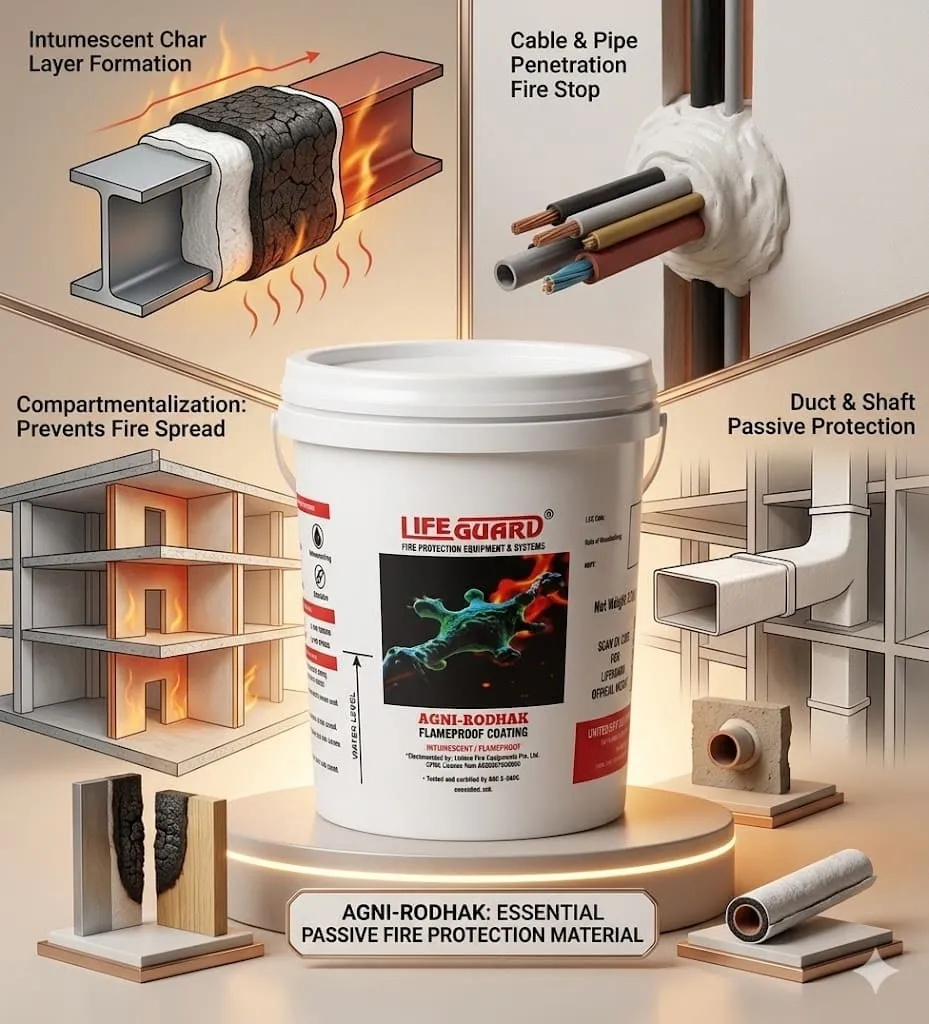
Passive Fire Protection Material – Advanced Fire Resistant Solutions for Modern Infrastructure
Passive Fire Protection Material plays a vital role in modern fire safety systems by preventing the spread of fire, smoke, and heat within buildings and industrial facilities. Unlike active fire protection systems such as fire alarms and sprinklers, passive fire protection materials work continuously without activation, helping contain fires, protect structural integrity, and provide valuable evacuation time during emergencies.
In commercial buildings, industrial plants, hospitals, educational institutions, hotels, data centers, airports, and residential complexes, passive fire protection materials are essential for improving overall fire resistance and ensuring occupant safety.
At LIFEGUARD® United Fire Equipments Pvt. Ltd., we provide high-performance passive fire protection materials designed to deliver superior fire resistance, structural safety, and compliance with national and international fire safety standards.
What is Passive Fire Protection Material?
Passive fire protection materials are fire-resistant products and systems used in construction and industrial infrastructure to slow down the spread of flames, heat, and smoke.
These materials are specially engineered to:
- Resist high temperatures
- Contain fire within compartments
- Protect structural elements
- Reduce smoke propagation
- Maintain building stability
- Improve evacuation safety
- Minimize fire-related damage
Passive fire protection systems remain operational 24/7 and form the foundation of comprehensive building fire safety.
Importance of Passive Fire Protection Materials
During a fire emergency, uncontrolled flames and smoke can rapidly spread through walls, ceilings, ducts, cable openings, and structural gaps. Passive fire protection materials help compartmentalize the fire and limit its movement.
Key Benefits Include:
- Enhanced life safety
- Reduced fire spread
- Increased evacuation time
- Protection of critical infrastructure
- Improved structural stability
- Reduced property damage
- Better smoke control
- Compliance with fire safety regulations
Passive fire protection materials are essential for both new construction projects and retrofitting existing buildings.
Types of Passive Fire Protection Materials
Fire-Rated Boards & Panels
Fire-rated boards are widely used to create fire-resistant walls, ceilings, shafts, and partitions.
Applications Include:
- Electrical rooms
- Server rooms
- Commercial buildings
- Hospitals
- Industrial facilities
- Escape corridors
These boards provide high fire resistance and thermal insulation.
Firestop Sealants
Firestop sealants are used to seal gaps and openings around pipes, cables, ducts, and conduits.
Benefits Include:
- Prevents smoke leakage
- Stops flame spread
- Maintains wall fire rating
- Flexible and durable performance
Firestop sealants are critical for maintaining compartment integrity.
Intumescent Coatings
Intumescent coatings expand when exposed to heat, forming a thick insulating layer that protects surfaces from extreme temperatures.
Common Applications:
- Structural steel
- Industrial plants
- Warehouses
- Commercial buildings
These coatings help prevent structural collapse during fires.
Fire-Rated Doors
Fire-resistant doors are designed to contain flames and smoke within a specific area.
Features Include:
- Heat-resistant construction
- Smoke seals
- Automatic closing systems
- Fire-rated hardware
Fire doors are essential for staircases, escape routes, and electrical rooms.
Fire-Rated Glass
Fire-rated glass systems provide visibility while maintaining fire compartmentation.
Used In:
- Office partitions
- Hospitals
- Hotels
- Educational institutions
- Commercial complexes
These systems improve both safety and aesthetics.
Fire & Smoke Dampers
Fire dampers prevent fire and smoke from spreading through HVAC duct systems.
Functions Include:
- Automatic closure during fire
- Smoke containment
- Protection of escape routes
- HVAC compartmentalization
These systems are essential for commercial and industrial buildings.
Fireproof Insulation Materials
Fire-resistant insulation materials help reduce heat transfer and improve structural fire resistance.
Common Materials Include:
- Mineral wool
- Rock wool
- Ceramic fiber insulation
- Fire-resistant foam systems
These materials are widely used in industrial and commercial infrastructure.
Cable Fire Protection Materials
Specialized cable coatings and wraps prevent fire spread through electrical wiring systems.
Applications Include:
- Data centers
- Power plants
- Electrical rooms
- Industrial facilities
These materials improve electrical fire safety and reduce smoke generation.
Applications of Passive Fire Protection Materials
Commercial Buildings
Protection for offices, malls, hotels, and business complexes.
Industrial Facilities
Fire-resistant protection for factories, warehouses, and manufacturing plants.
Hospitals & Healthcare
Enhanced fire safety for patient care areas, ICUs, and operation theatres.
Educational Institutions
Protection for schools, colleges, laboratories, and libraries.
Data Centers
Fireproofing for server rooms, UPS systems, and electrical infrastructure.
Residential Buildings
Improved occupant safety and structural protection.
Benefits of Advanced Passive Fire Protection Materials
- Continuous fire protection
- Slows down fire spread
- Reduces smoke movement
- Improves structural integrity
- Enhances occupant safety
- Reduces repair costs
- Increases evacuation time
- Long-term durability
Importance of Fire Compartmentation
Passive fire protection materials support fire compartmentation — a key fire safety strategy used to contain fire within a limited area.
Fire Compartmentation Helps:
- Prevent rapid fire spread
- Protect evacuation routes
- Minimize building damage
- Improve firefighting operations
- Enhance overall life safety
Proper compartmentation is essential for modern building safety design.
Fire Safety Compliance & Standards
Passive fire protection materials must comply with:
- National Building Code (NBC)
- BIS Fire Safety Standards
- Fire Department Regulations
- International Fire Resistance Standards
- Industrial Safety Norms
Regular inspection and maintenance ensure long-term fire resistance performance.
Why Choose LIFEGUARD® for Passive Fire Protection Materials?
LIFEGUARD® United Fire Equipments Pvt. Ltd. is a trusted provider of advanced passive fire protection systems and materials in India. We deliver customized fire-resistant solutions for commercial, industrial, healthcare, educational, and residential applications.
Our Passive Fire Protection Solutions Include:
- Fire-rated boards & partitions
- Firestop systems
- Fire-rated doors
- Intumescent coatings
- Structural steel fireproofing
- Fire-resistant sealants
- Smoke barriers
- Fire safety consultation & audits
Our expert technical team ensures reliable, certified, and high-performance passive fire protection systems tailored to modern infrastructure requirements.
Future of Passive Fire Protection Materials
Modern passive fire protection technologies are evolving with innovations such as:
- Smart fire-resistant materials
- Eco-friendly fireproof systems
- Advanced intumescent technologies
- High-performance fire-rated composites
- Sustainable fire-resistant construction materials
These innovations are improving building safety, durability, and fire resistance efficiency.
Conclusion
Passive fire protection materials are a crucial part of modern fire safety infrastructure. By slowing fire spread, protecting structural integrity, reducing smoke movement, and improving evacuation time, these materials significantly enhance overall building safety and reduce fire-related risks.
Investing in advanced passive fire protection materials ensures long-term safety, regulatory compliance, and structural resilience for commercial, industrial, healthcare, educational, and residential buildings.
Contact LIFEGUARD® United Fire Equipments Pvt. Ltd.
Manufacturer of ISI Certified Fire Safety Equipment
📞 8048034226
📧 ufe126@gmail.com | info@lifeguardindia.in
Keywords






