
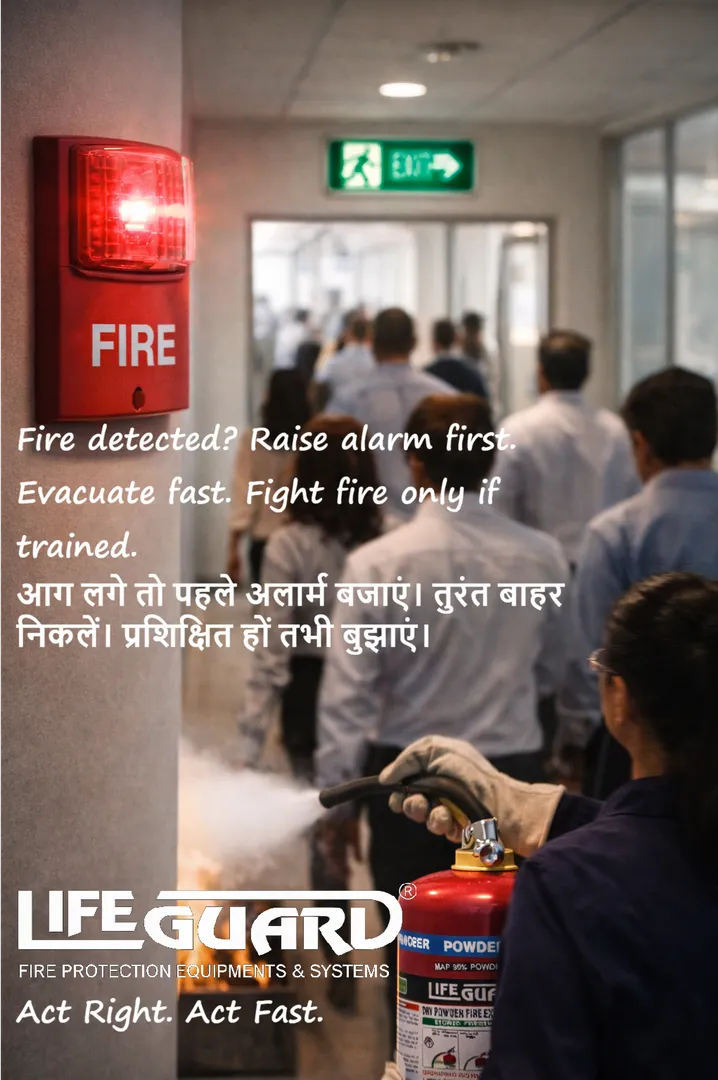
Fire Detected? Raise Alarm First. Evacuate Fast. Fight Fire Only If Trained.
In every major fire investigation across high-rise buildings, buses, railways, hospitals, factories and public gathering places, one mistake appears again and again:
people try to fight the fire first—without alerting others or evacuating.
Fire emergencies are not moments for heroics. They are moments for discipline, sequence and clarity.
At LIFEGUARD® (United Fire Equipments Pvt. Ltd.), we reinforce one life-saving rule that must be universally followed:
Raise the alarm first. Evacuate immediately. Fight the fire only if you are trained and it is safe to do so.
Why the Sequence Matters in Fire Emergencies
Fire spreads faster than human reaction time. Smoke incapacitates before flames reach you. Toxic gases can render a person unconscious in minutes.
Following the correct sequence ensures:
- Maximum people are alerted early
- Evacuation begins before panic sets in
- Emergency services are informed in time
- Only competent persons attempt firefighting
Breaking this sequence costs lives.
Step 1: Raise the Alarm — Immediately
The first action upon detecting fire or smoke is to raise the alarm.
🔔 How to Raise the Alarm
- Activate the manual call point (MCP)
- Shout “FIRE” to alert nearby occupants
- Inform security / control room
- Trigger vehicle or building alarm systems
❗ Why This Is Critical
- Alerts people who may be asleep, immobile or unaware
- Initiates automatic fire suppression systems
- Activates evacuation alarms
- Calls emergency response teams into action
Do not delay alarm activation—even for a small fire.
Step 2: Evacuate Fast — Life Over Property
Once the alarm is raised, evacuation is the priority.
🚶 Evacuation Rules That Save Lives
- Use designated fire exits only
- Do not use lifts
- Assist children, elderly, patients and persons with disabilities
- Stay low if smoke is present
- Proceed calmly to the assembly area
Where Evacuation Is Most Critical
- Hospitals: patients cannot self-evacuate
- Buses & trains: confined spaces fill with smoke quickly
- High-rise buildings: evacuation time increases with height
- Public places: panic can cause stampede
No fire extinguisher is more valuable than a human life.
Step 3: Fight the Fire — Only If Trained & Safe
Firefighting is not mandatory for untrained occupants.
✔ Fight the Fire ONLY If:
- Fire is small and contained
- You have been trained
- Correct extinguisher is available
- Your escape route is clear
- Smoke is minimal
❌ Do NOT Fight the Fire If:
- Fire is spreading rapidly
- Thick smoke is present
- You are unsure of extinguisher type
- You are alone in a crowded area
- The fire involves lithium batteries or hazardous materials
Untrained firefighting often creates casualties, not solutions.
Common Fatal Mistakes During Fire Incidents
❌ Trying to extinguish fire before raising alarm
❌ Delaying evacuation to “save belongings”
❌ Using wrong fire extinguisher
❌ Re-entering the building
❌ Ignoring alarms assuming it’s a drill
Fire does not forgive hesitation.
Sector-Wise Importance of the Fire Response Rule
🏢 High-Rise Buildings
- Alarm alerts upper floors
- Early evacuation prevents smoke entrapment
- Trained fire wardens handle firefighting
🚌 Buses & Public Transport
- Driver raises alarm immediately
- Passenger evacuation begins
- Suppression systems activate automatically
🚆 Railways & Metro
- Coach alarms alert driver and control
- Passengers evacuated at next safe halt
- Trained staff manage fire control
🏥 Hospitals & Healthcare
- Alarm triggers emergency protocols
- Staff evacuate patients in stages
- Firefighting handled by trained teams only
🏟️ Public Gathering Places
- Alarm prevents panic through early warning
- Crowd movement controlled
- Firefighting handled by trained security
Fire Safety Systems That Support Correct Action
To ensure the correct sequence is followed, facilities must have:
- Fire detection & alarm systems
- Manual call points
- Clearly marked exits & emergency lighting
- Trained fire wardens and staff
- Correct fire extinguishers
- Automatic suppression systems
Fire safety systems exist to support human decision-making under stress.
How LIFEGUARD® Enables Safe Fire Response
LIFEGUARD supports organizations with:
- Fire detection & alarm systems
- Fire extinguishers (including lithium fire solutions)
- Automatic suppression systems
- Fire exit signage & emergency lighting
- Fire drills, training & SOP development
- Fire safety audits and AMC services
We design systems that guide people to do the right thing—fast.
Remember the Golden Fire Rule
Fire detected? Raise alarm first.
Evacuate fast.
Fight fire only if trained.
This rule has saved countless lives—and must be practiced, not just posted.
SEO Keyword Bank
Primary Keywords
- Fire detected raise alarm evacuate
- Fire emergency response procedure
Secondary Keywords
- Fire evacuation procedure
- Fire safety response steps
- What to do when fire is detected
Long-Tail Keywords
- What to do first when fire is detected
- Fire emergency sequence for buildings and hospitals
- Fire safety procedure for buses and public places
- Raise alarm evacuate fight fire only if trained
Meta Title & Meta Description (SEO Optimized)
Meta Title:
Fire Detected? Raise Alarm First | Evacuation & Fire Safety – LIFEGUARD
Meta Description:
Fire detected? Raise alarm first. Evacuate fast. Fight fire only if trained. Learn the correct fire emergency response sequence for buildings, buses, hospitals, railways and public places.
Take Preparedness Seriously—Lives Depend On It
United Fire Equipments Pvt. Ltd.
Manufacturer of ISI Certified Fire Safety Equipment
📞 8048034226
📧 ufe126@gmail.com, info@lifeguardindia.in
📌 Conduct Fire Drills | Upgrade Fire Alarm Systems | Train Fire Wardens
Keywords






