
School Clean Agent Suppression System Provider in Africa
Advanced Fire Protection for Schools and Educational Institutions
LIFEGUARD® is a trusted school clean agent suppression system provider in Africa, offering professionally engineered fire protection solutions for critical areas in schools, colleges, universities, training centres, libraries, laboratories and educational campuses.
Modern educational institutions depend on sensitive electronic equipment, digital records, communication systems and essential electrical infrastructure. Conventional water-based fire protection may not be suitable for every application, particularly where water could damage valuable equipment or interrupt important academic operations. LIFEGUARD® clean agent suppression systems provide rapid, effective and residue-free fire protection for these high-value areas.
Our solutions can be designed according to the protected enclosure, identified fire risk, applicable project specifications and requirements of the relevant local authority.
What Is a Clean Agent Fire Suppression System?
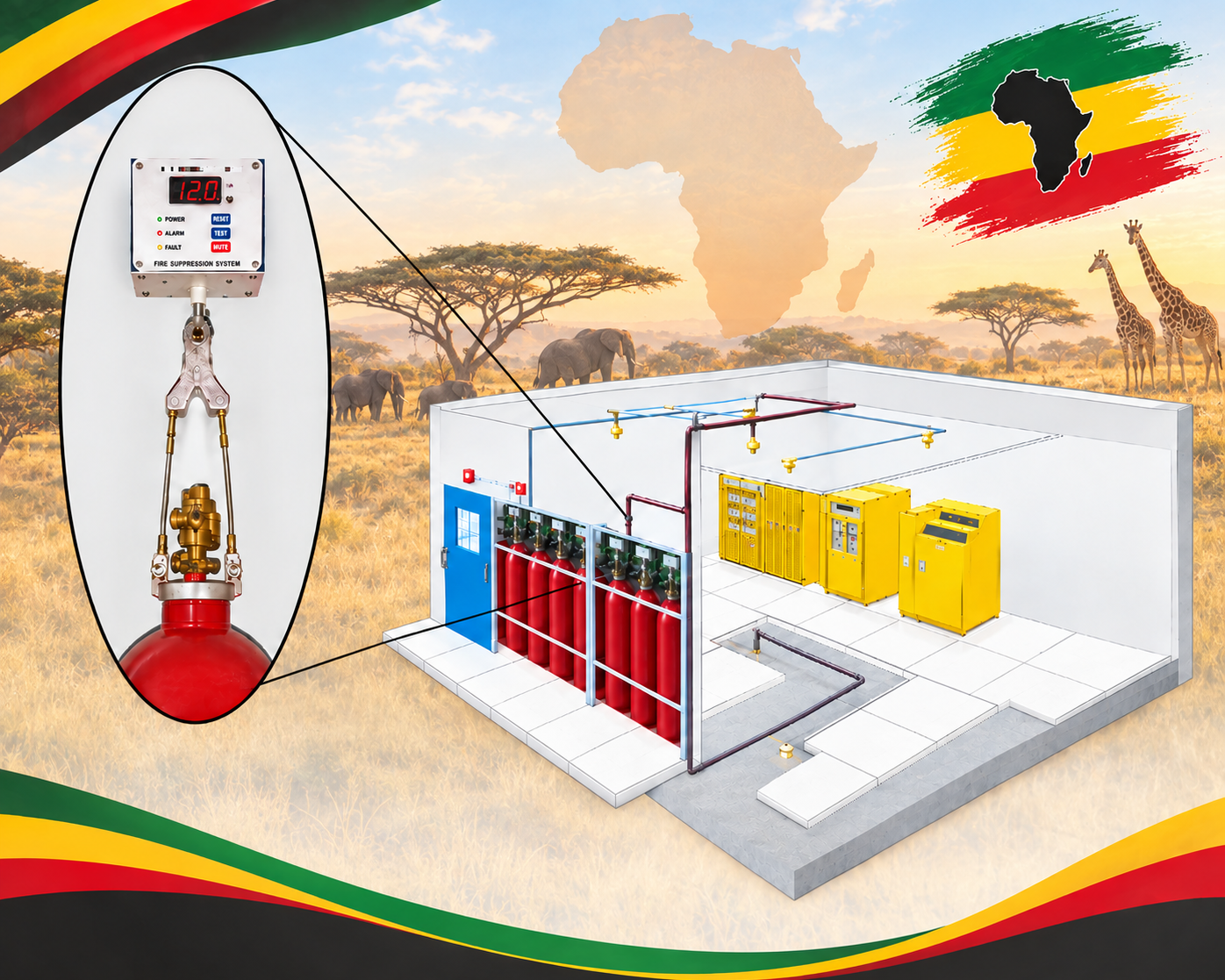
A clean agent fire suppression system is an automatic fire protection solution that uses a gaseous extinguishing agent to control or suppress a fire at an early stage. The agent is discharged through an engineered piping and nozzle network throughout the protected enclosure.
Clean agent systems are suitable for occupied or normally occupied spaces when correctly designed, installed and maintained in accordance with the applicable standards and agent-specific safety requirements.
Unlike water, foam or dry chemical powder, a clean agent does not leave harmful residue after discharge. This makes it an effective solution for rooms containing electronic equipment, documents and other assets that may be damaged by conventional extinguishing media.
Clean Agent Suppression Applications in Schools
LIFEGUARD® provides clean agent fire suppression solutions for various critical areas within educational institutions, including:
- Computer laboratories
- Server and data rooms
- Information technology rooms
- Electrical control rooms
- UPS and battery rooms, subject to hazard assessment
- School communication rooms
- CCTV surveillance rooms
- Examination record rooms
- Digital libraries and archives
- Audio-visual control rooms
- Research laboratories
- Administration data centres
- Campus network rooms
- Museum and heritage display areas
- Control panels and electrical enclosures
Every protected space is evaluated individually to determine the appropriate system configuration, extinguishing-agent quantity, piping arrangement, nozzle location and control philosophy.
Why Schools in Africa Need Clean Agent Fire Protection
Educational institutions across Africa are rapidly adopting digital learning systems, computer laboratories, smart classrooms, electronic attendance systems and centralised IT infrastructure. These installations increase the concentration of electrical and electronic equipment on school campuses.
A small electrical fault in a server rack, UPS unit, control panel or computer laboratory can develop into a serious fire incident. Such a fire may result in:
- Loss of valuable educational equipment
- Damage to student and administrative records
- Interruption of classes and examinations
- Disruption of campus communication networks
- High replacement and restoration costs
- Extended operational downtime
- Risk to students, teachers and support staff
A properly designed clean agent suppression system helps detect and suppress fire at an early stage while limiting damage to sensitive equipment.
Key Benefits of LIFEGUARD® Clean Agent Systems
Rapid Fire Suppression
The system is designed to detect a fire condition and discharge the extinguishing agent quickly, helping control the incident before it spreads to adjacent equipment or areas.
No Residue After Discharge
Clean agents leave no powder, foam or water residue. This significantly reduces post-discharge cleaning requirements and helps protect electronic equipment.
Protection Against Secondary Damage
Water-based firefighting can cause extensive secondary damage to servers, computers, documents and electrical equipment. Clean agent systems suppress fire without introducing water into the protected room.
Reduced Operational Downtime
Because the extinguishing agent does not leave residue, recovery and restoration may be faster than with powder, foam or water-based extinguishing systems.
Electrically Non-Conductive Agent
Clean agents are suitable for protecting electrical and electronic equipment when the system is properly designed for the identified hazard.
Automatic and Manual Operation
The system can be configured for automatic release through the fire detection and control panel, while also incorporating manual-release and abort facilities where required.
Engineered Protection
Agent quantity, pipe size, nozzle selection and discharge arrangement are established through system calculations and project-specific engineering.
Clean Agent Options
Depending on the project specification, room characteristics, environmental considerations and applicable regulations, LIFEGUARD® can offer systems using appropriate clean extinguishing agents.
FK-5-1-12 Clean Agent System
FK-5-1-12 is a clean extinguishing agent used for protecting critical facilities and sensitive equipment. It is stored as a liquid and discharged as a gas through an engineered distribution network.
Important characteristics include:
- Rapid suppression performance
- No residue after discharge
- Electrically non-conductive properties
- Suitability for high-value electronic equipment
- Reduced clean-up following system activation
- Application in occupied spaces when designed within applicable safety limits
HFC-227ea Clean Agent System
HFC-227ea is widely used for total-flooding fire suppression applications. It can be suitable for server rooms, electrical rooms, communication facilities and other sensitive environments.
Its key characteristics include:
- Fast fire suppression
- Compact cylinder arrangement
- No water or powder residue
- Suitability for electrical and electronic risks
- Engineered total-flooding protection
Final agent selection should be based on the project specification, hazard classification, environmental regulations, room conditions and requirements of the authority having jurisdiction.
Components of a School Clean Agent Suppression System
A complete system may include:
- Clean agent storage cylinder
- Cylinder valve and actuation assembly
- Pressure gauge and monitoring accessories
- Discharge piping and fittings
- Engineered discharge nozzles
- Fire detection and gas-release control panel
- Smoke, heat or multi-criteria detectors
- Manual-release station
- Abort switch
- Electronic sounder and visual alarm
- Pre-discharge warning devices
- Discharge indicator
- Pressure switch
- Emergency stop or isolation arrangement, where specified
- Warning and safety signage
- Equipment shutdown and interlock modules
- HVAC or air-conditioning shutdown interface
- Fire-rated cable and containment accessories, where required
The exact system configuration will depend on the site conditions and approved design.
How the System Operates
The clean agent suppression system normally follows a controlled detection and release sequence:
- A detector identifies smoke or another fire condition inside the protected room.
- The fire alarm and gas-release panel receives the signal.
- Cross-zone detection may be used to confirm the fire condition and minimise accidental discharge.
- Audible and visual alarms warn occupants.
- A programmed time delay allows personnel to leave the room.
- Connected ventilation and air-conditioning systems may be shut down.
- Dampers, doors or other required interfaces are activated.
- The clean agent is released through the piping and discharge nozzles.
- The required design concentration is established throughout the protected enclosure.
- The concentration is maintained for the necessary period to reduce the possibility of re-ignition.
The sequence can be modified according to the approved cause-and-effect matrix and local fire-safety requirements.
Professional System Design and Engineering
A clean agent suppression system should not be selected only according to the floor area of a room. Effective protection requires a detailed technical assessment.
LIFEGUARD® engineering support may include:
- Site information review
- Hazard and application assessment
- Room-volume calculation
- Identification of permanent openings
- Selection of the appropriate clean agent
- Calculation of the required agent quantity
- Cylinder-capacity selection
- Piping layout development
- Pipe-sizing and hydraulic-flow calculations
- Nozzle selection and positioning
- Detection and control philosophy
- Cause-and-effect matrix
- Equipment shutdown and interlock planning
- Preparation of technical submittals
- Installation drawings and documentation
- Testing and commissioning procedures
Factors such as altitude, minimum and maximum temperature, room volume, false-ceiling voids, raised-floor voids and unclosable openings must be considered during system design.
Room Integrity and Retention Time
The effectiveness of a total-flooding clean agent system depends on the integrity of the protected enclosure. Openings around cables, ducts, doors, pipes and ventilation systems may allow the agent to escape and reduce its concentration.
Where required, a room-integrity or door-fan test should be conducted to evaluate enclosure leakage and estimate the expected agent-retention time. Identified leakage points should be properly sealed before the system is handed over.
Room-integrity assessment may include:
- Door and window gaps
- Cable penetrations
- Pipe penetrations
- Raised-floor openings
- False-ceiling openings
- Ventilation ducts
- Exhaust fans
- Unsealed wall penetrations
- Transfer grilles and pressure-relief openings
Appropriate pressure-relief arrangements may also be required to protect the enclosure during agent discharge.
Compliance and Quality Assurance
LIFEGUARD® systems can be designed and supplied with reference to relevant project requirements and internationally recognised clean agent fire suppression practices, including NFPA 2001 where specified.
Depending on the destination country and project requirements, compliance may also involve:
- Local fire-service requirements
- National building and fire codes
- Consultant-approved specifications
- Insurance requirements
- Electrical and occupational-safety regulations
- Requirements of the local authority having jurisdiction
- Approved or listed system components where specified
All final designs should be reviewed and approved by the project consultant and relevant authority before installation.
Installation, Testing and Commissioning
Correct installation is essential for the reliable performance of a clean agent suppression system. LIFEGUARD® supports the execution of clean agent projects through trained personnel and authorised partners, depending on the project location.
Typical installation and commissioning activities include:
- Verification of approved drawings
- Inspection of cylinders and system components
- Installation of cylinder brackets and supports
- Installation of discharge piping
- Installation and orientation of nozzles
- Detector and alarm-device installation
- Control-panel wiring
- Interface testing
- Pipe-pressure or pneumatic testing, as applicable
- Continuity and insulation testing
- Functional testing of alarms and release circuits
- Simulation of the discharge sequence
- Verification of time delays and interlocks
- Preparation of testing and commissioning records
- Operator training and system handover
Actual agent discharge testing is undertaken only when specifically required, planned and approved.
Annual Maintenance and System Support
A clean agent suppression system must be periodically inspected and maintained to ensure that it remains ready for operation.
Recommended maintenance activities may include:
- Visual inspection of clean agent cylinders
- Cylinder-pressure verification
- Inspection for corrosion or physical damage
- Valve and actuator inspection
- Detector and alarm testing
- Manual-release and abort-switch testing
- Control-panel battery testing
- Verification of shutdown and interlock functions
- Inspection of pipes, supports and nozzles
- Confirmation that nozzles are unobstructed
- Review of room modifications and new penetrations
- Inspection of safety signs
- Updating maintenance records
- Reassessment of enclosure integrity after structural changes
Any modification to the protected room, including the addition of partitions, equipment, cable openings or ventilation systems, should be reviewed by a competent clean agent system engineer.
Clean Agent Protection for Different Educational Facilities
Primary and Secondary Schools
Clean agent systems can protect computer rooms, CCTV rooms, network equipment and administrative data infrastructure without exposing sensitive assets to water damage.
Colleges and Universities
Universities often contain research laboratories, data centres, server rooms, archives, communication hubs and specialised control rooms that require engineered fire protection.
Technical and Vocational Institutions
Technical institutes may have electrical laboratories, automation rooms, simulator rooms and high-value training equipment requiring specialised suppression solutions.
International Schools
International schools often use advanced IT systems, centralised access control, digital learning infrastructure and sophisticated campus-management systems. Clean agent protection helps safeguard this critical infrastructure.
Libraries, Archives and Record Rooms
Clean agent systems can protect important records and digital archives where the use of water or dry powder could cause severe secondary damage.
Clean Agent System Provider Across Africa
LIFEGUARD® supports clean agent suppression requirements for projects across Africa through project-based supply, technical coordination and local installation support, where available.
We welcome enquiries from:
- Schools and universities
- Government education departments
- Engineering consultants
- Architects
- EPC contractors
- Fire protection contractors
- Facility-management companies
- System integrators
- Importers and distributors
- Local fire-safety companies
Our solutions are suitable for educational projects in East Africa, West Africa, North Africa, Central Africa and Southern Africa, subject to applicable trade, certification and local regulatory requirements.
Why Choose LIFEGUARD®?
LIFEGUARD® is backed by United Fire Equipments Pvt. Ltd., an established manufacturer and fire-protection solution provider. We focus on dependable equipment, application-based engineering and responsive project support.
Our strengths include:
- Experience in fire protection and suppression systems
- Project-specific clean agent system design
- Support for technical submittals and approvals
- Engineered pipe and nozzle calculations
- Detection and releasing-system integration
- Quality-controlled system components
- Installation and commissioning support
- Training and handover documentation
- Maintenance guidance and after-sales support
- Solutions for institutional and infrastructure projects
- Support for distributors, contractors and project partners
Project Documentation
Depending on the agreed scope, LIFEGUARD® can provide relevant technical and project documentation, such as:
- Technical data sheets
- Product catalogues
- System drawings
- Cylinder and component details
- Agent-quantity calculations
- Hydraulic-flow calculations
- Bill of quantities
- Cause-and-effect matrix
- Installation guidelines
- Inspection and testing formats
- Commissioning reports
- Operation and maintenance manuals
- Warranty documents
- Compliance certificates, as applicable
- Training and handover records
Frequently Asked Questions
Is a clean agent suppression system suitable for a school server room?
Yes. Clean agent systems are commonly used for server rooms because they suppress fire without discharging water, foam or dry chemical powder onto sensitive equipment.
Does the clean agent damage computers?
An approved clean agent, when properly selected and applied, does not leave residue and is suitable for protecting electronic equipment. The system must be designed in accordance with the agent manufacturer’s requirements and applicable standards.
Can the system operate automatically?
Yes. It can use automatic fire detection and a gas-release control panel. Manual-release and abort functions may also be provided according to the approved design.
Is an alarm provided before discharge?
The system can include audible and visual pre-discharge warnings together with a programmed time delay, allowing occupants to evacuate before the agent is released.
Is room-integrity testing required?
Room-integrity testing is recommended, and may be required by the specification or authority, for total-flooding systems. It helps confirm whether the enclosure can retain the required agent concentration.
Can LIFEGUARD® supply systems to African countries?
Yes. LIFEGUARD® can support project-specific supply and technical requirements for African markets, subject to destination-country regulations, logistics and project approvals.
Can the system be customised?
Yes. Each system is engineered according to the room volume, protected risk, site conditions, applicable standards and consultant requirements.
Request a Clean Agent Suppression Proposal
If you are developing a new school, upgrading an existing campus or planning fire protection for a computer laboratory, server room or electrical facility, contact LIFEGUARD® for a project-specific clean agent suppression proposal.
For an accurate technical and commercial offer, please provide:
- Protected room dimensions
- Floor-to-ceiling height
- Raised-floor or false-ceiling details
- Room temperature range
- Site location and altitude
- Type of equipment being protected
- Architectural or layout drawings
- Preferred clean agent
- Applicable technical specification
- Required approvals or certifications
- Scope of supply, installation and commissioning
Contact LIFEGUARD®
United Fire Equipments Pvt. Ltd.
Manufacturer of ISI-Certified Fire Safety Equipment
Brand: LIFEGUARD®
Phone: 8048034226
Email: ufe126@gmail.com | info@lifeguardindia.in
Website: www.lifeguardindia.in
LIFEGUARD®—your reliable school clean agent suppression system provider in Africa for professionally engineered fire protection solutions.
Suggested SEO Metadata
SEO Title: School Clean Agent Suppression System Provider Africa | LIFEGUARD®
Meta Description: LIFEGUARD® provides engineered clean agent suppression systems for school server rooms, computer laboratories, electrical rooms and educational campuses across Africa.
Primary Keyword: School clean agent suppression system provider Africa
Related Keywords: School clean agent fire suppression Africa, clean agent system supplier Africa, school server room fire suppression, educational institution fire protection Africa, FK-5-1-12 suppression system Africa, HFC-227ea system provider Africa, school fire suppression company Africa, clean agent system manufacturer India, server room fire protection for schools
Suggested URL: /school-clean-agent-suppression-system-provider-africa/