
School Fire Extinguisher System Provider in Europe
Reliable Fire Protection Solutions for European Schools
LIFEGUARD® is an experienced school fire extinguisher system provider in Europe, offering comprehensive fire protection solutions for schools, colleges, universities, nurseries, training institutes, libraries, laboratories, hostels and other educational facilities.
Educational buildings accommodate students of different age groups and contain diverse fire hazards, including electrical equipment, combustible furniture, paper records, laboratory chemicals, cooking oils, heating equipment and vehicle fuel. Protecting these environments requires more than installing identical extinguishers throughout the premises. Each area must be assessed individually, and the correct fire extinguisher type, capacity and location must be selected.
LIFEGUARD® supports European distributors, contractors, consultants, facility managers and institutional buyers with application-specific fire extinguishers and associated school fire safety equipment.
Complete School Fire Extinguisher Systems
As a professional school fire extinguisher system provider for Europe, LIFEGUARD® offers solutions for different areas of an educational campus, including:
- Classrooms and staff rooms
- Administrative offices
- Libraries and record rooms
- Computer and IT laboratories
- Science and chemistry laboratories
- Electrical and UPS rooms
- School kitchens and cafeterias
- Workshops and technical training rooms
- Auditoriums and multipurpose halls
- Hostels and residential blocks
- Generator and utility rooms
- Parking areas and garages
- Sports facilities
- School buses and transport vehicles
- Warehouses and general storage rooms
Our approach is based on the nature of the fire risk present in each location. The final selection must comply with project specifications, applicable European requirements and the regulations of the destination country.
Types of School Fire Extinguishers
ABC Dry Powder Fire Extinguishers
ABC dry powder fire extinguishers are versatile first-response units suitable for multiple common fire risks. Depending on the approved application, they may be installed in workshops, maintenance areas, parking facilities, security cabins, utility rooms, school buses and selected outdoor locations.
Dry powder extinguishers provide rapid firefighting performance, but the powder residue may affect sensitive electronic equipment. Their use must therefore be evaluated according to the surrounding environment.
Carbon Dioxide Fire Extinguishers
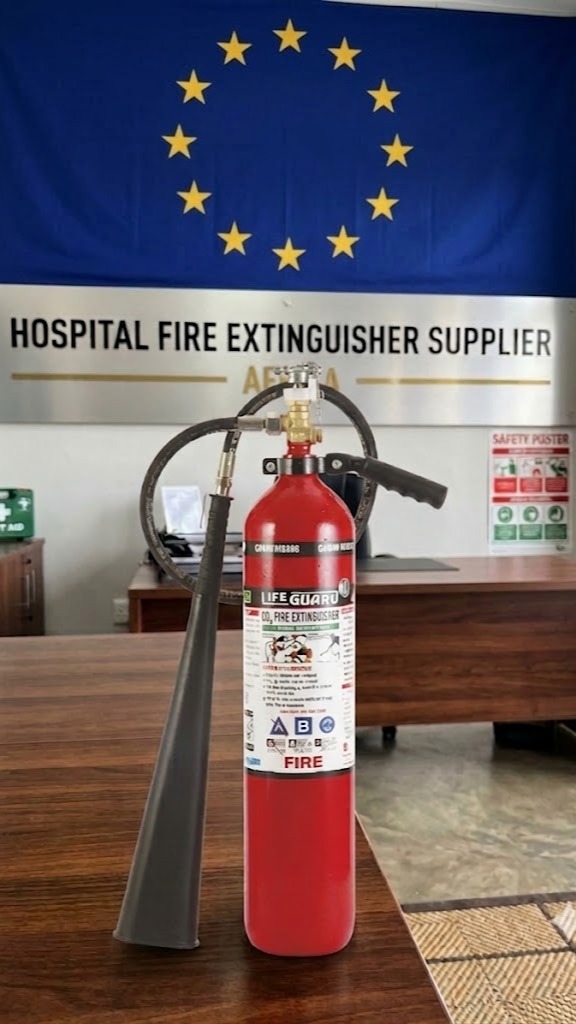
Carbon dioxide fire extinguishers are commonly considered for electrical and electronic equipment. They do not leave powder or liquid residue, making them suitable for areas such as:
- Computer laboratories
- Server and network rooms
- Electrical panels
- UPS and battery rooms
- Audio-visual rooms
- Communication equipment areas
- Control panels
CO₂ extinguishers require careful handling because the discharge horn and surrounding components can become extremely cold. They must be selected and positioned according to the applicable risk assessment.
Water Fire Extinguishers
Water extinguishers may be used for Class A fires involving ordinary combustible materials such as paper, wood, cloth and selected furnishings. These hazards are frequently found in classrooms, offices, libraries and administrative areas.
Water extinguishers must not be used on energised electrical equipment, flammable-liquid fires or cooking-oil fires. The responsible fire-safety professional should verify their suitability before installation.
Water Mist Fire Extinguishers
Water mist extinguishers produce fine droplets and may be considered for selected educational environments. Depending on their tested ratings and manufacturer instructions, these extinguishers can offer controlled discharge with reduced water consumption and limited collateral damage.
Their exact application must be based on the approved fire rating, electrical suitability and applicable European requirements.
Foam Fire Extinguishers
Foam extinguishers can be selected for certain Class A and flammable-liquid fire risks. Potential school applications may include maintenance workshops, storage areas and technical departments where approved combustible or flammable liquids are handled.
The environmental properties, permitted applications and local restrictions applicable to the foam formulation must be reviewed before selection for a European project.
Wet Chemical Fire Extinguishers
School kitchens and cafeterias can experience high-temperature fires involving cooking oils and fats. Wet chemical extinguishers are designed for these specialised risks.
They may be incorporated into the fire safety arrangement for:
- Commercial school kitchens
- Canteens
- Cafeterias
- Catering laboratories
- Hostel kitchens
- Food technology departments
Fire blankets and approved automatic kitchen suppression systems may also be required as part of the complete kitchen fire protection strategy.
Clean-Agent Fire Extinguishers
Clean-agent fire extinguishers may be considered for areas containing sensitive electronic devices, valuable documents or laboratory instruments. They are designed to minimise residue and help reduce secondary damage to protected equipment.
The extinguishing agent must be permitted in the destination market and selected according to current environmental, safety and regulatory requirements.
Fire Extinguisher Systems for School Laboratories
School laboratories can contain flammable liquids, chemicals, electrical appliances, gas connections and specialised instruments. These mixed risks require a detailed hazard assessment.
Depending on the materials and processes involved, laboratory protection may include:
- Suitable portable fire extinguishers
- Fire blankets
- Emergency isolation arrangements
- Smoke, heat or specialised detection
- Clearly marked evacuation routes
- Secure chemical storage
- Emergency response instructions
- Staff training
No single extinguisher is suitable for every laboratory chemical. The safety data sheets for stored substances and the advice of a qualified fire-safety professional should be considered when developing the protection plan.
Fire Extinguisher Systems for School Kitchens
Cooking areas represent a significant fire risk due to hot oils, fats, electrical appliances, gas equipment and combustible deposits in extraction systems. The kitchen fire safety arrangement may include:
- Wet chemical extinguishers
- Fire blankets
- Suitable extinguishers for electrical equipment
- Automatic kitchen hood suppression
- Heat or flame detection
- Emergency gas and electrical isolation
- Clearly identified escape routes
Portable extinguishers should be positioned where they are readily accessible without requiring the user to move toward the fire.
School Bus Fire Extinguisher Solutions
Fire protection should extend to school transport. School buses can face risks related to electrical wiring, batteries, fuel, lubricants and the engine compartment.
LIFEGUARD® can support portable fire extinguisher requirements for school buses and institutional vehicles. Selection should account for:
- Vehicle category and size
- Passenger capacity
- Engine and fuel type
- Applicable transport regulations
- Mounting location
- Environmental and vibration conditions
- Required fire rating
The extinguisher must be securely mounted, clearly identified and easily accessible to trained personnel. Drivers and attendants should prioritise stopping the vehicle safely, evacuating passengers and contacting emergency services.
Correct Selection and Placement
A reliable school fire extinguisher system must be based on a documented fire-risk assessment. Selection and placement should consider:
- Building size and number of floors
- Occupancy and student age groups
- Fire hazard classification
- Escape routes and final exits
- Travel distance to an extinguisher
- Presence of electrical installations
- Laboratory and workshop risks
- Kitchen and cooking-oil hazards
- Heating and utility equipment
- Indoor and outdoor environmental conditions
- Accessibility and visibility
- Applicable local and European requirements
Extinguishers should be installed at designated points using appropriate brackets, stands or cabinets. Identification signs should remain visible, and equipment should never obstruct corridors, doors or escape routes.
Inspection, Servicing and Maintenance
Fire extinguishers must be maintained so they remain operational when needed. A planned inspection and servicing programme may include:
- Routine visual checks
- Verification of pressure indication, where applicable
- Examination of the safety pin and tamper seal
- Inspection for corrosion, leakage or damage
- Checking hose and nozzle condition
- Confirmation that labels remain legible
- Verification of accessibility and signage
- Scheduled servicing by competent personnel
- Refilling after any full or partial discharge
- Pressure testing or requalification when required
- Maintenance of inspection and service records
The exact inspection frequency and servicing procedure should follow the applicable regulations, adopted standards, manufacturer instructions and requirements of the country where the equipment is installed.
Fire Safety Training for Educational Personnel
Providing extinguishers without appropriate training can limit their effectiveness. Schools should deliver suitable fire safety awareness to:
- Teachers and administrative personnel
- Laboratory assistants
- Kitchen and cafeteria employees
- Security staff
- Maintenance personnel
- Hostel wardens
- School bus drivers and attendants
Training should explain how to raise an alarm, initiate evacuation, select the correct extinguisher and maintain a safe exit route. Portable firefighting equipment should be used only on a small, early-stage fire when the person is trained and conditions remain safe.
Evacuation and protection of students must always receive priority over firefighting.
Supporting Fire Safety Equipment for Schools
A comprehensive school fire safety system may include more than portable extinguishers. Depending on the building and applicable regulations, associated equipment may include:
- Fire detection and alarm systems
- Smoke and heat detectors
- Manual call points
- Sounders and visual alarm devices
- Fire hose reels
- Hydrant equipment
- Fire blankets
- Emergency lighting
- Exit and directional signs
- Extinguisher stands and cabinets
- Kitchen fire suppression systems
- Clean-agent suppression systems
- Evacuation plans and assembly-point signs
The complete arrangement should be developed in coordination with the project consultant, fire protection contractor and relevant approving authority.
Why Choose LIFEGUARD®?
LIFEGUARD® brings decades of fire safety industry experience to educational and institutional projects. We provide practical product-selection support and export coordination for customers across European markets.
Our capabilities include:
- Extensive range of portable fire extinguishers
- Application-based product recommendations
- Solutions for classrooms, laboratories, kitchens and buses
- Support for bulk and project-based requirements
- Technical data and product documentation
- Export packaging and shipment coordination
- Private-label and project-specific support, subject to agreement
- Assistance for distributors and fire protection contractors
- After-sales and maintenance guidance
- Customised commercial proposals
Actual product certification, conformity documentation and market availability should be confirmed for the specific model, destination country and project before ordering.
Serving Educational Projects Across Europe
LIFEGUARD® supports enquiries from distributors, contractors, institutions and procurement organisations across European markets, including:
- Germany
- France
- Italy
- Spain
- Portugal
- Netherlands
- Belgium
- Austria
- Poland
- Czech Republic
- Romania
- Greece
- Sweden
- Denmark
- Finland
- Norway
- Ireland
- United Kingdom
- Other European destinations
Product acceptance, labelling, certification and import requirements can differ between countries. Buyers should therefore provide the destination and technical specifications at the enquiry stage.
Request a School Fire Extinguisher System Quotation
For a suitable technical and commercial proposal, please share:
- Country and delivery destination
- Name and type of educational institution
- Building drawings or floor area
- Number of floors and buildings
- Room-wise hazard details
- Required extinguisher types and capacities
- Quantity required
- Technical specifications
- Certification and documentation requirements
- Packaging and labelling requirements
- Required delivery schedule
Our team will review the available information and recommend an appropriate solution according to the stated project requirements.
Contact LIFEGUARD®
LIFEGUARD® – United Fire Equipments Pvt. Ltd.
Manufacturer of ISI-Certified Fire Safety Equipment
Corporate Office:
LIFEGUARD TOWER, K-960, Opp. SBI, Rithala, Rohini, Delhi – 110085, India
Manufacturing Facility:
B-38, Mangolpuri Industrial Area, Phase-II, Delhi – 110034, India
Contact us for school fire extinguishers, fire safety equipment, bulk institutional requirements, distributor enquiries and export support for European projects.
SEO Information
SEO Title: School Fire Extinguisher System Provider Europe | LIFEGUARD®
Meta Description: LIFEGUARD® is a school fire extinguisher system provider for Europe, offering application-based extinguishers for classrooms, laboratories, kitchens, electrical rooms and school buses.
Primary Keyword: School fire extinguisher system provider Europe
Secondary Keywords:
- School fire extinguisher supplier Europe
- School fire protection system Europe
- Fire extinguishers for European schools
- Educational institution fire safety equipment
- School laboratory fire extinguisher
- School kitchen fire extinguisher
- School bus fire extinguisher Europe
- Fire safety equipment exporter to Europe
Suggested URL: