A portable extinguisher can control early flames, but it cannot automatically cool a burning traction battery or prevent reignition. You will be able to match the equipment to the incident stage, verify meaningful test evidence, and build an emergency procedure that protects people rather than relying on a flame-out demonstration.
Key takeaways
- Confirm whether the battery pack is involved before selecting an extinguisher.
- Follow isolation, evacuation and emergency-call steps before attempting suppression.
- Compare agents for cooling, visibility and electrical-safety risks.
- Request test evidence covering lithium-ion battery fires, not only extinguisher ratings.
Identify the Fire Before You Choose the Response
An early secondary fire burns material around the battery: seat foam, wiring insulation, plastics, tyres, or a charging connector. Flames stay localized, the traction battery shows no swelling, venting, hissing, popping, or rapid heat increase, and smoke does not emerge from pack seams or underneath the vehicle.
Thermal runaway is an internal cell failure, not simply a larger flame. A lithium-ion battery fire can produce dense smoke, jets of hot gas, repeated popping, electrolyte odour, rapid temperature rise, and flames or smoke from several pack locations. The fire can return after visible flames disappear because neighbouring cells remain hot.
| Condition | Signs | Meaning for response |
|---|---|---|
| Early secondary fire | Localized flame; stable pack; no venting or rapid heat rise | An EV fire extinguisher may address incipient flames if you have a clear escape route and the vehicle is accessible. |
| Thermal runaway | Smoke or heat from the pack; hissing, popping, venting; rapid escalation; flames beneath the vehicle | Do not treat flame knockdown as control. Evacuate and summon emergency services for prolonged cooling and monitoring. |
| Uncertain condition | Smoke source hidden; damaged, submerged, crashed, or charging vehicle | Assume battery involvement and do not approach to investigate. |
A large UL 711 A, B, or C rating does not prove traction-battery performance. UL 9540A evaluates fire propagation in energy-storage systems, not portable extinguishers for road vehicles. Check whether the manufacturer tested cooling, propagation prevention, or reignition resistance; Class D is not automatically suitable because lithium-ion cells do not contain exposed metallic lithium.
Use the Extinguisher Only Within a Safe Emergency Sequence
Treat a smoking or hissing battery as an active hazard, not a minor flame. A vehicle can retain high-voltage energy after shutdown, collision or apparent extinguishment, so keep people away and begin the battery fire emergency procedure immediately.
1. Stop work, warn everyone and activate the site alarm. Do not open the battery enclosure, touch exposed conductors or approach a smoking, hissing, venting or burning pack.
2. If you can do so without entering smoke or moving toward the vehicle, stop the charger using its emergency isolation switch. Do not rely on the vehicle service disconnect or automatic high-voltage vehicle isolation as proof that the pack is electrically dead.
3. Evacuate along a clear route, account for people and keep vehicles away from the incident. Call emergency services, report the vehicle type, charging status, visible flames, smoke, hissing and any collision damage.
4. Attempt first response only if the fire is small, accessible, and outside the battery pack; you have the correct extinguisher, training, a safe escape route and a safe approach distance. Do not approach if flames, heat, smoke or venting block your exit.
5. Follow the extinguisher label for distance, discharge duration and aiming point. Use short applications only when you can retreat, and never stand over the pack or in the smoke plume. A Class C marking does not make exposed conductors safe or prove battery-fire control.
Visible flames can disappear while thermal runaway continues. Tell firefighters about any re-ignition, and keep the vehicle isolated until they declare it safe.
Compare Agents by Cooling, Visibility and Electrical Risk
Cooling, flame knockdown, visibility and electrical compatibility point to different choices. Match the agent to the objective: control a surface flame, protect nearby property or provide water cooling EV battery cells.
| Agent | Cooling and visibility | Electrical risk and vehicle use |
|---|---|---|
| Water | Strongest sustained cooling and the best chance of slowing cell propagation; creates runoff, corrosion and possible steam. | Use only with confirmed electrical compatibility and safe application procedures; Class C marking alone is not enough. |
| Water mist | Removes heat with less water and can preserve visibility better than powder, but its battery performance depends on droplet design and application time. | Require evidence for energized vehicle systems and traction batteries, not just a general electrical rating. |
| Foam extinguisher | Cools and blankets fuel or plastic surface fires; the blanket can obstruct inspection and contaminated foam requires cleanup. | Do not assume foam reaches or cools cells inside a pack; verify conductivity data. |
| Dry chemical | Knocks down flames quickly, but dry chemical residue contaminates connectors, sensors and interiors and severely reduces visibility. | Useful for accessible secondary fires when the label permits energized equipment; it rarely provides sustained battery cooling. |
| Carbon dioxide | Leaves little residue and preserves visibility, but removes little heat and disperses rapidly outdoors. | Suitable for small enclosed surface fires, not thermal runaway or exposed high-voltage conductors. |
| Clean agents | Leave little residue and preserve visibility, but provide limited sustained cooling and can be displaced outdoors. | Select only with specific battery evidence and ventilation limits. |
| Class D | Intended for combustible-metal fires, not automatically lithium-ion cells. | Do not select it merely because the vehicle has a lithium battery. |
A Class C designation addresses agent conductivity, not cell propagation or reignition. Require storage-temperature limits, freeze protection, cleanup instructions and electrical-compatibility evidence.
Demand Evidence for Battery Performance, Not Just a Rating
A Class C marking addresses the extinguishing agent’s electrical-conductivity hazard. It does not show that the extinguisher can control a burning high-voltage battery, stop cell propagation or prevent reignition. A UL 711 rating is based on standardized fire tests, not a standardized traction-battery test.
UL 9540A evaluates thermal-runaway propagation in battery-energy-storage systems; it is not a portable-extinguisher performance standard for road vehicles.
Ask the supplier for evidence that identifies:
- The test article: loose cell, module, open housing or intact vehicle pack
- Pack condition, access limits, crash damage, cooling plates and failed-cell location
- Agent quantity, discharge duration, nozzle pattern, application distance and aiming point
- Whether the result measured flame knockdown, cooling, propagation control or reignition resistance
- Temperature readings and the observation period after discharge
| Document or claim | What it establishes | What it does not establish |
|---|---|---|
| EN 3 listing or UL/ULC listing | Recognized extinguisher compliance under the named scheme | EV-pack control unless that test is explicitly included |
| UL 711 rating | Performance on specified standardized fires | Battery thermal-runaway control |
| Manufacturer EV test | Results under its stated battery and discharge conditions | Performance on a different pack or access condition |
| UL 9540A report | Battery-system thermal-runaway propagation behaviour | Portable-extinguisher effectiveness |
Treat a short flame-out video as incomplete evidence. Hot cells can reignite after visible flames disappear, particularly when the agent cannot reach the damaged pack’s interior.
Match the Equipment to Your Site and Response Capacity
Buy for the time you have before trained responders arrive, not for the vehicle badge alone. A compact extinguisher may suit an accessible passenger-compartment fire; it is not a substitute for sustained cooling when a large traction battery has entered thermal runaway.
- Passenger cars and scooters need equipment that one person can reach and carry without crossing the vehicle’s likely escape path.
- Buses, vans and trucks need greater agent quantity, longer extinguisher discharge duration and a plan for compartments or battery packs that cannot be reached directly.
- A large battery pack increases the need for sustained water application, thermal imaging and post-incident observation; a short flame knockdown can leave hot cells behind.
- Tight underground parking demands equipment positioned near exits, clear exclusion zones and ventilation planning. Do not place responders between a smoking vehicle and the only escape route.
- Charging bays need EV charging station fire protection, isolation procedures and equipment that responders can access without approaching a damaged charger or cable.
- A fleet needs distributed coverage and written inspection responsibilities, not one extinguisher in a security office. That is part of fleet emergency preparedness.
- If fire-service arrival will take 10 minutes rather than 2, plan for earlier alarm activation, evacuation and monitoring rather than simply buying a larger cylinder.
Ask the supplier to identify the tested battery size, application method, discharge duration, flame-control claim and cooling or reignition evidence. UL 9540A describes battery fire propagation testing; it does not prove portable-extinguisher performance on road vehicles.
When reviewing equipment from United Fire Equipment Pvt Ltd, request the listing or local approval, test report and instructions for thermal imaging and reignition monitoring. A service disconnect does not prove the pack is electrically dead.
Related products
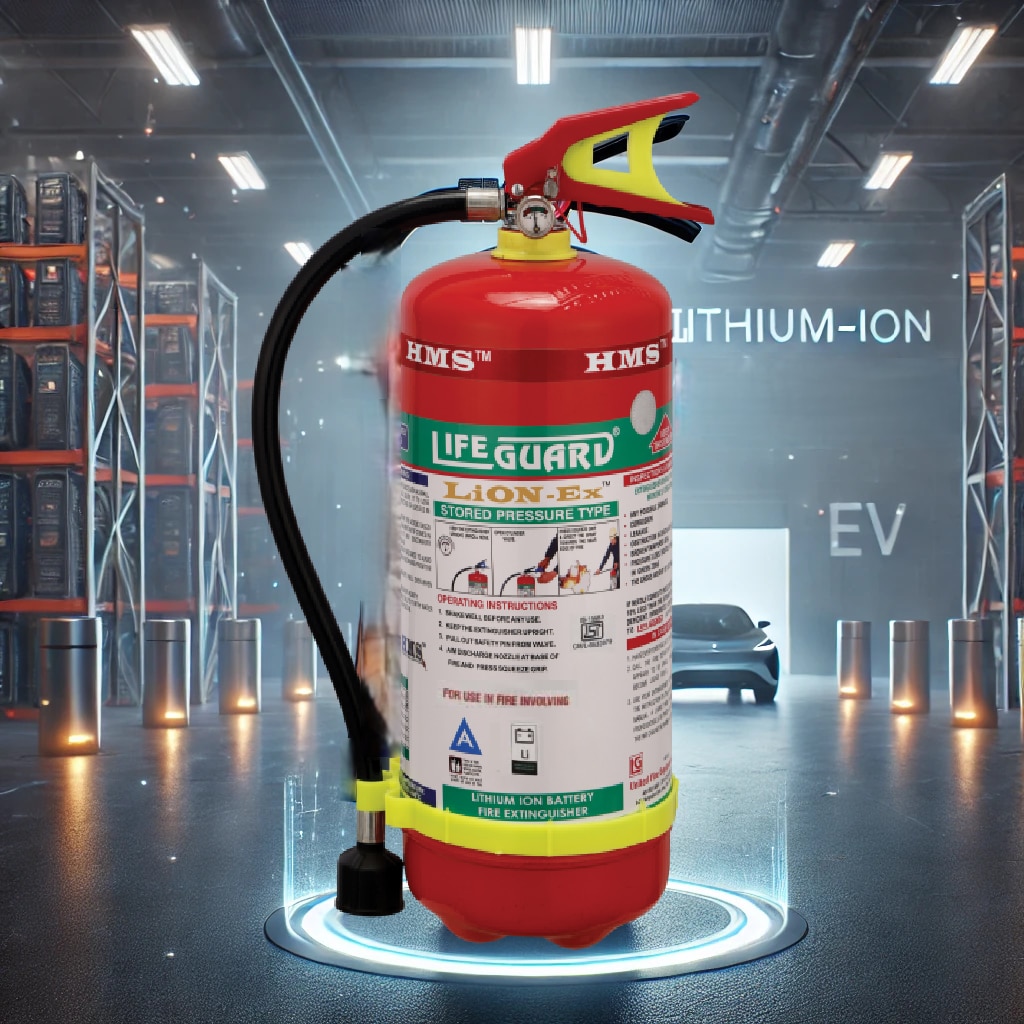 | EV FIRE EV FIRE EXTINGUISHER ₹54000 Lifeguard EV Fire Extinguisher Manufacturer – Complete Safety for Electric Vehicles The future of mobility is electric. |
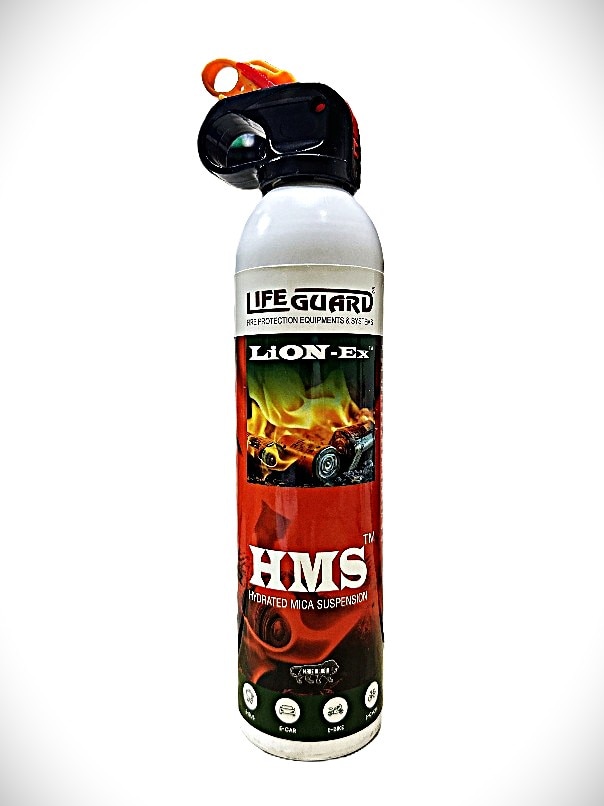 | Lithium Ion Fire Extinguisher EV Battery fire extinguisher ₹4500 Lifeguard EV Fire Extinguisher Manufacturer – Complete Safety for Electric Vehicles The future of mobility is electric. |
Frequently asked questions
How can you tell whether an EV fire involves the traction battery?
Look for battery-pack swelling, venting, hissing, popping, rapid heat increase, smoke from pack seams or smoke underneath the vehicle. A localized fire in seat foam, wiring insulation, plastics, tyres or a charging connector indicates a different initial response.
When is it safe to use an extinguisher on an electric vehicle fire?
Use one only within a safe emergency sequence: raise the alarm, call emergency services, isolate the area and keep an escape route. Attempt suppression only when the fire is localized, you can maintain a safe position and the battery shows no signs of involvement.
What should you compare between EV fire extinguisher agents?
Compare cooling performance, smoke and flame visibility, residue, re-ignition risk and electrical hazards. A suitable agent must fit the identified fire rather than relying on a generic extinguisher label.
What evidence should you request before buying an EV fire extinguisher?
Ask for documented test results showing performance on lithium-ion battery fires, including the battery type, test conditions, extinguishing outcome and re-ignition observations. Do not treat a standard fire rating alone as proof of battery performance.
Related products
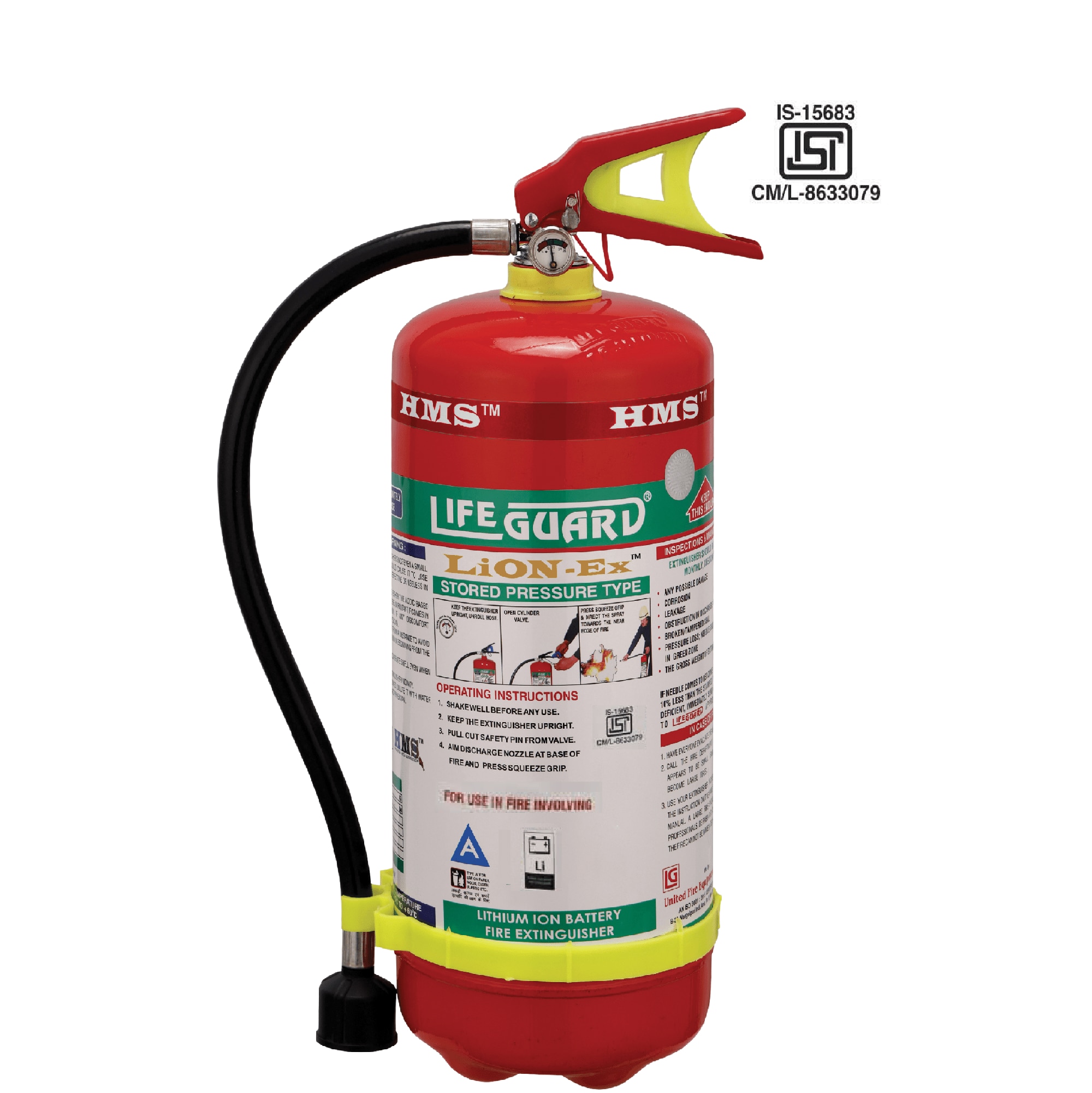 | Lithium Ion Fire Extinguisher LiON-Ex 6 Liters Lithium Battery Fire Extinguisher ₹58500 LiON-Ex Fire Extinguisher for Lithium Ion Battery fire, capacity 6 liters. |
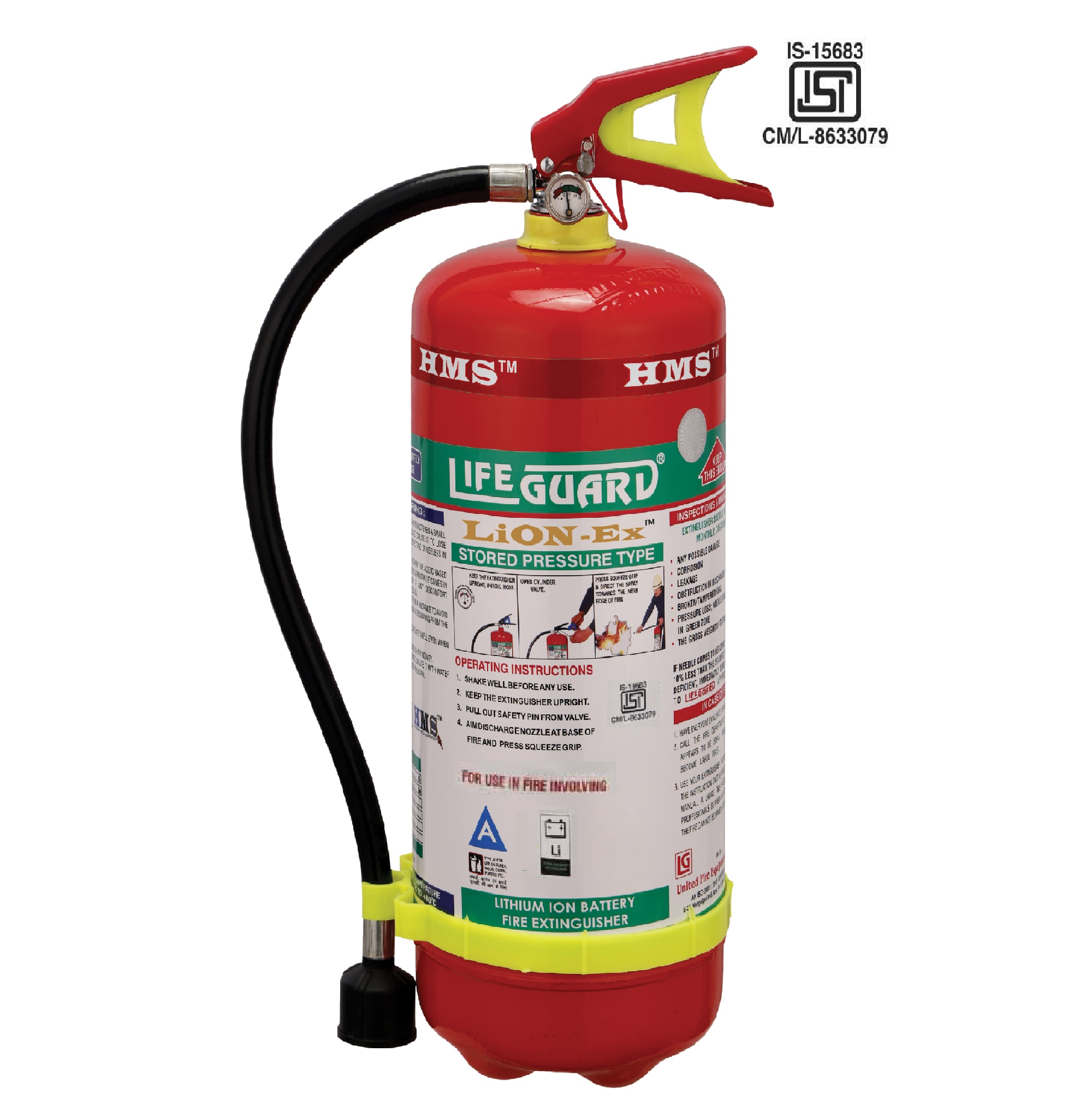 | Lithium Ion Fire Extinguisher LiON-Ex 9 Liters Lithium Fire Extinguisher ₹72000 LiON-Ex Fire Extinguisher for Lithium Ion Battery fire, capacity 9 liters filled with HMS agent, duly ISI marked, tested as per IS : 15683. |
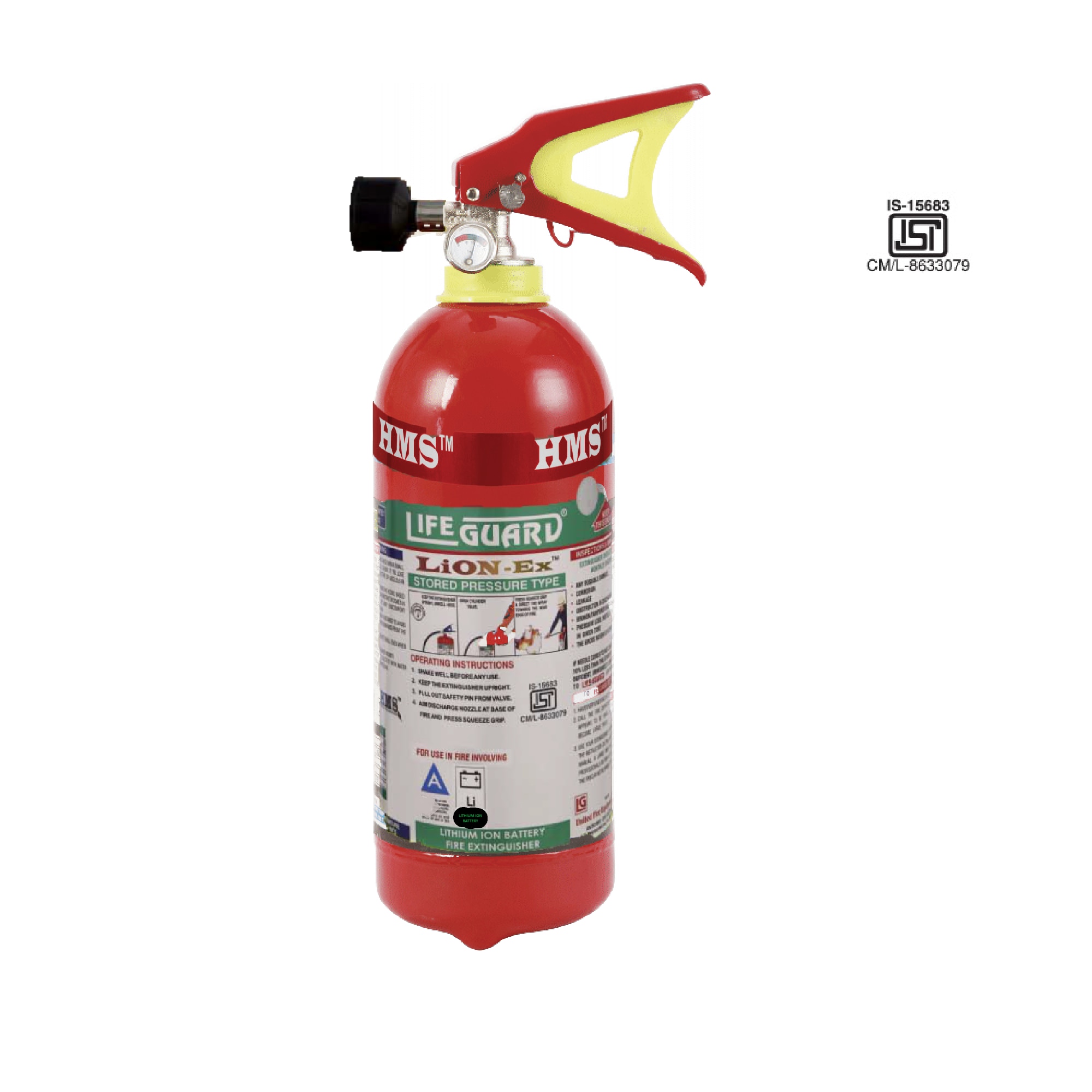 | Lithium Ion Fire Extinguisher LiON-Ex 2 litres ₹18000 LiON-Ex Fire Extinguisher for Lithium Ion Battery fire, capacity 2ltrs. filled with HMS agent, duly ISI marked, tested as per IS : 15683. |
 | Lithium Ion Fire Extinguisher LION-Ex 1 Liter ₹10000 LiON-Ex Fire Extinguisher for Lithium Ion Battery fire, capacity 1 Liter filled with HMS agent, duly tested as per IS : 15683. |