
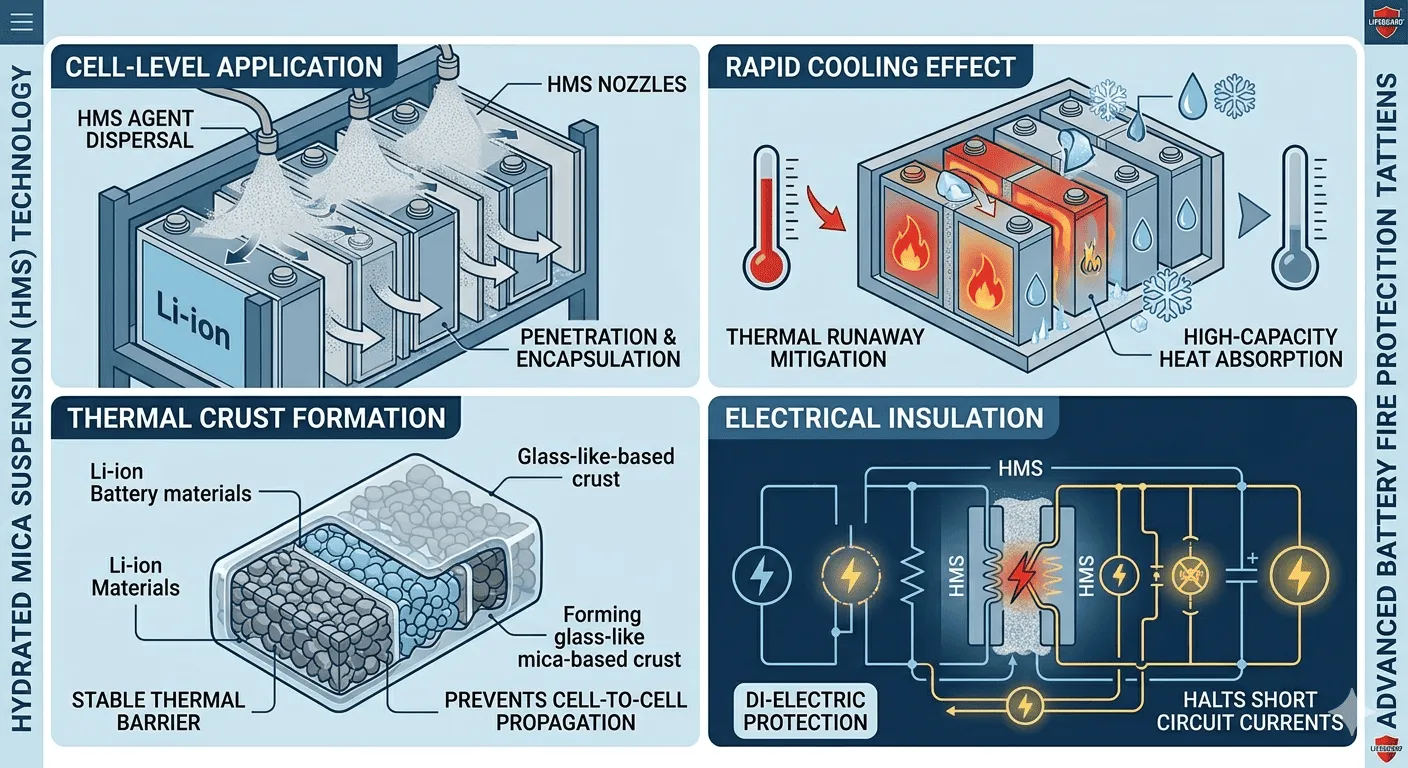
Why Lithium Fires Reignite – Understanding the Risks of Lithium-Ion Battery Fires
Advanced Fire Safety Insights by LIFEGUARD®
Lithium-ion batteries have transformed modern technology and power systems, becoming essential components in electric vehicles (EVs), energy storage systems (ESS), mobile devices, data centers, telecom infrastructure, and industrial applications. While these batteries offer high energy efficiency and performance, they also introduce unique fire risks that are far more complex than conventional fires.
One of the most dangerous characteristics of lithium-ion battery fires is their tendency to reignite even after the flames appear to be extinguished. Understanding why lithium fires reignite is critical for improving fire safety planning, emergency response, and battery fire suppression strategies.
LIFEGUARD® provides advanced fire safety solutions designed to manage lithium battery fire hazards, thermal runaway events, and re-ignition risks effectively across modern industrial and commercial environments.
Why Lithium-Ion Battery Fires Reignite
Thermal Runaway Continues Internally
The primary reason lithium battery fires reignite is because the internal chemical reaction inside the battery may continue even after visible flames disappear.
This process is called thermal runaway.
During thermal runaway:
- Battery cells generate extreme heat internally
- Chemical reactions continue inside damaged cells
- Heat spreads to neighboring battery cells
- Flammable gases continue to release
- Hidden hotspots remain active
As a result, the battery can ignite again minutes, hours, or even days after the initial fire appears controlled.
What is Thermal Runaway?
Thermal runaway is a self-sustaining chain reaction inside lithium-ion batteries where increasing heat causes further chemical instability and energy release.
Common causes include:
- Overcharging
- Internal short circuits
- Mechanical damage
- Manufacturing defects
- High-temperature exposure
Once thermal runaway starts, it becomes difficult to stop without specialized cooling and suppression systems.
Hidden Heat Inside Battery Cells
Even after flames are extinguished externally, battery cells may still contain:
- Extremely high internal temperatures
- Stored chemical energy
- Unstable electrolytes
- Residual electrical energy
If these conditions are not fully controlled, the battery can reignite repeatedly.
Release of Flammable Gases
Lithium-ion batteries release highly flammable gases during thermal runaway, including:
- Hydrogen
- Methane
- Carbon monoxide
- Volatile organic compounds
If these gases accumulate and encounter heat or sparks, re-ignition can occur rapidly.
Fire Spread Between Battery Cells
Modern lithium-ion battery packs contain multiple tightly packed cells. When one cell overheats:
- Heat transfers to adjacent cells
- Additional cells enter thermal runaway
- Fire continues to spread internally
This chain reaction significantly increases re-ignition risks.
Why Traditional Fire Extinguishers May Not Be Enough
Conventional fire extinguishers may suppress visible flames temporarily but often cannot:
- Cool battery cells sufficiently
- Stop internal chemical reactions
- Prevent thermal propagation
- Eliminate hidden hotspots
Lithium battery fires require specialized fire suppression systems designed for:
- Rapid cooling
- Heat absorption
- Thermal management
- Re-ignition prevention
Importance of Lithium Fire Suppression Systems
Continuous Cooling
Battery fires require prolonged cooling to reduce internal temperatures safely.
Thermal Monitoring
Advanced systems help detect hidden hotspots and abnormal temperature rise.
Fire Isolation
Prevents fire spread to nearby battery modules or infrastructure.
Re-Ignition Prevention
Specialized suppression agents help stabilize damaged battery cells.
Industries at Risk from Lithium Battery Re-Ignition
Electric Vehicle (EV) Infrastructure
EV battery fires can reignite after accidents, charging failures, or battery damage.
Energy Storage Systems (ESS)
Large-scale battery storage facilities require advanced thermal runaway protection.
Data Centers
Backup battery systems may create hidden fire risks in critical environments.
Telecom Infrastructure
Battery banks powering communication systems require continuous fire safety monitoring.
Warehousing & Logistics
Stored lithium batteries can pose significant re-ignition hazards during transportation and storage.
Best Practices to Reduce Lithium Fire Re-Ignition Risks
- Install specialized lithium battery fire suppression systems
- Use thermal monitoring and early detection systems
- Ensure proper battery cooling mechanisms
- Avoid overcharging batteries
- Conduct regular battery inspections
- Isolate damaged batteries immediately
- Train personnel for lithium fire emergency response
- Use approved charging and battery management systems
LIFEGUARD® Solutions for Lithium Battery Fire Safety
LIFEGUARD® provides advanced fire safety solutions designed specifically for modern battery fire risks, including:
- Lithium battery fire extinguishers
- Thermal runaway protection systems
- EV battery fire suppression systems
- ESS fire protection solutions
- Watermist suppression systems
- Industrial fire detection and suppression technologies
Our systems are engineered to improve fire safety, minimize infrastructure damage, and reduce re-ignition risks across high-risk battery environments.
Why Choose LIFEGUARD®?
ISI Certified Fire Safety Equipment
Trusted manufacturer of high-quality fire protection products.
Expertise in Battery Fire Protection
Advanced solutions for lithium-ion battery and thermal runaway hazards.
Customized Fire Safety Solutions
Tailored systems for EVs, ESS facilities, data centers, and industrial applications.
Reliable Technical Support
Professional guidance for fire safety planning, installation, and emergency preparedness.
Commitment to Innovation & Safety
Focused on delivering dependable fire protection technologies for modern industries.
Conclusion
Lithium-ion battery fires are unique because they can reignite long after visible flames are extinguished. Internal thermal runaway, hidden heat generation, flammable gas release, and battery cell propagation make these fires highly challenging to control.
Effective lithium fire safety requires advanced suppression systems, continuous cooling, thermal monitoring, and specialized emergency response strategies.
LIFEGUARD® delivers reliable fire protection solutions designed to manage lithium battery fire hazards, prevent re-ignition, and protect critical infrastructure across India’s rapidly growing battery-powered industries.
Contact LIFEGUARD®
LIFEGUARD®
United Fire Equipments Pvt. Ltd.
Manufacturer of ISI Certified Fire Safety Equipment
📞 8048034226
📧 ufe126@gmail.com | info@lifeguardindia.in
Keywords






