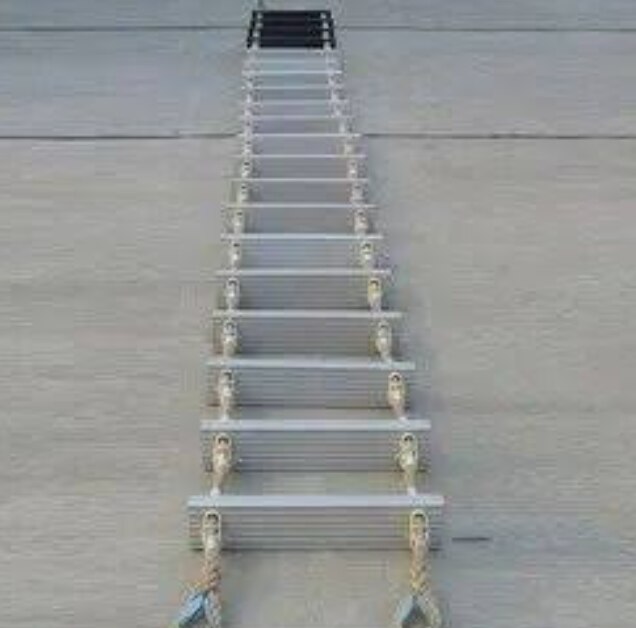
A ten-metre ladder is useful only when it reaches from a specific escape opening to a clear, safe landing and remains usable after rain, storage and repeated inspections. You will be able to measure the route, specify the ladder and anchor correctly, test the equipment, and decide whether it belongs in your commercial evacuation plan before Delhi’s monsoon.
Key takeaways
- Measure vertical drop, landing clearance and anchor position before ordering.
- Treat ladder, anchor, user limit and documents as one safety system.
- Quarantine wet, damaged or undocumented ladders before the monsoon.
- Rehearse deployment so staff do not improvise during an evacuation.
Measure the real escape route before ordering ten metres
A ten-metre ladder reaches the planned escape point only if the measured vertical drop, anchorage and landing leave usable length. Nominal length is not usable vertical travel: sag, top termination, wall angle and clearance consume it.
1. Measure from the actual window sill, balcony edge, roof opening or hatch anchorage to the final safe landing. Do not estimate from storeys. Note projections, wall geometry, ladder swing and the exact point where a person can step clear.
2. Map every possible location: upper-floor offices, warehouses, shops, temporary structures, rooftops, balconies and shafts where stair access could be blocked. Record occupants, exits, route width, lighting, landing clearance and the risk of striking people or objects below.
3. Treat a ten metre rope ladder for before monsoon commercial emergency evacuation in delhi as supplementary rescue equipment unless the fire-safety authority, fire consultant and approved evacuation design accept it as an egress component. It cannot replace enclosed stairs, protected exits, exit access or a discharge route.
4. Assess smoke, rain, standing water, gloves, protective footwear, reduced visibility and crowd movement. A dry, daylight demonstration does not prove safe monsoon use.
5. For lithium-ion storage, charging or electric-vehicle operations, connect the ladder plan to battery-fire evacuation, isolation, ventilation, fire-service notification and re-ignition procedures. Battery thermal runaway can produce toxic gases and renewed fire, so the ladder is only one part of the response.
Specify the ladder, anchor and user limits as one safety system
Compare a commercial evacuation ladder before rains as a complete safety system, not by its model name or rope-breaking-strength figure. Require a current technical sheet covering the ladder, terminations, hooks, brackets and anchor arrangement.
Compare these specifications:
| Specification | Require on the technical sheet |
|---|---|
| Rope and rungs | Rope construction and material; rung material; anti-slip treatment |
| Dimensions | Rung spacing, clear width, number of rungs and maximum deployment height |
| Environment | Wet-condition performance, temperature limits, UV and mildew limitations |
| Compatibility | Chemical compatibility, cleaning instructions and retirement criteria |
| Capacity | Rated load for the complete assembly, safety factor, one-person or multiple-user limit, and whether tools or rescue loads are included |
The supplier must describe a controlled-descent method, anti-sway provisions where needed, user training and the rescue plan. A flexible ten-metre ladder can swing from the wall, rotate under a foot and strike people below.
Secure the upper end to a verified load-bearing anchor with compatible hooks or brackets. Protect rope and webbing from sharp edges. Never attach it to:
- Handrails, pipes, cable trays or rainwater fittings
- Façade elements or fixtures with unverified capacity or condition
- A ladder hook being used as a fall-arrest anchor
A ladder anchor is not automatically suitable for fall arrest. Harnesses and lanyards require a separately designed, compatible system covering anchor strength, connectors, clearance and rescue.
Name trained users, limit simultaneous occupants to the documented rating, and record the inspection and evacuation procedure. A product described only as “LG-533” does not establish any of these limits.
Use documents and traceability to evaluate the LG-533 before purchase
Treat “lg 533 rope ladder monsoon in delhi” as a search phrase, not a safety specification. Before purchase, obtain the current manufacturer’s technical sheet and installation instructions; the model number does not prove anchorage capacity, fire performance, length under load or acceptance by Delhi authorities.
Request this evidence in writing:
- Maximum deployment height, complete-assembly rated load, permitted user limit and safety factor.
- Rope, rung, hook and termination materials; wet-condition and UV limitations; anti-slip details; cleaning and storage limits.
- Test reports showing the method, date, tested configuration and scope of each test.
- The named Indian standard or certification, issuing body, certificate number and exact configuration covered.
- Batch or serial number, manufacturing date, inspection instructions, replacement parts and retirement criteria.
Supplier comparison should look like this:
| Criterion | Documented supplier | Price-only offer |
|---|---|---|
| Complete assembly rating | Load, users, terminations and anchor interface stated | Rope strength or no rating |
| Installation support | Anchor guidance, training and inspection basis provided | Buyer left to improvise |
| Traceability | Batch or serial records and replacement route | No verifiable product history |
| Certification | Standard, issuer, number and scope match the unit | Certificate scope unclear or absent |
United Fire Equipment Pvt Ltd is one supplier you can ask for this missing evidence, but record every document received and reject any unit whose rating, certificate scope or inspection basis cannot match the planned installation.
Do not assume an LG-549 fire rescue kit contains or replaces the ladder arrangement; require an itemised contents list and procedure.
Related product
 | Evacuation System LG-533 Rope Ladder Length 10Mtr ₹7700 Rope Ladder Length 10Mtr View product → |
Inspect, store and quarantine the ladder before Delhi’s wet season
A stored ladder is ready only after a dated pre-monsoon inspection confirms the complete assembly is serviceable, identifiable and accessible. Do not treat its presence in a cabinet as evidence of readiness.
1. Examine every rope fibre, splice, termination and stitch for cuts, abrasion, glazing, pulled fibres, distortion, chemical attack, mildew and contamination. Check every rung for looseness, cracks, deformation, damaged anti-slip covering and secure attachment.
2. Inspect hooks, brackets, locking parts and anchor points for corrosion, missing hardware, sharp edges and weakened fixings. Check labels, batch or serial numbers, packaging and seals for legibility and damage.
3. Quarantine the ladder after a fall, fire, sharp-edge contact, chemical spill, unknown loading or prolonged wet storage. Tag defects clearly and remove the equipment from service until a competent person assesses it, repairs it and records its release. This follows the quarantine principle used in OSHA ladder inspection practice.
4. Store the ladder clean, dry, ventilated and off the floor, away from standing water, chemicals and prolonged sunlight. Never seal damp equipment in a closed cabinet; trapped moisture encourages mildew, corrosion and rope deterioration.
5. Record the inspection date, inspector, location, condition, corrective action, release date and next inspection. Include the batch or serial number, installation date, retirement basis and trained custodian in the stock record.
Schedule rope ladder seasonal demand in Delhi around this inspection and emergency-drill calendar, not rainfall alone. Test readiness against rain, standing water, smoke, lost lighting, gloves, protective footwear, reduced visibility and crowd movement; a dry daylight demonstration proves little.
Deploy it through a rehearsed procedure, not an emergency improvisation
Do not hand a ten-metre ladder to the first person who reaches the window. Name trained custodians, assign a spotter, and rehearse the procedure without putting anyone on the ladder or exposing anyone to a fall.
1. Keep the escape window or hatch clear. Unlock it immediately and check that the landing below has no vehicles, stock, cables, people or other obstructions.
2. Secure the ladder to the approved load-bearing anchor with compatible hooks or brackets. Inspect the connection, then verify the anchor and hardware only by the manufacturer’s controlled, non-human method.
3. Deploy the ladder fully. Confirm that every rung, termination and anti-sway control is correctly positioned, with no sharp-edge contact or wall obstruction.
4. Establish a spotter and a reliable communication method. Control descent one person at a time unless the documented assembly rating and procedure expressly allow simultaneous users.
5. Keep the area below clear of falling objects and collision risk. Maintain emergency lighting, evacuation signage and a route to a safe place of discharge.
6. Call emergency services, give the building address and floor, and report fire, smoke or lithium-ion battery involvement. Do not send anyone back inside for equipment.
7. After use, remove the ladder from service for inspection, drying and documented release. Quarantine it after a fall, fire, chemical exposure or unknown loading.
Test the procedure in daylight and rain-representative conditions where safe. A dry demonstration does not validate monsoon evacuation. Record exits, occupants, custodians, cabinet location, inspection interval and disposal criteria in the purchase specification.
Frequently asked questions
Is a ten-metre rope ladder enough for a commercial evacuation route?
Only after measuring the usable vertical drop, top termination, wall angle, sag and landing clearance. Nominal ladder length does not equal usable travel.
What should you verify before buying an LG-533 rope ladder?
Request the product identification, manufacturer instructions, rated user limits, anchor requirements, inspection guidance, batch or serial traceability and applicable test or certification documents.
How should a rope ladder be stored before Delhi’s monsoon?
Keep it dry, clean, ventilated and protected from sunlight, chemicals, abrasion, rodents and standing water. Quarantine it after wetting or damage until inspection is complete.
How do you prepare staff to use a commercial evacuation ladder?
Rehearse alarm communication, access to the ladder, anchor confirmation, controlled descent, landing clearance, assistance for vulnerable users and post-drill inspection.
Keywords