Industrial Fire Protection Coating – Advanced Fire Safety Solutions by LIFEGUARD
Reliable Industrial Fire Protection Coating Solutions for Structural Steel and Industrial Infrastructure
Protect Your Industrial Assets with Advanced Fire-Resistant Coating Technology
Fire safety is a critical requirement for industrial facilities, manufacturing plants, warehouses, commercial buildings, and infrastructure projects. An unexpected fire can cause severe structural damage, interrupt business operations, and endanger human lives.
LIFEGUARD – United Fire Equipments Pvt. Ltd. understands the importance of effective passive fire protection in industrial environments. Industrial fire protection coating systems are designed to improve the fire resistance of structural elements, helping maintain structural stability for a specified period during fire exposure.
Industrial fire protection coatings provide an additional protective barrier against elevated temperatures, helping delay structural deterioration and allowing valuable time for evacuation and emergency response.
Whether you are planning a new industrial facility or upgrading an existing building, selecting an appropriate fire protection coating system is an important step toward improving overall fire safety.
What Is Industrial Fire Protection Coating?
Industrial fire protection coating is a specialized protective coating system applied to structural steel and other suitable substrates to improve their performance under fire exposure.
Unlike conventional decorative paints, fire protection coatings are formulated to react to or resist extreme heat, depending on the coating technology.
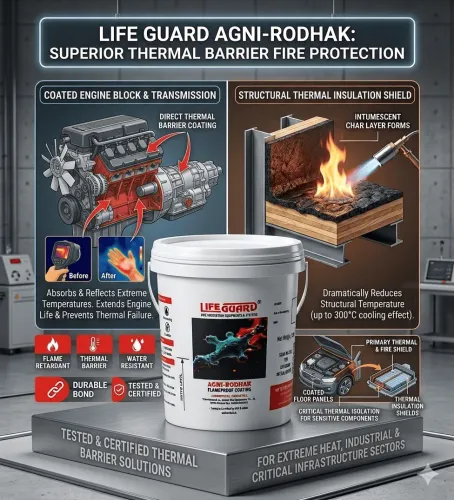
One of the most widely used technologies is intumescent fire protection coating. When exposed to high temperatures, an intumescent coating expands and forms an insulating char layer that slows heat transfer to the protected steel surface.
This thermal barrier helps delay the temperature rise of structural steel, reducing the risk of premature loss of load-bearing capacity during a fire.
Industrial fire protection coatings are commonly considered for:
- Steel structures and industrial sheds
- Manufacturing plants and production facilities
- Warehouses and logistics centers
- Oil and gas installations
- Petrochemical and chemical processing facilities
- Power plants and energy infrastructure
- Commercial and high-rise buildings
- Airports, metro stations, and infrastructure projects
- Industrial machinery supports and equipment structures
The appropriate coating system depends on the substrate, fire exposure scenario, environmental conditions, structural design, and required fire resistance rating.
Types of Industrial Fire Protection Coatings
1. Intumescent Fire Protection Coating
Intumescent fire protection coatings are widely used for protecting structural steel against fire.
When exposed to heat, these coatings undergo a chemical reaction that causes them to expand into a thick, insulating char layer. This layer slows the transfer of heat to the steel substrate.
Key Benefits:
- Helps delay structural steel temperature rise during fire exposure
- Can provide a relatively smooth architectural finish
- Suitable for many industrial and commercial steel structures
- Available in systems designed for different environmental conditions
- Can be specified for tested fire resistance periods
2. Cementitious Fire Protection Coating
Cementitious fire protection systems use specially formulated mineral-based materials to provide thermal insulation to structural components.
These systems are frequently used where a thicker protective layer is acceptable and the installation conditions support their use.
Key Benefits:
- Effective thermal insulation when correctly specified
- Suitable for selected industrial and infrastructure applications
- Can be economical for large structural areas
- Available in systems with tested fire resistance performance
3. Epoxy Intumescent Fire Protection Coating
Epoxy intumescent coatings are engineered for demanding industrial environments, including selected oil and gas, petrochemical, and offshore applications.
Depending on their formulation and tested approvals, these coatings may be suitable for hydrocarbon fire exposure and severe environmental conditions.
Key Benefits:
- Robust protective coating systems
- Suitable for demanding industrial operating environments
- Options for hydrocarbon fire protection
- Can be integrated with compatible corrosion protection systems
- Suitable for selected onshore and offshore installations
Why Is Industrial Fire Protection Coating Important?
Structural steel is strong, durable, and widely used in industrial construction. However, its mechanical strength and stiffness decrease significantly as its temperature rises during a fire.
Without suitable passive fire protection, exposed steel members may reach critical temperatures that compromise their load-bearing capacity.
A properly designed industrial fire protection coating system helps address this risk.
Major Advantages of Industrial Fire Protection Coatings
1. Improved Structural Fire Resistance
Fire protection coatings help delay heat transfer to protected structural elements, supporting the required fire resistance performance.
2. Enhanced Occupant Safety
By helping structural members maintain their performance for a specified period, fire protection systems can contribute to safer evacuation conditions.
3. Protection of Industrial Infrastructure
Suitable passive fire protection can help reduce the potential for severe structural damage during a fire.
4. Support for Regulatory Compliance
Tested and correctly specified coating systems can help projects meet applicable building codes, fire safety requirements, and project specifications.
5. Reduced Potential for Business Interruption
Effective fire protection is one component of a comprehensive strategy to reduce fire-related losses and operational disruption.
6. Long-Term Asset Protection
When properly selected, applied, inspected, and maintained, industrial fire protection coatings can provide durable passive fire protection.
Industrial Applications of Fire Protection Coatings
Fire Protection Coating for Steel Structures
Structural steel is commonly used in factories, industrial sheds, warehouses, and commercial buildings.
Fire protection coating for steel structures helps delay heat transfer to steel beams, columns, and other designated structural members during fire exposure.
Fire Protection Coating for Factories
Manufacturing facilities may contain combustible materials, electrical installations, process equipment, and other potential fire hazards.
Industrial fire protection coatings can form part of a broader fire safety strategy for protecting designated structural components.
Fire Protection Coating for Warehouses
Warehouses and logistics facilities often feature large-span steel structures and significant stored material inventories.
Suitable fire protection systems can help improve structural fire resistance in accordance with the facility's fire safety design.
Fire Protection Coating for Oil and Gas Facilities
Oil and gas installations may require specialized passive fire protection systems designed for hydrocarbon fire scenarios.
Coating selection must consider the relevant fire exposure, structural requirements, operating environment, and applicable testing standards.
Fire Protection Coating for Power Plants
Power generation facilities contain critical structural and operational infrastructure.
Passive fire protection coatings can help protect selected steel structures and equipment-supporting members where fire resistance is required.
Fire Resistance Ratings and Applicable Standards
Industrial fire protection coating systems are selected according to project-specific fire resistance requirements.
Depending on the tested system and applicable design standards, specified fire resistance periods may include:
- 30 minutes
- 60 minutes
- 90 minutes
- 120 minutes
- 180 minutes
The achievable rating depends on factors such as the tested coating system, structural steel section factor, applied dry film thickness, design temperature, and exposure conditions.
Relevant fire testing and assessment frameworks may include IS 3809, ISO 834, EN 13381, ASTM E119, UL 263, and UL 1709, as applicable to the project and fire scenario.
The applicable standard, approved coating thickness, and required fire rating must be established through qualified fire protection design and supported by appropriate test or assessment documentation.
How to Select the Right Industrial Fire Protection Coating
Choosing a suitable fire protection coating requires consideration of several technical factors.
Fire Exposure Type: Determine whether the structure requires protection against cellulosic building fires, hydrocarbon fires, or another specified fire scenario.
Required Fire Resistance: Establish the required rating according to applicable regulations and project specifications.
Substrate and Steel Section: Evaluate the structural elements, section dimensions, and critical steel temperatures.
Environmental Conditions: Consider indoor or outdoor exposure, humidity, corrosive atmospheres, and operating conditions.
Coating Compatibility: Ensure that primers, fire protection coatings, and topcoats form a compatible, approved system.
Application and Quality Control: Verify surface preparation, application procedures, coating thickness, curing conditions, and inspection requirements.
A technically appropriate system should be selected based on verified performance rather than coating thickness or price alone.
Why Choose LIFEGUARD for Industrial Fire Protection Requirements?
LIFEGUARD – United Fire Equipments Pvt. Ltd. is focused on helping industrial and commercial customers address their fire safety requirements.
Our approach emphasizes the importance of selecting fire protection solutions according to actual project risks, structural requirements, and applicable safety standards.
When evaluating industrial fire protection coatings, customers should prioritize:
- Appropriate coating technology for the intended application
- Verified fire resistance performance
- Compatibility with existing protective coating systems
- Suitability for industrial environmental conditions
- Correct application and inspection procedures
- Long-term maintenance and fire safety considerations
A comprehensive fire protection strategy should integrate passive fire protection with suitable fire detection, alarm, suppression, emergency planning, and other required safety measures.
Industrial Fire Protection Coating Solutions in India
Industrial development across India continues to create demand for reliable passive fire protection solutions in factories, warehouses, infrastructure, and commercial construction.
From new industrial projects to facility modernization, fire protection coating systems play an important role in improving structural fire safety.
LIFEGUARD recognizes the importance of practical, standards-based fire protection solutions for industrial facilities throughout India.
Whether your project involves structural steel protection, an industrial warehouse, a manufacturing facility, or a specialized infrastructure installation, understanding the correct fire protection requirements is essential for effective system selection.
Frequently Asked Questions (FAQs)
Q1. What is industrial fire protection coating?
Industrial fire protection coating is a specialized coating system designed to improve the fire resistance of structural steel or other suitable substrates by reducing heat transfer during fire exposure.
Q2. What is the difference between fire protection coating and normal paint?
Normal paint is primarily used for decoration or surface protection. Fire protection coatings are specially formulated and tested to provide defined fire protection performance under specified conditions.
Q3. What is intumescent fire protection coating?
Intumescent coating is a fire-reactive coating that expands when exposed to elevated temperatures, forming an insulating char layer that helps protect the underlying substrate.
Q4. Can fire protection coating be applied to existing steel structures?
Yes, certain fire protection systems can be applied to existing structures, subject to an assessment of the substrate, existing coatings, structural requirements, surface preparation, and coating compatibility.
Q5. How long does industrial fire protection coating last?
Service life depends on the coating formulation, operating environment, surface preparation, application quality, inspection, and maintenance. The manufacturer's technical documentation should be consulted.
Q6. Is industrial fire protection coating waterproof?
Not all fire protection coatings are waterproof or suitable for outdoor exposure. Some systems require compatible protective topcoats, while others are specifically engineered for harsh environments.
Q7. What is the price of industrial fire protection coating in India?
Pricing depends on the coating technology, required fire resistance rating, structural steel dimensions, coating thickness, surface preparation, application conditions, and total project area.
A project-specific technical assessment is recommended for accurate costing.
Q8. Is fire protection coating compulsory for industrial buildings?
Requirements depend on applicable building regulations, occupancy classification, structural design, fire safety approvals, and project specifications. A qualified fire safety professional should establish the requirements.
Contact LIFEGUARD for Industrial Fire Protection Coating Enquiries
Protect Your People. Protect Your Assets. Strengthen Industrial Fire Safety.
Industrial fire protection is an essential investment in the safety and resilience of modern infrastructure.
For industrial fire protection coating requirements, structural steel fire resistance considerations, and project-specific fire safety enquiries, connect with:
LIFEGUARD
United Fire Equipments Pvt. Ltd.
Contact our team to discuss your industrial fire protection requirements and the appropriate next steps for your project.
Enquire Now | Request Technical Information | Discuss Your Project
Keywords