A battery emergency light earns its place when a power trip, smoke condition or fire-service isolation leaves people moving through a dark battery room, inverter room or access route. You will be able to judge the investment by mapping escape risks, specifying measurable performance, and comparing lifetime maintenance against the consequences of losing visibility during an incident.
Key takeaways
- Prioritise exits, stairs, control rooms, battery rooms and outdoor muster points.
- Demand documented emergency duration, photometric results, battery data and product approvals.
- Account for Delhi heat, dust, voltage events and battery replacement labour.
- Choose fittings after comparing coverage, testing, maintenance and whole-life cost.
When emergency lighting pays for itself in an energy facility
Emergency lighting pays for itself when a local outage could leave people in smoke, darkness or an isolated plant area while they are evacuating or operating emergency controls.
The case for battery emergency lights for energy facilities evacuation in Delhi is strongest around battery racks, BESS containers, switchgear, inverters and rooftop plant where normal lighting can disappear during a fault, thermal event or fire-service shutdown.
| Type | Purpose | What it does not replace |
|---|---|---|
| Escape-route lighting | Lights corridors, stairs, doors, route changes and final exits | A compliant means of escape |
| Open-area or anti-panic lighting | Reduces falls and disorientation in larger rooms | Task lighting for normal operations |
| Illuminated exit signs | Shows the direction and location of an exit | Emergency illumination along the route |
| Normal standby lighting | Keeps work areas operating after a supply failure | Life-safety lighting unless specifically designed and approved for that role |
Commercial evacuation lighting energy facility projects should compare fitting and installation costs with periodic testing, battery replacement, maintenance access, delayed evacuation, missed isolation controls and a fall caused by poor visibility. High value comes from enclosed or remote routes, long aisles, stairs and areas where smoke can obscure landmarks.
The case weakens for a small, continuously occupied site with proven generator transfer, strong daylight, short unobstructed routes and no remote or enclosed plant. Do not approve fittings from a catalogue checklist alone: require a layout-based assessment and a witnessed outage test.
Emergency lights support exit signs and alarms; they do not replace either system or a properly designed standby-power arrangement.
Where to place fittings across rooms, routes and muster areas
Place fittings from the escape route outward, not wherever ceiling space remains. Mark battery rooms, BESS containers, inverter rooms, switchgear rooms, control rooms, corridors, stairs, exits, muster points and outdoor access routes on the life-safety drawing.
1. Trace each escape route and place fittings so people can see every change of direction, door threshold, change in level, stair tread and final exit. Illuminate fire-alarm call points, extinguishers, first-aid kits and emergency isolation controls; a bright corridor with an invisible isolation switch still creates a safety failure.
2. Keep luminaires out of racks, cabinets and positions directly above battery modules when they obstruct inspection, replacement, access aisles or fire-service approach. Preserve route illumination if a rack, cabinet or container section is isolated during an incident.
3. Extend the plan beyond the building. Include the route from each exit to the outdoor muster point when staff cross a yard, rooftop walkway or container compound. For an emergency light for battery facilities in Delhi, check heat, dust and equipment shadows rather than assuming one fitting covers an entire area.
4. Require a photometric layout, not fitting symbols alone. Inspect for dark bands between racks, glare in smoke and shadows behind equipment, then record mounting height, viewing direction and access for testing and replacement. A lux calculation that ignores these conditions can approve a fitting while leaving the actual escape path dark.
What performance and approvals should the specification demand
Put measurable performance requirements in the purchase specification, approval submission and commissioning plan for a commercial evacuation lighting energy facility. Cite IS 3217, the National Building Code of India 2016 provisions for emergency lighting and exit signage, and the Delhi Fire Service approval conditions applicable to the site.
| Document | Required statement | Failure prevented |
|---|---|---|
| Design basis | Adopted code edition, minimum illuminance for every escape route and open area, uniformity, glare control and maximum fitting spacing | Averages that hide dark bands or disabling glare |
| Installation | Mounting height, exit-sign viewing distance, route coverage and endurance period | Unreadable signs and inaccessible fittings |
| Power coordination | Connection with fire alarm, exit signage, generator or other standby source | Lights lost when a local panel is isolated |
For battery emergency lights for energy facilities evacuation in Delhi, confirm whether the authority, fire approval or project specification requires 90 minutes or longer. NFPA 101 uses 90 minutes as a widely adopted life-safety benchmark.
Do not approve average lux alone: require a lux calculation, commissioning test and documented outage test showing visibility at stairs, doors, route changes, fire equipment and emergency isolation controls.
A luminaire connected only to the panel serving chargers, HVAC or process equipment can fail when that panel is isolated during a battery incident. Require the designer to show circuit segregation and selective isolation, while confirming that illuminated exit signs remain distinct from normal standby lighting and do not substitute for a compliant escape route.
How battery architecture, Delhi conditions and maintenance change the calculation
Dependability depends on architecture, heat and proof of maintenance—not the label on the fitting. An emergency light for battery facilities in Delhi must keep operating after a local trip, smoke event or generator transfer, then deliver its stated duration under site conditions.
1. Choose self-contained luminaires when avoiding a long emergency circuit matters. They place chargers, batteries, indicators and failure points throughout the facility. A central battery system simplifies testing, status monitoring and replacement logistics, but one battery-room event can remove every fitting; use fire-rated distribution, circuit segregation and protection against that event.
2. Treat each luminaire battery as a separate safety device, not as a substitute for the site’s lithium-ion storage battery. Require a documented charger, low-voltage cut-off, overcharge protection, temperature limits and an emergency-run-time test. An unverified lithium pack can swell, lose output or enter thermal runaway.
3. Require the manufacturer’s ambient-temperature range, output-derating curve, charging-temperature limits, battery chemistry and replacement interval. Delhi heat, dust, humidity, rooftop exposure, voltage fluctuation, generator transfer time and poor maintenance access can shorten runtime, especially in unconditioned rooms.
4. Test monthly for function and annually for full discharge. Record each fitting or circuit, actual duration, failed indicator, replacement date and whether normal facility loading was present. A brief lamp-on check will not expose a battery that fails after five minutes.
Before selecting ordinary fittings for a lead-acid room, review hydrogen ventilation, ignition sources and electrical-area classification. Ordinary commercial equipment is unsuitable where the classification requires approved wiring and luminaires.
How to compare a proposed fitting and make the investment decision
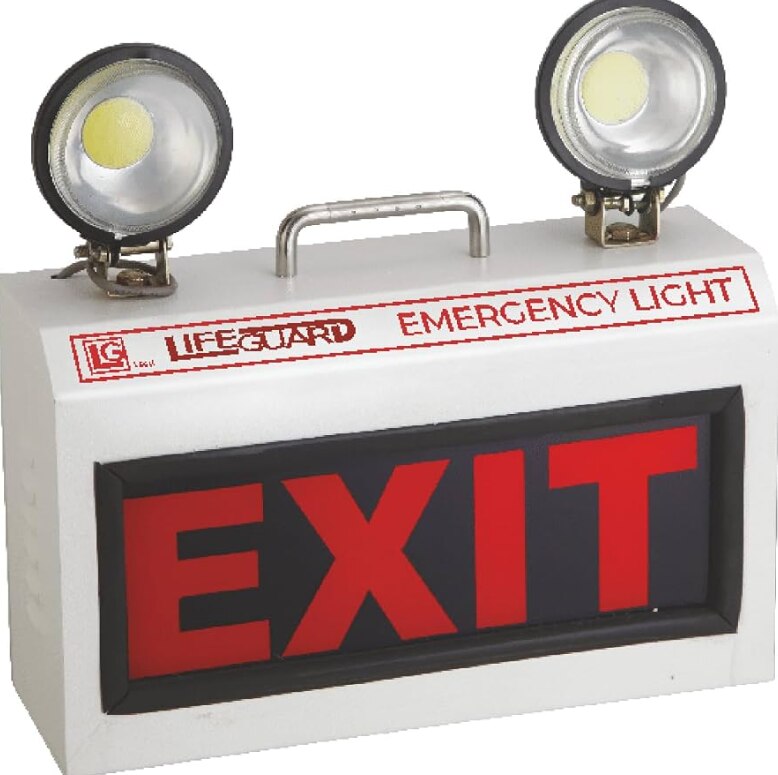
Approve a proposed LG 641 fitting only after the supplier proves what it is, where it works and how it will be maintained. “LG 641 emergency light energy operators” is not a recognised performance category; treat it as a model name or internal code until documented.
Request this evidence for an emergency light for battery facilities in Delhi:
- Identifiable datasheet, photometric file and certification
- Ingress rating, operating-temperature range and battery chemistry
- A documented 90-minute endurance test and available service parts
- A site-specific lux calculation covering routes, stairs, controls and equipment
- Separate exit-sign viewing distance, not a lumen claim for the emergency luminaire
- The fitting or circuit identified on the test schedule
- A replacement procedure that works while the facility remains live
United Fire Equipment Pvt Ltd can provide supporting documentation, but demand identical evidence from every bidder.
| Option | Approve when | Reject when |
|---|---|---|
| Proposed fitting | Photometry, endurance, certification and route coverage are verified | It has only a catalogue description or lumen figure |
| Exit sign | Viewing distance and sign legibility are documented | The supplier substitutes luminaire output for sign visibility |
| Installation | It meets adopted IS 3217, NBC 2016 and Delhi Fire Service requirements | Authority coordination or circuit isolation is unresolved |
| Ownership cost | Testing, parts and battery replacement have funded dates | No maintenance access or replacement budget exists |
The investment is defensible for enclosed or remote routes facing outage or thermal-event risk. Reject it when photometry, endurance proof, route coverage or live-facility maintenance remains unanswered.
Related product
 | Evacuation System LG-641 EMERGENCY LIGHT WITH BATTERY ₹8100 EMERGENCY LIGHT WITH BATTERY View product → |
Frequently asked questions
When do battery emergency lights pay for themselves in an energy facility?
They earn their value when a power failure could expose workers to darkness, smoke or isolated plant hazards during evacuation or emergency control operations. Compare the fitting cost with outage risk, evacuation time, incident consequences and maintenance effort.
Where should emergency-light fittings be installed in an energy facility?
Cover final exits, escape routes, stairs, changes in level, intersections, fire equipment, first-aid points, control rooms, electrical rooms, battery rooms and areas where workers operate emergency controls. Illuminate outdoor routes and muster areas when evacuation continues beyond the building.
What should you demand when specifying commercial evacuation lighting?
Request the rated emergency duration, lumen output, photometric test data, self-test or test-switch method, battery chemistry, charging time, operating temperature range, ingress protection rating and records of applicable Indian approvals and test standards.
How do Delhi conditions affect emergency-light battery selection and maintenance?
High heat, dust, monsoon moisture, voltage fluctuations and difficult access can shorten battery life or increase faults. Check the specified temperature range and IP rating, keep fittings accessible for testing, and budget for scheduled discharge tests, cleaning and battery replacement.
How can you compare a proposed emergency light before buying it?
Compare maintained and non-maintained operation, measured coverage rather than lumen claims, emergency duration, battery replacement interval, self-test features, warranty, spares, installation labour and inspection records. Select the option with the lowest credible whole-life cost that meets your evacuation design.
Keywords